a. Calculate Ea if k1 = 4.62 x 10 -7 1/Ms at 315 oC and k2...
a. Calculate Ea if k1 = 4.62 x 10 -7 1/Ms at 315 oC and k2 is 2.31 x 10 -4 1/Ms at 678 oC. b. Based on your answer to a, what’s k at 400 oC?
Homework Answers
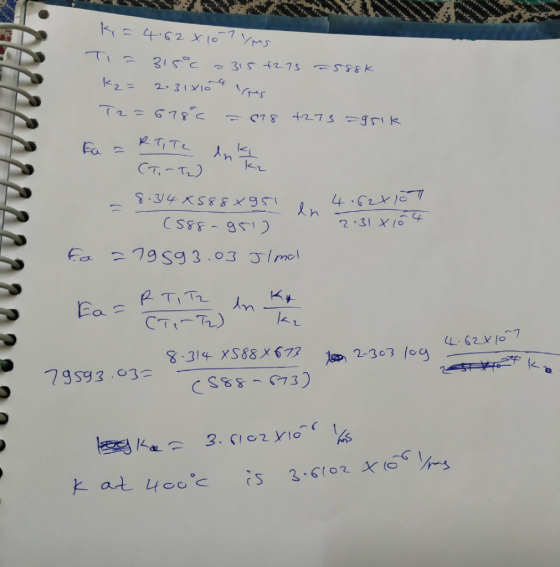
a. Calculate Ea if k1 = 4.62 x 10 -7 1/Ms at 315 oC and k2...
a. Calculate Ea if k1 = 4.62 x 10 -7 1/Ms at 315 oC and k2 is 2.31 x 10 -4 1/Ms at 678 oC. b. Based on your answer to a, what’s k at 400 oC? 16. The following 2 step mechanism has been proposed. Step 1 : A (g) + B (g) -> X (g) + Y (g) k1 = fast Step 2: X (g) + C (g) -> Y (g) + Z (g) k2 = slow a....
(10) 1. The diprotic acid, H2A, has Kai i.e. (K1) = 1.00 X 10 and K2...
 (10) 1. The diprotic acid, H2A, has Kai i.e. (K1) = 1.00 X 10 and K2 = 1.00 X 10⁸. a) Consider a solution of 0.100 M H2A. Calculate the pH, and calculate the following concentrations: (H2A), (HA) and (A2). b) Consider a solution of 0.100 M NaHA. Calculate the pH, and calculate the following concentrations: (H2A), CHA') and (AP).
The diprotic acid, H2A, has Ka1 i.e. (K1) = 1.00 X 10⁻⁴ and K2 = 1.00...
The diprotic acid, H2A, has Ka1 i.e. (K1) = 1.00 X 10⁻⁴ and K2 = 1.00 X 10⁻⁸. a) Consider a solution of 0.100 M H2A. Calculate the pH, and calculate the following concentrations: [H2A], [HA- ] and [A2- ]. b) Consider a solution of 0.100 M NaHA. Calculate the pH, and calculate the following concentrations: [H2A], [HA- ] and [A2- ].
The following questions is based on ionization of carbonic acid. [H2CO3 = H+ + HCO3- K1 = 4.7 X 10⁻⁷, pK1 = 6.34 ] [HCO3- = H+ CO3-2 K2 = 4.4 X 10⁻¹¹, pK2 = 10.36] Calculate the pH ofthe solution form...
The following questions is based on ionization of carbonic acid. [H2CO3 = H+ + HCO3- K1 = 4.7 X 10⁻⁷, pK1 = 6.34 ] [HCO3- = H+ CO3-2 K2 = 4.4 X 10⁻¹¹, pK2 = 10.36] Calculate the pH ofthe solution form by mixing the following: a)50.0ml of 0.100 M H2CO3 with 50.0ml of 0.050 M NaOH . b)50.0ml of 0.100 M H2CO3 with 50.0ml of 0.150 M NaOH . c)50.0ml of 0.100 M H2CO3 with 50.0ml of 0.100 M...
[Rh(Cl)5(OH2)]2- undergoes dissociative ligand exchange. Ratios of k-1/k2 were obtained as shown ...
 [Rh(Cl)5(OH2)]2- undergoes
dissociative ligand exchange. Ratios of k-1/k2 were obtained as
shown below/
I don't know the part C. Can you explain part C?
10) (10 marks) [Rh(ClI)s(OH2)]2- undergoes dissociative ligand exchange. Ratios of k-1/k2 were obtained as shown below. [Rh(Cl)5(OH2)]2. + X. Cl- N3- k-1/k2 62 7 (a) Do you expect kı and k-1 to change when X changes from Cl to N3? No (b) Provide a reasonable explanation for your answer in part (a). k1 k2 [Rh(Cl)512, +...
[Rh(Cl)5(OH2)]2- undergoes
dissociative ligand exchange. Ratios of k-1/k2 were obtained as
shown below/
I don't know the part C. Can you explain part C?
10) (10 marks) [Rh(ClI)s(OH2)]2- undergoes dissociative ligand exchange. Ratios of k-1/k2 were obtained as shown below. [Rh(Cl)5(OH2)]2. + X. Cl- N3- k-1/k2 62 7 (a) Do you expect kı and k-1 to change when X changes from Cl to N3? No (b) Provide a reasonable explanation for your answer in part (a). k1 k2 [Rh(Cl)512, +...
Learning Goal: To use the Arrhenius equation to calculate the activation energy. As temperature rises, the...
Learning Goal: To use the Arrhenius equation to calculate the activation energy. As temperature rises, the average kinetic energy of molecules increases. In a chemical reaction, this means that a higher percentage of the molecules possess the required activation energy, and the reaction goes faster. This relationship is shown by the Arrhenius equation k=Ae−Ea/RT where k is the rate constant, A is the frequency factor, Ea is the activation energy, R = 8.3145 J/(K⋅mol) is the gas constant, and T...
part 1 is wrong Calculate the pH of each solution. A solution containing 0.0243 M maleic...
 part 1 is wrong
Calculate the pH of each solution. A solution containing 0.0243 M maleic acid and 0.034 M disodium maleate. The K, values for maleic acid are 1.20 x 10-?(K) and 5.37 x 10 (K2). pH = 2.00 A solution containing 0.0360 M succinic acid and 0.023 M potassium hydrogen succinate. The K, values for succinic acid are 6.21 x 10" (K1) and 2.31 x 10 "(K), pH = 4.01
part 1 is wrong
Calculate the pH of each solution. A solution containing 0.0243 M maleic acid and 0.034 M disodium maleate. The K, values for maleic acid are 1.20 x 10-?(K) and 5.37 x 10 (K2). pH = 2.00 A solution containing 0.0360 M succinic acid and 0.023 M potassium hydrogen succinate. The K, values for succinic acid are 6.21 x 10" (K1) and 2.31 x 10 "(K), pH = 4.01
1) Given the two reactions: a) H2S<--> HS- + H+, K1=9.13 x 10⁻⁸ b) HS-<--> S2-...
1) Given the two reactions: a) H2S<--> HS- + H+, K1=9.13 x 10⁻⁸ b) HS-<--> S2- + H+, K2=1.20 x 10⁻¹⁹ what is the equilibrium constant Kfinal for thefollowing reaction? S2- + 2H+<--> H2S 2) Given the two reactions: a)PbCl2 <--> Pb2+ + 2Cl-,K1= 1.80 x 10⁻¹⁰ b) AgCl<--> Ag+ + Cl-, K2= 1.23 x10⁻⁴ what is the equilibrium constant Kfinal for thefollowing reaction? PbCl2 + 2Ag+<--> 2AgCl + Pb2+
Lunes CHEMWORK The Hg2+ ion forms complex ions with I as follows: Hg2+ + HgT+ HgI + 1 =Hg2 K1 = 1.0 108 K2=1.0 x 10...
 Lunes CHEMWORK The Hg2+ ion forms complex ions with I as follows: Hg2+ + HgT+ HgI + 1 =Hg2 K1 = 1.0 108 K2=1.0 x 10⁵ K3 -1.0 x 10° K4 = 1.0 * 108 Hgl2 + 1 + HgI3 HgI3 + 1 = Hg142 A solution is prepared by dissolving 0.057 mol Hg(NO3)2 and 5.00 mol Nal in enough water to make 1.0 L of solution. Calculate the equilibrium concentration of [Hg142]. (Hg142) = M Calculate the equilibrium concentration...
7) Calculate the key of a reaction at 315 °K and a AG° = -35.7 kJ/mol....
 7) Calculate the key of a reaction at 315 °K and a AG° = -35.7 kJ/mol. Is the reaction favorable? a. Keq = 8.38*10°; exergonic b. Keq = 8.38*10-5; endergonic c. Keg = 3.76*10°; exergonic d. Keq = 3.76*10-4; endergonic
 (10) 1. The diprotic acid, H2A, has Kai i.e. (K1) = 1.00 X 10 and K2 = 1.00 X 10⁸. a) Consider a solution of 0.100 M H2A. Calculate the pH, and calculate the following concentrations: (H2A), (HA) and (A2). b) Consider a solution of 0.100 M NaHA. Calculate the pH, and calculate the following concentrations: (H2A), CHA') and (AP).
 [Rh(Cl)5(OH2)]2- undergoes
dissociative ligand exchange. Ratios of k-1/k2 were obtained as
shown below/
I don't know the part C. Can you explain part C?
10) (10 marks) [Rh(ClI)s(OH2)]2- undergoes dissociative ligand exchange. Ratios of k-1/k2 were obtained as shown below. [Rh(Cl)5(OH2)]2. + X. Cl- N3- k-1/k2 62 7 (a) Do you expect kı and k-1 to change when X changes from Cl to N3? No (b) Provide a reasonable explanation for your answer in part (a). k1 k2 [Rh(Cl)512, +...
[Rh(Cl)5(OH2)]2- undergoes
dissociative ligand exchange. Ratios of k-1/k2 were obtained as
shown below/
I don't know the part C. Can you explain part C?
10) (10 marks) [Rh(ClI)s(OH2)]2- undergoes dissociative ligand exchange. Ratios of k-1/k2 were obtained as shown below. [Rh(Cl)5(OH2)]2. + X. Cl- N3- k-1/k2 62 7 (a) Do you expect kı and k-1 to change when X changes from Cl to N3? No (b) Provide a reasonable explanation for your answer in part (a). k1 k2 [Rh(Cl)512, +...
 part 1 is wrong
Calculate the pH of each solution. A solution containing 0.0243 M maleic acid and 0.034 M disodium maleate. The K, values for maleic acid are 1.20 x 10-?(K) and 5.37 x 10 (K2). pH = 2.00 A solution containing 0.0360 M succinic acid and 0.023 M potassium hydrogen succinate. The K, values for succinic acid are 6.21 x 10" (K1) and 2.31 x 10 "(K), pH = 4.01
part 1 is wrong
Calculate the pH of each solution. A solution containing 0.0243 M maleic acid and 0.034 M disodium maleate. The K, values for maleic acid are 1.20 x 10-?(K) and 5.37 x 10 (K2). pH = 2.00 A solution containing 0.0360 M succinic acid and 0.023 M potassium hydrogen succinate. The K, values for succinic acid are 6.21 x 10" (K1) and 2.31 x 10 "(K), pH = 4.01
 Lunes CHEMWORK The Hg2+ ion forms complex ions with I as follows: Hg2+ + HgT+ HgI + 1 =Hg2 K1 = 1.0 108 K2=1.0 x 10⁵ K3 -1.0 x 10° K4 = 1.0 * 108 Hgl2 + 1 + HgI3 HgI3 + 1 = Hg142 A solution is prepared by dissolving 0.057 mol Hg(NO3)2 and 5.00 mol Nal in enough water to make 1.0 L of solution. Calculate the equilibrium concentration of [Hg142]. (Hg142) = M Calculate the equilibrium concentration...
 7) Calculate the key of a reaction at 315 °K and a AG° = -35.7 kJ/mol. Is the reaction favorable? a. Keq = 8.38*10°; exergonic b. Keq = 8.38*10-5; endergonic c. Keg = 3.76*10°; exergonic d. Keq = 3.76*10-4; endergonic
Most questions answered within 3 hours.
-
Where is the error in this code sequence?
String s1 = "Hello";
String s2 = "ello";...
asked 11 months ago -
Financial data for Joel de Paris, Inc., for last year
follow:
Joel de Paris, Inc.
Balance...
asked 11 months ago -
Consider this reaction:
Al2(SO4)3 (aq)+ BaCl3
(aq) Al2Cl6 (aq)- +
3BaSO4(s) . What is the...
asked 11 months ago -
Suppose that Savneet is considering increasing her
recent random sample from 20 car rentals to 40...
asked 11 months ago -
Trucks arrive at an unloading terminal at an average rate of 120
per hour.
Trucks arrive...
asked 11 months ago -
Why are methanol and ethanol completely soluble in water while
octanol is not very little soluble....
asked 11 months ago -
A facilities manager at a university reads in a research report
that the mean amount of...
asked 11 months ago -
When the CuSO4 is rehydrated by adding water to the anhydrous
compound, is this an endothermic...
asked 11 months ago -
A ray of sunlight is passing from diamond into crown glass; the
angle of incidence is...
asked 11 months ago -
A block of mass 0.249 kg is placed on top of a light, vertical
spring of...
asked 11 months ago -
how do the kidneys compensate in the presences of acidosis
a) trigger hyperventilate
b) reserve acid...
asked 11 months ago -
Question 501 pts
The rental rate of capital to the firm increases. Which of the
following...
asked 11 months ago