
Homework Answers

uio nghkkuuuuuuuuuuuuuuuuuuuuuuuu;hhhhhhhhhhhhhhhhhhhhhhhhhhhhhhhhh;uh;hbjkb
m.biii;hujjjjjjjjjjjjjjjjjjjjjjjjjjjjjbhkhk
Add Answer to:
it) 2) A river has a steady speed of 0.600 m/s. A student swims upstream a...
A river has a steady speed of 0.450 m/s. A student swims upstream a distance of...
 A river has a steady speed of 0.450 m/s. A student swims upstream a distance of 1.70 km and swims back to the starting point. If the student can swim at a speed of 1.40 m/s in still water, how long does the trip take swimming up and down in the current)? If the water were still, by how much would the trip be longer or shorter? (Give a negative answer for a shorter trip.)
A river has a steady speed of 0.500 m/s. A student swims upstream a distance of...
A river has a steady speed of 0.500 m/s. A student swims upstream a distance of 2.00 km and swims back to the starting point. If the student can swim at a speed of 1.20 m/s in still water, how long does the trip take?
please show how to get answer for a), b), c). 29. aIC A river has a...
 please show how to get answer for a), b), c).
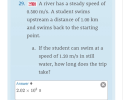
29. aIC A river has a steady speed of 0.500 m/s. A student swims upstream a distance of 1.00 km and swims back to the starting point. a. If the student can swim ata speed of 1.20 m/s in still water, how long does the trip take? Answer 2.02 x 10³ s b. How much time is required in still water for the same length swim? Answer 1.67 x 10³...
please show how to get answer for a), b), c).
29. aIC A river has a steady speed of 0.500 m/s. A student swims upstream a distance of 1.00 km and swims back to the starting point. a. If the student can swim ata speed of 1.20 m/s in still water, how long does the trip take? Answer 2.02 x 10³ s b. How much time is required in still water for the same length swim? Answer 1.67 x 10³...
If the number is a decimal please include 4 digits past the decimal point if available....
 If the number is a decimal
please include 4 digits past the decimal point if available.
2. + -12 points PSE64P. 041 My Notes A river has a steady speed of 0.500 m/s. A student swims upstream a distance of 1.65 km and swims back to the starting point. If the student can swim at a speed of 1.00 m/s in still water, how long does the trip take (swimming up and down in the current)? If the water were...
If the number is a decimal
please include 4 digits past the decimal point if available.
2. + -12 points PSE64P. 041 My Notes A river has a steady speed of 0.500 m/s. A student swims upstream a distance of 1.65 km and swims back to the starting point. If the student can swim at a speed of 1.00 m/s in still water, how long does the trip take (swimming up and down in the current)? If the water were...
A swimmer is able to swim at a speed of 0.92 m/s in still water. (a)...
A swimmer is able to swim at a speed of 0.92 m/s in still water. (a) How long does it take the swimmer to go a distance of 1590 m in still water? Call this time t1.(b) The swimmer then decides to swim the same distance in a river having a current with a speed of 0.53 m/s. How long does this take if she swims with the current? Call this time t2. (c) How long does it take her...
A swimmer, capable of swimming at a speed of 1.60 m/s in still water (i.e., the...
A swimmer, capable of swimming at a speed of 1.60 m/s in still water (i.e., the swimmer can swim with a speed of 1.60 m/s relative to the water), starts to swim directly across a 2.67-km-wide river. However, the current is 1.40 m/s, and it carries the swimmer downstream. (a) How long does it take the swimmer to cross the river? (b) How far downstream will the swimmer be upon reaching the other side of the river? (Write on paper)
A person can swim with a speed of 2.05m/s. A 34.2 m wide river flows with...
A person can swim with a speed of 2.05m/s. A 34.2 m wide river flows with a velocity of 4.25m/s[N]. a. if a person swims directly across the river, what will be his velocity? b. If a person swims directly across the river how long will it take him to reach other side? c. If person wants to swim directly across the river. Is this possible? why or why not?
Q2 1. Kinematics of swimming A swimmer swims directly across a river of width L that...
 Q2
1. Kinematics of swimming A swimmer swims directly across a river of width L that flows with a constant and uniform speed uo. (a) If the swimmer swims with constant speed to. how long does it take them to cross the river? (b) How far downstream of their starting point does the swim- mer reach the opposite shore? (c) What is the minimum speed to that will allow the swimmer to cross the river? 2. Kinematics of swimming The...
Q2
1. Kinematics of swimming A swimmer swims directly across a river of width L that flows with a constant and uniform speed uo. (a) If the swimmer swims with constant speed to. how long does it take them to cross the river? (b) How far downstream of their starting point does the swim- mer reach the opposite shore? (c) What is the minimum speed to that will allow the swimmer to cross the river? 2. Kinematics of swimming The...
A swimmer, capable of swimming at a speed of 1.02 m/s in still water (i.e., the...
A swimmer, capable of swimming at a speed of 1.02 m/s in still water (i.e., the swimmer can swim with a speed of 1.02 m/s relative to the water), starts to swim directly across a 2.96-km-wide river. However, the current is 0.550 m/s, and it carries the swimmer downstream. (a) How long does it take the swimmer to cross the river? (b) How far downstream will the swimmer be upon reaching the other side of the river?
A swimmer, capable of swimming at a speed of 1.5 m/s in still water (i.e., the...
A swimmer, capable of swimming at a speed of 1.5 m/s in still water (i.e., the swimmer can swim with a speed of 1.5 m/s relative to the water), starts to swim directly across a 3.0-km-wide river. However, the current is 0.91 m/s, and it carries the swimmer downstream. (a) How long does it take the swimmer to cross the river? Incorrect: Your answer is incorrect. s (b) How far downstream will the swimmer be upon reaching the other side...
 A river has a steady speed of 0.450 m/s. A student swims upstream a distance of 1.70 km and swims back to the starting point. If the student can swim at a speed of 1.40 m/s in still water, how long does the trip take swimming up and down in the current)? If the water were still, by how much would the trip be longer or shorter? (Give a negative answer for a shorter trip.)
 please show how to get answer for a), b), c).
29. aIC A river has a steady speed of 0.500 m/s. A student swims upstream a distance of 1.00 km and swims back to the starting point. a. If the student can swim ata speed of 1.20 m/s in still water, how long does the trip take? Answer 2.02 x 10³ s b. How much time is required in still water for the same length swim? Answer 1.67 x 10³...
please show how to get answer for a), b), c).
29. aIC A river has a steady speed of 0.500 m/s. A student swims upstream a distance of 1.00 km and swims back to the starting point. a. If the student can swim ata speed of 1.20 m/s in still water, how long does the trip take? Answer 2.02 x 10³ s b. How much time is required in still water for the same length swim? Answer 1.67 x 10³...
 If the number is a decimal
please include 4 digits past the decimal point if available.
2. + -12 points PSE64P. 041 My Notes A river has a steady speed of 0.500 m/s. A student swims upstream a distance of 1.65 km and swims back to the starting point. If the student can swim at a speed of 1.00 m/s in still water, how long does the trip take (swimming up and down in the current)? If the water were...
If the number is a decimal
please include 4 digits past the decimal point if available.
2. + -12 points PSE64P. 041 My Notes A river has a steady speed of 0.500 m/s. A student swims upstream a distance of 1.65 km and swims back to the starting point. If the student can swim at a speed of 1.00 m/s in still water, how long does the trip take (swimming up and down in the current)? If the water were...
 Q2
1. Kinematics of swimming A swimmer swims directly across a river of width L that flows with a constant and uniform speed uo. (a) If the swimmer swims with constant speed to. how long does it take them to cross the river? (b) How far downstream of their starting point does the swim- mer reach the opposite shore? (c) What is the minimum speed to that will allow the swimmer to cross the river? 2. Kinematics of swimming The...
Q2
1. Kinematics of swimming A swimmer swims directly across a river of width L that flows with a constant and uniform speed uo. (a) If the swimmer swims with constant speed to. how long does it take them to cross the river? (b) How far downstream of their starting point does the swim- mer reach the opposite shore? (c) What is the minimum speed to that will allow the swimmer to cross the river? 2. Kinematics of swimming The...
Most questions answered within 3 hours.
-
Where is the error in this code sequence?
String s1 = "Hello";
String s2 = "ello";...
asked 11 months ago -
Financial data for Joel de Paris, Inc., for last year
follow:
Joel de Paris, Inc.
Balance...
asked 11 months ago -
Consider this reaction:
Al2(SO4)3 (aq)+ BaCl3
(aq) Al2Cl6 (aq)- +
3BaSO4(s) . What is the...
asked 11 months ago -
Suppose that Savneet is considering increasing her
recent random sample from 20 car rentals to 40...
asked 11 months ago -
Trucks arrive at an unloading terminal at an average rate of 120
per hour.
Trucks arrive...
asked 11 months ago -
Why are methanol and ethanol completely soluble in water while
octanol is not very little soluble....
asked 11 months ago -
A facilities manager at a university reads in a research report
that the mean amount of...
asked 11 months ago -
When the CuSO4 is rehydrated by adding water to the anhydrous
compound, is this an endothermic...
asked 11 months ago -
A ray of sunlight is passing from diamond into crown glass; the
angle of incidence is...
asked 11 months ago -
A block of mass 0.249 kg is placed on top of a light, vertical
spring of...
asked 11 months ago -
how do the kidneys compensate in the presences of acidosis
a) trigger hyperventilate
b) reserve acid...
asked 11 months ago -
Question 501 pts
The rental rate of capital to the firm increases. Which of the
following...
asked 11 months ago