

Homework Answers
Add Answer to:
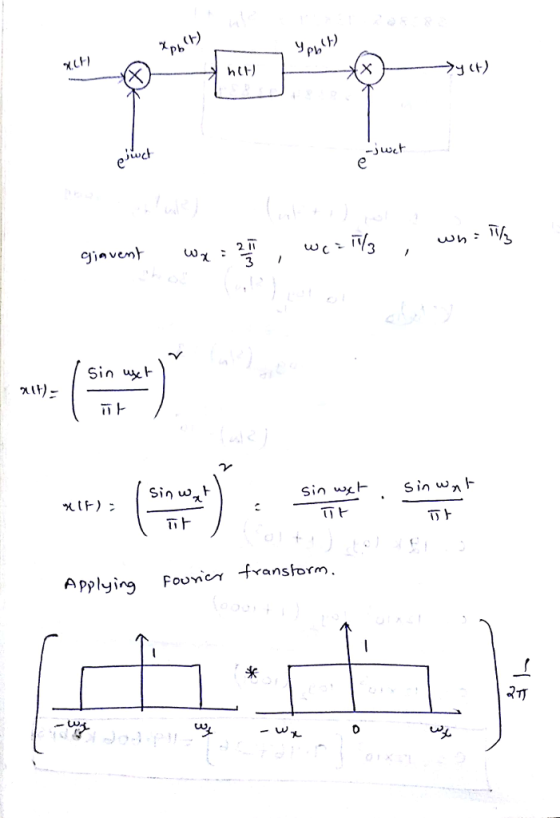
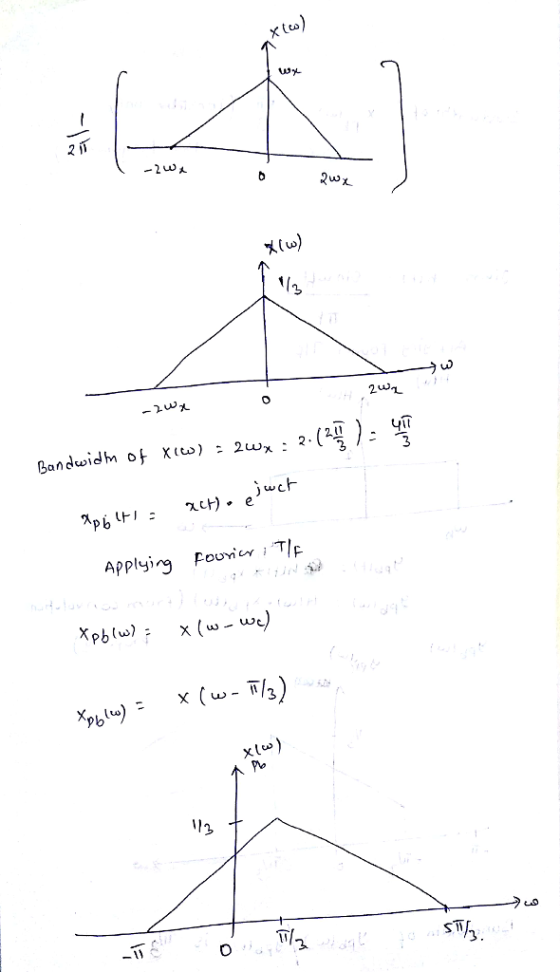
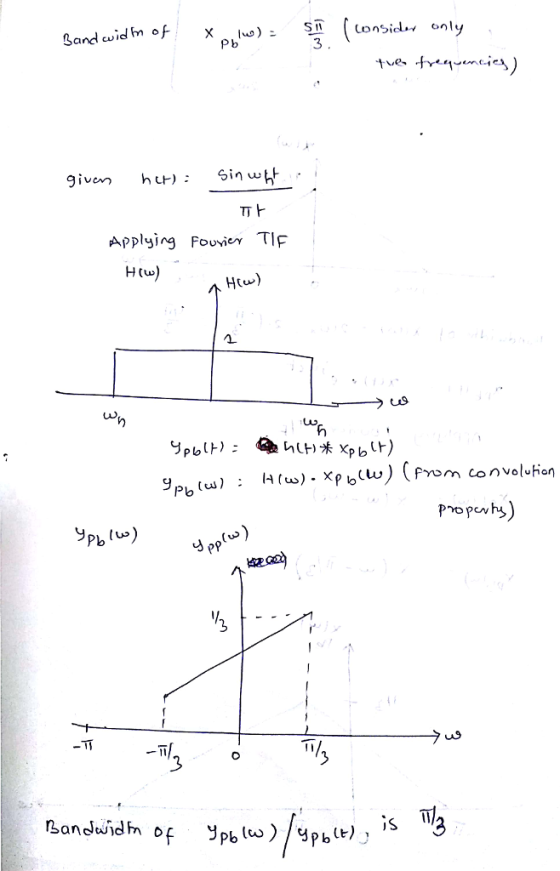
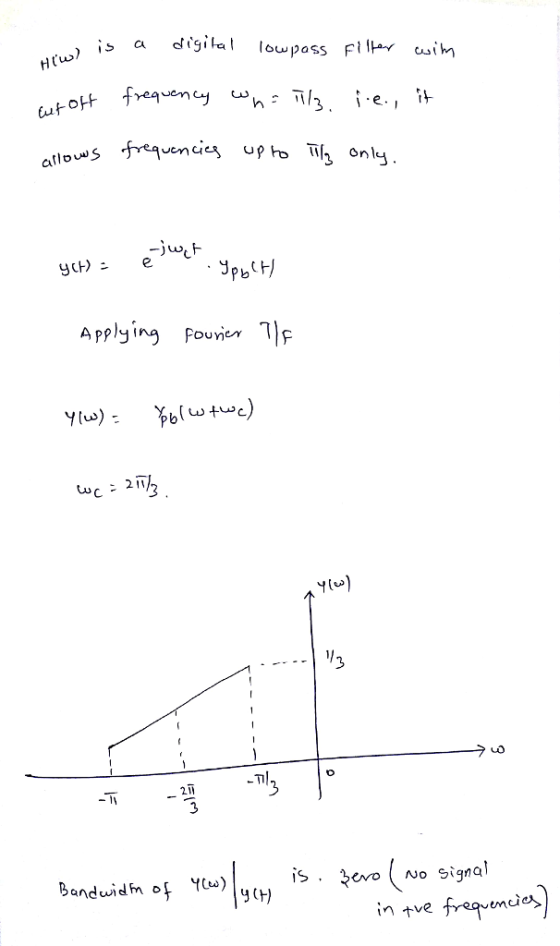
x(t)--24b(t) h(t) Y b(t). ejoet e-joct Figure 1. Schematic diagram of a communication system Consider the...
Q2 (a) Given the signal x(t) and system h(t) as presented in Figure Q2(a). Determine the...
 Q2 (a) Given the signal x(t) and system h(t) as presented in Figure Q2(a). Determine the output y(t) using the graphical representation of convolution integral. (7 marks) x(1) h(t) 1 e-'u(t) e-2 (1) 0 Figure Q2(a) Q2 (b) Consider a system as shown in Figure Q2(b). t2 - 1 x(t) y(t) Advance by 1 second Х Figure Q2(b) Find the input-output relation between x(t) and y(t). (i) (1 mark) Examine whether the system is time variant or time invariant. (5...
Question No.(6) The schematic diagram of Figure (6) represents a control system whose purpose is to...
 Question No.(6) The schematic diagram of Figure (6) represents a control system whose purpose is to hold the level of the liquid in the tank at a desired level. The liquid level is controlled by a float whose position h(t) is monitored. Draw the functional block diagram for the overall system Reservoir GEAR TRAIN --X AMPLIFIER CONTROLLER G00 Ninlet valves Nqo Float Tank Figure (6) Schematic diagram of liquid level control system
Question No.(6) The schematic diagram of Figure (6)...
Question No.(6) The schematic diagram of Figure (6) represents a control system whose purpose is to hold the level of the liquid in the tank at a desired level. The liquid level is controlled by a float whose position h(t) is monitored. Draw the functional block diagram for the overall system Reservoir GEAR TRAIN --X AMPLIFIER CONTROLLER G00 Ninlet valves Nqo Float Tank Figure (6) Schematic diagram of liquid level control system
Question No.(6) The schematic diagram of Figure (6)...
Question No.(5) The schematic diagram of Figure (5) represents a liquid level control system. The liquid...
 Question No.(5) The schematic diagram of Figure (5) represents a liquid level control system. The liquid level is monitored by a float whose position is h(t). Draw the functional block diagram for the overall system, showing the functional relationship between the transfer function. Reservoir GEAR TRAIN + N inlet valves + AMPLIFIER M Ch CONTROLLER ea ei Ka GA Nqn Float At) Tank Figure (5) Schematic diagram of liquid level control system
Question No.(5) The schematic diagram of Figure (5)...
Question No.(5) The schematic diagram of Figure (5) represents a liquid level control system. The liquid level is monitored by a float whose position is h(t). Draw the functional block diagram for the overall system, showing the functional relationship between the transfer function. Reservoir GEAR TRAIN + N inlet valves + AMPLIFIER M Ch CONTROLLER ea ei Ka GA Nqn Float At) Tank Figure (5) Schematic diagram of liquid level control system
Question No.(5) The schematic diagram of Figure (5)...
h(t) h(1) + ht) Figure Q2 (a) Q2 (a) Consider the system shown in Figure Q2...
 h(t) h(1) + ht) Figure Q2 (a) Q2 (a) Consider the system shown in Figure Q2 (a). Find the overall impulse response of the system, h(t) with impulse responses given below. h(t) = 3e-Stu(t) hy(t) = et u(t) hg(t) = 2t u(t) (5 marks) (b) Determine whether the system, h(t) obtained in Q2 (a) is: (1) Stable (3 marks) (ii) Causal (2 marks) Q3. (a) Explain the Gibbs phenomenon. (3 marks) (b) Given a signal 3 x(t) = x+7cos (41t+...
Question 3 (35 marks) Consider a mechanical system shown in Figure 3. The system is at rest for t
 Question 3 (35 marks) Consider a mechanical system shown in Figure 3. The system is at rest for t<0. The input force f is applied at 0. The displacement x is the output of the system and is measured from the equilibrium position. kI b2 bi it Figure 3. Schematic of a mechanical system. (a) Obtain the traf) (10 marks) X (s) F(s) (b) Use of force-voltage analogy, obtain the equations for an electrical system (5 marks) (c) Draw a...
Create chart or table Consider the system with the impulse response ht)e u(t), as shown in Figure...
 Create chart or table Consider the system with the impulse response ht)e u(t), as shown in Figure 3.2(a). This system's response to an input of x(t) 1) would be y(t) h(r ult 1). as shown in Figure 3.2(b). If the input signal is a sum of weighted, time-shifted impulses as described by (3.10), separated in time by Δ = 0.1 (s) so that xt)01-0.1k), as shown in Figure 3.2(c), then, according to (3.11), the output is This output signal is...
2. (30 marks] Consider the system shown in Fig. 1. Find the output y(t) for the...
 2. (30 marks] Consider the system shown in Fig. 1. Find the output y(t) for the following h(t) and r(t) using the convolution integral. x(r) y(r) h(t) Figure 1: System for Q2 1.5 2t33 0 otherwise h(t)=2rect(-3.5) x(t) = h(t) = 2 rect (-3 -
The input x(t) and output y(t) of a causal LTI system are related through the block-diagram...
 The input x(t) and output y(t) of a causal LTI system are related through the block-diagram representation shown in Figure P 9.35. Determine a differential equation relating y(t) and x(t). is this system stable?
c) An excitation signal x(t) of frequency contents shown below is input to the communication system shown below Find and draw the output signal y(t) or Y(). # if the draw using MATLAB with the code w...
 c) An excitation signal x(t) of
frequency contents shown below is input to the communication system
shown below Find and draw the output signal y(t) or Y().
# if the draw using MATLAB with the code will be better
c) An excitation signal x(t) of frequency contents shown below X(@) 2W 2W is input to the communication system shown below e(t) v(t) 0 -3w 3w cos(5wt) coe(3wt) Find and draw the output signal ) or Y(a).
c) An excitation signal...
c) An excitation signal x(t) of
frequency contents shown below is input to the communication system
shown below Find and draw the output signal y(t) or Y().
# if the draw using MATLAB with the code will be better
c) An excitation signal x(t) of frequency contents shown below X(@) 2W 2W is input to the communication system shown below e(t) v(t) 0 -3w 3w cos(5wt) coe(3wt) Find and draw the output signal ) or Y(a).
c) An excitation signal...
Consider the single-line diagram of the three-phase power system shown in Figure 1. Component ratings are...
 Consider the single-line diagram of the three-phase power system shown in Figure 1. Component ratings are as follows: Generator G1: 750 MVA, 18 kV, X0.2 per unit Generator G2: 750 MVA, 18 kV, X 0.2 per unit Synchronous Motor M: 1,500 MVA, 20 kV, X-20% A-Y Transformers Ti, T2, T's, & T.: 750 MVA, 500 kV Y/20 kV A, X = 10% Y-Y Transformer T's 1,500 MVA, 500 kV Y/20 kV Y, X-10% ne L:X (a) Using bases of 100...
 Q2 (a) Given the signal x(t) and system h(t) as presented in Figure Q2(a). Determine the output y(t) using the graphical representation of convolution integral. (7 marks) x(1) h(t) 1 e-'u(t) e-2 (1) 0 Figure Q2(a) Q2 (b) Consider a system as shown in Figure Q2(b). t2 - 1 x(t) y(t) Advance by 1 second Х Figure Q2(b) Find the input-output relation between x(t) and y(t). (i) (1 mark) Examine whether the system is time variant or time invariant. (5...
 Question No.(6) The schematic diagram of Figure (6) represents a control system whose purpose is to hold the level of the liquid in the tank at a desired level. The liquid level is controlled by a float whose position h(t) is monitored. Draw the functional block diagram for the overall system Reservoir GEAR TRAIN --X AMPLIFIER CONTROLLER G00 Ninlet valves Nqo Float Tank Figure (6) Schematic diagram of liquid level control system
Question No.(6) The schematic diagram of Figure (6)...
Question No.(6) The schematic diagram of Figure (6) represents a control system whose purpose is to hold the level of the liquid in the tank at a desired level. The liquid level is controlled by a float whose position h(t) is monitored. Draw the functional block diagram for the overall system Reservoir GEAR TRAIN --X AMPLIFIER CONTROLLER G00 Ninlet valves Nqo Float Tank Figure (6) Schematic diagram of liquid level control system
Question No.(6) The schematic diagram of Figure (6)...
 Question No.(5) The schematic diagram of Figure (5) represents a liquid level control system. The liquid level is monitored by a float whose position is h(t). Draw the functional block diagram for the overall system, showing the functional relationship between the transfer function. Reservoir GEAR TRAIN + N inlet valves + AMPLIFIER M Ch CONTROLLER ea ei Ka GA Nqn Float At) Tank Figure (5) Schematic diagram of liquid level control system
Question No.(5) The schematic diagram of Figure (5)...
Question No.(5) The schematic diagram of Figure (5) represents a liquid level control system. The liquid level is monitored by a float whose position is h(t). Draw the functional block diagram for the overall system, showing the functional relationship between the transfer function. Reservoir GEAR TRAIN + N inlet valves + AMPLIFIER M Ch CONTROLLER ea ei Ka GA Nqn Float At) Tank Figure (5) Schematic diagram of liquid level control system
Question No.(5) The schematic diagram of Figure (5)...
 h(t) h(1) + ht) Figure Q2 (a) Q2 (a) Consider the system shown in Figure Q2 (a). Find the overall impulse response of the system, h(t) with impulse responses given below. h(t) = 3e-Stu(t) hy(t) = et u(t) hg(t) = 2t u(t) (5 marks) (b) Determine whether the system, h(t) obtained in Q2 (a) is: (1) Stable (3 marks) (ii) Causal (2 marks) Q3. (a) Explain the Gibbs phenomenon. (3 marks) (b) Given a signal 3 x(t) = x+7cos (41t+...
 Question 3 (35 marks) Consider a mechanical system shown in Figure 3. The system is at rest for t<0. The input force f is applied at 0. The displacement x is the output of the system and is measured from the equilibrium position. kI b2 bi it Figure 3. Schematic of a mechanical system. (a) Obtain the traf) (10 marks) X (s) F(s) (b) Use of force-voltage analogy, obtain the equations for an electrical system (5 marks) (c) Draw a...
 Create chart or table Consider the system with the impulse response ht)e u(t), as shown in Figure 3.2(a). This system's response to an input of x(t) 1) would be y(t) h(r ult 1). as shown in Figure 3.2(b). If the input signal is a sum of weighted, time-shifted impulses as described by (3.10), separated in time by Δ = 0.1 (s) so that xt)01-0.1k), as shown in Figure 3.2(c), then, according to (3.11), the output is This output signal is...
 2. (30 marks] Consider the system shown in Fig. 1. Find the output y(t) for the following h(t) and r(t) using the convolution integral. x(r) y(r) h(t) Figure 1: System for Q2 1.5 2t33 0 otherwise h(t)=2rect(-3.5) x(t) = h(t) = 2 rect (-3 -
 The input x(t) and output y(t) of a causal LTI system are related through the block-diagram representation shown in Figure P 9.35. Determine a differential equation relating y(t) and x(t). is this system stable?
 c) An excitation signal x(t) of
frequency contents shown below is input to the communication system
shown below Find and draw the output signal y(t) or Y().
# if the draw using MATLAB with the code will be better
c) An excitation signal x(t) of frequency contents shown below X(@) 2W 2W is input to the communication system shown below e(t) v(t) 0 -3w 3w cos(5wt) coe(3wt) Find and draw the output signal ) or Y(a).
c) An excitation signal...
c) An excitation signal x(t) of
frequency contents shown below is input to the communication system
shown below Find and draw the output signal y(t) or Y().
# if the draw using MATLAB with the code will be better
c) An excitation signal x(t) of frequency contents shown below X(@) 2W 2W is input to the communication system shown below e(t) v(t) 0 -3w 3w cos(5wt) coe(3wt) Find and draw the output signal ) or Y(a).
c) An excitation signal...
 Consider the single-line diagram of the three-phase power system shown in Figure 1. Component ratings are as follows: Generator G1: 750 MVA, 18 kV, X0.2 per unit Generator G2: 750 MVA, 18 kV, X 0.2 per unit Synchronous Motor M: 1,500 MVA, 20 kV, X-20% A-Y Transformers Ti, T2, T's, & T.: 750 MVA, 500 kV Y/20 kV A, X = 10% Y-Y Transformer T's 1,500 MVA, 500 kV Y/20 kV Y, X-10% ne L:X (a) Using bases of 100...
Most questions answered within 3 hours.
-
Where is the error in this code sequence?
String s1 = "Hello";
String s2 = "ello";...
asked 10 months ago -
Financial data for Joel de Paris, Inc., for last year
follow:
Joel de Paris, Inc.
Balance...
asked 10 months ago -
Consider this reaction:
Al2(SO4)3 (aq)+ BaCl3
(aq) Al2Cl6 (aq)- +
3BaSO4(s) . What is the...
asked 10 months ago -
Suppose that Savneet is considering increasing her
recent random sample from 20 car rentals to 40...
asked 10 months ago -
Trucks arrive at an unloading terminal at an average rate of 120
per hour.
Trucks arrive...
asked 10 months ago -
Why are methanol and ethanol completely soluble in water while
octanol is not very little soluble....
asked 10 months ago -
A facilities manager at a university reads in a research report
that the mean amount of...
asked 10 months ago -
When the CuSO4 is rehydrated by adding water to the anhydrous
compound, is this an endothermic...
asked 10 months ago -
A ray of sunlight is passing from diamond into crown glass; the
angle of incidence is...
asked 10 months ago -
A block of mass 0.249 kg is placed on top of a light, vertical
spring of...
asked 10 months ago -
how do the kidneys compensate in the presences of acidosis
a) trigger hyperventilate
b) reserve acid...
asked 10 months ago -
Question 501 pts
The rental rate of capital to the firm increases. Which of the
following...
asked 10 months ago