
Homework Answers
= 446.52 gms. of NO2
11) option a
because endothermic reactions can requires less temprature or
decrease in temperature to increase the rate of reaction
12)
Kp = pHI^2/(pH2 * pI2)
Kp = 10^2/(1*1)
Kp = 100
given Kp = 10
so option C is correct
13) it is a exothermic reaction so the temperature increases
equilibrium shifted towards left side (reversible reaction)
it favours H2 and Br2 formation
so option C is correct
14) 4H3O^+(aq) + 2Cl^-(aq) + MnO2(s) <....> Mn^+2(aq) + 6H2O
(l) + Cl2(g)
option b is correct
Add Answer to:
An decrease in temperature increases the reaction rate because temperature affects the equilibrium constant of the...
The following reaction was allowed to come to equilibrium at 35 degree C. The initial molar...
 The following reaction was allowed to come to equilibrium at 35 degree C. The initial molar concentration for SO_3 is 0.675 M ([SO_3| = 0.675 M) and the initial molar concentration for CO_2 is 0.444 M (|CO_2] = 0.444 M). After the reaction reached equilibrium the concentration of CO_2 now equals 0.214 M ((CO_2] = 0.214 M). What is the K_c value for the reaction? 0.00987 0.0342 7.31 11.8 16.7 At 35 degree C the equilibrium constant value (K_c) for...
At a given temperature, the equilibrium constant K_c for the reaction 2 NO(g) + 2 H_2(g)...
 At a given temperature, the equilibrium constant K_c for the reaction 2 NO(g) + 2 H_2(g) implies N_2(g) + 2 H_2O(g) What is the equilibrium constant for the following reaction? NO(g) + H_2(g) implies 1/2 N_2(g) + H_2 O(g) Correct. Think About It When we multiply a chemical reaction by a number, the new value of the equilibrium constant is the first equilibrium constant raised to the number.
At elevated temperatures, BrF_5 establishes the following equilibrium. 2BrF_5(g) Br_2(g) + 5F_2(g) The equilibrium concentrations of...
 At elevated temperatures, BrF_5 establishes the following equilibrium. 2BrF_5(g) Br_2(g) + 5F_2(g) The equilibrium concentrations of the gases at 1500 K are 0.0064 mol/L for BrF_5, 0.0018 mol/L for Br_2, and 0.0090 mol/L for F_o. Calculate the value of K_r. The reaction of iron and water vapor results in an equilibrium 3Fe(s) + 4H_2O(g) Fe_3O_4(s) + 4H_2(g) and an equilibrium constant, K_c, of 4.6 at 850 degree C. What is the concentration of hydrogen present at equilibrium if the reaction...
Use the reactions provided below and their associated enthalpies to find delta_rH for the reaction PCl_3(l)...
 Use the reactions provided below and their associated enthalpies to find delta_rH for the reaction PCl_3(l) + Cl_2(g) rightarrow PCl_5(s) at 25 degree C and 1 bar, (b) Calculate the corresponding enthalpy of reaction a 65 degree C if delta_r C_p, m = -50 J K^-1 mol^-1 (constant from 25-65 degree C). Does the reaction enthalpy increase or decrease with temperature? Given reactions (25 degree C, 1 bar): 2 P(s) + 3 Cl_2(g) rightarrow PCl_3(l) delta_rH = -640 kJ/mol Reaction...
At 25°C, the equilibrium constant K for the reaction in the solven 2BrCl = Br2 +...
 At 25°C, the equilibrium constant K for the reaction in the solven 2BrCl = Br2 + Cl2 is 0.141. If the initial concentration of chlorine is 0.0300 M and of bromine monochloride is 0.0200 M, what is the equilibrium concentration of bromine? 1.35 x 10⁻³M 2.70 x 10⁻³M 8.82 x 10⁻³ M 9.70 x 10⁻² M. none of these choices is correct Ammonium iodide dissociates reversibly to ammonia and hydrogen iodide. D. NH4Is) + NH3(g) +HI(g) At 400°C, Kp =...
Explain why each change in conditions would affect the reaction rate of reaction when sodium metal...
Explain why each change in conditions would affect the reaction rate of reaction when sodium metal reacts with chlorine gas to form NaCl? As a catalyst is added to the mixture the reaction rate will increase because As temperature decreases the reaction rate will decrease because As volume decreases the reaction rate will increase because As concentration increases the reaction rate will increase because As the surface area of a molecule is decreased the reaction rate will decrease because As...
Name: 1. An exothermic reaction is allowed to reach equilibrium. If the temperature of the reaction...
 Name: 1. An exothermic reaction is allowed to reach equilibrium. If the temperature of the reaction mixture is decreased, the equilibrium will shift towards the product side: True False [1pt] 2. For the reaction C(s) + H2O(g) CO(g) + H2(g) a decrease in concentration of C(s) will cause the reaction to shift to the left oTrue False [1pt] 3. Define the following terms: [1.5pts] a. Activation Energy b. Exothermic Reaction c. Equilibrium [1p) 4. Determine the equilibrium constant K C(s)...
Explain why each change in conditions would affect the reaction rate of reaction when sodium metal...
Explain why each change in conditions would affect the reaction rate of reaction when sodium metal reacts with chlorine gas to form NaCl? As volume increases the reaction rate will decrease because ? As concentration increases the reaction rate will increase because? As the surface area of a molecule is increased the reaction rate will increase because? As temperature decreases the reaction rate will decrease because? As pressure decreases the reaction rate will decrease because? As a catalyst is added...
The mechanism for the chain reaction between gaseous hydrogen and gaseous bromine is where M is...
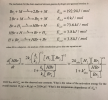 The mechanism for the chain reaction between gaseous hydrogen and gaseous bromine is where M is a chaperon. An analysis of this mechanism gives the rate equation as: when k_obs and k' _obs are the observed rate constants. What is the value of the activation energy for the overall reaction H_2(g) + Br_2(g) rightarrow 2 HBr(g)? What is the temperature dependence of k'_obs?
Question 10 Increase in temperature results in in rate of reaction because Decrease, decrease in PH...
 Question 10 Increase in temperature results in in rate of reaction because Decrease, decrease in PH Decrease, collision occurs with lower energy Increase, collision occur with higher energy Increase, increase in pH
 The following reaction was allowed to come to equilibrium at 35 degree C. The initial molar concentration for SO_3 is 0.675 M ([SO_3| = 0.675 M) and the initial molar concentration for CO_2 is 0.444 M (|CO_2] = 0.444 M). After the reaction reached equilibrium the concentration of CO_2 now equals 0.214 M ((CO_2] = 0.214 M). What is the K_c value for the reaction? 0.00987 0.0342 7.31 11.8 16.7 At 35 degree C the equilibrium constant value (K_c) for...
 At a given temperature, the equilibrium constant K_c for the reaction 2 NO(g) + 2 H_2(g) implies N_2(g) + 2 H_2O(g) What is the equilibrium constant for the following reaction? NO(g) + H_2(g) implies 1/2 N_2(g) + H_2 O(g) Correct. Think About It When we multiply a chemical reaction by a number, the new value of the equilibrium constant is the first equilibrium constant raised to the number.
 At elevated temperatures, BrF_5 establishes the following equilibrium. 2BrF_5(g) Br_2(g) + 5F_2(g) The equilibrium concentrations of the gases at 1500 K are 0.0064 mol/L for BrF_5, 0.0018 mol/L for Br_2, and 0.0090 mol/L for F_o. Calculate the value of K_r. The reaction of iron and water vapor results in an equilibrium 3Fe(s) + 4H_2O(g) Fe_3O_4(s) + 4H_2(g) and an equilibrium constant, K_c, of 4.6 at 850 degree C. What is the concentration of hydrogen present at equilibrium if the reaction...
 Use the reactions provided below and their associated enthalpies to find delta_rH for the reaction PCl_3(l) + Cl_2(g) rightarrow PCl_5(s) at 25 degree C and 1 bar, (b) Calculate the corresponding enthalpy of reaction a 65 degree C if delta_r C_p, m = -50 J K^-1 mol^-1 (constant from 25-65 degree C). Does the reaction enthalpy increase or decrease with temperature? Given reactions (25 degree C, 1 bar): 2 P(s) + 3 Cl_2(g) rightarrow PCl_3(l) delta_rH = -640 kJ/mol Reaction...
 At 25°C, the equilibrium constant K for the reaction in the solven 2BrCl = Br2 + Cl2 is 0.141. If the initial concentration of chlorine is 0.0300 M and of bromine monochloride is 0.0200 M, what is the equilibrium concentration of bromine? 1.35 x 10⁻³M 2.70 x 10⁻³M 8.82 x 10⁻³ M 9.70 x 10⁻² M. none of these choices is correct Ammonium iodide dissociates reversibly to ammonia and hydrogen iodide. D. NH4Is) + NH3(g) +HI(g) At 400°C, Kp =...
 Name: 1. An exothermic reaction is allowed to reach equilibrium. If the temperature of the reaction mixture is decreased, the equilibrium will shift towards the product side: True False [1pt] 2. For the reaction C(s) + H2O(g) CO(g) + H2(g) a decrease in concentration of C(s) will cause the reaction to shift to the left oTrue False [1pt] 3. Define the following terms: [1.5pts] a. Activation Energy b. Exothermic Reaction c. Equilibrium [1p) 4. Determine the equilibrium constant K C(s)...
 The mechanism for the chain reaction between gaseous hydrogen and gaseous bromine is where M is a chaperon. An analysis of this mechanism gives the rate equation as: when k_obs and k' _obs are the observed rate constants. What is the value of the activation energy for the overall reaction H_2(g) + Br_2(g) rightarrow 2 HBr(g)? What is the temperature dependence of k'_obs?
 Question 10 Increase in temperature results in in rate of reaction because Decrease, decrease in PH Decrease, collision occurs with lower energy Increase, collision occur with higher energy Increase, increase in pH
Most questions answered within 3 hours.
-
Where is the error in this code sequence?
String s1 = "Hello";
String s2 = "ello";...
asked 11 months ago -
Financial data for Joel de Paris, Inc., for last year
follow:
Joel de Paris, Inc.
Balance...
asked 11 months ago -
Consider this reaction:
Al2(SO4)3 (aq)+ BaCl3
(aq) Al2Cl6 (aq)- +
3BaSO4(s) . What is the...
asked 11 months ago -
Suppose that Savneet is considering increasing her
recent random sample from 20 car rentals to 40...
asked 11 months ago -
Trucks arrive at an unloading terminal at an average rate of 120
per hour.
Trucks arrive...
asked 11 months ago -
Why are methanol and ethanol completely soluble in water while
octanol is not very little soluble....
asked 11 months ago -
A facilities manager at a university reads in a research report
that the mean amount of...
asked 11 months ago -
When the CuSO4 is rehydrated by adding water to the anhydrous
compound, is this an endothermic...
asked 11 months ago -
A ray of sunlight is passing from diamond into crown glass; the
angle of incidence is...
asked 11 months ago -
A block of mass 0.249 kg is placed on top of a light, vertical
spring of...
asked 11 months ago -
how do the kidneys compensate in the presences of acidosis
a) trigger hyperventilate
b) reserve acid...
asked 11 months ago -
Question 501 pts
The rental rate of capital to the firm increases. Which of the
following...
asked 11 months ago