
Homework Answers
Write all the 5 equations as given:
Br2 + M ------> 2 Br + M, Ea,1 = 192.9 kJ/mol (chain initiation) ….(1)
Br + H2 ------> HBr + H, Ea,3 = 73.6 kJ/mol (propagation) ….(2)
HBr + H ------> H2 + Br, Ea,4 = 3.8 kJ/mol (propagation) …..(3)
H + Br2 -----> HBr + Br, Ea,5 = 3.8 kJ/mol (propagation) …..(4)
2 Br + M ------> Br2 + M, Ea,2 = 0 kJ/mol (termination) …..(5)
Multiply (2) by 2 and add all the equations above to obtain
Br2 + M + 2 Br + 2 H2 + HBr + H + H + Br2 + 2 Br + M ------> 2 Br + M + 2 HBr + 2 H + H2 + Br + HBr + Br + Br2 + M
====> 2 Br2 + 2 M + 4 Br + 2 H2 + HBr + 2 H -----> 4 Br + 2 M + 3 HBr + 2 H + H2 + Br2
Cancel out common terms from both sides to write
Br2 + H2 -----> 2 HBr
which is our required equation.
Note that Ea terms are extensive, i.e, they depend on the number of moles; hence we should multiply Ea,3 by 2 and add to get the overall activation energy as
Ea = Ea,1 + 2*Ea,3 + Ea,4 + Ea,5 + Ea,2 = (192.9 kJ/mol) + (2)*(73.6 kJ/mol) + (3.8 kJ/mol) + (3.8 kJ/mol) + (0 kJ/mol) = 347.7 kJ/mol (ans).
Note that k’obs = k4/k5. As per Arrhenius equation, we know that
k4 = A.e^(-Ea,4/RT)
and k5 = A.e^(-Ea,5/RT)
where A is Arrhenius constant and T is the temperature.
Therefore,
k4/k5 = e^(-Ea,4/RT)/e^(-Ea,5/RT)
===> k4/k5 = e^(-Ea,4/RT + Ea,5/RT) = e^(1/RT)*(Ea,5 – Ea,4) = e^(1/RT).(3.8 – 3.8) = e^(1/RT).(0) = e0 = 1
Therefore, k’obs = 1 and hence independent of temperature (ans).
Add Answer to:
The mechanism for the chain reaction between gaseous hydrogen and gaseous bromine is where M is...
Consider the following chain-reaction mechanism for the ortho-para (p to o hydrogen conversion: initiation M +...
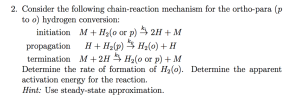 Consider the following chain-reaction mechanism for the ortho-para (p to o hydrogen conversion: initiation M + H_2 (o or p) 2H + M propagation H + H_2(p) H_2(o) + H termination M + 2H H_2 (o or p) M Determine the rate of formation of H_2(o). Determine the apparent activation energy for the reaction.
Consider the mechanism for hydrogen and chlorine: Cl_2 + M rightarrow Cl + Cl + M...
 Consider the mechanism for hydrogen and chlorine: Cl_2 + M rightarrow Cl + Cl + M Cl + H_2 rightarrow HCl + H, H + Cl_2 rightarrow HCl + Cl, Cl + Cl + M rightarrow Cl_2 + M. With appropriate steady-state assumptions, we know: d[HCl]/dt = 2 k_2 Squareroot k_1/k_4 [Cl_2]^0.5 [H_2] If NCl_3 is added to the mixture as an inhibitor, the following reaction needs to be considered: NCl_3 + Cl rightarrow NCl_2 + Cl_2 What is the...
An decrease in temperature increases the reaction rate because temperature affects the equilibrium constant of the...
 An decrease in temperature increases the reaction rate because temperature affects the equilibrium constant of the reaction a smaller fraction of the collisions have the correct orientation of molecules. the activation energy of the reaction will decrease. less collisions will have enough energy to exceed the activation energy. the activation energy of the reaction will increase. The equilibrium constant, K_p, for the reaction H_2(g) + I_2(g) doubleheadarrow 2HI(g) is 10.0 at 450 degree C. A rigid cylinder at that temperature...
Help?? Consider the following reaction: H_2(g) hydrogen + 2ICI(g) iodine chloride righarrow HCI(g) hydrogen chloride +...
 Help??
Consider the following reaction: H_2(g) hydrogen + 2ICI(g) iodine chloride righarrow HCI(g) hydrogen chloride + 1_2(g) iodine The rate law for this reaction has been determined experimentally, and it is first order in both hydrogen gas and iodine chloride gas (second order overall). Propose a mechanism with a minimum of two steps which is consistent with the observed rate law, and indicate which of the steps is likety to be the rate-determining step in the mechanism.
Help??
Consider the following reaction: H_2(g) hydrogen + 2ICI(g) iodine chloride righarrow HCI(g) hydrogen chloride + 1_2(g) iodine The rate law for this reaction has been determined experimentally, and it is first order in both hydrogen gas and iodine chloride gas (second order overall). Propose a mechanism with a minimum of two steps which is consistent with the observed rate law, and indicate which of the steps is likety to be the rate-determining step in the mechanism.
A proposed mechanism for the reaction of NO_2 and CO is 2 NO_2(g) rightarrow NO(g) +...
 A proposed mechanism for the reaction of NO_2 and CO is 2 NO_2(g) rightarrow NO(g) + NO_3(g) (Slow, endothermic) NO_3(g) + CO(g) rightarrow NO_2(g) + CO_2(g) (Fast, exothermic) a) Write the overall reaction. b) Identify each of the following as a reactant, product, , or intermediate, NO_2, CO, NO_3, CO_2, NO. c) Draw a reaction coordinate for this reaction. Indicate on this drawing the activation energy for each step and the overall enthalpy change. d) Give a plausible rate law.
Question 20 2.5 pts The gas-phase reaction of nitric oxide (NO) with bromine (Br2), occurs by...
 Question 20 2.5 pts The gas-phase reaction of nitric oxide (NO) with bromine (Br2), occurs by the following two- step mechanism: NO(g) + NO(g) = N2O2(g) (fast, equilibrium) N202 + Br2 → 2 NOBr(g) (slow) What is the observed rate law for the overall reaction? A. Rate = k[NO] [N202][Br2] B. Rate = k[N202][Br] C. Rate = k[NO]”[Br2] D. Rate = k[NO] E. Rate = k[NO]”[N202][Br2]
The gas phase reaction of nitric oxide, NO, with bromine, Br2, to produce nitrosyl bromide, NOBr,...
 The gas phase reaction of nitric oxide, NO, with bromine, Br2,
to produce nitrosyl bromide, NOBr,
occurs according to the net reaction: A possible reaction
mechanism is:
?1
Step 1: 2 NO ⇌ N2O2
?−1
Step 2: N2O2 + Br2
2NO+Br2 → 2NOBr
2 NOBr
Neither step is faster than the other. What is the order of the
overall reaction, and what is the overall rate constant (expressed
in terms of the individual rate constants for the elementary
steps)?
9....
The gas phase reaction of nitric oxide, NO, with bromine, Br2,
to produce nitrosyl bromide, NOBr,
occurs according to the net reaction: A possible reaction
mechanism is:
?1
Step 1: 2 NO ⇌ N2O2
?−1
Step 2: N2O2 + Br2
2NO+Br2 → 2NOBr
2 NOBr
Neither step is faster than the other. What is the order of the
overall reaction, and what is the overall rate constant (expressed
in terms of the individual rate constants for the elementary
steps)?
9....
The following mechanism has been proposed for the gas phase reaction of nitrogen monoxide with bromine....
The following mechanism has been proposed for the gas phase reaction of nitrogen monoxide with bromine. .....step 1.....fast:......NO + Br2 <==> NOBr2 .....step 2.....slow:....NOBr2 + NO -->2 NOBr (1) What is the equation for the overall reaction? Use the smallest integer coefficients possible. If a box is not needed, leave it blank. _____ + ______ ----> __________ (2) Enter the formula of any species that acts as a reaction intermediate? If none leave box blank: __________ (3) Complete the rate law...
Suppose the reaction between nitric oxide and oxygen proceeds by the following mechanism: rate constant elementary...
 Suppose the reaction between nitric oxide and oxygen proceeds by the following mechanism: rate constant elementary reaction step NO(g)+ 02(g) NO2(9) 0(g) 1 NO(g) O(g) NO2(9) k2 2 Suppose also k,»k,. That is, the first step is much faster than the second. 2* Write the balanced chemical equation for the overall chemical reaction: Write the experimentally observable rate law for the overall chemical reaction rate k Note: your answer should not contain the concentrations of any intermediates. Express the rate...
Please help with this sheet answer with thorough steps! A plot of the reciprocal concentration of...
 Please help with this sheet answer with thorough steps!
A plot of the reciprocal concentration of chemical A versus time yielded a straight line with a slope of 0.25 M^-1s^-1. What is the order of the reaction with respect to chemical A. Determine the value of the rate constant (including units) The mole fraction of water in a solution is 0.80. If the vapor pressure of pure water at 25 degree C is 23.8 mm Hg, what is the partial...
Please help with this sheet answer with thorough steps!
A plot of the reciprocal concentration of chemical A versus time yielded a straight line with a slope of 0.25 M^-1s^-1. What is the order of the reaction with respect to chemical A. Determine the value of the rate constant (including units) The mole fraction of water in a solution is 0.80. If the vapor pressure of pure water at 25 degree C is 23.8 mm Hg, what is the partial...
 Consider the following chain-reaction mechanism for the ortho-para (p to o hydrogen conversion: initiation M + H_2 (o or p) 2H + M propagation H + H_2(p) H_2(o) + H termination M + 2H H_2 (o or p) M Determine the rate of formation of H_2(o). Determine the apparent activation energy for the reaction.
 Consider the mechanism for hydrogen and chlorine: Cl_2 + M rightarrow Cl + Cl + M Cl + H_2 rightarrow HCl + H, H + Cl_2 rightarrow HCl + Cl, Cl + Cl + M rightarrow Cl_2 + M. With appropriate steady-state assumptions, we know: d[HCl]/dt = 2 k_2 Squareroot k_1/k_4 [Cl_2]^0.5 [H_2] If NCl_3 is added to the mixture as an inhibitor, the following reaction needs to be considered: NCl_3 + Cl rightarrow NCl_2 + Cl_2 What is the...
 An decrease in temperature increases the reaction rate because temperature affects the equilibrium constant of the reaction a smaller fraction of the collisions have the correct orientation of molecules. the activation energy of the reaction will decrease. less collisions will have enough energy to exceed the activation energy. the activation energy of the reaction will increase. The equilibrium constant, K_p, for the reaction H_2(g) + I_2(g) doubleheadarrow 2HI(g) is 10.0 at 450 degree C. A rigid cylinder at that temperature...
 Help??
Consider the following reaction: H_2(g) hydrogen + 2ICI(g) iodine chloride righarrow HCI(g) hydrogen chloride + 1_2(g) iodine The rate law for this reaction has been determined experimentally, and it is first order in both hydrogen gas and iodine chloride gas (second order overall). Propose a mechanism with a minimum of two steps which is consistent with the observed rate law, and indicate which of the steps is likety to be the rate-determining step in the mechanism.
Help??
Consider the following reaction: H_2(g) hydrogen + 2ICI(g) iodine chloride righarrow HCI(g) hydrogen chloride + 1_2(g) iodine The rate law for this reaction has been determined experimentally, and it is first order in both hydrogen gas and iodine chloride gas (second order overall). Propose a mechanism with a minimum of two steps which is consistent with the observed rate law, and indicate which of the steps is likety to be the rate-determining step in the mechanism.
 A proposed mechanism for the reaction of NO_2 and CO is 2 NO_2(g) rightarrow NO(g) + NO_3(g) (Slow, endothermic) NO_3(g) + CO(g) rightarrow NO_2(g) + CO_2(g) (Fast, exothermic) a) Write the overall reaction. b) Identify each of the following as a reactant, product, , or intermediate, NO_2, CO, NO_3, CO_2, NO. c) Draw a reaction coordinate for this reaction. Indicate on this drawing the activation energy for each step and the overall enthalpy change. d) Give a plausible rate law.
 Question 20 2.5 pts The gas-phase reaction of nitric oxide (NO) with bromine (Br2), occurs by the following two- step mechanism: NO(g) + NO(g) = N2O2(g) (fast, equilibrium) N202 + Br2 → 2 NOBr(g) (slow) What is the observed rate law for the overall reaction? A. Rate = k[NO] [N202][Br2] B. Rate = k[N202][Br] C. Rate = k[NO]”[Br2] D. Rate = k[NO] E. Rate = k[NO]”[N202][Br2]
 The gas phase reaction of nitric oxide, NO, with bromine, Br2,
to produce nitrosyl bromide, NOBr,
occurs according to the net reaction: A possible reaction
mechanism is:
?1
Step 1: 2 NO ⇌ N2O2
?−1
Step 2: N2O2 + Br2
2NO+Br2 → 2NOBr
2 NOBr
Neither step is faster than the other. What is the order of the
overall reaction, and what is the overall rate constant (expressed
in terms of the individual rate constants for the elementary
steps)?
9....
The gas phase reaction of nitric oxide, NO, with bromine, Br2,
to produce nitrosyl bromide, NOBr,
occurs according to the net reaction: A possible reaction
mechanism is:
?1
Step 1: 2 NO ⇌ N2O2
?−1
Step 2: N2O2 + Br2
2NO+Br2 → 2NOBr
2 NOBr
Neither step is faster than the other. What is the order of the
overall reaction, and what is the overall rate constant (expressed
in terms of the individual rate constants for the elementary
steps)?
9....
 Suppose the reaction between nitric oxide and oxygen proceeds by the following mechanism: rate constant elementary reaction step NO(g)+ 02(g) NO2(9) 0(g) 1 NO(g) O(g) NO2(9) k2 2 Suppose also k,»k,. That is, the first step is much faster than the second. 2* Write the balanced chemical equation for the overall chemical reaction: Write the experimentally observable rate law for the overall chemical reaction rate k Note: your answer should not contain the concentrations of any intermediates. Express the rate...
 Please help with this sheet answer with thorough steps!
A plot of the reciprocal concentration of chemical A versus time yielded a straight line with a slope of 0.25 M^-1s^-1. What is the order of the reaction with respect to chemical A. Determine the value of the rate constant (including units) The mole fraction of water in a solution is 0.80. If the vapor pressure of pure water at 25 degree C is 23.8 mm Hg, what is the partial...
Please help with this sheet answer with thorough steps!
A plot of the reciprocal concentration of chemical A versus time yielded a straight line with a slope of 0.25 M^-1s^-1. What is the order of the reaction with respect to chemical A. Determine the value of the rate constant (including units) The mole fraction of water in a solution is 0.80. If the vapor pressure of pure water at 25 degree C is 23.8 mm Hg, what is the partial...
Most questions answered within 3 hours.
-
Where is the error in this code sequence?
String s1 = "Hello";
String s2 = "ello";...
asked 10 months ago -
Financial data for Joel de Paris, Inc., for last year
follow:
Joel de Paris, Inc.
Balance...
asked 10 months ago -
Consider this reaction:
Al2(SO4)3 (aq)+ BaCl3
(aq) Al2Cl6 (aq)- +
3BaSO4(s) . What is the...
asked 10 months ago -
Suppose that Savneet is considering increasing her
recent random sample from 20 car rentals to 40...
asked 10 months ago -
Trucks arrive at an unloading terminal at an average rate of 120
per hour.
Trucks arrive...
asked 10 months ago -
Why are methanol and ethanol completely soluble in water while
octanol is not very little soluble....
asked 10 months ago -
A facilities manager at a university reads in a research report
that the mean amount of...
asked 10 months ago -
When the CuSO4 is rehydrated by adding water to the anhydrous
compound, is this an endothermic...
asked 10 months ago -
A ray of sunlight is passing from diamond into crown glass; the
angle of incidence is...
asked 10 months ago -
A block of mass 0.249 kg is placed on top of a light, vertical
spring of...
asked 10 months ago -
how do the kidneys compensate in the presences of acidosis
a) trigger hyperventilate
b) reserve acid...
asked 10 months ago -
Question 501 pts
The rental rate of capital to the firm increases. Which of the
following...
asked 10 months ago