 Help??
Homework Answers
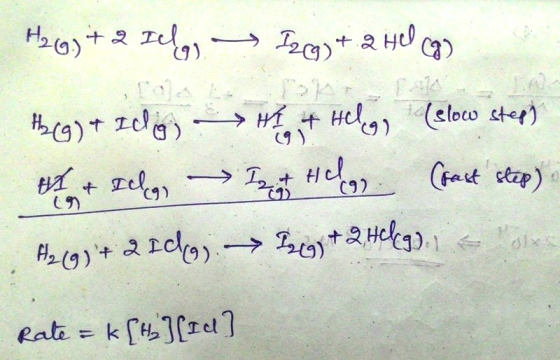
Add Answer to:
Help??
Consider the following reaction: H_2(g) hydrogen + 2ICI(g) iodine chloride righarrow HCI(g) hydrogen chloride +...
2. Consider the reaction below between nitric oxide and hydrogen gas: 2 NO(g) + 2 H2(g)...
 2. Consider the reaction below between nitric oxide and hydrogen gas: 2 NO(g) + 2 H2(g) - N2 + 2 H2009) Upon being studied experimentally, it has been determined that the rate law expression for this reaction is first order in Hz and second order in NO(g). With this information in mind, answer the following: [Tip: You can assume that the steady-state approximation is valid for any intermediate here.) a. As written, is the reaction above a valid mechanism? In...
K_c for the reaction of hydrogen and iodine to produce hydrogen iodide, H_2 (g) + I_2...
 K_c for the reaction of hydrogen and iodine to produce hydrogen iodide, H_2 (g) + I_2 (g) 2HI (g) is 54.3 at 430 degree C. Determine the initial and equilibrium concentration of HI if initial concentrations of H_2 and I_2 are both 0.10 M and their equilibrium concentrations are both 0.043 M at 430 degree C. [HI]_i = M [HI]_e = M
The decomposition of hydrogen peroxide, H 2 O 2 , may be catalyzed with the iodine...
The decomposition of hydrogen peroxide, H 2 O 2 , may be catalyzed with the iodine ion. Chemists propose this reaction occurs according to the following mechanism. Step 1 H 2 O 2 + I - > H 2 O + OI - slow Step 2 H 2 O 2 + OI - > H 2 O + O 2 + I - fast (a) Show that these steps are consistent with the overall stoichiometry of the reaction. (b) How...
K_c for the reaction of hydrogen and iodine to produce hydrogen iodide, H_2(g)+I_2(g) doubleheadarrow 2HI(g) is...
 K_c for the reaction of hydrogen and iodine to produce hydrogen iodide, H_2(g)+I_2(g) doubleheadarrow 2HI(g) is 54.3 at 430 degree C. Determine the initial and equilibrium concentration of H_2and I_2 are both 0.11 M and their equilibrium concentrations are both 0.048 M at 430 degree
20. The reaction of nitric oxide (NO(g)) with a molecular hydrogen (H2(g)) results in the production...
 20. The reaction of nitric oxide (NO(g)) with a molecular hydrogen (H2(g)) results in the production of molecular nitrogen and water as follows: 2NO(g) + 2H2(g) N20(g)+2H2O(g) According to the following proposed mechanism of this reaction 2NO(g) k-1 (fast equilibrium) N2O2(g) H2(g)+ N2O2(g) N2O(g)+2H20(g) Which of the following is TRUE A) The reaction rate of hydrogen decomposition is consistent with the observed 3rd order. The reaction rate of hydrogen decomposition is consistent with the observed 4th order. B) C) The...
The following process may take place in three steps: 2 CIO (g) =2 Cl (g) +...
 The following process may take place in three steps: 2 CIO (g) =2 Cl (g) + O2 (g) S1: 2 CIO (g) = CIOOCI (g) S2: CIOOCI (g) = CIOO (g) + Cl (g) S3: CIOO (g) + Cl (g) + O2 (g) The rate law for this process has been experimentally determined to be Rate = k[CIO]?. Based off this information, which of the following statements is TRUE? O The reaction is first order overall O The rate law...
For the reaction of iodine atoms with hydrogen molecules in teh gas phase, these rate constants...
 For the reaction of iodine atoms with hydrogen molecules in teh
gas phase, these rate constants were obatined experimentally: 2
I(g) H2(g) ?> 2 HI (g) Calculate the activation energy for this
process:
For the reaction of iodine atoms with hydrogen molecules in teh
gas phase, these rate constants were obatined experimentally: 2
I(g) H2(g) ?> 2 HI (g) Calculate the activation energy for this
process:
Propose a plausible two-step mechanism for the given reaction (Pool: 5 of 5) Propose a plausible...
 Propose a plausible two-step mechanism for the given reaction (Pool: 5 of 5) Propose a plausible two-step mechanism for the reaction given below with the steps provided. Overall Reaction: 2A + 2B rightarrow C + D Experimentally Determined Rate Law: rate = K[A][B]^2 Two-Step Mechanism: Step 1: Step 2:
The reaction of hydrogen chloride(g) with ammonia(g) to form ammonium chloride(s) proceeds as follows. HCI(g) +...
 The reaction of hydrogen chloride(g) with ammonia(g) to form ammonium chloride(s) proceeds as follows. HCI(g) + NH3(g) - NHACI(S) When 10.4 grams of HCl(g) react with sufficient NH3(g), 50.2 kJ of energy are evolved What is the value of AH for the chemical equation given? АНrxn=
The mechanism for the chain reaction between gaseous hydrogen and gaseous bromine is where M is...
 The mechanism for the chain reaction between gaseous hydrogen and gaseous bromine is where M is a chaperon. An analysis of this mechanism gives the rate equation as: when k_obs and k' _obs are the observed rate constants. What is the value of the activation energy for the overall reaction H_2(g) + Br_2(g) rightarrow 2 HBr(g)? What is the temperature dependence of k'_obs?
 2. Consider the reaction below between nitric oxide and hydrogen gas: 2 NO(g) + 2 H2(g) - N2 + 2 H2009) Upon being studied experimentally, it has been determined that the rate law expression for this reaction is first order in Hz and second order in NO(g). With this information in mind, answer the following: [Tip: You can assume that the steady-state approximation is valid for any intermediate here.) a. As written, is the reaction above a valid mechanism? In...
 K_c for the reaction of hydrogen and iodine to produce hydrogen iodide, H_2 (g) + I_2 (g) 2HI (g) is 54.3 at 430 degree C. Determine the initial and equilibrium concentration of HI if initial concentrations of H_2 and I_2 are both 0.10 M and their equilibrium concentrations are both 0.043 M at 430 degree C. [HI]_i = M [HI]_e = M
 K_c for the reaction of hydrogen and iodine to produce hydrogen iodide, H_2(g)+I_2(g) doubleheadarrow 2HI(g) is 54.3 at 430 degree C. Determine the initial and equilibrium concentration of H_2and I_2 are both 0.11 M and their equilibrium concentrations are both 0.048 M at 430 degree
 20. The reaction of nitric oxide (NO(g)) with a molecular hydrogen (H2(g)) results in the production of molecular nitrogen and water as follows: 2NO(g) + 2H2(g) N20(g)+2H2O(g) According to the following proposed mechanism of this reaction 2NO(g) k-1 (fast equilibrium) N2O2(g) H2(g)+ N2O2(g) N2O(g)+2H20(g) Which of the following is TRUE A) The reaction rate of hydrogen decomposition is consistent with the observed 3rd order. The reaction rate of hydrogen decomposition is consistent with the observed 4th order. B) C) The...
 The following process may take place in three steps: 2 CIO (g) =2 Cl (g) + O2 (g) S1: 2 CIO (g) = CIOOCI (g) S2: CIOOCI (g) = CIOO (g) + Cl (g) S3: CIOO (g) + Cl (g) + O2 (g) The rate law for this process has been experimentally determined to be Rate = k[CIO]?. Based off this information, which of the following statements is TRUE? O The reaction is first order overall O The rate law...
 For the reaction of iodine atoms with hydrogen molecules in teh
gas phase, these rate constants were obatined experimentally: 2
I(g) H2(g) ?> 2 HI (g) Calculate the activation energy for this
process:
For the reaction of iodine atoms with hydrogen molecules in teh
gas phase, these rate constants were obatined experimentally: 2
I(g) H2(g) ?> 2 HI (g) Calculate the activation energy for this
process:
 Propose a plausible two-step mechanism for the given reaction (Pool: 5 of 5) Propose a plausible two-step mechanism for the reaction given below with the steps provided. Overall Reaction: 2A + 2B rightarrow C + D Experimentally Determined Rate Law: rate = K[A][B]^2 Two-Step Mechanism: Step 1: Step 2:
 The reaction of hydrogen chloride(g) with ammonia(g) to form ammonium chloride(s) proceeds as follows. HCI(g) + NH3(g) - NHACI(S) When 10.4 grams of HCl(g) react with sufficient NH3(g), 50.2 kJ of energy are evolved What is the value of AH for the chemical equation given? АНrxn=
 The mechanism for the chain reaction between gaseous hydrogen and gaseous bromine is where M is a chaperon. An analysis of this mechanism gives the rate equation as: when k_obs and k' _obs are the observed rate constants. What is the value of the activation energy for the overall reaction H_2(g) + Br_2(g) rightarrow 2 HBr(g)? What is the temperature dependence of k'_obs?
Most questions answered within 3 hours.
-
Where is the error in this code sequence?
String s1 = "Hello";
String s2 = "ello";...
asked 10 months ago -
Financial data for Joel de Paris, Inc., for last year
follow:
Joel de Paris, Inc.
Balance...
asked 10 months ago -
Consider this reaction:
Al2(SO4)3 (aq)+ BaCl3
(aq) Al2Cl6 (aq)- +
3BaSO4(s) . What is the...
asked 10 months ago -
Suppose that Savneet is considering increasing her
recent random sample from 20 car rentals to 40...
asked 10 months ago -
Trucks arrive at an unloading terminal at an average rate of 120
per hour.
Trucks arrive...
asked 10 months ago -
Why are methanol and ethanol completely soluble in water while
octanol is not very little soluble....
asked 10 months ago -
A facilities manager at a university reads in a research report
that the mean amount of...
asked 10 months ago -
When the CuSO4 is rehydrated by adding water to the anhydrous
compound, is this an endothermic...
asked 10 months ago -
A ray of sunlight is passing from diamond into crown glass; the
angle of incidence is...
asked 10 months ago -
A block of mass 0.249 kg is placed on top of a light, vertical
spring of...
asked 10 months ago -
how do the kidneys compensate in the presences of acidosis
a) trigger hyperventilate
b) reserve acid...
asked 10 months ago -
Question 501 pts
The rental rate of capital to the firm increases. Which of the
following...
asked 10 months ago