

Homework Answers
QUESTION 69.
Answer: Buffer the pH changes in the blood plasma
Explanation: The acidic hydronium ions form carbonic acid when neutralized by the bicarbonate ions. The carbonic acid formed acts as part of the buffer system and hence regulates blood plasma pH changes.
QUESTION 59.
Answer: the production of free hydrogen ions is equal to their loss in the solution.
Explanation: Acid-base balance depends upon hydrogen ions and hydroxide ions present in the solution. Since all acid-base reactions are redox reactions, for equilibrium to take place the hydrogen ions produced should be equal to the ones lost.
Add Answer to:
Question 69 (1 point) What is the primary role of the carbonic acid - bicarbonate buffer...
21. What are the characteristics of the carbonic acid-bicarbonate buffer system (select all that apply? a...
 21. What are the characteristics of the carbonic acid-bicarbonate buffer system (select all that apply? a CO2 is eliminated by the lungs b. Neutralizes HCl acid to yield carbonic acid and salt c. H2CO3 formed by neutralization dissociates into H2O and CO2 d. Shifts H+ in and out of cell in exchange for other cations such as potassium and sodium e. Free basic radicals dissociate into ammonia and OH-, which combines with Ho to form water 22. What are characteristics...
Question 1 (1 point) All of the following statements about bicarbonate ions are true EXCEPT: bicarbonate...
 Question 1 (1 point) All of the following statements about bicarbonate ions are true EXCEPT: bicarbonate ions are excreted in the urine in proportion to hydrogen ion excretion. the kidneys are capable of synthesizing new bicarbonate ions. O the kidneys can reabsorb bicarbonate ions. O bicarbonate ions act in a chemical buffer system as a weak base. there is many more bicarbonate ions than carbonic acid molecules in the carbonic acid-bicarbonate buffer system. Question 2 (1 point) Which of these...
The question is Did the combination of carbonic acid and bicarbonate function as a buffer? Support...
The question is Did the combination of carbonic acid and bicarbonate function as a buffer? Support your response with data. Buffers are chemical mixtures that resist pH change when exposed to acids or bases. They contain both a weak proton donor and weak proton acceptor. The former neutralizes any strong bases added and the latter neutralizes any strong acids added to the buffer. Our bodies rely upon a combination of three different buffers to maintain stable pH: the bicarbonate buffer...
\ Part 3: Preparing and testing the carbonic acid/bicarbonate buffer 3) and 6) Buffer 0.1...
 \
Part 3: Preparing and testing the carbonic acid/bicarbonate buffer 3) and 6) Buffer 0.1 MHCI A: Buffer A: Buffer B: Butter B: Buffer Part 4: Testing water for pH resistance 2) and 5) DFDFDF A: HO B: H0 Question 6 1 pts pH in Beaker A pH in Beaker B After 5 drops NaOH Solution Initial After 5 drops HCI After 20 drops HCI Initial After 20 drops NaOH Buffer (part 3) Water (part 4) Use the data...
\
Part 3: Preparing and testing the carbonic acid/bicarbonate buffer 3) and 6) Buffer 0.1 MHCI A: Buffer A: Buffer B: Butter B: Buffer Part 4: Testing water for pH resistance 2) and 5) DFDFDF A: HO B: H0 Question 6 1 pts pH in Beaker A pH in Beaker B After 5 drops NaOH Solution Initial After 5 drops HCI After 20 drops HCI Initial After 20 drops NaOH Buffer (part 3) Water (part 4) Use the data...
1. 50.0 mL of a pH 6.00 carbonic acid buffer is titrated with 0.2857 M NaOH,...
 1. 50.0 mL of a pH 6.00 carbonic acid buffer is titrated with 0.2857 M NaOH, requiring 17.47 mL to reach the second equivalence point. a. Calculate the molarity of carbonic acid and bicarbonate in the original buffer. (10 pts) Carbonic acid Bicarbonate: b. Calculate the pH of the solution after a total of 100.0 mL of 0.2857 M NaOH is added to the buffer and equilibrium is established. (10 pts) c. 7.833 g of solid lead(II) carbonate is added...
Part 3: Preparing and testing the carbonic acid/bicarbonate buffer 3) and 6) Buffer 0.1 MHCI A:...
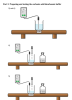 Part 3: Preparing and testing the carbonic acid/bicarbonate buffer 3) and 6) Buffer 0.1 MHCI A: Buffer A: Buffer B: Butter B: Buffer Part 4: Testing water for pH resistance 2) and 5) DFDFDF A: HO B: H0 Parts 3 and 4. 5) Write a balanced equation for the reaction that occurred when HCl was added to the buffer. (The reactants are HCl and the chemical you answered for Question 3 above.) Please use the superscripts and subscripts to enter...
please answer 17,22, 23 QUESTION 17 Which of the following best describes the role of the...
 please answer 17,22, 23
QUESTION 17 Which of the following best describes the role of the syncytiotrophoblast? produces progesterone to maintain the pregnancy gives rise to the chorionic villi O provides the structural basis for the umbilical cord gives rise to the embryonic disk digests uterine cells during the process of implantation QUESTION 22 Which of the following occurs if a strong acid is added to the bicarbonate buffer system? the bicarbonate ions of the salt tie up excess hydrogen...
please answer 17,22, 23
QUESTION 17 Which of the following best describes the role of the syncytiotrophoblast? produces progesterone to maintain the pregnancy gives rise to the chorionic villi O provides the structural basis for the umbilical cord gives rise to the embryonic disk digests uterine cells during the process of implantation QUESTION 22 Which of the following occurs if a strong acid is added to the bicarbonate buffer system? the bicarbonate ions of the salt tie up excess hydrogen...
potassiun muai B.s history, why might Cir have more serious effects on Part C: Day 3:...
 potassiun muai B.s history, why might Cir have more serious effects on Part C: Day 3: Admission to the Hospita After a prolonged period vomiting bs of vomiting, metabolic acidosis develops. This change results from a number of factors: . Loss of bicarbon ate ions in duodenal secretions Lack of nutrients leading to cata bolism of stored fats and protein with production of excessive a amounts of ketoacids Dehydration and decreased blood volume leading to decreased excretion of acids by...
What is the answer to question 15, 16, 17 and 18, and also how did you...
 What is the answer to question 15, 16, 17 and 18, and also how
did you calculate it
15) (5 pts) equilibrium information below: Calculate the initial pH of the solution given the following reaction and Ca(OH)2(s) Ca+(aq) +20H-(ag) with Kso 1.3 x 10⁵ A) 12.1 B) 11.8 C) 10.3 D) 8.2 E) None of these choices are correct 2x 13x6 (x) 2. 6.3x10⁶ (x) 2 -0.0036 -10002 0.0072 16) (5 pts) How many moles of sodium acetate (conjugate base)...
What is the answer to question 15, 16, 17 and 18, and also how
did you calculate it
15) (5 pts) equilibrium information below: Calculate the initial pH of the solution given the following reaction and Ca(OH)2(s) Ca+(aq) +20H-(ag) with Kso 1.3 x 10⁵ A) 12.1 B) 11.8 C) 10.3 D) 8.2 E) None of these choices are correct 2x 13x6 (x) 2. 6.3x10⁶ (x) 2 -0.0036 -10002 0.0072 16) (5 pts) How many moles of sodium acetate (conjugate base)...
3.(16.3) Identify all the correct statements about an acid-base buffer solution. I. It can be prepared...
 3.(16.3) Identify all the correct statements about an acid-base buffer solution. I. It can be prepared by combining a strong acid with a salt of its conjugate base. II. It can be prepared by combining a weak acid with a salt of its conjugate base. III. It can be prepared by combining a weak base with its conjugate acid. IV. The pH of a buffer solution does not change when the solution is diluted. V. A buffer solution resists changes...
 21. What are the characteristics of the carbonic acid-bicarbonate buffer system (select all that apply? a CO2 is eliminated by the lungs b. Neutralizes HCl acid to yield carbonic acid and salt c. H2CO3 formed by neutralization dissociates into H2O and CO2 d. Shifts H+ in and out of cell in exchange for other cations such as potassium and sodium e. Free basic radicals dissociate into ammonia and OH-, which combines with Ho to form water 22. What are characteristics...
 Question 1 (1 point) All of the following statements about bicarbonate ions are true EXCEPT: bicarbonate ions are excreted in the urine in proportion to hydrogen ion excretion. the kidneys are capable of synthesizing new bicarbonate ions. O the kidneys can reabsorb bicarbonate ions. O bicarbonate ions act in a chemical buffer system as a weak base. there is many more bicarbonate ions than carbonic acid molecules in the carbonic acid-bicarbonate buffer system. Question 2 (1 point) Which of these...
 \
Part 3: Preparing and testing the carbonic acid/bicarbonate buffer 3) and 6) Buffer 0.1 MHCI A: Buffer A: Buffer B: Butter B: Buffer Part 4: Testing water for pH resistance 2) and 5) DFDFDF A: HO B: H0 Question 6 1 pts pH in Beaker A pH in Beaker B After 5 drops NaOH Solution Initial After 5 drops HCI After 20 drops HCI Initial After 20 drops NaOH Buffer (part 3) Water (part 4) Use the data...
\
Part 3: Preparing and testing the carbonic acid/bicarbonate buffer 3) and 6) Buffer 0.1 MHCI A: Buffer A: Buffer B: Butter B: Buffer Part 4: Testing water for pH resistance 2) and 5) DFDFDF A: HO B: H0 Question 6 1 pts pH in Beaker A pH in Beaker B After 5 drops NaOH Solution Initial After 5 drops HCI After 20 drops HCI Initial After 20 drops NaOH Buffer (part 3) Water (part 4) Use the data...
 1. 50.0 mL of a pH 6.00 carbonic acid buffer is titrated with 0.2857 M NaOH, requiring 17.47 mL to reach the second equivalence point. a. Calculate the molarity of carbonic acid and bicarbonate in the original buffer. (10 pts) Carbonic acid Bicarbonate: b. Calculate the pH of the solution after a total of 100.0 mL of 0.2857 M NaOH is added to the buffer and equilibrium is established. (10 pts) c. 7.833 g of solid lead(II) carbonate is added...
 Part 3: Preparing and testing the carbonic acid/bicarbonate buffer 3) and 6) Buffer 0.1 MHCI A: Buffer A: Buffer B: Butter B: Buffer Part 4: Testing water for pH resistance 2) and 5) DFDFDF A: HO B: H0 Parts 3 and 4. 5) Write a balanced equation for the reaction that occurred when HCl was added to the buffer. (The reactants are HCl and the chemical you answered for Question 3 above.) Please use the superscripts and subscripts to enter...
 please answer 17,22, 23
QUESTION 17 Which of the following best describes the role of the syncytiotrophoblast? produces progesterone to maintain the pregnancy gives rise to the chorionic villi O provides the structural basis for the umbilical cord gives rise to the embryonic disk digests uterine cells during the process of implantation QUESTION 22 Which of the following occurs if a strong acid is added to the bicarbonate buffer system? the bicarbonate ions of the salt tie up excess hydrogen...
please answer 17,22, 23
QUESTION 17 Which of the following best describes the role of the syncytiotrophoblast? produces progesterone to maintain the pregnancy gives rise to the chorionic villi O provides the structural basis for the umbilical cord gives rise to the embryonic disk digests uterine cells during the process of implantation QUESTION 22 Which of the following occurs if a strong acid is added to the bicarbonate buffer system? the bicarbonate ions of the salt tie up excess hydrogen...
 potassiun muai B.s history, why might Cir have more serious effects on Part C: Day 3: Admission to the Hospita After a prolonged period vomiting bs of vomiting, metabolic acidosis develops. This change results from a number of factors: . Loss of bicarbon ate ions in duodenal secretions Lack of nutrients leading to cata bolism of stored fats and protein with production of excessive a amounts of ketoacids Dehydration and decreased blood volume leading to decreased excretion of acids by...
 What is the answer to question 15, 16, 17 and 18, and also how
did you calculate it
15) (5 pts) equilibrium information below: Calculate the initial pH of the solution given the following reaction and Ca(OH)2(s) Ca+(aq) +20H-(ag) with Kso 1.3 x 10⁵ A) 12.1 B) 11.8 C) 10.3 D) 8.2 E) None of these choices are correct 2x 13x6 (x) 2. 6.3x10⁶ (x) 2 -0.0036 -10002 0.0072 16) (5 pts) How many moles of sodium acetate (conjugate base)...
What is the answer to question 15, 16, 17 and 18, and also how
did you calculate it
15) (5 pts) equilibrium information below: Calculate the initial pH of the solution given the following reaction and Ca(OH)2(s) Ca+(aq) +20H-(ag) with Kso 1.3 x 10⁵ A) 12.1 B) 11.8 C) 10.3 D) 8.2 E) None of these choices are correct 2x 13x6 (x) 2. 6.3x10⁶ (x) 2 -0.0036 -10002 0.0072 16) (5 pts) How many moles of sodium acetate (conjugate base)...
 3.(16.3) Identify all the correct statements about an acid-base buffer solution. I. It can be prepared by combining a strong acid with a salt of its conjugate base. II. It can be prepared by combining a weak acid with a salt of its conjugate base. III. It can be prepared by combining a weak base with its conjugate acid. IV. The pH of a buffer solution does not change when the solution is diluted. V. A buffer solution resists changes...
Most questions answered within 3 hours.
-
Where is the error in this code sequence?
String s1 = "Hello";
String s2 = "ello";...
asked 10 months ago -
Financial data for Joel de Paris, Inc., for last year
follow:
Joel de Paris, Inc.
Balance...
asked 10 months ago -
Consider this reaction:
Al2(SO4)3 (aq)+ BaCl3
(aq) Al2Cl6 (aq)- +
3BaSO4(s) . What is the...
asked 10 months ago -
Suppose that Savneet is considering increasing her
recent random sample from 20 car rentals to 40...
asked 10 months ago -
Trucks arrive at an unloading terminal at an average rate of 120
per hour.
Trucks arrive...
asked 10 months ago -
Why are methanol and ethanol completely soluble in water while
octanol is not very little soluble....
asked 10 months ago -
A facilities manager at a university reads in a research report
that the mean amount of...
asked 10 months ago -
When the CuSO4 is rehydrated by adding water to the anhydrous
compound, is this an endothermic...
asked 10 months ago -
A ray of sunlight is passing from diamond into crown glass; the
angle of incidence is...
asked 10 months ago -
A block of mass 0.249 kg is placed on top of a light, vertical
spring of...
asked 10 months ago -
how do the kidneys compensate in the presences of acidosis
a) trigger hyperventilate
b) reserve acid...
asked 10 months ago -
Question 501 pts
The rental rate of capital to the firm increases. Which of the
following...
asked 10 months ago