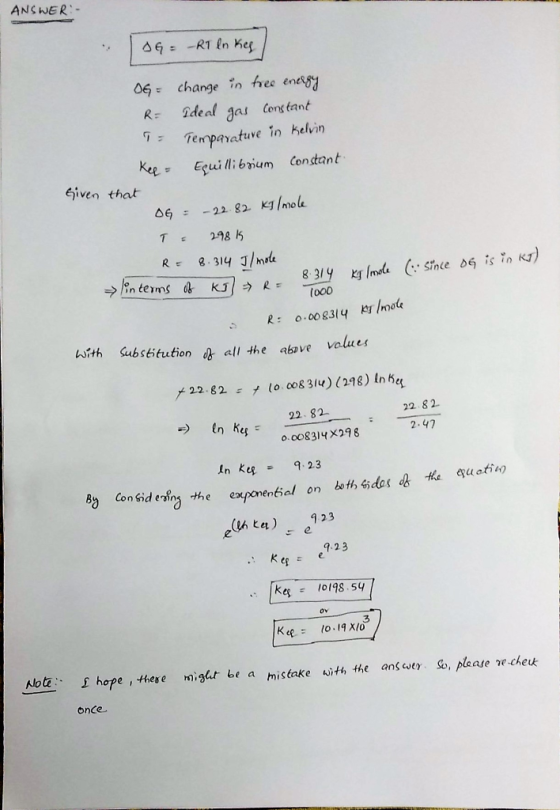
Calculate the Keq for the equlibrium A--B between the chair conformation of t butylcyclohexane, given a...
Calculate the Keq for the equlibrium A--B between the chair conformation of t butylcyclohexane, given a value of AG -22.82 kJ/ mol at 298K
formula AG = - RTlnKeq
please show solution!
The answer is 10.002 but i dont know how get there.
Thanks
Homework Answers
Add Answer to:
Calculate the Keq for the equlibrium A--B between the chair
conformation of t butylcyclohexane, given a...
Following are the alternative chair conformations for trans-2-methylcyclohexanamine: NH2 NH2 CHз CH3 A Using the data...
 Following are the alternative chair conformations for trans-2-methylcyclohexanamine: NH2 NH2 CHз CH3 A Using the data for AG for monosubstituted cyclohexanes at room temperature (25°C) and the representative value* for the gauche interaction of two equatorially positioned substituents in the 1,2-position: axial equatorial AG° (kJ/mol) Group AG° (kJ/mol) Group C=N NH2 CH3 1,2-gauche -5.9 -0.8 -2.4 -7.3 Br ОН -3.9 3.8 kJ/mol a) Calculate the difference in the Gibbs free energy between the second and first conformation including the algebraic...
Hello I have a question. Following are the alternative chair conformations for trans-2-bromocyclohexanamine: . Using the...
 Hello I have a question.
Following are the alternative chair conformations for
trans-2-bromocyclohexanamine: . Using the data for ΔG for
monosubstituted cyclohexanes at room temperature (25ºC) and the
representative value* for the gauche interaction of two
equatorially positioned substituents in the 1,2-position: a)
Calculate the difference in the Gibbs free energy between the
second and first conformation including the algebraic sign. kJ/mol
b) Given your value in (a), calculate the percent of the chair,
indicated as B, presented in an...
Hello I have a question.
Following are the alternative chair conformations for
trans-2-bromocyclohexanamine: . Using the data for ΔG for
monosubstituted cyclohexanes at room temperature (25ºC) and the
representative value* for the gauche interaction of two
equatorially positioned substituents in the 1,2-position: a)
Calculate the difference in the Gibbs free energy between the
second and first conformation including the algebraic sign. kJ/mol
b) Given your value in (a), calculate the percent of the chair,
indicated as B, presented in an...
Following are the alternative chair conformations for trans-1,4-dimethylcyclohexane: . Using the data for ΔG for monosubstituted...
 Following are the alternative chair conformations for
trans-1,4-dimethylcyclohexane:
.
Using the data for ΔG for monosubstituted cyclohexanes at room
temperature (25ºC) and the representative value* for the gauche
interaction of two equatorially positioned substituents in the
1,2-position:
a) Calculate the difference in the Gibbs free energy between
the second and first conformation including the algebraic sign.
kJ/mol
b) Given your value in (a), calculate the percent of the
chair, indicated as B, presented in an equilibrium mixture of the
conformers...
Following are the alternative chair conformations for
trans-1,4-dimethylcyclohexane:
.
Using the data for ΔG for monosubstituted cyclohexanes at room
temperature (25ºC) and the representative value* for the gauche
interaction of two equatorially positioned substituents in the
1,2-position:
a) Calculate the difference in the Gibbs free energy between
the second and first conformation including the algebraic sign.
kJ/mol
b) Given your value in (a), calculate the percent of the
chair, indicated as B, presented in an equilibrium mixture of the
conformers...
References button, Strain Energy Increments) to calculate the energy difference between the two chair conformations of...
 References button, Strain Energy Increments) to calculate the energy difference between the two chair conformations of the compound below. b. Specify substituent positions (axial or equatorial) in the more stable chair. c. Estimate the percent of the more stable chair at equilibrium at 25°C. (To determine the percent of the more stable chair at equilibrium, fir calculate Keaq, and then use this value to find the percentage.) CH3 CH3 Answers: a. The energy difference is 4 b. In the more...
Under standard conditions at T = 298 K, the free energy difference, AG, between the two...
 Under standard conditions at T = 298 K, the free energy difference, AG, between the two chair conformations of a substituted cyclohexane molecule is 5.46 kJ/mol. At equilibrium, what percentage of the sample will be in the most stable conformation? Please enter your answer to the nearest whole number. Do NOT include the % sign. For example, if your answer is 21.35%, please input 21
Calculate the Entropy of the reaction equilibrium between 2NO2 - N2O4 given the equation: Delta G...
Calculate the Entropy of the reaction equilibrium between 2NO2 - N2O4 given the equation: Delta G = Delta H - T Delta S where: Enthalpy = -47.5 Kj/mol Gibbs free energy = -3.59 Kj/mol Temperature = 298K
please show the work. I'm getting an answer the is not there using: DeltaG= -(R)(T)(lnK). I...
 please show the work. I'm getting an answer the is not there
using: DeltaG= -(R)(T)(lnK). I get -11.3 Kj.
For the reaction 3H2(g) N2(g) S 2NH3(g), Kc = 9.0 at 350°C. Calculate AG at 350°C. Multiple Choice 25.4 kJ/mol 27.4 kJ/mol 29.4 kJ/mol 31.4 kJ/mol
please show the work. I'm getting an answer the is not there
using: DeltaG= -(R)(T)(lnK). I get -11.3 Kj.
For the reaction 3H2(g) N2(g) S 2NH3(g), Kc = 9.0 at 350°C. Calculate AG at 350°C. Multiple Choice 25.4 kJ/mol 27.4 kJ/mol 29.4 kJ/mol 31.4 kJ/mol
Please help and explain steps, thanks Consider the reaction of silver ion with bromide ion given...
 Please help and explain steps, thanks
Consider the reaction of silver ion with bromide ion given below at 25°C. Ag+ (aq) + Br+ (aq) → AgBr (s) What is the value of AGº for this reaction, if the equilibrium constant, Keq = 2.0 x 10¹²? A) -5.9 kJ/mol B) -70 kJ/mol C) -5.9 x 10³ kJ/mol D) -7.0 104 kJ/mol E) -0.69 kJ/mol The rest mass of a proton is 1.00727252 u and that of a neutron is 1.008665 u....
Please help and explain steps, thanks
Consider the reaction of silver ion with bromide ion given below at 25°C. Ag+ (aq) + Br+ (aq) → AgBr (s) What is the value of AGº for this reaction, if the equilibrium constant, Keq = 2.0 x 10¹²? A) -5.9 kJ/mol B) -70 kJ/mol C) -5.9 x 10³ kJ/mol D) -7.0 104 kJ/mol E) -0.69 kJ/mol The rest mass of a proton is 1.00727252 u and that of a neutron is 1.008665 u....
Need help with part B! Please explain answer. Thank you! Calculate the following thermodynamic parameters for...
 Need help with part B! Please
explain answer. Thank you!
Calculate the following thermodynamic parameters for reaction between cytochrome c and Complex IV at 25°C (as described in Problem 12). End Of Chapter, Problem 18a Yes! This is correct. (a) What is the A value for the oxidation of cytochrome c by the CuA redox center in Complex IV when the ratio of cyt c (Fe2+/cyt c (Fe3+) is 20 and the ratio of Cua (Cu2+y/Cua (Cut) is 3? (Express...
Need help with part B! Please
explain answer. Thank you!
Calculate the following thermodynamic parameters for reaction between cytochrome c and Complex IV at 25°C (as described in Problem 12). End Of Chapter, Problem 18a Yes! This is correct. (a) What is the A value for the oxidation of cytochrome c by the CuA redox center in Complex IV when the ratio of cyt c (Fe2+/cyt c (Fe3+) is 20 and the ratio of Cua (Cu2+y/Cua (Cut) is 3? (Express...
i need help on question 2a,b,c and 3a,b,c on the post lab. Experiment EQ-309 Post-Lab Questions...
 i
need help on question 2a,b,c and 3a,b,c on the post lab.
Experiment EQ-309 Post-Lab Questions Determination Of An Equilibrium Constant (To be answered in the "Analysis" section of your lab report) 1 a) Calculate the molarity of the silver nitrate solution provided. b) Calculate the molarity of the sodium chloride solution provided. 2 a) Use the data from each titration to calculate the value of K for the reaction, Ag(NH)2+ + Cl" - AgCl, + 2 NH, b) Calculate...
i
need help on question 2a,b,c and 3a,b,c on the post lab.
Experiment EQ-309 Post-Lab Questions Determination Of An Equilibrium Constant (To be answered in the "Analysis" section of your lab report) 1 a) Calculate the molarity of the silver nitrate solution provided. b) Calculate the molarity of the sodium chloride solution provided. 2 a) Use the data from each titration to calculate the value of K for the reaction, Ag(NH)2+ + Cl" - AgCl, + 2 NH, b) Calculate...
 Following are the alternative chair conformations for trans-2-methylcyclohexanamine: NH2 NH2 CHз CH3 A Using the data for AG for monosubstituted cyclohexanes at room temperature (25°C) and the representative value* for the gauche interaction of two equatorially positioned substituents in the 1,2-position: axial equatorial AG° (kJ/mol) Group AG° (kJ/mol) Group C=N NH2 CH3 1,2-gauche -5.9 -0.8 -2.4 -7.3 Br ОН -3.9 3.8 kJ/mol a) Calculate the difference in the Gibbs free energy between the second and first conformation including the algebraic...
 Hello I have a question.
Following are the alternative chair conformations for
trans-2-bromocyclohexanamine: . Using the data for ΔG for
monosubstituted cyclohexanes at room temperature (25ºC) and the
representative value* for the gauche interaction of two
equatorially positioned substituents in the 1,2-position: a)
Calculate the difference in the Gibbs free energy between the
second and first conformation including the algebraic sign. kJ/mol
b) Given your value in (a), calculate the percent of the chair,
indicated as B, presented in an...
Hello I have a question.
Following are the alternative chair conformations for
trans-2-bromocyclohexanamine: . Using the data for ΔG for
monosubstituted cyclohexanes at room temperature (25ºC) and the
representative value* for the gauche interaction of two
equatorially positioned substituents in the 1,2-position: a)
Calculate the difference in the Gibbs free energy between the
second and first conformation including the algebraic sign. kJ/mol
b) Given your value in (a), calculate the percent of the chair,
indicated as B, presented in an...
 Following are the alternative chair conformations for
trans-1,4-dimethylcyclohexane:
.
Using the data for ΔG for monosubstituted cyclohexanes at room
temperature (25ºC) and the representative value* for the gauche
interaction of two equatorially positioned substituents in the
1,2-position:
a) Calculate the difference in the Gibbs free energy between
the second and first conformation including the algebraic sign.
kJ/mol
b) Given your value in (a), calculate the percent of the
chair, indicated as B, presented in an equilibrium mixture of the
conformers...
Following are the alternative chair conformations for
trans-1,4-dimethylcyclohexane:
.
Using the data for ΔG for monosubstituted cyclohexanes at room
temperature (25ºC) and the representative value* for the gauche
interaction of two equatorially positioned substituents in the
1,2-position:
a) Calculate the difference in the Gibbs free energy between
the second and first conformation including the algebraic sign.
kJ/mol
b) Given your value in (a), calculate the percent of the
chair, indicated as B, presented in an equilibrium mixture of the
conformers...
 References button, Strain Energy Increments) to calculate the energy difference between the two chair conformations of the compound below. b. Specify substituent positions (axial or equatorial) in the more stable chair. c. Estimate the percent of the more stable chair at equilibrium at 25°C. (To determine the percent of the more stable chair at equilibrium, fir calculate Keaq, and then use this value to find the percentage.) CH3 CH3 Answers: a. The energy difference is 4 b. In the more...
 Under standard conditions at T = 298 K, the free energy difference, AG, between the two chair conformations of a substituted cyclohexane molecule is 5.46 kJ/mol. At equilibrium, what percentage of the sample will be in the most stable conformation? Please enter your answer to the nearest whole number. Do NOT include the % sign. For example, if your answer is 21.35%, please input 21
 please show the work. I'm getting an answer the is not there
using: DeltaG= -(R)(T)(lnK). I get -11.3 Kj.
For the reaction 3H2(g) N2(g) S 2NH3(g), Kc = 9.0 at 350°C. Calculate AG at 350°C. Multiple Choice 25.4 kJ/mol 27.4 kJ/mol 29.4 kJ/mol 31.4 kJ/mol
please show the work. I'm getting an answer the is not there
using: DeltaG= -(R)(T)(lnK). I get -11.3 Kj.
For the reaction 3H2(g) N2(g) S 2NH3(g), Kc = 9.0 at 350°C. Calculate AG at 350°C. Multiple Choice 25.4 kJ/mol 27.4 kJ/mol 29.4 kJ/mol 31.4 kJ/mol
 Please help and explain steps, thanks
Consider the reaction of silver ion with bromide ion given below at 25°C. Ag+ (aq) + Br+ (aq) → AgBr (s) What is the value of AGº for this reaction, if the equilibrium constant, Keq = 2.0 x 10¹²? A) -5.9 kJ/mol B) -70 kJ/mol C) -5.9 x 10³ kJ/mol D) -7.0 104 kJ/mol E) -0.69 kJ/mol The rest mass of a proton is 1.00727252 u and that of a neutron is 1.008665 u....
Please help and explain steps, thanks
Consider the reaction of silver ion with bromide ion given below at 25°C. Ag+ (aq) + Br+ (aq) → AgBr (s) What is the value of AGº for this reaction, if the equilibrium constant, Keq = 2.0 x 10¹²? A) -5.9 kJ/mol B) -70 kJ/mol C) -5.9 x 10³ kJ/mol D) -7.0 104 kJ/mol E) -0.69 kJ/mol The rest mass of a proton is 1.00727252 u and that of a neutron is 1.008665 u....
 Need help with part B! Please
explain answer. Thank you!
Calculate the following thermodynamic parameters for reaction between cytochrome c and Complex IV at 25°C (as described in Problem 12). End Of Chapter, Problem 18a Yes! This is correct. (a) What is the A value for the oxidation of cytochrome c by the CuA redox center in Complex IV when the ratio of cyt c (Fe2+/cyt c (Fe3+) is 20 and the ratio of Cua (Cu2+y/Cua (Cut) is 3? (Express...
Need help with part B! Please
explain answer. Thank you!
Calculate the following thermodynamic parameters for reaction between cytochrome c and Complex IV at 25°C (as described in Problem 12). End Of Chapter, Problem 18a Yes! This is correct. (a) What is the A value for the oxidation of cytochrome c by the CuA redox center in Complex IV when the ratio of cyt c (Fe2+/cyt c (Fe3+) is 20 and the ratio of Cua (Cu2+y/Cua (Cut) is 3? (Express...
 i
need help on question 2a,b,c and 3a,b,c on the post lab.
Experiment EQ-309 Post-Lab Questions Determination Of An Equilibrium Constant (To be answered in the "Analysis" section of your lab report) 1 a) Calculate the molarity of the silver nitrate solution provided. b) Calculate the molarity of the sodium chloride solution provided. 2 a) Use the data from each titration to calculate the value of K for the reaction, Ag(NH)2+ + Cl" - AgCl, + 2 NH, b) Calculate...
i
need help on question 2a,b,c and 3a,b,c on the post lab.
Experiment EQ-309 Post-Lab Questions Determination Of An Equilibrium Constant (To be answered in the "Analysis" section of your lab report) 1 a) Calculate the molarity of the silver nitrate solution provided. b) Calculate the molarity of the sodium chloride solution provided. 2 a) Use the data from each titration to calculate the value of K for the reaction, Ag(NH)2+ + Cl" - AgCl, + 2 NH, b) Calculate...
Most questions answered within 3 hours.
-
Where is the error in this code sequence?
String s1 = "Hello";
String s2 = "ello";...
asked 10 months ago -
Financial data for Joel de Paris, Inc., for last year
follow:
Joel de Paris, Inc.
Balance...
asked 10 months ago -
Consider this reaction:
Al2(SO4)3 (aq)+ BaCl3
(aq) Al2Cl6 (aq)- +
3BaSO4(s) . What is the...
asked 10 months ago -
Suppose that Savneet is considering increasing her
recent random sample from 20 car rentals to 40...
asked 10 months ago -
Trucks arrive at an unloading terminal at an average rate of 120
per hour.
Trucks arrive...
asked 10 months ago -
Why are methanol and ethanol completely soluble in water while
octanol is not very little soluble....
asked 10 months ago -
A facilities manager at a university reads in a research report
that the mean amount of...
asked 10 months ago -
When the CuSO4 is rehydrated by adding water to the anhydrous
compound, is this an endothermic...
asked 10 months ago -
A ray of sunlight is passing from diamond into crown glass; the
angle of incidence is...
asked 10 months ago -
A block of mass 0.249 kg is placed on top of a light, vertical
spring of...
asked 10 months ago -
how do the kidneys compensate in the presences of acidosis
a) trigger hyperventilate
b) reserve acid...
asked 10 months ago -
Question 501 pts
The rental rate of capital to the firm increases. Which of the
following...
asked 10 months ago