Please help and explain steps, thanks
Homework Answers
Add Answer to:
Please help and explain steps, thanks
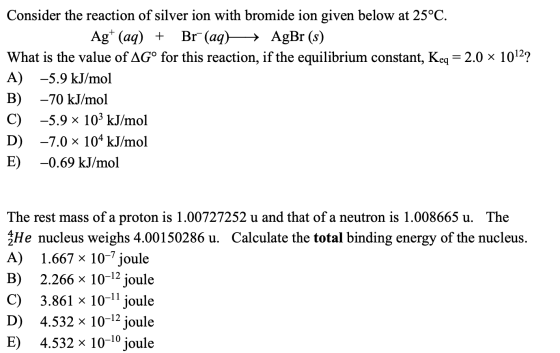
Consider the reaction of silver ion with bromide ion given...
please explain how you got all your answers 20. Calculate the MOLAR SOLUBILITY of silver bromide...
 please explain how you got all your answers
20. Calculate the MOLAR SOLUBILITY of silver bromide (Kp - 5.40 x 10¹³) in 1.0 M NH. Complex ion [Ag(NHs)2] can be formed (K, 1.70 x 10). Ag(NH,) (aq)+ Br' (aq) Overall Reaction: AgBr(s)+2 NH,(aq) 21. The pH of a 0.0412 M solution of a monoprotic acid is 1.39. Is this a STRONG ACID? a. Yes b. No c. Not enough information d. Unknown
please explain how you got all your answers
20. Calculate the MOLAR SOLUBILITY of silver bromide (Kp - 5.40 x 10¹³) in 1.0 M NH. Complex ion [Ag(NHs)2] can be formed (K, 1.70 x 10). Ag(NH,) (aq)+ Br' (aq) Overall Reaction: AgBr(s)+2 NH,(aq) 21. The pH of a 0.0412 M solution of a monoprotic acid is 1.39. Is this a STRONG ACID? a. Yes b. No c. Not enough information d. Unknown
all 5&6 5.) Solid silver bromide , AgBr, can be dissolved by adding concentrated aqueous ammonia to give the water- soluble silver-ammonia complex ion. AgBr(s) + 2NH,(aq) U Ag(NH), (aq) + Br(a...
 all 5&6
5.) Solid silver bromide , AgBr, can be dissolved by adding concentrated aqueous ammonia to give the water- soluble silver-ammonia complex ion. AgBr(s) + 2NH,(aq) U Ag(NH), (aq) + Br(aq) (a) Show that this equation is the sum of two other equations, one representing the dissolution of AgBr into its component ions and the other representing the formation of the silver-ammonium complex from silver ion and ammonia (b) Calculate the equilibrium constant for the above reaction K,(AgBr) =...
all 5&6
5.) Solid silver bromide , AgBr, can be dissolved by adding concentrated aqueous ammonia to give the water- soluble silver-ammonia complex ion. AgBr(s) + 2NH,(aq) U Ag(NH), (aq) + Br(aq) (a) Show that this equation is the sum of two other equations, one representing the dissolution of AgBr into its component ions and the other representing the formation of the silver-ammonium complex from silver ion and ammonia (b) Calculate the equilibrium constant for the above reaction K,(AgBr) =...
Please help me on this multistep problem 1. Solid silver bromide (AgBr) will disassociate slightly in...
 Please help me on this multistep problem
1. Solid silver bromide (AgBr) will disassociate slightly in water to produce Ag and Br. AgBr(s) +- Agtaq) + Braq) Ksp = 1.3 x 10⁻⁵ a. Calculate the equilibrium concentration of Ag if the solution if the solid AgBr is dissolved in pure water. Assume that the solution is behaving ideally (y = 1) b. Now let's explore the reaction if we take into account non-ideal behavior. Calculate the concentration of Ag in...
Please help me on this multistep problem
1. Solid silver bromide (AgBr) will disassociate slightly in water to produce Ag and Br. AgBr(s) +- Agtaq) + Braq) Ksp = 1.3 x 10⁻⁵ a. Calculate the equilibrium concentration of Ag if the solution if the solid AgBr is dissolved in pure water. Assume that the solution is behaving ideally (y = 1) b. Now let's explore the reaction if we take into account non-ideal behavior. Calculate the concentration of Ag in...
a) Use the tabulated half-cell potentials to calculate AGº for the following balanced redox reaction. (F=...
 a) Use the tabulated half-cell potentials to calculate AGº for the following balanced redox reaction. (F= 96,485 C/mol e) 2Li(s) + Cl2(g) → 2 Cl-(20) + 2Li *(90 E Li (ag) +_ Li(s) -3.04V Cl: (g) + 2e_2 +1.36 V Cl(aq) -8.49 x 10 sk] b. -425 kJ a. C. +324 k] d. -849 kJ | b) Name the following coordination complex: [Fe(H 20) 4F 2]F a. tetraaguadifluoroiron(II) fluoride O b.tetraaquadifluoroiron(III) fluoride c. diflugrotetrahydroiron(II) fluoride O d. difluorotetrahydrgironfluoride c) How...
I need help with all three questions please and thank you! *four 4. Consider the reaction:...
 I need help with all three questions please and thank
you!
*four
4. Consider the reaction: 2 SOX) + g) = 2 50 (8) A 2.0 L flask was filled with 0.0400 moles o. 00200 moles of O. At equilibrium 0.0296 moles of so, were found what is the equilibrium constant for this reaction? A) 2.556 x 10 + B) 3.664 x 10 C) 6.953 x 10² D) 9.964 x 10² E) 3.116 x 10 5. What is a conjugate...
I need help with all three questions please and thank
you!
*four
4. Consider the reaction: 2 SOX) + g) = 2 50 (8) A 2.0 L flask was filled with 0.0400 moles o. 00200 moles of O. At equilibrium 0.0296 moles of so, were found what is the equilibrium constant for this reaction? A) 2.556 x 10 + B) 3.664 x 10 C) 6.953 x 10² D) 9.964 x 10² E) 3.116 x 10 5. What is a conjugate...
Please help with solving Question 1 (A-C) Thank you! Unless otherwise specified in the problem, you...
 Please help with solving Question 1 (A-C) Thank you!
Unless otherwise specified in the problem, you may assume that all solutions are at 25°C. 1. 50.0 mL of a pH 6.00 carbonic acid buffer is titrated with 0.2857 M NaOH, requiring 17.47 mL to reach the second equivalence point. a. Calculate the molarity of carbonic acid and bicarbonate in the original buffer. Carbonic acid: Bicarbonate: b. Calculate the pH of the solution after a total of 100.0 mL of 0.2857...
Please help with solving Question 1 (A-C) Thank you!
Unless otherwise specified in the problem, you may assume that all solutions are at 25°C. 1. 50.0 mL of a pH 6.00 carbonic acid buffer is titrated with 0.2857 M NaOH, requiring 17.47 mL to reach the second equivalence point. a. Calculate the molarity of carbonic acid and bicarbonate in the original buffer. Carbonic acid: Bicarbonate: b. Calculate the pH of the solution after a total of 100.0 mL of 0.2857...
can you please show me the detailed steps for solving each of the problems thanks 4)...
 can you please show me the detailed steps for solving
each of the problems
thanks
4) Calculate the molar solubility of a barium fluoride solution that contains 6.5 x 10 M barium nitrate. 5) Calcium nitrate is slowly added to a solution that contains 0.10 M PO ions and 0.10 M OH ions. a) Which ion will precipitate first? Kp of Ca (PO4)2 1.2 x 10 25, Kp of Ca(OH), 4.68 x 10 b) When the second precipitate starts to...
can you please show me the detailed steps for solving
each of the problems
thanks
4) Calculate the molar solubility of a barium fluoride solution that contains 6.5 x 10 M barium nitrate. 5) Calcium nitrate is slowly added to a solution that contains 0.10 M PO ions and 0.10 M OH ions. a) Which ion will precipitate first? Kp of Ca (PO4)2 1.2 x 10 25, Kp of Ca(OH), 4.68 x 10 b) When the second precipitate starts to...
21C.1(a) The reaction of propylxanthate ion in acetic acid buffer solutions has the mechanism A− +H+→P....
 21C.1(a) The reaction of propylxanthate ion in acetic acid buffer
solutions
has the mechanism A− +H+→P. Near 30 °C the rate constant is given
by the
empirical expression kr=(2.05×10¹³) e−(8681K)/T dm3mol−1 s−1.
Evaluate the
energy and entropy of activation at 30 °C.
21C.1(b) The reaction A− +H+→P has a rate constant given by the
empirical
expression kr=(6.92×10¹²)e−(5925K)/T dm3mol−1 s−1. Evaluate the
energy and
entropy of activation at 25 °C.
Please explain why they calculated H=E-RT like that
like why is...
21C.1(a) The reaction of propylxanthate ion in acetic acid buffer
solutions
has the mechanism A− +H+→P. Near 30 °C the rate constant is given
by the
empirical expression kr=(2.05×10¹³) e−(8681K)/T dm3mol−1 s−1.
Evaluate the
energy and entropy of activation at 30 °C.
21C.1(b) The reaction A− +H+→P has a rate constant given by the
empirical
expression kr=(6.92×10¹²)e−(5925K)/T dm3mol−1 s−1. Evaluate the
energy and
entropy of activation at 25 °C.
Please explain why they calculated H=E-RT like that
like why is...
Please I need help on this. I'm so lost 1. Acetic acid (H)CO2H) has k, =...
 Please I need help on this. I'm so lost
1. Acetic acid (H)CO2H) has k, = 1.8 x 10- and acetate (H:C:01") has ks = 5.6 x 10⁻¹⁰. (a) Write balanced chemical equilibrium equations (with physical states) for acid dissociation of acetic acid and base hydrolysis of acetate ion. (b) Write K, and equilibrium constant expressions for the above reactions. (c) Use your expressions from part b to show that Kx. = 1.0 x 10-* = [H,O'][OH). 2. For each...
Please I need help on this. I'm so lost
1. Acetic acid (H)CO2H) has k, = 1.8 x 10- and acetate (H:C:01") has ks = 5.6 x 10⁻¹⁰. (a) Write balanced chemical equilibrium equations (with physical states) for acid dissociation of acetic acid and base hydrolysis of acetate ion. (b) Write K, and equilibrium constant expressions for the above reactions. (c) Use your expressions from part b to show that Kx. = 1.0 x 10-* = [H,O'][OH). 2. For each...
help please? this was the only other information given REPORT SHEET Determination of the Solubility-Product Constant...
 help please?
this was the only other information given
REPORT SHEET Determination of the Solubility-Product Constant for a Sparingly Soluble Salt EXPERIMENT 8 A. Preparation of a Calibration Curve Initial (Cro121 0.0024 M Absorbance 5 mL Volume of 0.0024 M K Cro Total volume 1. I mL 100 mL 2. 100ML 3. 10 mL 100ml 4. 15 mL 100 ML Molar extinction coefficient for [CrO2) [Cro,2) 2.4x100M 12x1044 2.4810M 3.6810M 0.04) 2037.37 0.85 1.13 2. 3. Average molar extinction coefficient...
help please?
this was the only other information given
REPORT SHEET Determination of the Solubility-Product Constant for a Sparingly Soluble Salt EXPERIMENT 8 A. Preparation of a Calibration Curve Initial (Cro121 0.0024 M Absorbance 5 mL Volume of 0.0024 M K Cro Total volume 1. I mL 100 mL 2. 100ML 3. 10 mL 100ml 4. 15 mL 100 ML Molar extinction coefficient for [CrO2) [Cro,2) 2.4x100M 12x1044 2.4810M 3.6810M 0.04) 2037.37 0.85 1.13 2. 3. Average molar extinction coefficient...
 please explain how you got all your answers
20. Calculate the MOLAR SOLUBILITY of silver bromide (Kp - 5.40 x 10¹³) in 1.0 M NH. Complex ion [Ag(NHs)2] can be formed (K, 1.70 x 10). Ag(NH,) (aq)+ Br' (aq) Overall Reaction: AgBr(s)+2 NH,(aq) 21. The pH of a 0.0412 M solution of a monoprotic acid is 1.39. Is this a STRONG ACID? a. Yes b. No c. Not enough information d. Unknown
please explain how you got all your answers
20. Calculate the MOLAR SOLUBILITY of silver bromide (Kp - 5.40 x 10¹³) in 1.0 M NH. Complex ion [Ag(NHs)2] can be formed (K, 1.70 x 10). Ag(NH,) (aq)+ Br' (aq) Overall Reaction: AgBr(s)+2 NH,(aq) 21. The pH of a 0.0412 M solution of a monoprotic acid is 1.39. Is this a STRONG ACID? a. Yes b. No c. Not enough information d. Unknown
 all 5&6
5.) Solid silver bromide , AgBr, can be dissolved by adding concentrated aqueous ammonia to give the water- soluble silver-ammonia complex ion. AgBr(s) + 2NH,(aq) U Ag(NH), (aq) + Br(aq) (a) Show that this equation is the sum of two other equations, one representing the dissolution of AgBr into its component ions and the other representing the formation of the silver-ammonium complex from silver ion and ammonia (b) Calculate the equilibrium constant for the above reaction K,(AgBr) =...
all 5&6
5.) Solid silver bromide , AgBr, can be dissolved by adding concentrated aqueous ammonia to give the water- soluble silver-ammonia complex ion. AgBr(s) + 2NH,(aq) U Ag(NH), (aq) + Br(aq) (a) Show that this equation is the sum of two other equations, one representing the dissolution of AgBr into its component ions and the other representing the formation of the silver-ammonium complex from silver ion and ammonia (b) Calculate the equilibrium constant for the above reaction K,(AgBr) =...
 Please help me on this multistep problem
1. Solid silver bromide (AgBr) will disassociate slightly in water to produce Ag and Br. AgBr(s) +- Agtaq) + Braq) Ksp = 1.3 x 10⁻⁵ a. Calculate the equilibrium concentration of Ag if the solution if the solid AgBr is dissolved in pure water. Assume that the solution is behaving ideally (y = 1) b. Now let's explore the reaction if we take into account non-ideal behavior. Calculate the concentration of Ag in...
Please help me on this multistep problem
1. Solid silver bromide (AgBr) will disassociate slightly in water to produce Ag and Br. AgBr(s) +- Agtaq) + Braq) Ksp = 1.3 x 10⁻⁵ a. Calculate the equilibrium concentration of Ag if the solution if the solid AgBr is dissolved in pure water. Assume that the solution is behaving ideally (y = 1) b. Now let's explore the reaction if we take into account non-ideal behavior. Calculate the concentration of Ag in...
 a) Use the tabulated half-cell potentials to calculate AGº for the following balanced redox reaction. (F= 96,485 C/mol e) 2Li(s) + Cl2(g) → 2 Cl-(20) + 2Li *(90 E Li (ag) +_ Li(s) -3.04V Cl: (g) + 2e_2 +1.36 V Cl(aq) -8.49 x 10 sk] b. -425 kJ a. C. +324 k] d. -849 kJ | b) Name the following coordination complex: [Fe(H 20) 4F 2]F a. tetraaguadifluoroiron(II) fluoride O b.tetraaquadifluoroiron(III) fluoride c. diflugrotetrahydroiron(II) fluoride O d. difluorotetrahydrgironfluoride c) How...
 I need help with all three questions please and thank
you!
*four
4. Consider the reaction: 2 SOX) + g) = 2 50 (8) A 2.0 L flask was filled with 0.0400 moles o. 00200 moles of O. At equilibrium 0.0296 moles of so, were found what is the equilibrium constant for this reaction? A) 2.556 x 10 + B) 3.664 x 10 C) 6.953 x 10² D) 9.964 x 10² E) 3.116 x 10 5. What is a conjugate...
I need help with all three questions please and thank
you!
*four
4. Consider the reaction: 2 SOX) + g) = 2 50 (8) A 2.0 L flask was filled with 0.0400 moles o. 00200 moles of O. At equilibrium 0.0296 moles of so, were found what is the equilibrium constant for this reaction? A) 2.556 x 10 + B) 3.664 x 10 C) 6.953 x 10² D) 9.964 x 10² E) 3.116 x 10 5. What is a conjugate...
 Please help with solving Question 1 (A-C) Thank you!
Unless otherwise specified in the problem, you may assume that all solutions are at 25°C. 1. 50.0 mL of a pH 6.00 carbonic acid buffer is titrated with 0.2857 M NaOH, requiring 17.47 mL to reach the second equivalence point. a. Calculate the molarity of carbonic acid and bicarbonate in the original buffer. Carbonic acid: Bicarbonate: b. Calculate the pH of the solution after a total of 100.0 mL of 0.2857...
Please help with solving Question 1 (A-C) Thank you!
Unless otherwise specified in the problem, you may assume that all solutions are at 25°C. 1. 50.0 mL of a pH 6.00 carbonic acid buffer is titrated with 0.2857 M NaOH, requiring 17.47 mL to reach the second equivalence point. a. Calculate the molarity of carbonic acid and bicarbonate in the original buffer. Carbonic acid: Bicarbonate: b. Calculate the pH of the solution after a total of 100.0 mL of 0.2857...
 can you please show me the detailed steps for solving
each of the problems
thanks
4) Calculate the molar solubility of a barium fluoride solution that contains 6.5 x 10 M barium nitrate. 5) Calcium nitrate is slowly added to a solution that contains 0.10 M PO ions and 0.10 M OH ions. a) Which ion will precipitate first? Kp of Ca (PO4)2 1.2 x 10 25, Kp of Ca(OH), 4.68 x 10 b) When the second precipitate starts to...
can you please show me the detailed steps for solving
each of the problems
thanks
4) Calculate the molar solubility of a barium fluoride solution that contains 6.5 x 10 M barium nitrate. 5) Calcium nitrate is slowly added to a solution that contains 0.10 M PO ions and 0.10 M OH ions. a) Which ion will precipitate first? Kp of Ca (PO4)2 1.2 x 10 25, Kp of Ca(OH), 4.68 x 10 b) When the second precipitate starts to...
 21C.1(a) The reaction of propylxanthate ion in acetic acid buffer
solutions
has the mechanism A− +H+→P. Near 30 °C the rate constant is given
by the
empirical expression kr=(2.05×10¹³) e−(8681K)/T dm3mol−1 s−1.
Evaluate the
energy and entropy of activation at 30 °C.
21C.1(b) The reaction A− +H+→P has a rate constant given by the
empirical
expression kr=(6.92×10¹²)e−(5925K)/T dm3mol−1 s−1. Evaluate the
energy and
entropy of activation at 25 °C.
Please explain why they calculated H=E-RT like that
like why is...
21C.1(a) The reaction of propylxanthate ion in acetic acid buffer
solutions
has the mechanism A− +H+→P. Near 30 °C the rate constant is given
by the
empirical expression kr=(2.05×10¹³) e−(8681K)/T dm3mol−1 s−1.
Evaluate the
energy and entropy of activation at 30 °C.
21C.1(b) The reaction A− +H+→P has a rate constant given by the
empirical
expression kr=(6.92×10¹²)e−(5925K)/T dm3mol−1 s−1. Evaluate the
energy and
entropy of activation at 25 °C.
Please explain why they calculated H=E-RT like that
like why is...
 Please I need help on this. I'm so lost
1. Acetic acid (H)CO2H) has k, = 1.8 x 10- and acetate (H:C:01") has ks = 5.6 x 10⁻¹⁰. (a) Write balanced chemical equilibrium equations (with physical states) for acid dissociation of acetic acid and base hydrolysis of acetate ion. (b) Write K, and equilibrium constant expressions for the above reactions. (c) Use your expressions from part b to show that Kx. = 1.0 x 10-* = [H,O'][OH). 2. For each...
Please I need help on this. I'm so lost
1. Acetic acid (H)CO2H) has k, = 1.8 x 10- and acetate (H:C:01") has ks = 5.6 x 10⁻¹⁰. (a) Write balanced chemical equilibrium equations (with physical states) for acid dissociation of acetic acid and base hydrolysis of acetate ion. (b) Write K, and equilibrium constant expressions for the above reactions. (c) Use your expressions from part b to show that Kx. = 1.0 x 10-* = [H,O'][OH). 2. For each...
 help please?
this was the only other information given
REPORT SHEET Determination of the Solubility-Product Constant for a Sparingly Soluble Salt EXPERIMENT 8 A. Preparation of a Calibration Curve Initial (Cro121 0.0024 M Absorbance 5 mL Volume of 0.0024 M K Cro Total volume 1. I mL 100 mL 2. 100ML 3. 10 mL 100ml 4. 15 mL 100 ML Molar extinction coefficient for [CrO2) [Cro,2) 2.4x100M 12x1044 2.4810M 3.6810M 0.04) 2037.37 0.85 1.13 2. 3. Average molar extinction coefficient...
help please?
this was the only other information given
REPORT SHEET Determination of the Solubility-Product Constant for a Sparingly Soluble Salt EXPERIMENT 8 A. Preparation of a Calibration Curve Initial (Cro121 0.0024 M Absorbance 5 mL Volume of 0.0024 M K Cro Total volume 1. I mL 100 mL 2. 100ML 3. 10 mL 100ml 4. 15 mL 100 ML Molar extinction coefficient for [CrO2) [Cro,2) 2.4x100M 12x1044 2.4810M 3.6810M 0.04) 2037.37 0.85 1.13 2. 3. Average molar extinction coefficient...
Most questions answered within 3 hours.
-
Where is the error in this code sequence?
String s1 = "Hello";
String s2 = "ello";...
asked 10 months ago -
Financial data for Joel de Paris, Inc., for last year
follow:
Joel de Paris, Inc.
Balance...
asked 10 months ago -
Consider this reaction:
Al2(SO4)3 (aq)+ BaCl3
(aq) Al2Cl6 (aq)- +
3BaSO4(s) . What is the...
asked 10 months ago -
Suppose that Savneet is considering increasing her
recent random sample from 20 car rentals to 40...
asked 10 months ago -
Trucks arrive at an unloading terminal at an average rate of 120
per hour.
Trucks arrive...
asked 10 months ago -
Why are methanol and ethanol completely soluble in water while
octanol is not very little soluble....
asked 10 months ago -
A facilities manager at a university reads in a research report
that the mean amount of...
asked 10 months ago -
When the CuSO4 is rehydrated by adding water to the anhydrous
compound, is this an endothermic...
asked 10 months ago -
A ray of sunlight is passing from diamond into crown glass; the
angle of incidence is...
asked 10 months ago -
A block of mass 0.249 kg is placed on top of a light, vertical
spring of...
asked 10 months ago -
how do the kidneys compensate in the presences of acidosis
a) trigger hyperventilate
b) reserve acid...
asked 10 months ago -
Question 501 pts
The rental rate of capital to the firm increases. Which of the
following...
asked 10 months ago