Give an example of 2 separate 1 bit errors that will not be detected with a...
Give an example of 2 separate 1 bit errors that will not be detected with a 1s complement checksum.
Homework Answers
Request Answer!
We need at least 10 more requests to produce the answer.
0 / 10 have requested this problem solution
The more requests, the faster the answer.
Add Answer to:
Give an example of 2 separate 1 bit errors that will not be
detected with a...
Up to how many bit errors can be detected for sure by the following mechanisms? just...
 Up to how many bit errors can be detected for sure by the following mechanisms? just write the number Checksum Single bit parity Two dimensional bit parity:
UDP and TCP use 1s complement for their checksum. Suppose you have the following two 8-bit...
UDP and TCP use 1s complement for their checksum. Suppose you have the following two 8-bit bytes: 0101, 1010. What is the 1s complement of the sum of these 8-bit bytes? Suppose the two bytes are altered during transmission with the checksum as follows: 1001, 0110. Can the checksum be used to detect the alteration?
Find an example of a pattern of six errors that cannot be detected by employing the...
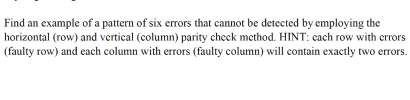 Find an example of a pattern of six errors that cannot be detected by employing the horizontal (row) and vertical (column) parity check method. HINT: cach row with crrors (faulty row) and each column with errors (faulty column) will contain exactly two errors.
Could you please provide an example of a pattern of six errors that cannot be detected...
Could you please provide an example of a pattern of six errors that cannot be detected by the use of 2-D parity method.
Suppose we want to transmit the message 10011010 and protect it from errors using the CRC...
Suppose we want to transmit the message 10011010 and protect it from errors using the CRC polynomial x^2+1. Encode the data bit sequence using the generator polynomial and give the code word. Using this polynomial, can all single-bit errors be detected? If not, give an example scenario of errors that goes undetected.
Give an example of a polynomial error, E1(X), that cannot be detected and an example of...
 Give an example of a polynomial error, E1(X), that cannot be detected and an example of a polynomial error, E2(X), that can be detected by the CRC generator P(X) = x4 + X2 + 1
A Hamming code is a technique where errors can not only be detected but can also...
A Hamming code is a technique where errors can not only be detected but can also be corrected. The simplest example of this kind of code is the (7,4)-Hamming code. In this scheme, a codeword is 7 bits long. We number the positions as follows: 1 2 3 4 5 6 7 The message that is sent is only four bits long, with these four bits occupying positions 3, 5, 6, and 7. Bits 1, 2, and 4 are...
Problem 3: Single Parity bit [10 Points] [11000101] is an 8-bit data codeword before appending a...
Problem 3: Single Parity bit [10 Points] [11000101] is an 8-bit data codeword before appending a parity bit. Please append a parity bit to this codeword such that: The resulting encoded codeword has even parity The resulting encoded codeword has odd parity Would all possible errors be detected when using even parity? Provide an example to support your answer. Would all possible errors be detected when using odd parity? Provide an example to support your answer.
18. Computing an Internet checksum Consider the two 16-bit words (shown in binary) below. Recall that...
 18. Computing an Internet checksum Consider the two 16-bit words (shown in binary) below. Recall that to compute the Internet checksum of a set of 16-bit words, we compute the one's complement sum [1] of the two words. That is, we add the two numbers together, making sure that any carry into the 17th bit of this initial sum is added back into the I's place of the resulting sum); we then take the one's complement of the result. Compute...
1. a)UDP and TCP use 1’s complement for their checksums. Suppose you have the following three...
1. a)UDP and TCP use 1’s complement for their checksums. Suppose you have the following three 8 bit bytes: 0101 0011, 0111 0110, 1001 0011. What is the 1’s complement of the sum of these 3 8-bit bytes? Show all work. Why is it that the 1’s complement is used and not just the sum? What is the sum of the three 8 bit bytes and the checksum you just computed? What is it if you change the first 8...
 Up to how many bit errors can be detected for sure by the following mechanisms? just write the number Checksum Single bit parity Two dimensional bit parity:
 Find an example of a pattern of six errors that cannot be detected by employing the horizontal (row) and vertical (column) parity check method. HINT: cach row with crrors (faulty row) and each column with errors (faulty column) will contain exactly two errors.
 Give an example of a polynomial error, E1(X), that cannot be detected and an example of a polynomial error, E2(X), that can be detected by the CRC generator P(X) = x4 + X2 + 1
 18. Computing an Internet checksum Consider the two 16-bit words (shown in binary) below. Recall that to compute the Internet checksum of a set of 16-bit words, we compute the one's complement sum [1] of the two words. That is, we add the two numbers together, making sure that any carry into the 17th bit of this initial sum is added back into the I's place of the resulting sum); we then take the one's complement of the result. Compute...
Most questions answered within 3 hours.
-
Where is the error in this code sequence?
String s1 = "Hello";
String s2 = "ello";...
asked 10 months ago -
Financial data for Joel de Paris, Inc., for last year
follow:
Joel de Paris, Inc.
Balance...
asked 10 months ago -
Consider this reaction:
Al2(SO4)3 (aq)+ BaCl3
(aq) Al2Cl6 (aq)- +
3BaSO4(s) . What is the...
asked 10 months ago -
Suppose that Savneet is considering increasing her
recent random sample from 20 car rentals to 40...
asked 10 months ago -
Trucks arrive at an unloading terminal at an average rate of 120
per hour.
Trucks arrive...
asked 10 months ago -
Why are methanol and ethanol completely soluble in water while
octanol is not very little soluble....
asked 10 months ago -
A facilities manager at a university reads in a research report
that the mean amount of...
asked 10 months ago -
When the CuSO4 is rehydrated by adding water to the anhydrous
compound, is this an endothermic...
asked 10 months ago -
A ray of sunlight is passing from diamond into crown glass; the
angle of incidence is...
asked 10 months ago -
A block of mass 0.249 kg is placed on top of a light, vertical
spring of...
asked 10 months ago -
how do the kidneys compensate in the presences of acidosis
a) trigger hyperventilate
b) reserve acid...
asked 10 months ago -
Question 501 pts
The rental rate of capital to the firm increases. Which of the
following...
asked 10 months ago