
Homework Answers


I need this equation's analytical solution with this non-homogenous boundary conditions =07 , 0 x L,120...
 I need this equation's analytical solution with this
non-homogenous boundary conditions
=07 , 0 x L,120 where a = 0.013 L=1 Initial condition T(z,0) = 0 BCs are 70, t > 0) = 50 TL,t50
I need this equation's analytical solution with this
non-homogenous boundary conditions
=07 , 0 x L,120 where a = 0.013 L=1 Initial condition T(z,0) = 0 BCs are 70, t > 0) = 50 TL,t50
Find the laplace transform of t(0<t<2). I was able to get to L(tu(t)-tu(t-2)) but according to a solution manual the next step would be this. L(tu(t))-L((t-2+2)u(t-2)). I am confused how they de...
Find the laplace transform of t(0<t<2). I was able to get to L(tu(t)-tu(t-2)) but according to a solution manual the next step would be this. L(tu(t))-L((t-2+2)u(t-2)). I am confused how they deduced this step.
I have an aqueous solution containing HBr (aq) and Br2 (l). This turns the solution brown....
I have an aqueous solution containing HBr (aq) and Br2 (l). This turns the solution brown. How can I extract the Br2 from the solution without affecting the HBr?
0.400 L of HBr were neutralized with 0. 2 L of a 6 M KOH solution....
0.400 L of HBr were neutralized with 0. 2 L of a 6 M KOH solution. What was the molarity of the acid neutralized?
I need solution for Problem 2 FL = 0 pinned u(0) 0 Consider a cable loaded statically by a sinusoidal distribution o...
 I need solution for Problem 2
FL = 0 pinned u(0) 0 Consider a cable loaded statically by a sinusoidal distribution of transverse load q = qsin (프 with 50, L 10. The prestressing force is P = 30 qL. The left-hand end is pinned, and there's no force applied at the right-hand end. Compute the approximate solution for the deflection of the wire from the Galerkin formulation. Consider a one-term approximation with the test function η1-x, and the basis...
I need solution for Problem 2
FL = 0 pinned u(0) 0 Consider a cable loaded statically by a sinusoidal distribution of transverse load q = qsin (프 with 50, L 10. The prestressing force is P = 30 qL. The left-hand end is pinned, and there's no force applied at the right-hand end. Compute the approximate solution for the deflection of the wire from the Galerkin formulation. Consider a one-term approximation with the test function η1-x, and the basis...
Find solution to the IBVP PDE BCs Ic u(0, t)-0, 0<oo l u(1, t) 0, 0<t<...
 Find solution to the IBVP PDE BCs Ic u(0, t)-0, 0<oo l u(1, t) 0, 0<t< oo u(z,0)=x-x2ババ1
Kernel and image proofl inear algebraI don't understand the solution L(0v)=0w if i put L(v3)=0w is...
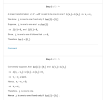 Kernel and image proofl inear algebraI don't understand the
solution L(0v)=0w if i put L(v3)=0w is it ok or not why it
has to be L(0v)=0w?? is it because one to one 0 has to be mapped to
0???
A linear transformation L: V → W is said to be
one-to-one if L (v1) = L (v2) implies that v1 = v2
(i.e., no two distinct vectors v1, v2 in V get mapped
into the same vector w ∈ W)....
Kernel and image proofl inear algebraI don't understand the
solution L(0v)=0w if i put L(v3)=0w is it ok or not why it
has to be L(0v)=0w?? is it because one to one 0 has to be mapped to
0???
A linear transformation L: V → W is said to be
one-to-one if L (v1) = L (v2) implies that v1 = v2
(i.e., no two distinct vectors v1, v2 in V get mapped
into the same vector w ∈ W)....
31 The beam deflective curve equation for sections 0 <I<L and L<I<L, The beam deflection dc...
 31 The beam deflective curve equation for sections 0 <I<L and L<I<L, The beam deflection dc at the mid-point of the beam where I = LL (12) (5) Total Marks: (25) Hints for Question 3 1) The bending moment M(x) for the beam AB may be simplified to two separate expressions for cach of the sections such that M (3) 90 24L L40 (51°c – 12x®L+8x"), for 06135 (-2+L), for ££<3<1 M2(x) 24 QUESTION 3 Consider a simple beam AB...
how do I prepare the 100mg/L of asprin acetaminophen and caffeine solution and dilute that solution...
 how do I prepare the 100mg/L of asprin acetaminophen and
caffeine solution
and dilute that solution with 1a% acetic acid to creat 50, 10
and 5mg/L solutions
Preparation of Standards: Using a 100ML volumetric flask and 1 % acetic acid solution (prepared in hood from glacial acetic acid using a 1000mL beaker and 10mL graduated cylinder), prepare and label a stock solution of 100 mg/L each of aspirin, acetaminophen, and caffeine combined together in a single volumetric flask. Using appropriate...
how do I prepare the 100mg/L of asprin acetaminophen and
caffeine solution
and dilute that solution with 1a% acetic acid to creat 50, 10
and 5mg/L solutions
Preparation of Standards: Using a 100ML volumetric flask and 1 % acetic acid solution (prepared in hood from glacial acetic acid using a 1000mL beaker and 10mL graduated cylinder), prepare and label a stock solution of 100 mg/L each of aspirin, acetaminophen, and caffeine combined together in a single volumetric flask. Using appropriate...
l. Find the general solution: (a) r" -4x +4x-0 (b) "-2r (c) 0. (d)4r' +3r-0
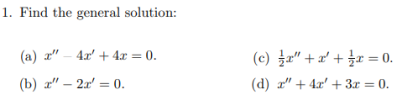 l. Find the general solution: (a) r" -4x +4x-0 (b) "-2r (c) 0. (d)4r' +3r-0
 I need this equation's analytical solution with this
non-homogenous boundary conditions
=07 , 0 x L,120 where a = 0.013 L=1 Initial condition T(z,0) = 0 BCs are 70, t > 0) = 50 TL,t50
I need this equation's analytical solution with this
non-homogenous boundary conditions
=07 , 0 x L,120 where a = 0.013 L=1 Initial condition T(z,0) = 0 BCs are 70, t > 0) = 50 TL,t50
 I need solution for Problem 2
FL = 0 pinned u(0) 0 Consider a cable loaded statically by a sinusoidal distribution of transverse load q = qsin (프 with 50, L 10. The prestressing force is P = 30 qL. The left-hand end is pinned, and there's no force applied at the right-hand end. Compute the approximate solution for the deflection of the wire from the Galerkin formulation. Consider a one-term approximation with the test function η1-x, and the basis...
I need solution for Problem 2
FL = 0 pinned u(0) 0 Consider a cable loaded statically by a sinusoidal distribution of transverse load q = qsin (프 with 50, L 10. The prestressing force is P = 30 qL. The left-hand end is pinned, and there's no force applied at the right-hand end. Compute the approximate solution for the deflection of the wire from the Galerkin formulation. Consider a one-term approximation with the test function η1-x, and the basis...
 Find solution to the IBVP PDE BCs Ic u(0, t)-0, 0<oo l u(1, t) 0, 0<t< oo u(z,0)=x-x2ババ1
 Kernel and image proofl inear algebraI don't understand the
solution L(0v)=0w if i put L(v3)=0w is it ok or not why it
has to be L(0v)=0w?? is it because one to one 0 has to be mapped to
0???
A linear transformation L: V → W is said to be
one-to-one if L (v1) = L (v2) implies that v1 = v2
(i.e., no two distinct vectors v1, v2 in V get mapped
into the same vector w ∈ W)....
Kernel and image proofl inear algebraI don't understand the
solution L(0v)=0w if i put L(v3)=0w is it ok or not why it
has to be L(0v)=0w?? is it because one to one 0 has to be mapped to
0???
A linear transformation L: V → W is said to be
one-to-one if L (v1) = L (v2) implies that v1 = v2
(i.e., no two distinct vectors v1, v2 in V get mapped
into the same vector w ∈ W)....
 31 The beam deflective curve equation for sections 0 <I<L and L<I<L, The beam deflection dc at the mid-point of the beam where I = LL (12) (5) Total Marks: (25) Hints for Question 3 1) The bending moment M(x) for the beam AB may be simplified to two separate expressions for cach of the sections such that M (3) 90 24L L40 (51°c – 12x®L+8x"), for 06135 (-2+L), for ££<3<1 M2(x) 24 QUESTION 3 Consider a simple beam AB...
 how do I prepare the 100mg/L of asprin acetaminophen and
caffeine solution
and dilute that solution with 1a% acetic acid to creat 50, 10
and 5mg/L solutions
Preparation of Standards: Using a 100ML volumetric flask and 1 % acetic acid solution (prepared in hood from glacial acetic acid using a 1000mL beaker and 10mL graduated cylinder), prepare and label a stock solution of 100 mg/L each of aspirin, acetaminophen, and caffeine combined together in a single volumetric flask. Using appropriate...
how do I prepare the 100mg/L of asprin acetaminophen and
caffeine solution
and dilute that solution with 1a% acetic acid to creat 50, 10
and 5mg/L solutions
Preparation of Standards: Using a 100ML volumetric flask and 1 % acetic acid solution (prepared in hood from glacial acetic acid using a 1000mL beaker and 10mL graduated cylinder), prepare and label a stock solution of 100 mg/L each of aspirin, acetaminophen, and caffeine combined together in a single volumetric flask. Using appropriate...
 l. Find the general solution: (a) r" -4x +4x-0 (b) "-2r (c) 0. (d)4r' +3r-0
Most questions answered within 3 hours.
-
Where is the error in this code sequence?
String s1 = "Hello";
String s2 = "ello";...
asked 11 months ago -
Financial data for Joel de Paris, Inc., for last year
follow:
Joel de Paris, Inc.
Balance...
asked 11 months ago -
Consider this reaction:
Al2(SO4)3 (aq)+ BaCl3
(aq) Al2Cl6 (aq)- +
3BaSO4(s) . What is the...
asked 11 months ago -
Suppose that Savneet is considering increasing her
recent random sample from 20 car rentals to 40...
asked 11 months ago -
Trucks arrive at an unloading terminal at an average rate of 120
per hour.
Trucks arrive...
asked 11 months ago -
Why are methanol and ethanol completely soluble in water while
octanol is not very little soluble....
asked 11 months ago -
A facilities manager at a university reads in a research report
that the mean amount of...
asked 11 months ago -
When the CuSO4 is rehydrated by adding water to the anhydrous
compound, is this an endothermic...
asked 11 months ago -
A ray of sunlight is passing from diamond into crown glass; the
angle of incidence is...
asked 11 months ago -
A block of mass 0.249 kg is placed on top of a light, vertical
spring of...
asked 11 months ago -
how do the kidneys compensate in the presences of acidosis
a) trigger hyperventilate
b) reserve acid...
asked 11 months ago -
Question 501 pts
The rental rate of capital to the firm increases. Which of the
following...
asked 11 months ago