
Homework Answers
Add Answer to:
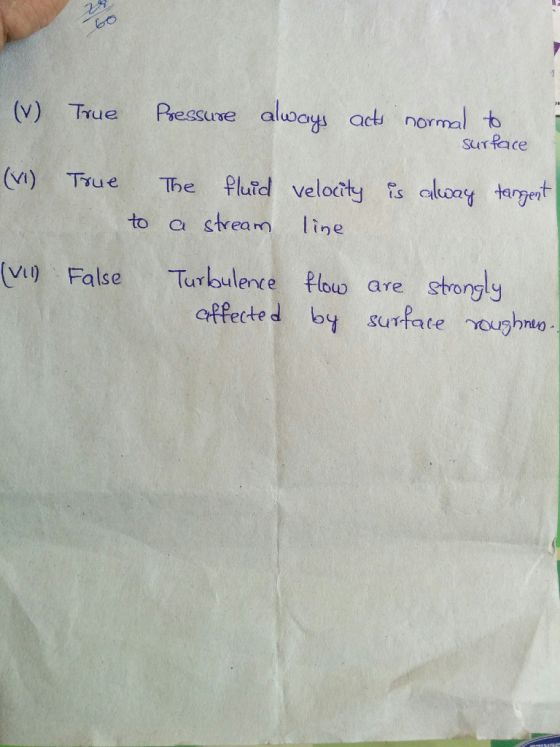
True/False: v) True/False: Pressure always acts normal to a surface. vi) True /False: The fluid velocity...
Velocity is always tangent to the curve of a particle's motion , true or false
Velocity is always tangent to the curve of a particle's motion , true or false
Q1. The velocity v of a fluid beyond which streamline flows, ceases and turbulence begins depending...
 Q1. The velocity v of a fluid beyond which streamline flows, ceases and turbulence begins depending on the radius r of the tube, density p and viscosity n of the fluid. Using dimensions (dimensional analysis), obtain an expression which relates v. r, p and n. Hint: v « rpn => y = krapne mass volume distance force Velocity density viscosity time (area) [velocity gradient] velocity gradient velocity Using dimensional analysis, find the values of a, b and c. length
8) Which of the following statements are true. a. Velocity is always tangent to the path....
 8) Which of the following statements are true. a. Velocity is always tangent to the path. b. Acceleration is tangent to the path if the motion is along a straight-line. There must be a normal component of acceleration in curved motion. d. There must be a normal component of velocity in curved motion. C.
Q1. The velocity v of a fluid beyond which streamline flows, ceases and turbulence begins depending...
 Q1. The velocity v of a fluid beyond which streamline flows, ceases and turbulence begins depending on the radius r of the tube, density p and viscosity n of the fluid. Using dimensions (dimensional analysis), obtain an expression which relates v, r, p and n. Hint: v o rpn => y = krºp nc distance mass volume 2 time Velocity density = force viscosity [area][velocity gradient]' velocity gradient = velocity Using dimensional analysis, find the values length of a, b...
Q1. The velocity v of a fluid beyond which streamline flows, ceases and turbulence begins depending...
 Q1. The velocity v of a fluid beyond which streamline flows, ceases and turbulence begins depending on the radius r of the tube, density p and viscosity n of the fluid. Using dimensions (dimensional analysis), obtain an expression which relates v, r, p and n. Hint: => Using dimensional analysis, find the values of a, b and c.
please sir, write clearly by hand Q1. The velocity v of a fluid beyond which streamline...
 please sir, write clearly by hand
Q1. The velocity v of a fluid beyond which streamline flows, ceases and turbulence begins depending on the radius r of the tube, density p and viscosity n of the fluid. Using dimensions (dimensional analysis), obtain an expression which relates v. 1, p and n. Hint: v arpn => y = krapon distance Velocity density mass viscosity volume force [area][velocity gradient time velocity gradient = velocity length Using dimensional analysis, find the values of...
please sir, write clearly by hand
Q1. The velocity v of a fluid beyond which streamline flows, ceases and turbulence begins depending on the radius r of the tube, density p and viscosity n of the fluid. Using dimensions (dimensional analysis), obtain an expression which relates v. 1, p and n. Hint: v arpn => y = krapon distance Velocity density mass viscosity volume force [area][velocity gradient time velocity gradient = velocity length Using dimensional analysis, find the values of...
A fluid flows past a circular cylinder of radius a with an upstream speed of Vo...
 A fluid flows past a circular cylinder of radius a with an upstream speed of Vo as shown in the figure below. A more advanced theory indicates that if viscous effects are negligible, the velocity of the fluid along the surface of the cylinder is given by V = 2V sin 0 Determine the (a) streamline and (b) normal components of acceleration on the surface of the cylinder if Vo = 12 m/s, a = 10 m, and 0 =...
QUESTION 6: PRESSURE BELOW THE SURFACE IN STILL WATER (OR HYDROSTATIC PRESSURE) (a) Is linearly related...
 QUESTION 6: PRESSURE BELOW THE SURFACE IN STILL WATER (OR HYDROSTATIC PRESSURE) (a) Is linearly related to depth; (b) Acts normal (perpendicular) to any solid surface; (c) Is related to the temperature of the fluid; (d) At a given depth, will act equally in any direction; (e) All of the above; UDALOT V AHESOOVIVON
State whether each statement below is True (T) or False (El. Use your best engineering judgment"....
 State whether each statement below is True (T) or False (El. Use your best engineering judgment". 1. Phenomenological laws classify and describe phenomena based on observation of macroscopic behavior without explanation of microscopic behavior. 2. Fourier's Law of Heat Conduction states that the heat flux is directly proportional to the temperature gradient. 3. A "gray surface" absorbs the same magnitude of radiation as a “black surface". 4. A "black surface" surfaces emit less radiation than does a "gray surface". 5....
True OR False ? A Newtonian fluid is, by definition, also incompressible. The speed of sound...
 True OR False ?
A Newtonian fluid is, by definition, also incompressible. The speed of sound through a fluid is always constant for that fluid and not a function of anything. An incompressible fluid is treated as having a constant density. + An incompressible fluid is treated as having a constant pressure. 5. The conservation of mass equation is only applicable to steady state processes.
True OR False ?
A Newtonian fluid is, by definition, also incompressible. The speed of sound through a fluid is always constant for that fluid and not a function of anything. An incompressible fluid is treated as having a constant density. + An incompressible fluid is treated as having a constant pressure. 5. The conservation of mass equation is only applicable to steady state processes.
 Q1. The velocity v of a fluid beyond which streamline flows, ceases and turbulence begins depending on the radius r of the tube, density p and viscosity n of the fluid. Using dimensions (dimensional analysis), obtain an expression which relates v. r, p and n. Hint: v « rpn => y = krapne mass volume distance force Velocity density viscosity time (area) [velocity gradient] velocity gradient velocity Using dimensional analysis, find the values of a, b and c. length
 8) Which of the following statements are true. a. Velocity is always tangent to the path. b. Acceleration is tangent to the path if the motion is along a straight-line. There must be a normal component of acceleration in curved motion. d. There must be a normal component of velocity in curved motion. C.
 Q1. The velocity v of a fluid beyond which streamline flows, ceases and turbulence begins depending on the radius r of the tube, density p and viscosity n of the fluid. Using dimensions (dimensional analysis), obtain an expression which relates v, r, p and n. Hint: v o rpn => y = krºp nc distance mass volume 2 time Velocity density = force viscosity [area][velocity gradient]' velocity gradient = velocity Using dimensional analysis, find the values length of a, b...
 Q1. The velocity v of a fluid beyond which streamline flows, ceases and turbulence begins depending on the radius r of the tube, density p and viscosity n of the fluid. Using dimensions (dimensional analysis), obtain an expression which relates v, r, p and n. Hint: => Using dimensional analysis, find the values of a, b and c.
 please sir, write clearly by hand
Q1. The velocity v of a fluid beyond which streamline flows, ceases and turbulence begins depending on the radius r of the tube, density p and viscosity n of the fluid. Using dimensions (dimensional analysis), obtain an expression which relates v. 1, p and n. Hint: v arpn => y = krapon distance Velocity density mass viscosity volume force [area][velocity gradient time velocity gradient = velocity length Using dimensional analysis, find the values of...
please sir, write clearly by hand
Q1. The velocity v of a fluid beyond which streamline flows, ceases and turbulence begins depending on the radius r of the tube, density p and viscosity n of the fluid. Using dimensions (dimensional analysis), obtain an expression which relates v. 1, p and n. Hint: v arpn => y = krapon distance Velocity density mass viscosity volume force [area][velocity gradient time velocity gradient = velocity length Using dimensional analysis, find the values of...
 A fluid flows past a circular cylinder of radius a with an upstream speed of Vo as shown in the figure below. A more advanced theory indicates that if viscous effects are negligible, the velocity of the fluid along the surface of the cylinder is given by V = 2V sin 0 Determine the (a) streamline and (b) normal components of acceleration on the surface of the cylinder if Vo = 12 m/s, a = 10 m, and 0 =...
 QUESTION 6: PRESSURE BELOW THE SURFACE IN STILL WATER (OR HYDROSTATIC PRESSURE) (a) Is linearly related to depth; (b) Acts normal (perpendicular) to any solid surface; (c) Is related to the temperature of the fluid; (d) At a given depth, will act equally in any direction; (e) All of the above; UDALOT V AHESOOVIVON
 State whether each statement below is True (T) or False (El. Use your best engineering judgment". 1. Phenomenological laws classify and describe phenomena based on observation of macroscopic behavior without explanation of microscopic behavior. 2. Fourier's Law of Heat Conduction states that the heat flux is directly proportional to the temperature gradient. 3. A "gray surface" absorbs the same magnitude of radiation as a “black surface". 4. A "black surface" surfaces emit less radiation than does a "gray surface". 5....
 True OR False ?
A Newtonian fluid is, by definition, also incompressible. The speed of sound through a fluid is always constant for that fluid and not a function of anything. An incompressible fluid is treated as having a constant density. + An incompressible fluid is treated as having a constant pressure. 5. The conservation of mass equation is only applicable to steady state processes.
True OR False ?
A Newtonian fluid is, by definition, also incompressible. The speed of sound through a fluid is always constant for that fluid and not a function of anything. An incompressible fluid is treated as having a constant density. + An incompressible fluid is treated as having a constant pressure. 5. The conservation of mass equation is only applicable to steady state processes.
Most questions answered within 3 hours.
-
Where is the error in this code sequence?
String s1 = "Hello";
String s2 = "ello";...
asked 11 months ago -
Financial data for Joel de Paris, Inc., for last year
follow:
Joel de Paris, Inc.
Balance...
asked 11 months ago -
Consider this reaction:
Al2(SO4)3 (aq)+ BaCl3
(aq) Al2Cl6 (aq)- +
3BaSO4(s) . What is the...
asked 11 months ago -
Suppose that Savneet is considering increasing her
recent random sample from 20 car rentals to 40...
asked 11 months ago -
Trucks arrive at an unloading terminal at an average rate of 120
per hour.
Trucks arrive...
asked 11 months ago -
Why are methanol and ethanol completely soluble in water while
octanol is not very little soluble....
asked 11 months ago -
A facilities manager at a university reads in a research report
that the mean amount of...
asked 11 months ago -
When the CuSO4 is rehydrated by adding water to the anhydrous
compound, is this an endothermic...
asked 11 months ago -
A ray of sunlight is passing from diamond into crown glass; the
angle of incidence is...
asked 11 months ago -
A block of mass 0.249 kg is placed on top of a light, vertical
spring of...
asked 11 months ago -
how do the kidneys compensate in the presences of acidosis
a) trigger hyperventilate
b) reserve acid...
asked 11 months ago -
Question 501 pts
The rental rate of capital to the firm increases. Which of the
following...
asked 11 months ago