Imagine you are sitting in a room full of oxygen molecules at 300 K. If the...
Imagine you are sitting in a room full of oxygen molecules at 300 K. If the room has a volume of 9.0 103 m3, what is the number of oxygen molecules in the room? molecules
Homework Answers

Add Answer to:
Imagine you are sitting in a room full of oxygen molecules at
300 K. If the...
The volume of 5.15 mol of oxygen gas is 3.08 m3 at 300. K. What is...
The volume of 5.15 mol of oxygen gas is 3.08 m3 at 300. K. What is the real pressure given that a=1.36 J m3/mol2, b=0.00320 m3/mol, and R=8.3145 J/mol K? Remember that Pascal=J/m3. need ASAP please!!
Imagine that you are compressing a piston full of steam (vapor), where the specific volume (v...
Imagine that you are compressing a piston full of steam (vapor), where the specific volume (v in m3/kg) depends on the pressure P as follows (at T= 498 K): P(v–B) =RT with B= ‐3.55 x 10⁻⁶m3/kg, where P has units of Pascal. How much work is required to compress the piston from V= 100 m3 to V= 80 m3 if you have 92.6 kg of steam in the piston? Assume the temperature stays constant at T = 498 K.
Air a. What is the volume of air in the room where you are right now?...
Air a. What is the volume of air in the room where you are right now? (You can measure the length, width, and height of the room with a measuring tape, or you can estimate these quantities. Just make sure you convert your answer to SI units.) b. What is the temperature in this room? (in SI units) c. Look up the current barometric pressure in your area, and convert it to SI units. d. Use the information from steps...
1. In a room full of air, the air is mainly composed of Nitrogen and Oxygen...
 1. In a room full of air, the air is mainly composed of Nitrogen and Oxygen molecules (both at room temperature). Find (to two significant figures) the values of Vrms for both molecules. (Eq. (20.26) relates Vrms to absolute temperature.) W A (97°07) = suda SW 1°xɛ Si on n oin onando CITI A ini 20 SUOISSAdy som innba
A rigid container initially contains 0.6 kg of oxygen at 4,000 kPa and 300 K, the...
A rigid container initially contains 0.6 kg of oxygen at 4,000 kPa and 300 K, the gas cools by lowering the pressure to 3,200 kPa. Determine: (a) the volume of the reservoir, in m3; (b) the final temperature, in K and (c) the total heat transferred, in kJ. That's all I have.
Imagine that there is a heavy box sitting on the floor that you want to lift...
Imagine that there is a heavy box sitting on the floor that you want to lift up & carry across the room. A. How do the forces compare: i. The force initially needed to lift the box off the ground ii. The force needed to continue lifting the box (vertically) in order to then carry it across the room? B. Explain why this makes sense to you.
At this very moment you are sitting in a room that is 10.5m x 10.5m x...
At this very moment you are sitting in a room that is 10.5m x 10.5m x 3.0m. How much heat would have to be removed to turn all the air in this room into liquid? Assume the air is transferred into a giant balloon beforehand so that it may collapse while it cools. Cp for air 29.1 J/mol/K Cv for air 20.8 J/mol/K c for liquid air 2042 J/kg/K Lv for air 199,000 J/kg Lf for air 26,000 J/kg Boiling...
Imagine that a full 500 mL bottle of water (d = 0.9998 g/mL) sitting in your...
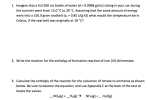 Imagine that a full 500 mL bottle of water (d = 0.9998 g/mL) sitting in your car during the summer went from 15.0 degree C to 20 degree C. Assuming that the same amount of energy went into a 150.0 gram seatbelt (S_h = 0.85 J/(g K)) what would the temperature be in Celsius, if the seat belt was originally at 18 degree C? Write the reaction for the enthalpy of formation reaction of iron (III) dichromate. Calculate the enthalpy...
Imagine you are sitting in the back row of the classroom. Your instructor is standing in...
Imagine you are sitting in the back row of the classroom. Your instructor is standing in the front of the room with a large concave spherical mirror. What do you see in the mirror as your instructor walks from the front of the room to your location; all the while the mirror is facing you? a) I see my image right side up. It gets larger as the mirror approaches. b) I see my image initially inverted and then right...
A physics lecture room has a volume of 294 m3 . Part A For a pressure...
A physics lecture room has a volume of 294 m3 . Part A For a pressure of 1.00 atm and a temperature of 24.0 ∘C, use the ideal-gas law to estimate the number of air molecules in the room. Assume all the air is N2. Part B Calculate the particle density-that is, the number of N2 molecules per cubic centimeter. Part C Calculate the mass of the air in the room.
 1. In a room full of air, the air is mainly composed of Nitrogen and Oxygen molecules (both at room temperature). Find (to two significant figures) the values of Vrms for both molecules. (Eq. (20.26) relates Vrms to absolute temperature.) W A (97°07) = suda SW 1°xɛ Si on n oin onando CITI A ini 20 SUOISSAdy som innba
 Imagine that a full 500 mL bottle of water (d = 0.9998 g/mL) sitting in your car during the summer went from 15.0 degree C to 20 degree C. Assuming that the same amount of energy went into a 150.0 gram seatbelt (S_h = 0.85 J/(g K)) what would the temperature be in Celsius, if the seat belt was originally at 18 degree C? Write the reaction for the enthalpy of formation reaction of iron (III) dichromate. Calculate the enthalpy...
Most questions answered within 3 hours.
-
Where is the error in this code sequence?
String s1 = "Hello";
String s2 = "ello";...
asked 11 months ago -
Financial data for Joel de Paris, Inc., for last year
follow:
Joel de Paris, Inc.
Balance...
asked 11 months ago -
Consider this reaction:
Al2(SO4)3 (aq)+ BaCl3
(aq) Al2Cl6 (aq)- +
3BaSO4(s) . What is the...
asked 11 months ago -
Suppose that Savneet is considering increasing her
recent random sample from 20 car rentals to 40...
asked 11 months ago -
Trucks arrive at an unloading terminal at an average rate of 120
per hour.
Trucks arrive...
asked 11 months ago -
Why are methanol and ethanol completely soluble in water while
octanol is not very little soluble....
asked 11 months ago -
A facilities manager at a university reads in a research report
that the mean amount of...
asked 11 months ago -
When the CuSO4 is rehydrated by adding water to the anhydrous
compound, is this an endothermic...
asked 11 months ago -
A ray of sunlight is passing from diamond into crown glass; the
angle of incidence is...
asked 11 months ago -
A block of mass 0.249 kg is placed on top of a light, vertical
spring of...
asked 11 months ago -
how do the kidneys compensate in the presences of acidosis
a) trigger hyperventilate
b) reserve acid...
asked 11 months ago -
Question 501 pts
The rental rate of capital to the firm increases. Which of the
following...
asked 11 months ago