help! i'm not sure how to go about this.

Homework Answers
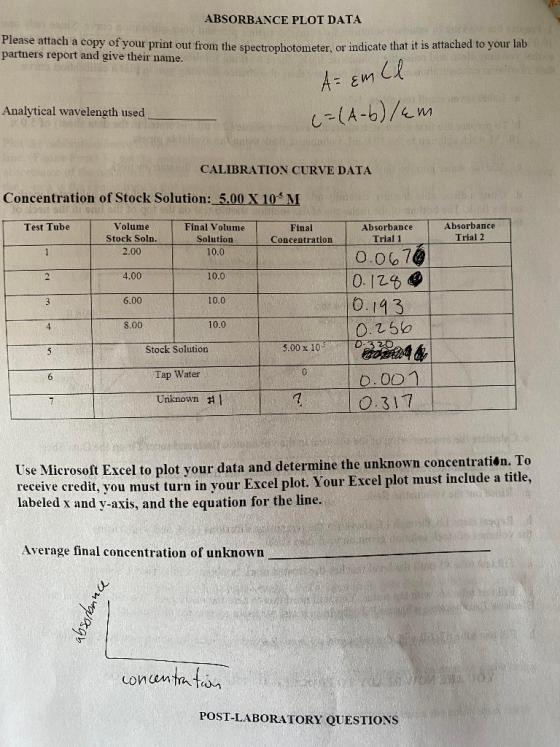
Calibration curve data:
Concentration of stock = 5.00 x 10⁻⁵ M
Final Concentration = Concentration of stock * Volume of stock/Final volume
Final volume for each tube = 10.00 mL
For tube 1, Final Concentration = 5.00 x 10-5 M * 2.00 mL/ 10.00 mL
= 1.00 x 10⁻⁵ M
For tube 2, Final Concentration = 5.00 x 10-5 M * 4.00 mL/ 10.00 mL
= 2.00 x 10⁻⁵ M
For tube 1, Final Concentration = 5.00 x 10-5 M * 6.00 mL/ 10.00 mL
= 3.00 x 10⁻⁵ M
For tube 1, Final Concentration = 5.00 x 10-5 M * 8.00 mL/ 10.00 mL
= 4.00 x 10⁻⁵ M
Volume of stock is different in each testube.
| Testube | Volume of stock solution | Final volume | Final concentration | Absorbance Trial 1 |
| 1 | 2.00 | 10.00 | 1.00 x 10⁻⁵ M | 0.067 |
| 2 | 4.00 | 10.00 | 2.00 x 10⁻⁵ M | 0.128 |
| 3 | 6.00 | 10.00 | 3.00 x 10⁻⁵ M | 0.193 |
| 4 | 8.00 | 10.00 | 4.00 x 10⁻⁵ M | 0.256 |
| 5 | Stock solution | 5.00 x 10⁻⁵ M | 0.320 | |
| 6 | Tap water | 0 | 0.007 | |
| 7 | Unknown | --- | 0.317 |
The calibration curve can be drawn as :
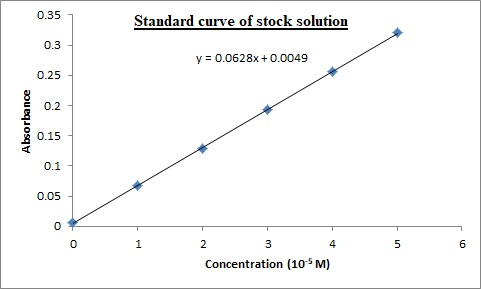
From the graph, equation of straight line is y = 0.0628x + 0.0049
Absorbance of unknown = 0.317 M
Calculate the concentration of unknown as shown below:
0.317 = 0.0628x + 0.0049
x = 4.97 x 10⁻⁵ M
Hence, concentration of unknown is 4.97 x 10^-5 M
---------------------------------------------------------------------------------------------------------------------------------------------------
Post Lab Questions
Answer 1a) Correct choice is option a)
Reason: It is because increasing the concentration of stock will increase the concentrations of all the standard solutions.
Answer 1b) Correct choice is option a)
Reason: It is because absorbance is directly proportional to concentration. Increasing the concentration of stock will increase the concentrations of all the standard solutions and hence, the absorbance becomes higher.
Answer 1c) Correct choice is option c)
Reason: It is because slope is the ratio of absorbance to that of concentration. As both these increase to same extent, the slope will remain unchanged.
Answer 1d) Correct choice is option c)
Reason: It is because, absorbance of unknown is independent of absorbance of the stock and will remain same as before.
Answer 2
Use of 20.0 mL volumetric flask will increase the volume of solution which will inturn decrease the concentration of all the standards.
So, the answers are:
Answer 2a) Correct choice is option b)
Reason: It is because concentration inversely varies with volume. So, increase in volume decreases the concentrations of all the standard solutions.
Answer 2b) Correct choice is option b)
Reason: It is because absorbance is directly proportional to concentration. Decrease in volume decreases the concentrations of all the standard solutions and hence, the absorbance becomes lower.
Answer 2c) Correct choice is option c)
Reason: It is because slope of line is the ratio of absorbance to that of concentration. As both these decrease to same extent, the slope will remain unchanged.
Answer 2d) Correct choice is option c)
Reason: It is because, absorbance of unknown is independent of absorbance of the stock and will remain same as before.
Answer 3
The effect of concentration on absorbance is as per Lambert Beer law. The concentration directly affects absorbance.
Two points always form a straight line while three or more points will affect the slope of straight line curve.
Five standard solution will give five different points which will determine the overall slope of the calibration curve. This will decide the proportionality constant between the concentration and absorbance which is not possible with two points.
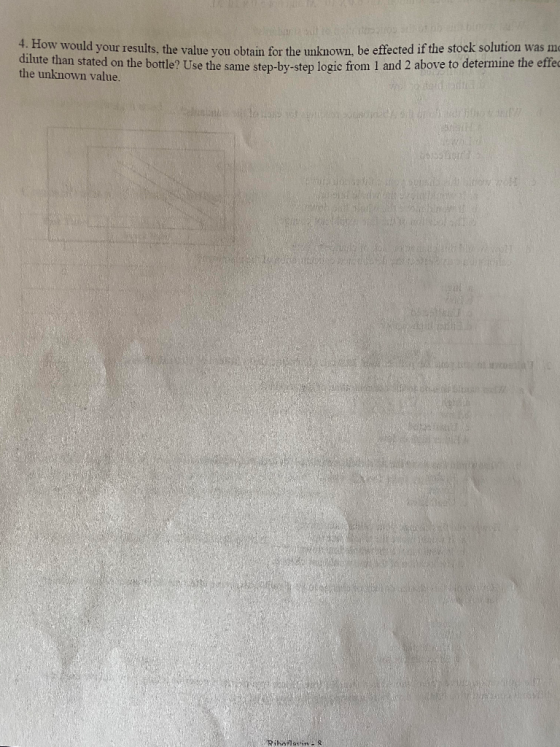
Answer 4
If concentration of stock is less than the given value, the concentration of each of the standard solutions will decrease. Absorbance being directly affected by concentration also decreases with this.
Due to equivalent amount of decrease in concentration as well as absorbance, the slope of the standard curve will remain same and hence, the equation of straight line will also be same.
Concentration of unknown is calculated from the equation of straight line and will be same irrespective of the concentration of the stock solution.
Hence, there will be no effect on the concentration of unknown.
Add Answer to:
help! i'm not sure how to go about this.
ABSORBANCE PLOT DATA Please attach a copy...
I'm a little lost and how to do the calculations. Please help? Wavelength of maximum absorbance,...
 I'm a little lost and how to do the calculations. Please
help?
Wavelength of maximum absorbance, lambda_min, determined from your prelab oratory graph of the data in Table 2 525 nm Concentration of Erythrosine B standard solution Diluted Solution Diluted Unknown Absorbance Known Solutions Molarity of standard solution (I) Molarity of stock solution (S) Calibration curve values
I'm a little lost and how to do the calculations. Please
help?
Wavelength of maximum absorbance, lambda_min, determined from your prelab oratory graph of the data in Table 2 525 nm Concentration of Erythrosine B standard solution Diluted Solution Diluted Unknown Absorbance Known Solutions Molarity of standard solution (I) Molarity of stock solution (S) Calibration curve values
Can someone please help me to plot a graph for an unknown sample thats absorbance is .154 and cal...
 can
someone please help me to plot a graph for an unknown sample thats
absorbance is .154 and calculate the unknown concentration using
A=K*M
concentration of a Solution by Absorbance Measurement Unknown Concentration X103 From Part A) x io4 Absorbance Part C: Absorbance as a function of concentration Plot absorbance versus concentration and draw best fit line. Attach graph. Refer to the instructions in Part Cof the procedure Part D: Unknown concentration Determine the concentration of your unknown sample using...
can
someone please help me to plot a graph for an unknown sample thats
absorbance is .154 and calculate the unknown concentration using
A=K*M
concentration of a Solution by Absorbance Measurement Unknown Concentration X103 From Part A) x io4 Absorbance Part C: Absorbance as a function of concentration Plot absorbance versus concentration and draw best fit line. Attach graph. Refer to the instructions in Part Cof the procedure Part D: Unknown concentration Determine the concentration of your unknown sample using...
Create a calibration graph Make sure that on your data table appears the correct number of...
 Create a calibration graph
Make sure that on your data table appears the correct number of significant figures! Solution Blank (diH2O) Absorbance y 0 Concentration (grams/mL) X 0 0.3708 0.185 Stock Diluted Solution #1 0.595 A 0.303A 0.150 A 0.074 Diluted Solution #2 Diluted Solution #3 Unknown 0.093 0.047 To be determined using Calibration Graph 0.68A Plot 2 Calibration Graphs 1) Use graph paper (on page 26) to create a calibration graph by hand. (Instructions are on page 27.) 2)...
Create a calibration graph
Make sure that on your data table appears the correct number of significant figures! Solution Blank (diH2O) Absorbance y 0 Concentration (grams/mL) X 0 0.3708 0.185 Stock Diluted Solution #1 0.595 A 0.303A 0.150 A 0.074 Diluted Solution #2 Diluted Solution #3 Unknown 0.093 0.047 To be determined using Calibration Graph 0.68A Plot 2 Calibration Graphs 1) Use graph paper (on page 26) to create a calibration graph by hand. (Instructions are on page 27.) 2)...
3. In Part A, you measure the absorbance of four FesCN" solutions and prepare a plot...
 3. In Part A, you measure the absorbance of four FesCN" solutions and prepare a plot (Absorbance vs. concentration) similar to the one below. Beer's Law Plot for FeSCN2 0.6 0.5 0.4 0.3 d 0.2 0.1 0 y = 2417.5× + 0.0483 R2 0.99897 0.00025 0.00015 0.0002 0.00005 0.0001 0 Concentration (M) You use this plot as a standard curve in Part B to determine the concentration of an unknown. If an unknown FeSCN2 solution gives an absorbance reading of...
Page 2 of 4 TREATMENT OF DATA: A. Concentration of Biomarker by Spect a linear line...
 Page 2 of 4 TREATMENT OF DATA: A. Concentration of Biomarker by Spect a linear line of best fit. Thls is rour callbration curve. Include the rable, Titles with Units, Linear Line of Best Fit, Equation for the Line of table below. Using a spreadsheet ocentration and mean absorbance of the four diluted solutions in the dilutedw. Using a t program, plot the mean absorbance versus concentration of the ed Best Fit anct th the raph:D and R? value. Attach...
please help with question 1 and 3 part c Name: 8 9 Lab Section: 7 Pre-lab: The Concentration of Riboflavin 1. The gi...
 please help with question 1 and 3 part c
Name: 8 9 Lab Section: 7 Pre-lab: The Concentration of Riboflavin 1. The given absorbance spectrum is recorded for a dye. Which is the most likely color of this dye? a. Blue-green b. Colorless c. Red d. Black M stock solution is diluted to 10.00 ml, what is the final 2. IF 4.00 ml of a 5.00 X 10 concentration? 3. The absorbance of known concentrations of blue food dye were...
please help with question 1 and 3 part c
Name: 8 9 Lab Section: 7 Pre-lab: The Concentration of Riboflavin 1. The given absorbance spectrum is recorded for a dye. Which is the most likely color of this dye? a. Blue-green b. Colorless c. Red d. Black M stock solution is diluted to 10.00 ml, what is the final 2. IF 4.00 ml of a 5.00 X 10 concentration? 3. The absorbance of known concentrations of blue food dye were...
Prelaboratory assignment Exp. 4 Beer’s Law 1.Calculate the Concentration of the Crystal Violet Solutions in Table...
 Prelaboratory assignment Exp. 4 Beer’s Law
1.Calculate the Concentration of the Crystal Violet Solutions in
Table 1 of the Procedureusing Vinitial x Minitial = Vdiluted x
Mdiluted (Note: Vdiluted = 15 mL). Record the concentrationsin
Table 1 AND in the Data table in the report sheet.
2.Plot the following data as absorbance vs concentration of X in
excel
Absorbance, A Molar Concentration of X
0.045 3.0 x 10⁻⁴ mol/L
0.097 6.2 x 10⁻⁴ mol/L
0.14 9.0 x 10⁻⁴ mol/L...
Prelaboratory assignment Exp. 4 Beer’s Law
1.Calculate the Concentration of the Crystal Violet Solutions in
Table 1 of the Procedureusing Vinitial x Minitial = Vdiluted x
Mdiluted (Note: Vdiluted = 15 mL). Record the concentrationsin
Table 1 AND in the Data table in the report sheet.
2.Plot the following data as absorbance vs concentration of X in
excel
Absorbance, A Molar Concentration of X
0.045 3.0 x 10⁻⁴ mol/L
0.097 6.2 x 10⁻⁴ mol/L
0.14 9.0 x 10⁻⁴ mol/L...
Page 10 Beer's Law Akuch Pyrs to shes your werk Show your work, Aplications Attach Peyes...
 Page 10 Beer's Law Akuch Pyrs to shes your werk Show your work, Aplications Attach Peyes 27, what is the value of absorbance that corresponds to 35.0 %T? 28. Molar absorpt ivity is the absorptivity when concentration is in units of molarity and the gth is in centimeters. If a 1.53 x 10 M solution has an absorbance of 0.426 in a 1.00 em cell when measured at a wavelength of 254 nm, what is the molar absorptivity of the...
Please help me answer questions from pre-lab homework Aspirin Analysis Lab 1) Calculate the molar concentration...
 Please help me answer questions from pre-lab homework
Aspirin Analysis Lab
1) Calculate the molar concentration (molarity) of a 250 mL stock solution prepared from 0.5 g of pure acetylsalicylic acid. 2) Calculate the molar concentration (molarity) of a 50 mL solution prepared from 2.5 mL of the acetylsalicylic acid stock solution from question 1. This will be labeled as Standard Solution A. 3) Simlarly, calculate the molar concentrations (molarities) of 50 mL the four individual solutions prepared from 2,...
Please help me answer questions from pre-lab homework
Aspirin Analysis Lab
1) Calculate the molar concentration (molarity) of a 250 mL stock solution prepared from 0.5 g of pure acetylsalicylic acid. 2) Calculate the molar concentration (molarity) of a 50 mL solution prepared from 2.5 mL of the acetylsalicylic acid stock solution from question 1. This will be labeled as Standard Solution A. 3) Simlarly, calculate the molar concentrations (molarities) of 50 mL the four individual solutions prepared from 2,...
Part 2. UV-Visible Spectroscopy Cut2 concentration Absorbance (mol/L) 0.0010 0.053 0.0025 0.128 0.0050 0.251 0.0075 0.378...
 Part 2. UV-Visible Spectroscopy Cut2 concentration Absorbance (mol/L) 0.0010 0.053 0.0025 0.128 0.0050 0.251 0.0075 0.378 0.0100 0.510 Diluted unknown, Trial 1 0.079 For your lab notebook: C. Sketch how you could make each of the the 5 standards for Part 2 from a 0.100 mol/L Cu2+ stock solution, 1.25 mol/L NH3 solution, and Dl water. The procedure is referenced in step 2b. Assume you would use 10-mL volumetric flasks to make the solutions. d. Sketch also how you would...
 I'm a little lost and how to do the calculations. Please
help?
Wavelength of maximum absorbance, lambda_min, determined from your prelab oratory graph of the data in Table 2 525 nm Concentration of Erythrosine B standard solution Diluted Solution Diluted Unknown Absorbance Known Solutions Molarity of standard solution (I) Molarity of stock solution (S) Calibration curve values
I'm a little lost and how to do the calculations. Please
help?
Wavelength of maximum absorbance, lambda_min, determined from your prelab oratory graph of the data in Table 2 525 nm Concentration of Erythrosine B standard solution Diluted Solution Diluted Unknown Absorbance Known Solutions Molarity of standard solution (I) Molarity of stock solution (S) Calibration curve values
 can
someone please help me to plot a graph for an unknown sample thats
absorbance is .154 and calculate the unknown concentration using
A=K*M
concentration of a Solution by Absorbance Measurement Unknown Concentration X103 From Part A) x io4 Absorbance Part C: Absorbance as a function of concentration Plot absorbance versus concentration and draw best fit line. Attach graph. Refer to the instructions in Part Cof the procedure Part D: Unknown concentration Determine the concentration of your unknown sample using...
can
someone please help me to plot a graph for an unknown sample thats
absorbance is .154 and calculate the unknown concentration using
A=K*M
concentration of a Solution by Absorbance Measurement Unknown Concentration X103 From Part A) x io4 Absorbance Part C: Absorbance as a function of concentration Plot absorbance versus concentration and draw best fit line. Attach graph. Refer to the instructions in Part Cof the procedure Part D: Unknown concentration Determine the concentration of your unknown sample using...
 Create a calibration graph
Make sure that on your data table appears the correct number of significant figures! Solution Blank (diH2O) Absorbance y 0 Concentration (grams/mL) X 0 0.3708 0.185 Stock Diluted Solution #1 0.595 A 0.303A 0.150 A 0.074 Diluted Solution #2 Diluted Solution #3 Unknown 0.093 0.047 To be determined using Calibration Graph 0.68A Plot 2 Calibration Graphs 1) Use graph paper (on page 26) to create a calibration graph by hand. (Instructions are on page 27.) 2)...
Create a calibration graph
Make sure that on your data table appears the correct number of significant figures! Solution Blank (diH2O) Absorbance y 0 Concentration (grams/mL) X 0 0.3708 0.185 Stock Diluted Solution #1 0.595 A 0.303A 0.150 A 0.074 Diluted Solution #2 Diluted Solution #3 Unknown 0.093 0.047 To be determined using Calibration Graph 0.68A Plot 2 Calibration Graphs 1) Use graph paper (on page 26) to create a calibration graph by hand. (Instructions are on page 27.) 2)...
 3. In Part A, you measure the absorbance of four FesCN" solutions and prepare a plot (Absorbance vs. concentration) similar to the one below. Beer's Law Plot for FeSCN2 0.6 0.5 0.4 0.3 d 0.2 0.1 0 y = 2417.5× + 0.0483 R2 0.99897 0.00025 0.00015 0.0002 0.00005 0.0001 0 Concentration (M) You use this plot as a standard curve in Part B to determine the concentration of an unknown. If an unknown FeSCN2 solution gives an absorbance reading of...
 Page 2 of 4 TREATMENT OF DATA: A. Concentration of Biomarker by Spect a linear line of best fit. Thls is rour callbration curve. Include the rable, Titles with Units, Linear Line of Best Fit, Equation for the Line of table below. Using a spreadsheet ocentration and mean absorbance of the four diluted solutions in the dilutedw. Using a t program, plot the mean absorbance versus concentration of the ed Best Fit anct th the raph:D and R? value. Attach...
 please help with question 1 and 3 part c
Name: 8 9 Lab Section: 7 Pre-lab: The Concentration of Riboflavin 1. The given absorbance spectrum is recorded for a dye. Which is the most likely color of this dye? a. Blue-green b. Colorless c. Red d. Black M stock solution is diluted to 10.00 ml, what is the final 2. IF 4.00 ml of a 5.00 X 10 concentration? 3. The absorbance of known concentrations of blue food dye were...
please help with question 1 and 3 part c
Name: 8 9 Lab Section: 7 Pre-lab: The Concentration of Riboflavin 1. The given absorbance spectrum is recorded for a dye. Which is the most likely color of this dye? a. Blue-green b. Colorless c. Red d. Black M stock solution is diluted to 10.00 ml, what is the final 2. IF 4.00 ml of a 5.00 X 10 concentration? 3. The absorbance of known concentrations of blue food dye were...
 Prelaboratory assignment Exp. 4 Beer’s Law
1.Calculate the Concentration of the Crystal Violet Solutions in
Table 1 of the Procedureusing Vinitial x Minitial = Vdiluted x
Mdiluted (Note: Vdiluted = 15 mL). Record the concentrationsin
Table 1 AND in the Data table in the report sheet.
2.Plot the following data as absorbance vs concentration of X in
excel
Absorbance, A Molar Concentration of X
0.045 3.0 x 10⁻⁴ mol/L
0.097 6.2 x 10⁻⁴ mol/L
0.14 9.0 x 10⁻⁴ mol/L...
Prelaboratory assignment Exp. 4 Beer’s Law
1.Calculate the Concentration of the Crystal Violet Solutions in
Table 1 of the Procedureusing Vinitial x Minitial = Vdiluted x
Mdiluted (Note: Vdiluted = 15 mL). Record the concentrationsin
Table 1 AND in the Data table in the report sheet.
2.Plot the following data as absorbance vs concentration of X in
excel
Absorbance, A Molar Concentration of X
0.045 3.0 x 10⁻⁴ mol/L
0.097 6.2 x 10⁻⁴ mol/L
0.14 9.0 x 10⁻⁴ mol/L...
 Page 10 Beer's Law Akuch Pyrs to shes your werk Show your work, Aplications Attach Peyes 27, what is the value of absorbance that corresponds to 35.0 %T? 28. Molar absorpt ivity is the absorptivity when concentration is in units of molarity and the gth is in centimeters. If a 1.53 x 10 M solution has an absorbance of 0.426 in a 1.00 em cell when measured at a wavelength of 254 nm, what is the molar absorptivity of the...
 Please help me answer questions from pre-lab homework
Aspirin Analysis Lab
1) Calculate the molar concentration (molarity) of a 250 mL stock solution prepared from 0.5 g of pure acetylsalicylic acid. 2) Calculate the molar concentration (molarity) of a 50 mL solution prepared from 2.5 mL of the acetylsalicylic acid stock solution from question 1. This will be labeled as Standard Solution A. 3) Simlarly, calculate the molar concentrations (molarities) of 50 mL the four individual solutions prepared from 2,...
Please help me answer questions from pre-lab homework
Aspirin Analysis Lab
1) Calculate the molar concentration (molarity) of a 250 mL stock solution prepared from 0.5 g of pure acetylsalicylic acid. 2) Calculate the molar concentration (molarity) of a 50 mL solution prepared from 2.5 mL of the acetylsalicylic acid stock solution from question 1. This will be labeled as Standard Solution A. 3) Simlarly, calculate the molar concentrations (molarities) of 50 mL the four individual solutions prepared from 2,...
 Part 2. UV-Visible Spectroscopy Cut2 concentration Absorbance (mol/L) 0.0010 0.053 0.0025 0.128 0.0050 0.251 0.0075 0.378 0.0100 0.510 Diluted unknown, Trial 1 0.079 For your lab notebook: C. Sketch how you could make each of the the 5 standards for Part 2 from a 0.100 mol/L Cu2+ stock solution, 1.25 mol/L NH3 solution, and Dl water. The procedure is referenced in step 2b. Assume you would use 10-mL volumetric flasks to make the solutions. d. Sketch also how you would...
Most questions answered within 3 hours.
-
Where is the error in this code sequence?
String s1 = "Hello";
String s2 = "ello";...
asked 10 months ago -
Financial data for Joel de Paris, Inc., for last year
follow:
Joel de Paris, Inc.
Balance...
asked 10 months ago -
Consider this reaction:
Al2(SO4)3 (aq)+ BaCl3
(aq) Al2Cl6 (aq)- +
3BaSO4(s) . What is the...
asked 10 months ago -
Suppose that Savneet is considering increasing her
recent random sample from 20 car rentals to 40...
asked 10 months ago -
Trucks arrive at an unloading terminal at an average rate of 120
per hour.
Trucks arrive...
asked 10 months ago -
Why are methanol and ethanol completely soluble in water while
octanol is not very little soluble....
asked 10 months ago -
A facilities manager at a university reads in a research report
that the mean amount of...
asked 10 months ago -
When the CuSO4 is rehydrated by adding water to the anhydrous
compound, is this an endothermic...
asked 10 months ago -
A ray of sunlight is passing from diamond into crown glass; the
angle of incidence is...
asked 10 months ago -
A block of mass 0.249 kg is placed on top of a light, vertical
spring of...
asked 10 months ago -
how do the kidneys compensate in the presences of acidosis
a) trigger hyperventilate
b) reserve acid...
asked 10 months ago -
Question 501 pts
The rental rate of capital to the firm increases. Which of the
following...
asked 10 months ago