
Homework Answers

Add Answer to:
solve it on paper neatly
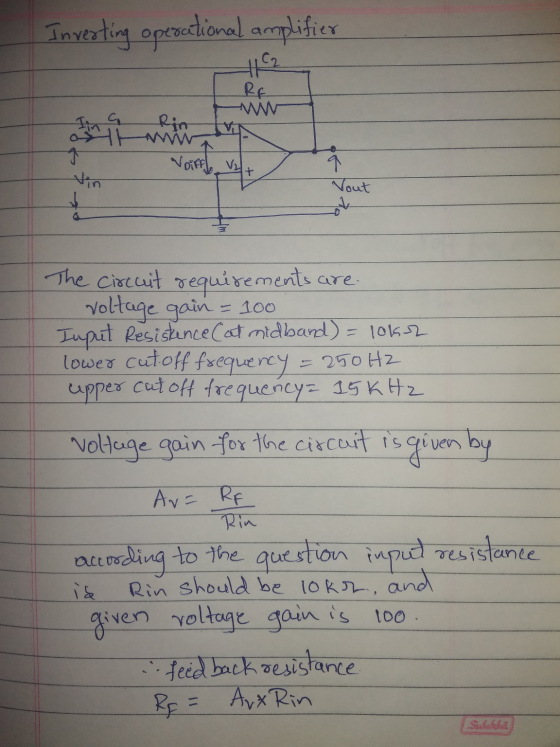
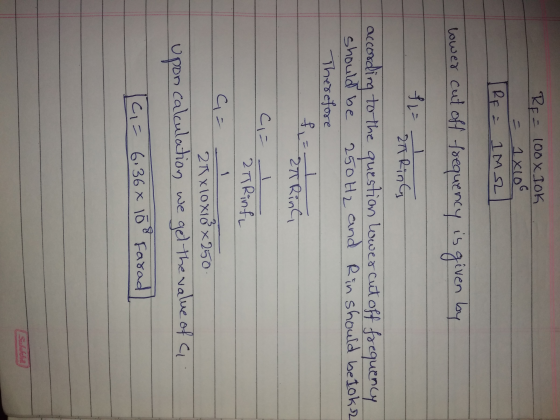
An inverting operational amplifier is to operate according to the following...
the voltage at eh input of an amplifier is 15mV rms. The amplifier delivers 0.02 a...
the voltage at eh input of an amplifier is 15mV rms. The amplifier delivers 0.02 a rms to a 12ohms load at 1 kHz. The input resistance of the amplifier is 1400ohms. Its lower cutoff frequency is 50 Hz and its bandwidth is 9.95 kHz Find a) upper cuttoff frequency b) the output power at 50Hz C) the midband power gain d) the power gain at fh
Design an amplifier with a gain of 10 that is to operate from a single positive...
Design an amplifier with a gain of 10 that is to operate from a single positive voltage source and deliver 2 volts peak to a 1K load at 1 KHz. The input resistance of the amplifier must be greater than 100 K and the low frequency response is to go down to 5 hz with no more than 3 dB signal loss. question1 “What is a reasonable power supply voltage?” according to the statement above here is some example i...
a The operational amplifier in Figure 3.a has a slew rate of 0.5V/us and a unity gain bandwid of 5 MHz. Determine () the voltage gain, and (ii) the maximum input frequency such that the output wa...
 a The operational amplifier in Figure 3.a has a slew rate of 0.5V/us and a unity gain bandwid of 5 MHz. Determine () the voltage gain, and (ii) the maximum input frequency such that the output waveform is undistorted. with Vpeak 1V and frequency f. () Determine the cutoff frequency, (ii) plot, to scale, the you use this integrator if the input frequency is 30 KHz? Explain your answer. that any feedback resistance is fixed to 5k2. b. In the...
TE Question 5 (20 marks) An active filter circuit is shown in Fig. 4. The cut-off frequency of this active filter is...
 TE Question 5 (20 marks) An active filter circuit is shown in Fig. 4. The cut-off frequency of this active filter is 1590Hz. The Input impedance and voltage gain of this filter are 10k0 and -5VN respectively Vout R1 vin R2 C1 Fig. 4 By assuming the operational amplifier, A is ideal, answer the following questions: (a) () State the type of this active fiter. (i) Explain the characteristic of this active filter. [2 marks] 3 marks] (b) 0) Calculate...
PART B: OPAMP as a non-inverting amplifier a) Implement the following circuit using the LM741 and...
 PART B: OPAMP as a non-inverting
amplifier
a) Implement the following circuit using the LM741
and energize the integrated circuit 741 with + 15v and -15v. In
addition, feed the circuit with a 1 Vpp and 1KHz sinusoidal signal.
Values: R2 = 10kΩ, R1 = 1KΩ
b) Obtain the graph of the output voltage and the input voltage.
Explain the differences between the graphs and determine
the circuit gain.
c) Change the R2 resistor with a 5.1k Ω resistor. Obtain...
PART B: OPAMP as a non-inverting
amplifier
a) Implement the following circuit using the LM741
and energize the integrated circuit 741 with + 15v and -15v. In
addition, feed the circuit with a 1 Vpp and 1KHz sinusoidal signal.
Values: R2 = 10kΩ, R1 = 1KΩ
b) Obtain the graph of the output voltage and the input voltage.
Explain the differences between the graphs and determine
the circuit gain.
c) Change the R2 resistor with a 5.1k Ω resistor. Obtain...
4. In the circuit shown below, a parallel RC network creates a frequency-dependent feedback path ...
 4. In the circuit shown below, a parallel RC network creates a frequency-dependent feedback path for the inverting amplifier block with gain Av (a large negative value). Use the Miller theorem to find the equivalent input impedance Zin as indicated in the diagram and then show that Vin/Vsig is given by the symbolic expression shown below right. Choose a value for capacitor C to make the upper cut-off frequency fH equal to 22 kHz. Repeat the calculation for the case...
Consider the following coupled amplifier circuit using BJT with the following specifications: VBE 0.7V, VA 80V,...
 Consider the following coupled amplifier circuit using BJT with the following specifications: VBE 0.7V, VA 80V, fr 800MHz, c 0.8pF, Cci 0.01uF, Cc2-0.luF, CE-10uF, Submit the following: 1. Hand calculation for the mid-band gain AM [Vo Vsig], lower 3dB frequency fi and upper 2. Spice simulation of the circuit: Submit:l) SPICE input file, 2) Probe output file showing 3. Compare the hand calculated and simulated values described above in a table and last 3dB frequency fH, and gain-bandwidth product mid-band...
Problem 4. For the following common-emitter (CE) amplifier, assume Vr-25mV, v-0.7v, Voc-12V and β = 120....
 Problem 4. For the following common-emitter (CE) amplifier, assume Vr-25mV, v-0.7v, Voc-12V and β = 120. Neglecting rx and rat a) Design for a low cut-off frequency of 120Hz and determine the mid-band gain Vee b) Design for a high cut-off frequency of 300 KHz (Hint: Remember what we did in the lab?) Raig 70 Kn R Ci 20 Kn R 12 ΚΩ 30 K R Vsig
You are required to design a 2-stage voltage amplifier (find values for RE, RC1, RC2) to meet the following criteria: an...
 You are required to design a 2-stage voltage amplifier (find
values for RE, RC1, RC2) to meet the following criteria: an input
resistance of 400 kΩ and an overall voltage gain equal to or
greater than 250, with a resistor output load, RL. Use a
common-emitter with emitter degradation (RE) stage for the input,
followed by a commonemitter amplifier with bias current equal to
0.5 mA. (VCC = 20 V, βo = 200 and the DC levels of the first...
You are required to design a 2-stage voltage amplifier (find
values for RE, RC1, RC2) to meet the following criteria: an input
resistance of 400 kΩ and an overall voltage gain equal to or
greater than 250, with a resistor output load, RL. Use a
common-emitter with emitter degradation (RE) stage for the input,
followed by a commonemitter amplifier with bias current equal to
0.5 mA. (VCC = 20 V, βo = 200 and the DC levels of the first...
(a) Design an inverting amplifier by choosing suitable resistor values for R1 and R2 to produce...
 (a) Design an inverting amplifier by choosing suitable resistor
values for R1 and R2 to produce a gain of 5 when both switches
Sw1 and Sw2 are open.
(b) Design the bias input circuit by choosing suitable resistors
R3 and R4 such that the voltage vb will be 0.5V if the
positive power supply of the op-amp is connected to a 5V battery.
Again both switches are open.
(c) Given Sw1 is open, the amplifier is turned on for
enough...
(a) Design an inverting amplifier by choosing suitable resistor
values for R1 and R2 to produce a gain of 5 when both switches
Sw1 and Sw2 are open.
(b) Design the bias input circuit by choosing suitable resistors
R3 and R4 such that the voltage vb will be 0.5V if the
positive power supply of the op-amp is connected to a 5V battery.
Again both switches are open.
(c) Given Sw1 is open, the amplifier is turned on for
enough...
 a The operational amplifier in Figure 3.a has a slew rate of 0.5V/us and a unity gain bandwid of 5 MHz. Determine () the voltage gain, and (ii) the maximum input frequency such that the output waveform is undistorted. with Vpeak 1V and frequency f. () Determine the cutoff frequency, (ii) plot, to scale, the you use this integrator if the input frequency is 30 KHz? Explain your answer. that any feedback resistance is fixed to 5k2. b. In the...
 TE Question 5 (20 marks) An active filter circuit is shown in Fig. 4. The cut-off frequency of this active filter is 1590Hz. The Input impedance and voltage gain of this filter are 10k0 and -5VN respectively Vout R1 vin R2 C1 Fig. 4 By assuming the operational amplifier, A is ideal, answer the following questions: (a) () State the type of this active fiter. (i) Explain the characteristic of this active filter. [2 marks] 3 marks] (b) 0) Calculate...
 PART B: OPAMP as a non-inverting
amplifier
a) Implement the following circuit using the LM741
and energize the integrated circuit 741 with + 15v and -15v. In
addition, feed the circuit with a 1 Vpp and 1KHz sinusoidal signal.
Values: R2 = 10kΩ, R1 = 1KΩ
b) Obtain the graph of the output voltage and the input voltage.
Explain the differences between the graphs and determine
the circuit gain.
c) Change the R2 resistor with a 5.1k Ω resistor. Obtain...
PART B: OPAMP as a non-inverting
amplifier
a) Implement the following circuit using the LM741
and energize the integrated circuit 741 with + 15v and -15v. In
addition, feed the circuit with a 1 Vpp and 1KHz sinusoidal signal.
Values: R2 = 10kΩ, R1 = 1KΩ
b) Obtain the graph of the output voltage and the input voltage.
Explain the differences between the graphs and determine
the circuit gain.
c) Change the R2 resistor with a 5.1k Ω resistor. Obtain...
 4. In the circuit shown below, a parallel RC network creates a frequency-dependent feedback path for the inverting amplifier block with gain Av (a large negative value). Use the Miller theorem to find the equivalent input impedance Zin as indicated in the diagram and then show that Vin/Vsig is given by the symbolic expression shown below right. Choose a value for capacitor C to make the upper cut-off frequency fH equal to 22 kHz. Repeat the calculation for the case...
 Consider the following coupled amplifier circuit using BJT with the following specifications: VBE 0.7V, VA 80V, fr 800MHz, c 0.8pF, Cci 0.01uF, Cc2-0.luF, CE-10uF, Submit the following: 1. Hand calculation for the mid-band gain AM [Vo Vsig], lower 3dB frequency fi and upper 2. Spice simulation of the circuit: Submit:l) SPICE input file, 2) Probe output file showing 3. Compare the hand calculated and simulated values described above in a table and last 3dB frequency fH, and gain-bandwidth product mid-band...
 Problem 4. For the following common-emitter (CE) amplifier, assume Vr-25mV, v-0.7v, Voc-12V and β = 120. Neglecting rx and rat a) Design for a low cut-off frequency of 120Hz and determine the mid-band gain Vee b) Design for a high cut-off frequency of 300 KHz (Hint: Remember what we did in the lab?) Raig 70 Kn R Ci 20 Kn R 12 ΚΩ 30 K R Vsig
 You are required to design a 2-stage voltage amplifier (find
values for RE, RC1, RC2) to meet the following criteria: an input
resistance of 400 kΩ and an overall voltage gain equal to or
greater than 250, with a resistor output load, RL. Use a
common-emitter with emitter degradation (RE) stage for the input,
followed by a commonemitter amplifier with bias current equal to
0.5 mA. (VCC = 20 V, βo = 200 and the DC levels of the first...
You are required to design a 2-stage voltage amplifier (find
values for RE, RC1, RC2) to meet the following criteria: an input
resistance of 400 kΩ and an overall voltage gain equal to or
greater than 250, with a resistor output load, RL. Use a
common-emitter with emitter degradation (RE) stage for the input,
followed by a commonemitter amplifier with bias current equal to
0.5 mA. (VCC = 20 V, βo = 200 and the DC levels of the first...
 (a) Design an inverting amplifier by choosing suitable resistor
values for R1 and R2 to produce a gain of 5 when both switches
Sw1 and Sw2 are open.
(b) Design the bias input circuit by choosing suitable resistors
R3 and R4 such that the voltage vb will be 0.5V if the
positive power supply of the op-amp is connected to a 5V battery.
Again both switches are open.
(c) Given Sw1 is open, the amplifier is turned on for
enough...
(a) Design an inverting amplifier by choosing suitable resistor
values for R1 and R2 to produce a gain of 5 when both switches
Sw1 and Sw2 are open.
(b) Design the bias input circuit by choosing suitable resistors
R3 and R4 such that the voltage vb will be 0.5V if the
positive power supply of the op-amp is connected to a 5V battery.
Again both switches are open.
(c) Given Sw1 is open, the amplifier is turned on for
enough...
Most questions answered within 3 hours.
-
Where is the error in this code sequence?
String s1 = "Hello";
String s2 = "ello";...
asked 10 months ago -
Financial data for Joel de Paris, Inc., for last year
follow:
Joel de Paris, Inc.
Balance...
asked 10 months ago -
Consider this reaction:
Al2(SO4)3 (aq)+ BaCl3
(aq) Al2Cl6 (aq)- +
3BaSO4(s) . What is the...
asked 10 months ago -
Suppose that Savneet is considering increasing her
recent random sample from 20 car rentals to 40...
asked 10 months ago -
Trucks arrive at an unloading terminal at an average rate of 120
per hour.
Trucks arrive...
asked 10 months ago -
Why are methanol and ethanol completely soluble in water while
octanol is not very little soluble....
asked 10 months ago -
A facilities manager at a university reads in a research report
that the mean amount of...
asked 10 months ago -
When the CuSO4 is rehydrated by adding water to the anhydrous
compound, is this an endothermic...
asked 10 months ago -
A ray of sunlight is passing from diamond into crown glass; the
angle of incidence is...
asked 10 months ago -
A block of mass 0.249 kg is placed on top of a light, vertical
spring of...
asked 10 months ago -
how do the kidneys compensate in the presences of acidosis
a) trigger hyperventilate
b) reserve acid...
asked 10 months ago -
Question 501 pts
The rental rate of capital to the firm increases. Which of the
following...
asked 10 months ago