Gauss’s law for electricity gave us a value for the electric field a distance r away...
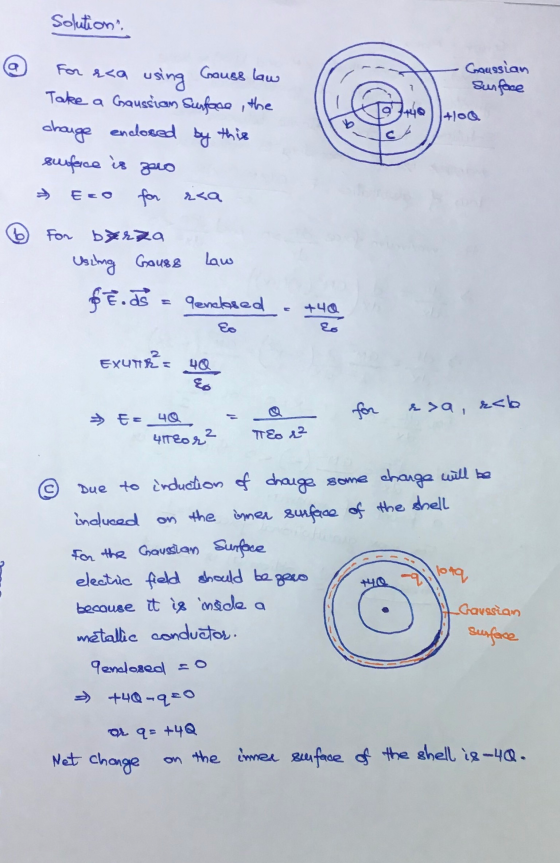
Gauss’s law for electricity gave us a value for the electric field a distance r away (E = (1/4πε0)(qenclosed/r2). You have a conductive solid sphere (radius of a) inside a conductive shell (inner radius of b and outer radius of c). The sphere has a charge of +4Q while the shell has a charge of +10Q. Find the following: a. What is the electric field for r<a? What is the electric field for b>r>a? b. What is the net charge on the INNER SURFACE OF THE SHELL?
Homework Answers
Add Answer to:
Gauss’s law for electricity gave us a value for the electric
field a distance r away...
2. (10 points) In class we found the Gauss's law for electricity gave us a value...
 2. (10 points) In class we found the Gauss's law for electricity gave us a value for the electric field a distance r away (E = (1/41ɛo) (Aenclosed/r?). You have a conductive solid sphere (radius of a) inside a conductive shell (inner radius of b and outer radius of c). The sphere has a charge of +4Q while the shell has a charge of +10Q. Find the following: a. What is the electric field for r<a? What is the electric...
2. (10 points) in class we found the Gauss's law for electricity gave us a value...
 2. (10 points) in class we found the Gauss's law for electricity gave us a value for the electric field a distance r away (E = (1/4xxo) (encloud/r"). You have a conductive solid sphere (radius of a) inside a conductive shell (inner radius of b and outer radius of c). The sphere has a charge of +4Q while the shell has a charge of +100. Find the following: What is the electric field for ra? What is the electric field...
Use Gauss’s law to calculate the electric field at a distance r from a point charge...
Use Gauss’s law to calculate the electric field at a distance r from a point charge +q. Hints: (1) If you use a spherical shell of radius r as your closed surface, then by symmetry the magnitude of the electric field is the same at all points on the sphere, and thus E can be factored out of the integral. (2) Since 4 r^2 is the equation for the area of the surface of a sphere, ´ dA = 4...
A smooth spherical shell of electricity insulating material with outer radius a and inner radius a/2....
 A
smooth spherical shell of electricity insulating material with
outer radius a and inner radius a/2. Inside of this sphere, also
with a radius of a/2, is a conducting solid sphere. The conducting
sphere has an excess amount of charge q. The density of the
insulating sphere is p.
A)
What must be the value of p so that the total charge of this setup
is 0?
B)
Using the value of p from part (A), what are the magnitude...
A
smooth spherical shell of electricity insulating material with
outer radius a and inner radius a/2. Inside of this sphere, also
with a radius of a/2, is a conducting solid sphere. The conducting
sphere has an excess amount of charge q. The density of the
insulating sphere is p.
A)
What must be the value of p so that the total charge of this setup
is 0?
B)
Using the value of p from part (A), what are the magnitude...
1. Find the electric field at point a for: a. A solid sphere of radius R...
 1. Find the electric field at point a for: a. A solid sphere of radius R carrying a volume charge density ρ b. An infinitely long, thin wire carrying a line charge density Side Cross Section C. A plane of infinite area carrying a surface charge density ơ PoT 2. Avery long cylinder with radius a and charge density pa-is placed inside of a conducting cylindrical shell. The cylindrical shell has an inner radius of b and a thickness of...
In the figure the sphere of radius R is solid and non-conductive and has a uniform...
 In the figure the sphere of radius R is solid and non-conductive and has a uniform charge volumetric distribution p0. A spherical shell with inner radius 2R and outer radius 3R is concentric with the sphere and unloaded. Find, in terms of p0 and R: a) the value of the electric charge in the sphere, b) the magnitude of the electric field at a radial distance r - 2.5R, c) the value of the surface charge density induced in the...
Please show work for all parts, thank you. Course Contents> ... > Assignment #3: Gauss' Law...
 Please show work for all parts, thank you.
Course Contents> ... > Assignment #3: Gauss' Law » 23-49 Electric field of a solid sphere concentric with a < Timer Notes Evaluate Feedback Print Info In the figure, a solid sphere of radius a = 8.6 cm is concentric with a spherical conducting shell of inner radius b = 20.6 cm and outer radius c = 22.6 cm. The sphere has a net uniform charge 41 = 6.00x10- C. The shell...
Please show work for all parts, thank you.
Course Contents> ... > Assignment #3: Gauss' Law » 23-49 Electric field of a solid sphere concentric with a < Timer Notes Evaluate Feedback Print Info In the figure, a solid sphere of radius a = 8.6 cm is concentric with a spherical conducting shell of inner radius b = 20.6 cm and outer radius c = 22.6 cm. The sphere has a net uniform charge 41 = 6.00x10- C. The shell...
Consider two concentric insulating cylinders of infinite length. The inner cylinder is solid with radius R,...
Consider two concentric insulating cylinders of infinite length. The inner cylinder is solid with radius R, while the outer cylinder is a hollow shell with inner radius a and outer radius b. Both cylinders have the same volume charge density of +ρ. Using Gauss’s Law, find the electric field as a function of r (where r = 0 at the central axis) in the interval a ≤ r < b. Note: Your final equation should be in terms of given...
Consider a charged sphere of radius R. The charge density is not constant. Rather, it blows...
Consider a charged sphere of radius R. The charge density is not constant. Rather, it blows up at the center of the sphere, but falls away exponentially fast away from the center, p(r)=(C/r2)e-kr where C is an unkown constant, and k determines how fast the charge density falls off. The total charge on the sphere is Q. a) Write down the Electric Field outside the sphere, where r ≥ R, in term of the total Q. b) Show that C=...
 2. (10 points) In class we found the Gauss's law for electricity gave us a value for the electric field a distance r away (E = (1/41ɛo) (Aenclosed/r?). You have a conductive solid sphere (radius of a) inside a conductive shell (inner radius of b and outer radius of c). The sphere has a charge of +4Q while the shell has a charge of +10Q. Find the following: a. What is the electric field for r<a? What is the electric...
 2. (10 points) in class we found the Gauss's law for electricity gave us a value for the electric field a distance r away (E = (1/4xxo) (encloud/r"). You have a conductive solid sphere (radius of a) inside a conductive shell (inner radius of b and outer radius of c). The sphere has a charge of +4Q while the shell has a charge of +100. Find the following: What is the electric field for ra? What is the electric field...
 A
smooth spherical shell of electricity insulating material with
outer radius a and inner radius a/2. Inside of this sphere, also
with a radius of a/2, is a conducting solid sphere. The conducting
sphere has an excess amount of charge q. The density of the
insulating sphere is p.
A)
What must be the value of p so that the total charge of this setup
is 0?
B)
Using the value of p from part (A), what are the magnitude...
A
smooth spherical shell of electricity insulating material with
outer radius a and inner radius a/2. Inside of this sphere, also
with a radius of a/2, is a conducting solid sphere. The conducting
sphere has an excess amount of charge q. The density of the
insulating sphere is p.
A)
What must be the value of p so that the total charge of this setup
is 0?
B)
Using the value of p from part (A), what are the magnitude...
 1. Find the electric field at point a for: a. A solid sphere of radius R carrying a volume charge density ρ b. An infinitely long, thin wire carrying a line charge density Side Cross Section C. A plane of infinite area carrying a surface charge density ơ PoT 2. Avery long cylinder with radius a and charge density pa-is placed inside of a conducting cylindrical shell. The cylindrical shell has an inner radius of b and a thickness of...
 In the figure the sphere of radius R is solid and non-conductive and has a uniform charge volumetric distribution p0. A spherical shell with inner radius 2R and outer radius 3R is concentric with the sphere and unloaded. Find, in terms of p0 and R: a) the value of the electric charge in the sphere, b) the magnitude of the electric field at a radial distance r - 2.5R, c) the value of the surface charge density induced in the...
 Please show work for all parts, thank you.
Course Contents> ... > Assignment #3: Gauss' Law » 23-49 Electric field of a solid sphere concentric with a < Timer Notes Evaluate Feedback Print Info In the figure, a solid sphere of radius a = 8.6 cm is concentric with a spherical conducting shell of inner radius b = 20.6 cm and outer radius c = 22.6 cm. The sphere has a net uniform charge 41 = 6.00x10- C. The shell...
Please show work for all parts, thank you.
Course Contents> ... > Assignment #3: Gauss' Law » 23-49 Electric field of a solid sphere concentric with a < Timer Notes Evaluate Feedback Print Info In the figure, a solid sphere of radius a = 8.6 cm is concentric with a spherical conducting shell of inner radius b = 20.6 cm and outer radius c = 22.6 cm. The sphere has a net uniform charge 41 = 6.00x10- C. The shell...
Most questions answered within 3 hours.
-
Where is the error in this code sequence?
String s1 = "Hello";
String s2 = "ello";...
asked 10 months ago -
Financial data for Joel de Paris, Inc., for last year
follow:
Joel de Paris, Inc.
Balance...
asked 10 months ago -
Consider this reaction:
Al2(SO4)3 (aq)+ BaCl3
(aq) Al2Cl6 (aq)- +
3BaSO4(s) . What is the...
asked 10 months ago -
Suppose that Savneet is considering increasing her
recent random sample from 20 car rentals to 40...
asked 10 months ago -
Trucks arrive at an unloading terminal at an average rate of 120
per hour.
Trucks arrive...
asked 10 months ago -
Why are methanol and ethanol completely soluble in water while
octanol is not very little soluble....
asked 10 months ago -
A facilities manager at a university reads in a research report
that the mean amount of...
asked 10 months ago -
When the CuSO4 is rehydrated by adding water to the anhydrous
compound, is this an endothermic...
asked 10 months ago -
A ray of sunlight is passing from diamond into crown glass; the
angle of incidence is...
asked 10 months ago -
A block of mass 0.249 kg is placed on top of a light, vertical
spring of...
asked 10 months ago -
how do the kidneys compensate in the presences of acidosis
a) trigger hyperventilate
b) reserve acid...
asked 10 months ago -
Question 501 pts
The rental rate of capital to the firm increases. Which of the
following...
asked 10 months ago