
Homework Answers
Add Answer to:
3. A skier is at the top of a slope 50m (the vertical height) above the...
3. A skier is at the top of a slope 50m (the vertical height) above the...
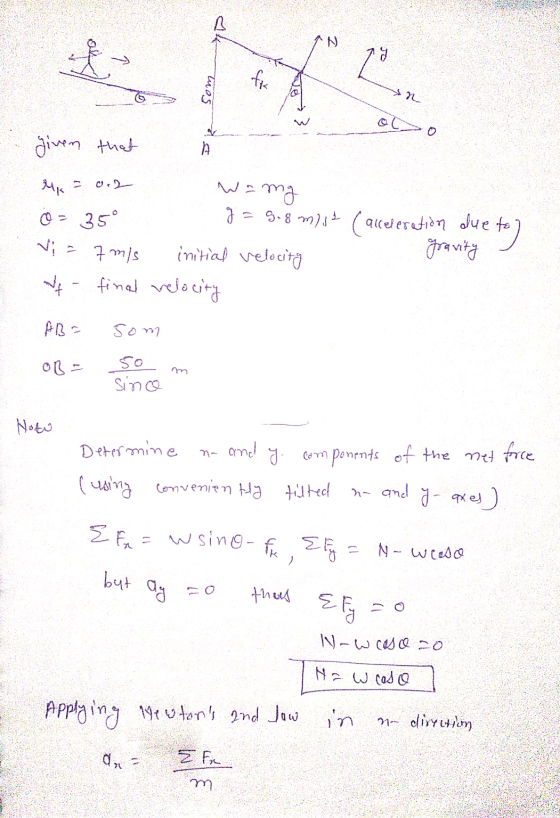
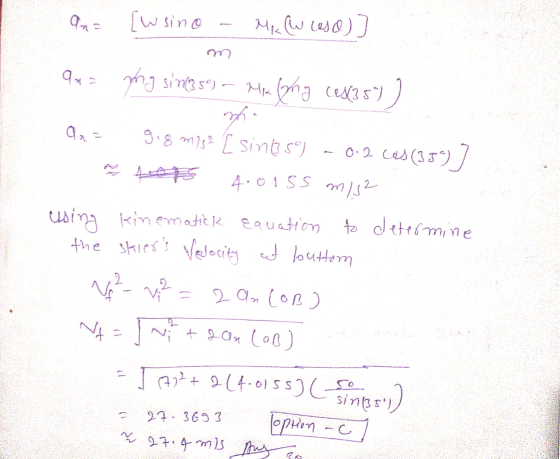
 3. A skier is at the top of a slope 50m (the vertical height) above the base of the slope with an initial speed of 7m/s. The slope is inclined 35 degrees above horizontal and has a coefficient of kinetic friction of 0.2. What will her speed be at the bottom of the incline? 28.8 m/s a. b. 26.5 m/s c. 27.4 m/s d. 36.2 m/s e. 32.1 m/s
A skier on a slope inclined at 4.7° to the horizontal pushes on ski poles and...
A skier on a slope inclined at 4.7° to the horizontal pushes on ski poles and starts down the slope. The initial speed is 2.7 m/s. The coefficient of kinetic friction between skis and snow is 0.11. Determine how far the skier will slide before coming to res
A skier, starting from rest, coasts down a slope that makes a 25.0o angle with the...
A skier, starting from rest, coasts down a slope that makes a 25.0o angle with the horizontal. The coefficient of kinetic friction between the snow and the skis is 0.200. The skier travels along the slope a distance of 11.4 m before skiing off the edge of a cliff. The skier falls a vertical distance of 3.80 m before landing on another downhill slope. Determine the speed with which the skier lands.
A 64.0-kg skier starts from rest at the top of a ski slope of height 64.0...
A 64.0-kg skier starts from rest at the top of a ski slope of height 64.0 m . a) If frictional forces do −1.01×10⁴ J of work on her as she descends, how fast is she going at the bottom of the slope? Take free fall acceleration to be g = 9.80 m/s2 b) Now moving horizontally, the skier crosses a patch of soft snow, where the coefficient of friction is 0.25. If the patch is of width 62.0 m...
A skier starts from rest at the top of a hill that is inclined at 9.8°...
A skier starts from rest at the top of a hill that is inclined at 9.8° with respect to the horizontal. The hillside is 240 m long, and the coefficient of friction between snow and skis is 0.0750. At the bottom of the hill, the snow is level and the coefficient of friction is unchanged. How far does the skier glide along the horizontal portion of the snow before coming to rest? m
A skier starts from rest at the top of a hill that is inclined at 10.0°...
A skier starts from rest at the top of a hill that is inclined at 10.0° with respect to the horizontal. The hillside is 250 m long, and the coefficient of friction between snow and skis is 0.0750. At the bottom of the hill, the snow is level and the coefficient of friction is unchanged. How far does the skier glide along the horizontal portion of the snow before coming to rest?
A skier starts from rest at the top of a hill that is inclined at 9.8°...
A skier starts from rest at the top of a hill that is inclined at 9.8° with respect to the horizontal. The hillside is 160 m long, and the coefficient of friction between snow and skis is 0.0750. At the bottom of the hill, the snow is level and the coefficient of friction is unchanged. How far does the skier glide along the horizontal portion of the snow before coming to rest?
A skier slides down from the top of a frictionless 400 incline of height 205 m....
A skier slides down from the top of a frictionless 400 incline of height 205 m. If she starts from rest, calculate the speed of the skier at the bottom of the incline.
A 1 kg block in the figure above begins at rest at the top of a...
A 1 kg block in the figure above begins at rest at the top of a slope. a. Assuming no friction, derive an expression for the speed of the block at the end of the slope if h = 0.4m and g = 9.8 m/s2. b. If θ = 30◦, calculate the horizontal component of the velocity when the block is at the bottom end of the slope. c. If θ = 30◦, calculate the vertical component of the velocity...
A skier is pulled up a slope at a constant velocity by a tow bar. The...
A skier is pulled up a slope at a constant velocity by a tow bar. The slope is inclined at 25.2 ° with respect to the horizontal. The force applied to the skier by the tow bar is parallel to the slope. The skier's mass is 46.5 kg, and the coefficient of kinetic friction between the skis and the snow is 0.158. Find the magnitude of the force that the tow bar exerts on the skier.
 3. A skier is at the top of a slope 50m (the vertical height) above the base of the slope with an initial speed of 7m/s. The slope is inclined 35 degrees above horizontal and has a coefficient of kinetic friction of 0.2. What will her speed be at the bottom of the incline? 28.8 m/s a. b. 26.5 m/s c. 27.4 m/s d. 36.2 m/s e. 32.1 m/s
Most questions answered within 3 hours.
-
Where is the error in this code sequence?
String s1 = "Hello";
String s2 = "ello";...
asked 11 months ago -
Financial data for Joel de Paris, Inc., for last year
follow:
Joel de Paris, Inc.
Balance...
asked 11 months ago -
Consider this reaction:
Al2(SO4)3 (aq)+ BaCl3
(aq) Al2Cl6 (aq)- +
3BaSO4(s) . What is the...
asked 11 months ago -
Suppose that Savneet is considering increasing her
recent random sample from 20 car rentals to 40...
asked 11 months ago -
Trucks arrive at an unloading terminal at an average rate of 120
per hour.
Trucks arrive...
asked 11 months ago -
Why are methanol and ethanol completely soluble in water while
octanol is not very little soluble....
asked 11 months ago -
A facilities manager at a university reads in a research report
that the mean amount of...
asked 11 months ago -
When the CuSO4 is rehydrated by adding water to the anhydrous
compound, is this an endothermic...
asked 11 months ago -
A ray of sunlight is passing from diamond into crown glass; the
angle of incidence is...
asked 11 months ago -
A block of mass 0.249 kg is placed on top of a light, vertical
spring of...
asked 11 months ago -
how do the kidneys compensate in the presences of acidosis
a) trigger hyperventilate
b) reserve acid...
asked 11 months ago -
Question 501 pts
The rental rate of capital to the firm increases. Which of the
following...
asked 11 months ago