

Homework Answers
Add Answer to:
electromagnetic
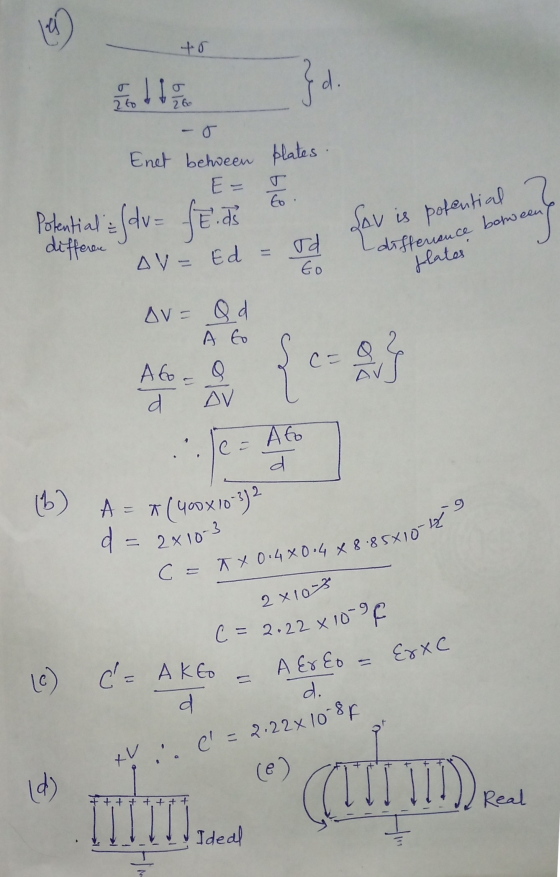
(b) Use the expression obtained in part(a) to calculate the approximate capacitance of a a...
(C) Calculate the total capacitance of the structure that consists of a dielectric slab (relative permittivity...
 (C) Calculate the total capacitance of the structure that consists of a dielectric slab (relative permittivity is ε) inserted between two parallel plates that are separate by a distance D. The thickness of the dielectric slab is d (obviously d 〈 D). The widths of the two gaps between the dielectric and two electrodes are (D - d)/3 and (2D - 2d)/3. Neglect fringing field effect and assume that the areas are all equal to A. AND when it is...
Consider an ideal parallel plate capacitor, having vacuum between two plates of area A and separation...
 Consider an ideal parallel plate capacitor, having vacuum between two plates of area A and separation d. The shape of the plates is arbitrary. By the following steps, prove that the capacitance is 0 d where ε0 is the permittivity. Assume that the charge on each plate is electric field E between the plates is uniform. , and that the Use Gauss' law to calculate the electric field E between the plates in terms of Q and A. (Use a...
A spherical capacitor has a spherical inner plate with radius a and outer plate with radius...
 A spherical capacitor has a spherical inner plate with radius a
and outer plate with radius b. The charge on the inner plate is +Q
and on the outer plate it is -Q. We have filled a cone shaped
region of angle θ (0 ≤ θ ≤ π) with a dielectric with constant κ.
The dielectric fills the entire volume between the two spheres
inside the cone. You may neglect any fringing effects between the
dielectric and the vacuum (dielectric...
A spherical capacitor has a spherical inner plate with radius a
and outer plate with radius b. The charge on the inner plate is +Q
and on the outer plate it is -Q. We have filled a cone shaped
region of angle θ (0 ≤ θ ≤ π) with a dielectric with constant κ.
The dielectric fills the entire volume between the two spheres
inside the cone. You may neglect any fringing effects between the
dielectric and the vacuum (dielectric...
of an electromagnetic wave propagating in a vacuum is 65 x 10 Hz. See the table for problem 1 1) To what part of the electromagnetic spectrum does this wave a) blue light 2) The electromag a)per...
 of an electromagnetic wave propagating in a vacuum is 65 x 10 Hz. See the table for problem 1 1) To what part of the electromagnetic spectrum does this wave a) blue light 2) The electromag a)perpendicular to b) parallel to the the magnetic field b) green light netic field of the electromagnetic wave is d) violet light c) antiparallel to the d) paralel to the wave velocity magnetic field magnetic field The speed of light in a medium is...
Consider a cylindrical capacitor like that shown in Fig. 24.6. Let d = rb − ra...
 Consider a cylindrical capacitor like that shown in Fig. 24.6. Let d = rb − ra be the spacing between the inner and outer conductors. (a) Let the radii of the two conductors be only slightly different, so that d << ra. Show that the result derived in Example 24.4 (Section 24.1) for the capacitance of a cylindrical capacitor then reduces to Eq. (24.2), the equation for the capacitance of a parallel-plate capacitor, with A being the surface area of...
 (C) Calculate the total capacitance of the structure that consists of a dielectric slab (relative permittivity is ε) inserted between two parallel plates that are separate by a distance D. The thickness of the dielectric slab is d (obviously d 〈 D). The widths of the two gaps between the dielectric and two electrodes are (D - d)/3 and (2D - 2d)/3. Neglect fringing field effect and assume that the areas are all equal to A. AND when it is...
 Consider an ideal parallel plate capacitor, having vacuum between two plates of area A and separation d. The shape of the plates is arbitrary. By the following steps, prove that the capacitance is 0 d where ε0 is the permittivity. Assume that the charge on each plate is electric field E between the plates is uniform. , and that the Use Gauss' law to calculate the electric field E between the plates in terms of Q and A. (Use a...
 A spherical capacitor has a spherical inner plate with radius a
and outer plate with radius b. The charge on the inner plate is +Q
and on the outer plate it is -Q. We have filled a cone shaped
region of angle θ (0 ≤ θ ≤ π) with a dielectric with constant κ.
The dielectric fills the entire volume between the two spheres
inside the cone. You may neglect any fringing effects between the
dielectric and the vacuum (dielectric...
A spherical capacitor has a spherical inner plate with radius a
and outer plate with radius b. The charge on the inner plate is +Q
and on the outer plate it is -Q. We have filled a cone shaped
region of angle θ (0 ≤ θ ≤ π) with a dielectric with constant κ.
The dielectric fills the entire volume between the two spheres
inside the cone. You may neglect any fringing effects between the
dielectric and the vacuum (dielectric...
 of an electromagnetic wave propagating in a vacuum is 65 x 10 Hz. See the table for problem 1 1) To what part of the electromagnetic spectrum does this wave a) blue light 2) The electromag a)perpendicular to b) parallel to the the magnetic field b) green light netic field of the electromagnetic wave is d) violet light c) antiparallel to the d) paralel to the wave velocity magnetic field magnetic field The speed of light in a medium is...
 Consider a cylindrical capacitor like that shown in Fig. 24.6. Let d = rb − ra be the spacing between the inner and outer conductors. (a) Let the radii of the two conductors be only slightly different, so that d << ra. Show that the result derived in Example 24.4 (Section 24.1) for the capacitance of a cylindrical capacitor then reduces to Eq. (24.2), the equation for the capacitance of a parallel-plate capacitor, with A being the surface area of...
Most questions answered within 3 hours.
-
Where is the error in this code sequence?
String s1 = "Hello";
String s2 = "ello";...
asked 10 months ago -
Financial data for Joel de Paris, Inc., for last year
follow:
Joel de Paris, Inc.
Balance...
asked 10 months ago -
Consider this reaction:
Al2(SO4)3 (aq)+ BaCl3
(aq) Al2Cl6 (aq)- +
3BaSO4(s) . What is the...
asked 10 months ago -
Suppose that Savneet is considering increasing her
recent random sample from 20 car rentals to 40...
asked 10 months ago -
Trucks arrive at an unloading terminal at an average rate of 120
per hour.
Trucks arrive...
asked 10 months ago -
Why are methanol and ethanol completely soluble in water while
octanol is not very little soluble....
asked 10 months ago -
A facilities manager at a university reads in a research report
that the mean amount of...
asked 10 months ago -
When the CuSO4 is rehydrated by adding water to the anhydrous
compound, is this an endothermic...
asked 10 months ago -
A ray of sunlight is passing from diamond into crown glass; the
angle of incidence is...
asked 10 months ago -
A block of mass 0.249 kg is placed on top of a light, vertical
spring of...
asked 10 months ago -
how do the kidneys compensate in the presences of acidosis
a) trigger hyperventilate
b) reserve acid...
asked 10 months ago -
Question 501 pts
The rental rate of capital to the firm increases. Which of the
following...
asked 10 months ago