Person A observes person B to be moving in the positive x-direction at a speed of...
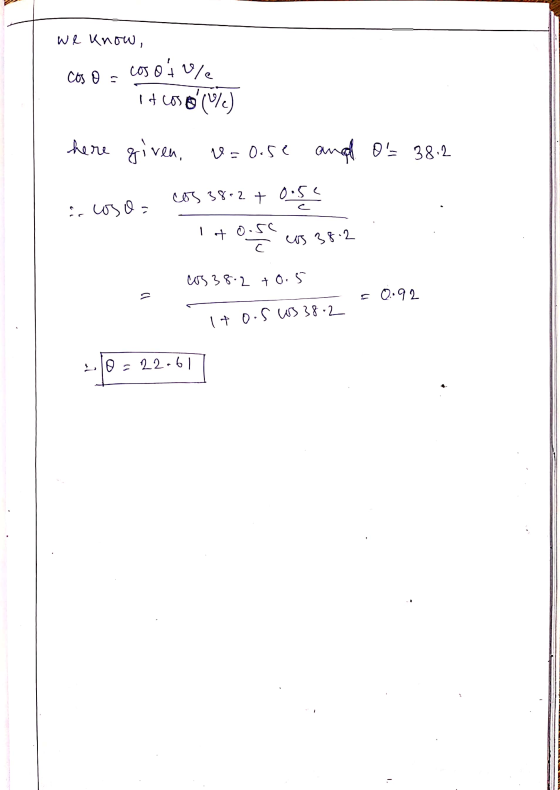
Person A observes person B to be moving in the positive x-direction at a speed of 0.5c.
Person B shines some laser light. Person B measures the angle between the direction the light is going and the x-axis to be 38.2.
What angle does person A measure between the light's direction and the x-axis? Answer in degrees.
Homework Answers
Add Answer to:
Person A observes person B to be moving in the positive
x-direction at a speed of...
Ball B, moving in the positive direction of an x axis at speed v, collides with...
Ball B, moving in the positive direction of an x axis at speed v, collides with stationary ball A at the origin. A and B have different masses. After the collision, B moves in the negative direction of the y axis at speed v/5. In what direction does A move, as an angle with respect to the x axis?
Ball B, moving in the positive direction of an x axis at speed v, collides with...
Ball B, moving in the positive direction of an x axis at speed v, collides with stationary ball A at the origin. A and B have different masses. After the collision, B moves in the negative direction of the y axis at speed v/2. In what direction does A move, as an angle with respect to the x axis?
1. Ball B, moving in the positive direction of an x axis at speed v, collides...
 1. Ball B, moving in the positive direction of an x axis at speed v, collides with stationary ball A at the origin. Ball A and B have different masses. After the collision, B moves at an angle of +30° with respect to the x axis with half its initial speed. (a) In what direction does A move as an angle with respect to the x axis? (b) If the collision is elastic, what is the ratio of the masses...
A rocket flies toward the earth at 0.5c and the captain shines a laser light beam...
A rocket flies toward the earth at 0.5c and the captain shines a laser light beam in the forward direction. Part A Which of the following statements about the speed of this light are correct? (There may be more than one correct answer.) Check all that apply. Check all that apply. A The captain measures speed c for the light. B An observer on earth measures speed c for the light. C The captain measures speed 0.5c for the light....
Q5 A 21.0 kg body is moving in the direction of the positive x axis with...
 Q5
A 21.0 kg body is moving in the direction of the positive x axis with a speed of 100.0 m/s when, owing to an internal explosion, it breaks into three parts. One part, whose mass is 7.00 kg, moves away from the point of explosion with a speed of 180 m/s in the direction of the positive y axis. A second fragment, with a mass of 4.00 kg, moves in the direction of the negative x axis with a...
Q5
A 21.0 kg body is moving in the direction of the positive x axis with a speed of 100.0 m/s when, owing to an internal explosion, it breaks into three parts. One part, whose mass is 7.00 kg, moves away from the point of explosion with a speed of 180 m/s in the direction of the positive y axis. A second fragment, with a mass of 4.00 kg, moves in the direction of the negative x axis with a...
A 32.0-$kg$ body is moving in the direction of the positive x axis with a speed...
A 32.0-$kg$ body is moving in the direction of the positive x axis with a speed of 376 $m/s$ when, owing to an internal explosion, it breaks into three pieces. One part, whose mass is 9.5 $kg$, moves away from the point of explosion with a speed of 371 $m/s$ along the positive y axis. A second fragment, whose mass is 3.0 $kg$, moves away from the point of explosion with a speed of 486 $m/s$ along the negative x...
An electron moving with a speed of 8.8 x10⁵ m/s in the positive z direction experiences...
An electron moving with a speed of 8.8 x10⁵ m/s in the positive z direction experiences zero magnetic force. When it moves in the positive x direction it experiences a force of 2.4 x10⁻¹³ N that points in the negative y direction. What is the magnitude and direction of the magnetic field? Magnitude: B= _____________T Direction: Magnetic field is pointed in ____________(indicate positive or negative) direction of ______________(indicate which axis i.e. x, y, or z) axis.
A photon moving in the +x-direction, scatters off a free stationary electron. The wavelength of the...
A photon moving in the +x-direction, scatters off a free stationary electron. The wavelength of the incident photon is 0.0410 nm. After the collision, the electron moves at an angle α below the +x-axis, while the photon moves at an angle θ = 73.3° above the +x-axis. (For the purpose of this exercise, assume that the electron is traveling slow enough that the non-relativistic relationship between momentum and velocity can be used.) (a) What is the angle α (in degrees)?...
An air hockey puck traveling in the positive x direction hits another puck sitting at rest...
 An air hockey puck traveling in the positive x direction hits another puck sitting at rest at the origin, in an elastic collision. After the collision, the first puck has has a speed less than before, and a path at an angle below the positive x axis (in the fourth quadrant). The stone originally at rest is now moving in what direction? O straight in the positive x direction O at an angle above the positive x axis (first quadrant)...
A train is moving at a speed of 0.6c along the positive x-direction (don't worry about...
 A train is moving at a speed of 0.6c along the positive x-direction (don't worry about the unrealistic numerical values). A taxi is chasing the train at a speed of 0.4c along the positive x-direction. Both speeds are measured relative to the train station, which is at rest. (a) Use the velocity transformation formula to find the speed of the taxi, as measured by a passenger on the train. (1) Use the velocity transformation formula to find the speed of...
 1. Ball B, moving in the positive direction of an x axis at speed v, collides with stationary ball A at the origin. Ball A and B have different masses. After the collision, B moves at an angle of +30° with respect to the x axis with half its initial speed. (a) In what direction does A move as an angle with respect to the x axis? (b) If the collision is elastic, what is the ratio of the masses...
 Q5
A 21.0 kg body is moving in the direction of the positive x axis with a speed of 100.0 m/s when, owing to an internal explosion, it breaks into three parts. One part, whose mass is 7.00 kg, moves away from the point of explosion with a speed of 180 m/s in the direction of the positive y axis. A second fragment, with a mass of 4.00 kg, moves in the direction of the negative x axis with a...
Q5
A 21.0 kg body is moving in the direction of the positive x axis with a speed of 100.0 m/s when, owing to an internal explosion, it breaks into three parts. One part, whose mass is 7.00 kg, moves away from the point of explosion with a speed of 180 m/s in the direction of the positive y axis. A second fragment, with a mass of 4.00 kg, moves in the direction of the negative x axis with a...
 An air hockey puck traveling in the positive x direction hits another puck sitting at rest at the origin, in an elastic collision. After the collision, the first puck has has a speed less than before, and a path at an angle below the positive x axis (in the fourth quadrant). The stone originally at rest is now moving in what direction? O straight in the positive x direction O at an angle above the positive x axis (first quadrant)...
 A train is moving at a speed of 0.6c along the positive x-direction (don't worry about the unrealistic numerical values). A taxi is chasing the train at a speed of 0.4c along the positive x-direction. Both speeds are measured relative to the train station, which is at rest. (a) Use the velocity transformation formula to find the speed of the taxi, as measured by a passenger on the train. (1) Use the velocity transformation formula to find the speed of...
Most questions answered within 3 hours.
-
Where is the error in this code sequence?
String s1 = "Hello";
String s2 = "ello";...
asked 11 months ago -
Financial data for Joel de Paris, Inc., for last year
follow:
Joel de Paris, Inc.
Balance...
asked 11 months ago -
Consider this reaction:
Al2(SO4)3 (aq)+ BaCl3
(aq) Al2Cl6 (aq)- +
3BaSO4(s) . What is the...
asked 11 months ago -
Suppose that Savneet is considering increasing her
recent random sample from 20 car rentals to 40...
asked 11 months ago -
Trucks arrive at an unloading terminal at an average rate of 120
per hour.
Trucks arrive...
asked 11 months ago -
Why are methanol and ethanol completely soluble in water while
octanol is not very little soluble....
asked 11 months ago -
A facilities manager at a university reads in a research report
that the mean amount of...
asked 11 months ago -
When the CuSO4 is rehydrated by adding water to the anhydrous
compound, is this an endothermic...
asked 11 months ago -
A ray of sunlight is passing from diamond into crown glass; the
angle of incidence is...
asked 11 months ago -
A block of mass 0.249 kg is placed on top of a light, vertical
spring of...
asked 11 months ago -
how do the kidneys compensate in the presences of acidosis
a) trigger hyperventilate
b) reserve acid...
asked 11 months ago -
Question 501 pts
The rental rate of capital to the firm increases. Which of the
following...
asked 11 months ago