
Homework Answers
Add Answer to:
Need help
Problem 5. Refraction of light (4 points) A parallel beam of light containing a...
10.A narrow beam of white light is incident normally on the surface of a triangular silicate...
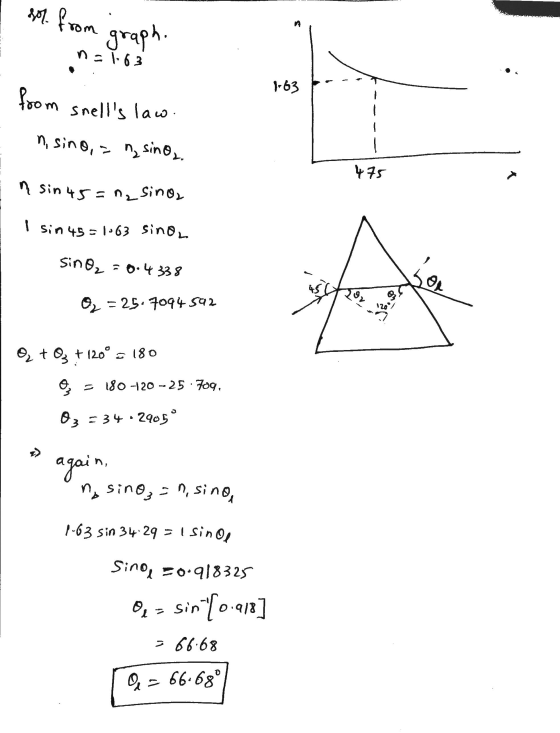
 10.A narrow beam of white light is incident normally on the surface of a triangular silicate flint glass prism with one angle of 90. The index of refraction for violet light is 1.66 and for red light is 1.61. The angle in the prism is equal to 30° of glass. a. On the diagram below show an approximate sketch for the refracted light from the opposite face of the prism Air @ White light 7800 Glass Calculate angular separation between...
10.A narrow beam of white light is incident normally on the surface of a triangular silicate...
 10.A narrow beam of white light is incident normally on the surface of a triangular silicate flint glass prism with one angle of 90. The index of refraction for violet light is 1.66 and for red light is 1.61. The angle in the prism is equal to 30° of glass. a. On the diagram below show an approximate sketch for the refracted light from the opposite face of the prism. Air B White light 780° Glass Calculate angular separation between...
The table lists the index of refraction for various substances at 20 °C for light with...
 The table lists the index of refraction for various substances at 20 °C for light with a wavelength of 589 nm in a vacuum. Through which substance will light travel with a wavelength of 403.7 nm? Ethyl Alcohol n = 1.361 Fused Quartz n = 1.460 Crown Glass n = 1.570 Carbon Tetrachloride n = 1.459 Crystalline Quartz n = 1.544 ethyl alcohol O fused quartz crown glass carbon tetrachloride crystalline quartz Question 5 4 pts In the figure below,...
Need help finding angles 3 and 4. Angle of incidence (degrees) = 30.000 Index of refraction of prism, n =1.500 Right In...
 Need help finding angles 3 and 4.
Angle of incidence (degrees) = 30.000 Index of refraction of prism, n =1.500 Right Interface Left Interface 60° Interactive Exercises 33.06: Refraction and the Equilateral Prism The simulation (linked below) shows an equilateral prism (the three angles depicted in the simulation equal 60°) immersed in an unknown transparent substance. The index of refraction n of the prism can be varied by a slider in the simulation. Monoch romatic light is incident on the...
Need help finding angles 3 and 4.
Angle of incidence (degrees) = 30.000 Index of refraction of prism, n =1.500 Right Interface Left Interface 60° Interactive Exercises 33.06: Refraction and the Equilateral Prism The simulation (linked below) shows an equilateral prism (the three angles depicted in the simulation equal 60°) immersed in an unknown transparent substance. The index of refraction n of the prism can be varied by a slider in the simulation. Monoch romatic light is incident on the...
(11%) Problem 6: A beam of light containing orange (610 nm) and violet (410 nm) wavelengths...
 (11%) Problem 6: A beam of light containing orange (610 nm) and violet (410 nm) wavelengths passes from fused quartz into water, striking the surface between them at a 49° incident angle with respect to the normal. Medium Red Orange Yellow Green Blue Violet (660 nm) (610 nm) (580 nm) (550 nm) (470 nm) (410 nm) | 1.331 1.332 1.333 | 1.335 | 1.338 1.342 Water Randomized Variables Diamond 2.410 2.415 2.4172.426 2.444 2.458 O= 49° Glass, | 1.512 1514...
shown perpendia looking straight down into the top of the glass. A light beam is shown...
 shown perpendia looking straight down into the top of the glass. A light beam is shown perpendicular to the surface hace of a film of olive oil floating on top of water inside the glass (see nghtness at a wavelength of 500 nm in the air. The indexes of refraction, n drawing below). When the student looks down at the film the student sees green light side view that has a maximum a for the materials are given below Light...
Partner: Date Name 11 Snell's Law Introduction When light passes from one material to another it ...
 Partner: Date Name 11 Snell's Law Introduction When light passes from one material to another it is always bent away from its original path. This process is known as refraction and the change in direction depends on the change in optical density (or refractive index) of the two materials. A larger change in refractive index results in a larger change in angle between incoming and outgoing light beams. A light beam bends closer to the normal in the material with...
1) Two parallel beams of light are brought together on a surface. Each beam has wave length h-500...
 1) Two parallel beams of light are brought together on a surface. Each beam has wave length h-500 nm and intensity 1 W/m at the surface. What is the resultant intensity for each of the following path lengths or phase differences between the beams? Phase or path length difference Intensity (W/m) 0 radians (phase) T/2 radians (phase) 60 degrees (phase) 3π radians (phase) 300 nm (path length) 1000 nm (path length) 5.5 λ (path length) 2) A wave of wavelength...
1. Conceptual questions: (This one should take less than 5 minutes. Manage your time!) a) For...
 1. Conceptual questions: (This one should take less than 5 minutes. Manage your time!) a) For a total internal reflection to occur, the incident angle of a light should be (greater/smaller) than the refractive angle. N S N s . b) Two identical bar magnets are given to the right. At point a, b, and c, the directions of the net magnetic fields are to the and (left? Or right?), respectively. b C c) A polarized electromagnetic wave passes through...
 10.A narrow beam of white light is incident normally on the surface of a triangular silicate flint glass prism with one angle of 90. The index of refraction for violet light is 1.66 and for red light is 1.61. The angle in the prism is equal to 30° of glass. a. On the diagram below show an approximate sketch for the refracted light from the opposite face of the prism Air @ White light 7800 Glass Calculate angular separation between...
 10.A narrow beam of white light is incident normally on the surface of a triangular silicate flint glass prism with one angle of 90. The index of refraction for violet light is 1.66 and for red light is 1.61. The angle in the prism is equal to 30° of glass. a. On the diagram below show an approximate sketch for the refracted light from the opposite face of the prism. Air B White light 780° Glass Calculate angular separation between...
 The table lists the index of refraction for various substances at 20 °C for light with a wavelength of 589 nm in a vacuum. Through which substance will light travel with a wavelength of 403.7 nm? Ethyl Alcohol n = 1.361 Fused Quartz n = 1.460 Crown Glass n = 1.570 Carbon Tetrachloride n = 1.459 Crystalline Quartz n = 1.544 ethyl alcohol O fused quartz crown glass carbon tetrachloride crystalline quartz Question 5 4 pts In the figure below,...
 Need help finding angles 3 and 4.
Angle of incidence (degrees) = 30.000 Index of refraction of prism, n =1.500 Right Interface Left Interface 60° Interactive Exercises 33.06: Refraction and the Equilateral Prism The simulation (linked below) shows an equilateral prism (the three angles depicted in the simulation equal 60°) immersed in an unknown transparent substance. The index of refraction n of the prism can be varied by a slider in the simulation. Monoch romatic light is incident on the...
Need help finding angles 3 and 4.
Angle of incidence (degrees) = 30.000 Index of refraction of prism, n =1.500 Right Interface Left Interface 60° Interactive Exercises 33.06: Refraction and the Equilateral Prism The simulation (linked below) shows an equilateral prism (the three angles depicted in the simulation equal 60°) immersed in an unknown transparent substance. The index of refraction n of the prism can be varied by a slider in the simulation. Monoch romatic light is incident on the...
 (11%) Problem 6: A beam of light containing orange (610 nm) and violet (410 nm) wavelengths passes from fused quartz into water, striking the surface between them at a 49° incident angle with respect to the normal. Medium Red Orange Yellow Green Blue Violet (660 nm) (610 nm) (580 nm) (550 nm) (470 nm) (410 nm) | 1.331 1.332 1.333 | 1.335 | 1.338 1.342 Water Randomized Variables Diamond 2.410 2.415 2.4172.426 2.444 2.458 O= 49° Glass, | 1.512 1514...
 shown perpendia looking straight down into the top of the glass. A light beam is shown perpendicular to the surface hace of a film of olive oil floating on top of water inside the glass (see nghtness at a wavelength of 500 nm in the air. The indexes of refraction, n drawing below). When the student looks down at the film the student sees green light side view that has a maximum a for the materials are given below Light...
 Partner: Date Name 11 Snell's Law Introduction When light passes from one material to another it is always bent away from its original path. This process is known as refraction and the change in direction depends on the change in optical density (or refractive index) of the two materials. A larger change in refractive index results in a larger change in angle between incoming and outgoing light beams. A light beam bends closer to the normal in the material with...
 1) Two parallel beams of light are brought together on a surface. Each beam has wave length h-500 nm and intensity 1 W/m at the surface. What is the resultant intensity for each of the following path lengths or phase differences between the beams? Phase or path length difference Intensity (W/m) 0 radians (phase) T/2 radians (phase) 60 degrees (phase) 3π radians (phase) 300 nm (path length) 1000 nm (path length) 5.5 λ (path length) 2) A wave of wavelength...
 1. Conceptual questions: (This one should take less than 5 minutes. Manage your time!) a) For a total internal reflection to occur, the incident angle of a light should be (greater/smaller) than the refractive angle. N S N s . b) Two identical bar magnets are given to the right. At point a, b, and c, the directions of the net magnetic fields are to the and (left? Or right?), respectively. b C c) A polarized electromagnetic wave passes through...
Most questions answered within 3 hours.
-
Where is the error in this code sequence?
String s1 = "Hello";
String s2 = "ello";...
asked 10 months ago -
Financial data for Joel de Paris, Inc., for last year
follow:
Joel de Paris, Inc.
Balance...
asked 10 months ago -
Consider this reaction:
Al2(SO4)3 (aq)+ BaCl3
(aq) Al2Cl6 (aq)- +
3BaSO4(s) . What is the...
asked 10 months ago -
Suppose that Savneet is considering increasing her
recent random sample from 20 car rentals to 40...
asked 10 months ago -
Trucks arrive at an unloading terminal at an average rate of 120
per hour.
Trucks arrive...
asked 10 months ago -
Why are methanol and ethanol completely soluble in water while
octanol is not very little soluble....
asked 10 months ago -
A facilities manager at a university reads in a research report
that the mean amount of...
asked 10 months ago -
When the CuSO4 is rehydrated by adding water to the anhydrous
compound, is this an endothermic...
asked 10 months ago -
A ray of sunlight is passing from diamond into crown glass; the
angle of incidence is...
asked 10 months ago -
A block of mass 0.249 kg is placed on top of a light, vertical
spring of...
asked 10 months ago -
how do the kidneys compensate in the presences of acidosis
a) trigger hyperventilate
b) reserve acid...
asked 10 months ago -
Question 501 pts
The rental rate of capital to the firm increases. Which of the
following...
asked 10 months ago