
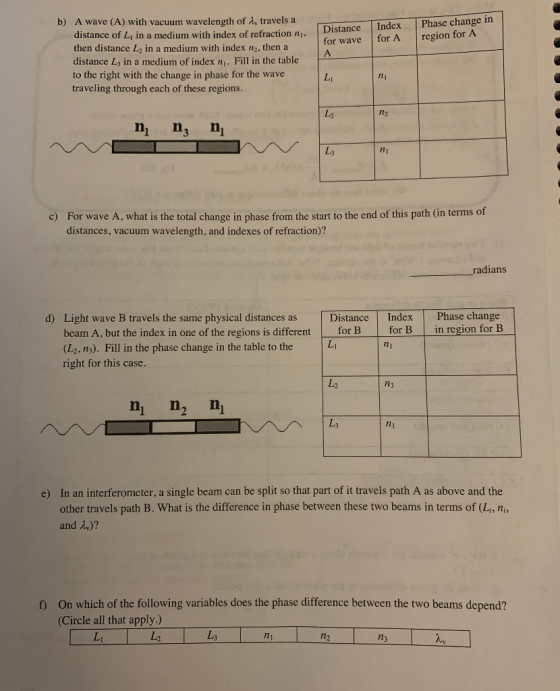

then distance La i mdum with index of refraction n, DistanceIndex Phase change in then distance L2 in a medium with index n2, then a b) A wave (A) with vacuum wavelength of Av travels a for wave for A region for A distance Ls in a medium of index ni. Fill in the table to the right with the change in phase for the wave traveling through each of these regions. /t n n3 n ni For wave A, what is the total change in phase from the start to the end of this path (in terms of distances, vacuum wavelength, and indexes of refraction)? c) radians Distance Index Phase change in region for Light wave B travels the same physical distances as beam A, but the index in one of the regions is different for Bfor B (Z2, n3). Fill in the phase change in the table to the right for this case. d) ni L2 n3 n n2 n ni In an interferometer, a single beam can be split so that part of it travels path A as above and the other travels path B. What is the difference in phase between these two beams in terms of (Li, n,, and λ.)? e) ) On which of the following variables does the phase difference between the two beams depend? (Circle all that apply)
g) Some of the variables above don't matter. Explain which ones and why you think this is so L3 112 13 3) A beam of light of vacuum wavelength A,ac-600.00 nmis split into two beams Beam I travels the following lengths through the respective mediums Lair = 10 cm .Beam II travels the following lengths through the respective mediums Lair10 cm The index of refraction for each medium is: Dair 1.0003, nglass 1.5000, nvacuum 1.0000 a) Find the phase difference between AIR GLASS ass= 1 mm VACUUM = 1 mm GLASS alass = 1 mm AIR Lair 10 cm AIR GLASS | Lglass = 1 mm AIR AIR GLASS | Lvac-1 mm Lair = 10cm these two beams at the end of their paths. Mirror A Iglas Lvac Lglass Lai Screen Mirror B Semi Silvered Assuming each of the beams has power of 1W, find the intensity of the combined beams b) Beam Splitter Source INTERFEROMETER DIAGRAM
Homework Answers

Add Answer to:
1) Two parallel beams of light are brought together on a surface. Each beam has wave length h-500...
2f and 2g please 2) A wave of wavelength 2 travels along a straight line between...
 2f and 2g please
2) A wave of wavelength 2 travels along a straight line between two points in space separated by distance L. a) Find the phase difference in the wave at these two points. _radians Distance Index for A Phase change in region for A for wave b) A wave (A) with vacuum wavelength of 2, travels a distance of L, in a medium with index of refraction ni, then distance Lin a medium with index n2, then...
2f and 2g please
2) A wave of wavelength 2 travels along a straight line between two points in space separated by distance L. a) Find the phase difference in the wave at these two points. _radians Distance Index for A Phase change in region for A for wave b) A wave (A) with vacuum wavelength of 2, travels a distance of L, in a medium with index of refraction ni, then distance Lin a medium with index n2, then...
A beam of coherent light of wavelength 623nm in air is incident on a rectabgular block of glass with index of refraction n= 1.40 A beam of coherent light of wavelength A0 623 nm in air is incident...
 A beam of coherent light of wavelength 623nm in air is
incident on a rectabgular block of glass with index of refraction
n= 1.40
A beam of coherent light of wavelength A0 623 nm in air is incident on a rectangular block of glass with index of refraction n 1.40. If, after emerging from the block, the wave that travels through the glass interfers destructively with the wave that travels through air. We ignore reflection on the block faces. Coherent...
A beam of coherent light of wavelength 623nm in air is
incident on a rectabgular block of glass with index of refraction
n= 1.40
A beam of coherent light of wavelength A0 623 nm in air is incident on a rectangular block of glass with index of refraction n 1.40. If, after emerging from the block, the wave that travels through the glass interfers destructively with the wave that travels through air. We ignore reflection on the block faces. Coherent...
h) A diode laser beam with a wavelength of 650 nm is divided into two beams...
 h) A diode laser beam with a wavelength of 650 nm is divided into two beams and allowed to travel through two arms of a coupled-waveguide with the same length of 10 mm and with a refractive index value of 1.49. Determine the phase difference between light-beams traveling through the waveguides when the refractive index value of one of the arm changes to 1.50 with a temperature change in one of the arm. (Speed of light: c-3 x 10⁸ m/s;...
In a laser experiment, a laser beam i of vacuum wavelength 1 has to propagate in...
 In a laser experiment, a laser beam i of vacuum wavelength 1 has to propagate in air (nı = 1) through a prism which is anti-reflex (AR) coated to minimize reflections. The prism is made from a glass which has an index of refraction of n3 = 1.3). The thin film is made from a higher index material with an index of n2 = 1.4. The angle of incidence between the laser and the prism is 0 = 30°. Which...
10.A narrow beam of white light is incident normally on the surface of a triangular silicate...
 10.A narrow beam of white light is incident normally on the surface of a triangular silicate flint glass prism with one angle of 90. The index of refraction for violet light is 1.66 and for red light is 1.61. The angle in the prism is equal to 30° of glass. a. On the diagram below show an approximate sketch for the refracted light from the opposite face of the prism. Air B White light 780° Glass Calculate angular separation between...
Plane coherent light waves with wavelength 565 nm are incident on two narrow parallel slits positioned...
Plane coherent light waves with wavelength 565 nm are incident on two narrow parallel slits positioned a distance d = 1 mm apart in a plane parallel to the incoming wavefronts. The interference pattern is observed on a screen parallel to the original wavefronts at 1 m from the two slits. One of the slits is covered on the illuminated side by a glass slide of 0.1 mm thickness with refractive index 1.5. a/ What is the phase difference ∆φ...
Partner: Date Name 11 Snell's Law Introduction When light passes from one material to another it ...
 Partner: Date Name 11 Snell's Law Introduction When light passes from one material to another it is always bent away from its original path. This process is known as refraction and the change in direction depends on the change in optical density (or refractive index) of the two materials. A larger change in refractive index results in a larger change in angle between incoming and outgoing light beams. A light beam bends closer to the normal in the material with...
1.) A double-concave lens focal length -20 cm has an object placed at a distance of...
1.) A double-concave lens focal length -20 cm has an object placed at a distance of 30 cm in front of it. How far from the mirror is the image formed? On what side of the lens is the image formed? What is the magnification? Is the image real or virtual? Upright or inverted? 2.) The second order fringe is located 5-cm from the central fringe when formed by a 10 lines/mm diffraction grating on a screen 5 meters away....
Question 6: What percentage error would result from miscounting the bars by one? EXPERIMENT 10 THIN...
 Question 6:
What percentage error would result from miscounting
the bars by one?
EXPERIMENT 10 THIN FILM INTERFERENCE Light from a monochromatic source is shined downward on two glass plates that are separated at one end by a hair. Light that is reflected from the top and bottom surfaces of the wedge-shaped thin film of air undergoes interference, and a series of dark and light lines are seen. By counting the number of dark or light lines over a known...
Question 6:
What percentage error would result from miscounting
the bars by one?
EXPERIMENT 10 THIN FILM INTERFERENCE Light from a monochromatic source is shined downward on two glass plates that are separated at one end by a hair. Light that is reflected from the top and bottom surfaces of the wedge-shaped thin film of air undergoes interference, and a series of dark and light lines are seen. By counting the number of dark or light lines over a known...
Question 5: How would dust and oil on the glass plates affect the results? EXPERIMENT 10 THIN FILM I...
 Question 5:
How would dust and oil on the glass plates affect the
results?
EXPERIMENT 10 THIN FILM INTERFERENCE Light from a monochromatic source is shined downward on two glass plates that are separated at one end by a hair. Light that is reflected from the top and bottom surfaces of the wedge-shaped thin film of air undergoes interference, and a series of dark and light lines are seen. By counting the number of dark or light lines over a...
Question 5:
How would dust and oil on the glass plates affect the
results?
EXPERIMENT 10 THIN FILM INTERFERENCE Light from a monochromatic source is shined downward on two glass plates that are separated at one end by a hair. Light that is reflected from the top and bottom surfaces of the wedge-shaped thin film of air undergoes interference, and a series of dark and light lines are seen. By counting the number of dark or light lines over a...
 2f and 2g please
2) A wave of wavelength 2 travels along a straight line between two points in space separated by distance L. a) Find the phase difference in the wave at these two points. _radians Distance Index for A Phase change in region for A for wave b) A wave (A) with vacuum wavelength of 2, travels a distance of L, in a medium with index of refraction ni, then distance Lin a medium with index n2, then...
2f and 2g please
2) A wave of wavelength 2 travels along a straight line between two points in space separated by distance L. a) Find the phase difference in the wave at these two points. _radians Distance Index for A Phase change in region for A for wave b) A wave (A) with vacuum wavelength of 2, travels a distance of L, in a medium with index of refraction ni, then distance Lin a medium with index n2, then...
 A beam of coherent light of wavelength 623nm in air is
incident on a rectabgular block of glass with index of refraction
n= 1.40
A beam of coherent light of wavelength A0 623 nm in air is incident on a rectangular block of glass with index of refraction n 1.40. If, after emerging from the block, the wave that travels through the glass interfers destructively with the wave that travels through air. We ignore reflection on the block faces. Coherent...
A beam of coherent light of wavelength 623nm in air is
incident on a rectabgular block of glass with index of refraction
n= 1.40
A beam of coherent light of wavelength A0 623 nm in air is incident on a rectangular block of glass with index of refraction n 1.40. If, after emerging from the block, the wave that travels through the glass interfers destructively with the wave that travels through air. We ignore reflection on the block faces. Coherent...
 h) A diode laser beam with a wavelength of 650 nm is divided into two beams and allowed to travel through two arms of a coupled-waveguide with the same length of 10 mm and with a refractive index value of 1.49. Determine the phase difference between light-beams traveling through the waveguides when the refractive index value of one of the arm changes to 1.50 with a temperature change in one of the arm. (Speed of light: c-3 x 10⁸ m/s;...
 In a laser experiment, a laser beam i of vacuum wavelength 1 has to propagate in air (nı = 1) through a prism which is anti-reflex (AR) coated to minimize reflections. The prism is made from a glass which has an index of refraction of n3 = 1.3). The thin film is made from a higher index material with an index of n2 = 1.4. The angle of incidence between the laser and the prism is 0 = 30°. Which...
 10.A narrow beam of white light is incident normally on the surface of a triangular silicate flint glass prism with one angle of 90. The index of refraction for violet light is 1.66 and for red light is 1.61. The angle in the prism is equal to 30° of glass. a. On the diagram below show an approximate sketch for the refracted light from the opposite face of the prism. Air B White light 780° Glass Calculate angular separation between...
 Partner: Date Name 11 Snell's Law Introduction When light passes from one material to another it is always bent away from its original path. This process is known as refraction and the change in direction depends on the change in optical density (or refractive index) of the two materials. A larger change in refractive index results in a larger change in angle between incoming and outgoing light beams. A light beam bends closer to the normal in the material with...
 Question 6:
What percentage error would result from miscounting
the bars by one?
EXPERIMENT 10 THIN FILM INTERFERENCE Light from a monochromatic source is shined downward on two glass plates that are separated at one end by a hair. Light that is reflected from the top and bottom surfaces of the wedge-shaped thin film of air undergoes interference, and a series of dark and light lines are seen. By counting the number of dark or light lines over a known...
Question 6:
What percentage error would result from miscounting
the bars by one?
EXPERIMENT 10 THIN FILM INTERFERENCE Light from a monochromatic source is shined downward on two glass plates that are separated at one end by a hair. Light that is reflected from the top and bottom surfaces of the wedge-shaped thin film of air undergoes interference, and a series of dark and light lines are seen. By counting the number of dark or light lines over a known...
 Question 5:
How would dust and oil on the glass plates affect the
results?
EXPERIMENT 10 THIN FILM INTERFERENCE Light from a monochromatic source is shined downward on two glass plates that are separated at one end by a hair. Light that is reflected from the top and bottom surfaces of the wedge-shaped thin film of air undergoes interference, and a series of dark and light lines are seen. By counting the number of dark or light lines over a...
Question 5:
How would dust and oil on the glass plates affect the
results?
EXPERIMENT 10 THIN FILM INTERFERENCE Light from a monochromatic source is shined downward on two glass plates that are separated at one end by a hair. Light that is reflected from the top and bottom surfaces of the wedge-shaped thin film of air undergoes interference, and a series of dark and light lines are seen. By counting the number of dark or light lines over a...
Most questions answered within 3 hours.
-
Where is the error in this code sequence?
String s1 = "Hello";
String s2 = "ello";...
asked 10 months ago -
Financial data for Joel de Paris, Inc., for last year
follow:
Joel de Paris, Inc.
Balance...
asked 10 months ago -
Consider this reaction:
Al2(SO4)3 (aq)+ BaCl3
(aq) Al2Cl6 (aq)- +
3BaSO4(s) . What is the...
asked 10 months ago -
Suppose that Savneet is considering increasing her
recent random sample from 20 car rentals to 40...
asked 10 months ago -
Trucks arrive at an unloading terminal at an average rate of 120
per hour.
Trucks arrive...
asked 10 months ago -
Why are methanol and ethanol completely soluble in water while
octanol is not very little soluble....
asked 10 months ago -
A facilities manager at a university reads in a research report
that the mean amount of...
asked 10 months ago -
When the CuSO4 is rehydrated by adding water to the anhydrous
compound, is this an endothermic...
asked 10 months ago -
A ray of sunlight is passing from diamond into crown glass; the
angle of incidence is...
asked 10 months ago -
A block of mass 0.249 kg is placed on top of a light, vertical
spring of...
asked 10 months ago -
how do the kidneys compensate in the presences of acidosis
a) trigger hyperventilate
b) reserve acid...
asked 10 months ago -
Question 501 pts
The rental rate of capital to the firm increases. Which of the
following...
asked 10 months ago