Consider a sequence of ideal polarizing lters, each with its
axis making the same angle with the axis of
the previous lter. These polarizers rotate the plane of
polarization of a light beam by a total angle of 45.

add a graph for part a
Homework Answers
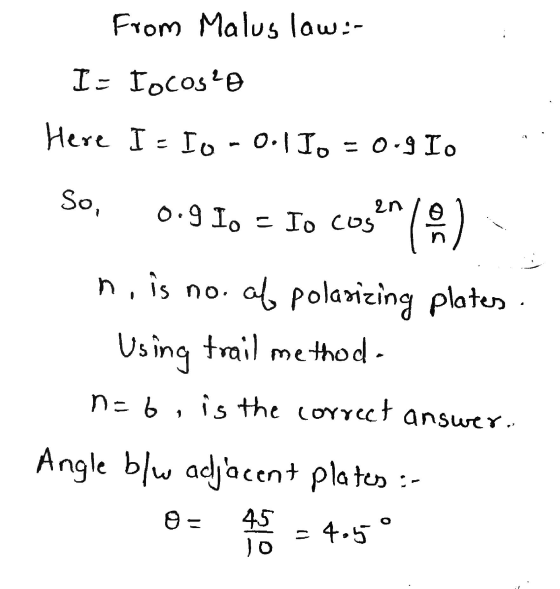
Add Answer to:
Consider a sequence of ideal polarizing lters, each with its
axis making the same angle with...
Consider a sequence of ideal polarizing filters, each with its axis making the same angle with...
 Consider a sequence of ideal polarizing filters, each with its
axis making the same angle with the axis of the previous filter.
These polarizers rotate the plane of polarization of a light beam
by a total angle of 45◦ .
a) In order to have no more than a 10.0% reduction of intensity,
what is the minimum number of polarizers needed? Hint: The equation
you will set up to solve this will be transcendental, so it is
impossible to solve...
Consider a sequence of ideal polarizing filters, each with its
axis making the same angle with the axis of the previous filter.
These polarizers rotate the plane of polarization of a light beam
by a total angle of 45◦ .
a) In order to have no more than a 10.0% reduction of intensity,
what is the minimum number of polarizers needed? Hint: The equation
you will set up to solve this will be transcendental, so it is
impossible to solve...
Question 2: Consider a sequence of ideal polarizing filters, each with its axis making the same...
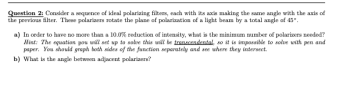 Question 2: Consider a sequence of ideal polarizing filters, each with its axis making the same angle with the axis of the previous filter. These polarizers rotate the plane of polarization of a light beam by a total angle of 45°. a) In order to have no more than a 10.0% reduction of intensity, what is the minimum number of polarizers needed? Hint: The equation you will set up to solve this will be transcendental, so it is impossible to...
A beam of initially unpolarized light passes through a sequence of three ideal polarizers. The angle...
 A beam of initially unpolarized light passes through a sequence of three ideal polarizers. The angle between the axes of the and second polarizers, labeled P12, is 22.1° and the angle between the axes of the second and third polarizers, labeled 023, 53.3°. What is the ratio of the intensity of light emerging from the third polarizer, 13 , to the intensity of light incident on the first polarizer, I ? A beam of unpolarized light shines on a stack...
The diagram below shows a beam of light shining through three linear polarizers in a row. The polarizing axis of each polarizer is measured at an angle (ϴ1,ϴ2,ϴ3) from vertical. Suppose that the orig...
 The diagram below shows a beam of light shining through three
linear polarizers in a row. The polarizing axis of each polarizer
is measured at an angle (ϴ1,ϴ2,ϴ3) from vertical.
Suppose that the original beam of light emanates from a
vertically polarized laser. The laser has a power output of 1 mW
and the beam has a diameter of 2 mm. What is the intensity of the
laser beam before it travels through any polarizers?
Calculate the final intensity of...
The diagram below shows a beam of light shining through three
linear polarizers in a row. The polarizing axis of each polarizer
is measured at an angle (ϴ1,ϴ2,ϴ3) from vertical.
Suppose that the original beam of light emanates from a
vertically polarized laser. The laser has a power output of 1 mW
and the beam has a diameter of 2 mm. What is the intensity of the
laser beam before it travels through any polarizers?
Calculate the final intensity of...
 Consider a sequence of ideal polarizing filters, each with its
axis making the same angle with the axis of the previous filter.
These polarizers rotate the plane of polarization of a light beam
by a total angle of 45◦ .
a) In order to have no more than a 10.0% reduction of intensity,
what is the minimum number of polarizers needed? Hint: The equation
you will set up to solve this will be transcendental, so it is
impossible to solve...
Consider a sequence of ideal polarizing filters, each with its
axis making the same angle with the axis of the previous filter.
These polarizers rotate the plane of polarization of a light beam
by a total angle of 45◦ .
a) In order to have no more than a 10.0% reduction of intensity,
what is the minimum number of polarizers needed? Hint: The equation
you will set up to solve this will be transcendental, so it is
impossible to solve...
 Question 2: Consider a sequence of ideal polarizing filters, each with its axis making the same angle with the axis of the previous filter. These polarizers rotate the plane of polarization of a light beam by a total angle of 45°. a) In order to have no more than a 10.0% reduction of intensity, what is the minimum number of polarizers needed? Hint: The equation you will set up to solve this will be transcendental, so it is impossible to...
 A beam of initially unpolarized light passes through a sequence of three ideal polarizers. The angle between the axes of the and second polarizers, labeled P12, is 22.1° and the angle between the axes of the second and third polarizers, labeled 023, 53.3°. What is the ratio of the intensity of light emerging from the third polarizer, 13 , to the intensity of light incident on the first polarizer, I ? A beam of unpolarized light shines on a stack...
 The diagram below shows a beam of light shining through three
linear polarizers in a row. The polarizing axis of each polarizer
is measured at an angle (ϴ1,ϴ2,ϴ3) from vertical.
Suppose that the original beam of light emanates from a
vertically polarized laser. The laser has a power output of 1 mW
and the beam has a diameter of 2 mm. What is the intensity of the
laser beam before it travels through any polarizers?
Calculate the final intensity of...
The diagram below shows a beam of light shining through three
linear polarizers in a row. The polarizing axis of each polarizer
is measured at an angle (ϴ1,ϴ2,ϴ3) from vertical.
Suppose that the original beam of light emanates from a
vertically polarized laser. The laser has a power output of 1 mW
and the beam has a diameter of 2 mm. What is the intensity of the
laser beam before it travels through any polarizers?
Calculate the final intensity of...
Most questions answered within 3 hours.
-
Where is the error in this code sequence?
String s1 = "Hello";
String s2 = "ello";...
asked 10 months ago -
Financial data for Joel de Paris, Inc., for last year
follow:
Joel de Paris, Inc.
Balance...
asked 10 months ago -
Consider this reaction:
Al2(SO4)3 (aq)+ BaCl3
(aq) Al2Cl6 (aq)- +
3BaSO4(s) . What is the...
asked 10 months ago -
Suppose that Savneet is considering increasing her
recent random sample from 20 car rentals to 40...
asked 10 months ago -
Trucks arrive at an unloading terminal at an average rate of 120
per hour.
Trucks arrive...
asked 10 months ago -
Why are methanol and ethanol completely soluble in water while
octanol is not very little soluble....
asked 10 months ago -
A facilities manager at a university reads in a research report
that the mean amount of...
asked 10 months ago -
When the CuSO4 is rehydrated by adding water to the anhydrous
compound, is this an endothermic...
asked 10 months ago -
A ray of sunlight is passing from diamond into crown glass; the
angle of incidence is...
asked 10 months ago -
A block of mass 0.249 kg is placed on top of a light, vertical
spring of...
asked 10 months ago -
how do the kidneys compensate in the presences of acidosis
a) trigger hyperventilate
b) reserve acid...
asked 10 months ago -
Question 501 pts
The rental rate of capital to the firm increases. Which of the
following...
asked 10 months ago