
Homework Answers
Ans:
a. True
explanation:

Add Answer to:
4. If a velocity graph of an object is a horizontal line, then the object is...
5. The following graph represents the velocity of an object, moving along a horizontal line as...
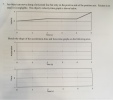
 5. The following graph represents the velocity of an object, moving along a horizontal line as a function of time. Express all answers to two significant figures. East is the positive direction and West is negative. (6 marks) Velocity Vs. Time 10 Velocity. (m/s) 10 12 14 -6 Time, t(s) a) Determine the acceleration of the object at 1.0s. b) Determine the average velocity of the object between 4.0 and 8.0 s. c) Over what time interval(s), if any, is...
5. The following graph represents the velocity of an object, moving along a horizontal line as...
 5. The following graph represents the velocity of an object, moving along a horizontal line as a function of time. Express all answers to two significant figures. East is the positive direction and West is negative. (6 marks) Velocity Vs. Time 10 8 6 Velocity. (m/s) 10 12 14 -2 -6 .8 Time, t, (s) a) Determine the acceleration of the object at 1.0. b) Determine the average velocity of the object between 4.0 and 8.0 s. c) Over what...
4. The following graph represents the position of an object, moving along a horizontal line as...
 4. The following graph represents the position of an object, moving along a horizontal line as a function of time. The positive direction is East and negative direction is West. Express all answers to two significant figures. (5 marks) Position Vs. Time 15 10 6 8 10 12 14 16 18 -10 -15 Time, t, (s) a) Over what time interval(s), if any, is the object stopped? b) At what time(s), if any, does the object change direction? c) Determine...
6. A 2.0-kg object moves in a straight line on a horizontal frictionless surface. The graph...
 6. A 2.0-kg object moves in a straight line on a horizontal frictionless surface. The graph above shows the velocity of the object as a function of time. The various equal time intervals (sections) are labeled using Roman numerals: I, II, III, IV, and V. The net force on the object always acts along the line of motion of the object Which section(s) of the graph correspond to a condition of zero net force? a. b. Which section(s) of the...
Part A: An object is moving with constant non-zero velocity in the +x axis. The position...
Part A: An object is moving with constant non-zero velocity in the +x axis. The position versus time graph of this object is Part B: An object is moving with constant non-zero acceleration in the +x axis. The position versus time graph of this object is Part C: An object is moving with constant non-zero velocity in the +x axis. The velocity versus time graph of this object is Part D: An object is moving with constant non-zero acceleration in...
4. Draw both a position-versus-time graph and a velocity-versus-time graph for an object at rest at...
 4. Draw both a position-versus-time graph and a velocity-versus-time graph for an object at rest at x=1m. 5. The figure shows the position-versus-time graphs for two objects, A and B, that are moving along the same axis. At the instant t1 s, is the speed of A greater than, less than, or equa to the speed of B? Explain. b. Do objects A and B ever have the same speed? If so, at what time or times? Explain. 6. Below...
An object can move along a horizontal line but only on the positive side of the...
 An object can move along a horizontal line but only on the positive side of the position axis. Friction is so small it is negligible. The object's velocity-time graph is shown below. 7. 0 Time (s) Sketch the shape of the acceleration-time and force-time graphs on the following axes. Time (s) Time (s)
Is this statement true? For a free fall object(the horizontal component of the initial velocity is...
Is this statement true? For a free fall object(the horizontal component of the initial velocity is zero), its velocity is zero when it reaches maximum height, but its acceleration is not zero at the same time.
If the net torque on a rotating object is zero, the angular velocity of the object...
If the net torque on a rotating object is zero, the angular velocity of the object cannot change. True or False? Explain A. True , Explan: _________ B False , Explan: _________ (I know the answer is B, I need help on explanation) Thanks
The figure(Figure 1) shows the velocity graph of a 2.7kg object as it moves along the...
 The figure(Figure 1) shows the velocity graph of a 2.7kg object
as it moves along the x-axis.
A) What is the net force acting on this object at t= 1
s?
B) At 4 s?
C) At 7 s?
The figure(Figure 1) shows the velocity graph of a 2.7kg object as it moves along the x - axis. A) What is the net force acting on this object at t= 1 s? B) At 4 s? C) At 7 s?
The figure(Figure 1) shows the velocity graph of a 2.7kg object
as it moves along the x-axis.
A) What is the net force acting on this object at t= 1
s?
B) At 4 s?
C) At 7 s?
The figure(Figure 1) shows the velocity graph of a 2.7kg object as it moves along the x - axis. A) What is the net force acting on this object at t= 1 s? B) At 4 s? C) At 7 s?
 5. The following graph represents the velocity of an object, moving along a horizontal line as a function of time. Express all answers to two significant figures. East is the positive direction and West is negative. (6 marks) Velocity Vs. Time 10 Velocity. (m/s) 10 12 14 -6 Time, t(s) a) Determine the acceleration of the object at 1.0s. b) Determine the average velocity of the object between 4.0 and 8.0 s. c) Over what time interval(s), if any, is...
 5. The following graph represents the velocity of an object, moving along a horizontal line as a function of time. Express all answers to two significant figures. East is the positive direction and West is negative. (6 marks) Velocity Vs. Time 10 8 6 Velocity. (m/s) 10 12 14 -2 -6 .8 Time, t, (s) a) Determine the acceleration of the object at 1.0. b) Determine the average velocity of the object between 4.0 and 8.0 s. c) Over what...
 4. The following graph represents the position of an object, moving along a horizontal line as a function of time. The positive direction is East and negative direction is West. Express all answers to two significant figures. (5 marks) Position Vs. Time 15 10 6 8 10 12 14 16 18 -10 -15 Time, t, (s) a) Over what time interval(s), if any, is the object stopped? b) At what time(s), if any, does the object change direction? c) Determine...
 6. A 2.0-kg object moves in a straight line on a horizontal frictionless surface. The graph above shows the velocity of the object as a function of time. The various equal time intervals (sections) are labeled using Roman numerals: I, II, III, IV, and V. The net force on the object always acts along the line of motion of the object Which section(s) of the graph correspond to a condition of zero net force? a. b. Which section(s) of the...
 4. Draw both a position-versus-time graph and a velocity-versus-time graph for an object at rest at x=1m. 5. The figure shows the position-versus-time graphs for two objects, A and B, that are moving along the same axis. At the instant t1 s, is the speed of A greater than, less than, or equa to the speed of B? Explain. b. Do objects A and B ever have the same speed? If so, at what time or times? Explain. 6. Below...
 An object can move along a horizontal line but only on the positive side of the position axis. Friction is so small it is negligible. The object's velocity-time graph is shown below. 7. 0 Time (s) Sketch the shape of the acceleration-time and force-time graphs on the following axes. Time (s) Time (s)
 The figure(Figure 1) shows the velocity graph of a 2.7kg object
as it moves along the x-axis.
A) What is the net force acting on this object at t= 1
s?
B) At 4 s?
C) At 7 s?
The figure(Figure 1) shows the velocity graph of a 2.7kg object as it moves along the x - axis. A) What is the net force acting on this object at t= 1 s? B) At 4 s? C) At 7 s?
The figure(Figure 1) shows the velocity graph of a 2.7kg object
as it moves along the x-axis.
A) What is the net force acting on this object at t= 1
s?
B) At 4 s?
C) At 7 s?
The figure(Figure 1) shows the velocity graph of a 2.7kg object as it moves along the x - axis. A) What is the net force acting on this object at t= 1 s? B) At 4 s? C) At 7 s?
Most questions answered within 3 hours.
-
Where is the error in this code sequence?
String s1 = "Hello";
String s2 = "ello";...
asked 10 months ago -
Financial data for Joel de Paris, Inc., for last year
follow:
Joel de Paris, Inc.
Balance...
asked 10 months ago -
Consider this reaction:
Al2(SO4)3 (aq)+ BaCl3
(aq) Al2Cl6 (aq)- +
3BaSO4(s) . What is the...
asked 10 months ago -
Suppose that Savneet is considering increasing her
recent random sample from 20 car rentals to 40...
asked 10 months ago -
Trucks arrive at an unloading terminal at an average rate of 120
per hour.
Trucks arrive...
asked 10 months ago -
Why are methanol and ethanol completely soluble in water while
octanol is not very little soluble....
asked 10 months ago -
A facilities manager at a university reads in a research report
that the mean amount of...
asked 10 months ago -
When the CuSO4 is rehydrated by adding water to the anhydrous
compound, is this an endothermic...
asked 10 months ago -
A ray of sunlight is passing from diamond into crown glass; the
angle of incidence is...
asked 10 months ago -
A block of mass 0.249 kg is placed on top of a light, vertical
spring of...
asked 10 months ago -
how do the kidneys compensate in the presences of acidosis
a) trigger hyperventilate
b) reserve acid...
asked 10 months ago -
Question 501 pts
The rental rate of capital to the firm increases. Which of the
following...
asked 10 months ago