A wall is built of two metals (stainless steel and copper) that are in thermal contact...
A wall is built of two metals (stainless steel and copper) that are in thermal contact with each other. The temperature difference across the entire wall is 32.055 K and across the copper sheet it is 2.272 K. If the steel sheet is 1.163 cm thick, how thick is the copper sheet? cm
Homework Answers
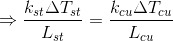
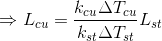
Using Fourier's law of heat conduction : 

Add Answer to:
A wall is built of two metals (stainless steel and copper) that
are in thermal contact...
Q 13.32: A wall is built of two metals (stainless steel and lead) that are in...
Q 13.32: A wall is built of two metals (stainless steel and lead) that are in thermal contact with each other. If the temperature difference across both metals is 28.856 K and across the (3.001 cm thick) lead plate is 12.32 K, how thick is the steel plate?
A) A stainless steel bar 11.8 cm long is welded end to end to a copper...
A) A stainless steel bar 11.8 cm long is welded end to end to a copper bar 22.6 cm long. Each bar has a square cross section, 2.0 cm on a side. The free end of the stainless steel bar is kept at 100∘C by placing it in contact with steam, and the free end of the copper bar is kept at with 0∘C by placing it in contact with ice. Both bars are perfectly insulated on their sides. What...
2. Two stainless steel plate 10 mm thick are subjected to a constant pressure of 1...
 2. Two stainless steel plate 10 mm thick are subjected to a constant pressure of 1 bar under vacuum conditions for which there is an overall temperature drop of 100°C across the plate. What would be effect of loading silicone oil on metallic interface? TABLE 3.1 Thermal contact resistance for (a) metallic interfaces under vacuum conditions and (b) aluminum interface (10-um surface roughness, 105 Nm2 with different interfacial fluids [1 Thermal Resistance, Rzc x 10 (m2-K/W) (a) Vacuum Interface Contact...
Problem 2 [8 marks] A wall is composed of 75 cm of stainless steel (-17 Wm...
 Problem 2 [8 marks] A wall is composed of 75 cm of stainless steel (-17 Wm and 4 cm of an insulating material. On one side of the wall, heat is continuously generated at a rate of 2500 W/m and the wan temperature is Ti = 500°C. On the other side of the wall, the air temperature is 30°C. a) Calculate the temperature at the steel and insulation interface, T b) Calculate the surface temperature of the insulating material (5)...
A wall is built that has an outer steel (k= 43 J/s m degrees C) wall...
A wall is built that has an outer steel (k= 43 J/s m degrees C) wall that is 0.012 m thick, then an inner wall of 0.014 m thick glass (k= 1.05 J/s m degrees C). The inside temperature is 21 degrees C and the outside is 2 degrees C. Q1: What is the temperature at the steel/glass interface? Q2: What would be the rate of heat flow? Q3: If the two walls were separated by a 0.224 m layer...
Steam at 150 °C flows in a stainless steel pipe which has a thermal conductivity of...
Steam at 150 °C flows in a stainless steel pipe which has a thermal conductivity of 16 W m-1 K -1 whose inner and outer diameters are 5 and 6 cm respectively. The pipe is covered with 3 cm think insulation having a thermal conductivity of 0.035 W m-1 K -1 . The combined convection and radiation heat transfer coefficient at the outside surface of the insulation is 20 W m-2 K -1 and the surroundings are at 10 °C....
Problem 2 (15 pts) A spherical container containing radioactive waste is thrown into the ocean waters maintained at 300 half of the container is made of stainless steel with a thermal conducti...
 Problem 2 (15 pts) A spherical container containing radioactive waste is thrown into the ocean waters maintained at 300 half of the container is made of stainless steel with a thermal conductivity of 15.1 W/mK. The convection coefficient has the same value of 555 W/m2 K with both lid and bottom. The inner radius of the co the container is 600 K (the same for the lid and may be assumed to have an infinite contact resistance. Assume that the...
A stainless-steel-bottomed kettle, its bottom 28 cm in diameter and 1.6 mm thick, sits on a...
A stainless-steel-bottomed kettle, its bottom 28 cm in diameter and 1.6 mm thick, sits on a burner. The kettle holds boiling water, and energy flows into the water from the kettle bottom at 800 W . What is the temperature of the bottom surface of the kettle? Thermal conductivity of stainless steel is 14 W/(m⋅K). Express your answer in degrees Celsius to four significant figures.
2.) A plane wall is made of brick with a thermal conductivity of 1.5 W/(m-K). The...
 2.) A plane wall is made of brick with a thermal conductivity of 1.5 W/(m-K). The wall is 20 cm thick and has a surface area of 10 m2. One side of the wall is exposed to outside air blowing against the wall resulting in a heat transfer coefficient of 20 W/(m2-K). The other side is exposed to an air-conditioned room with a convective heat transfer coefficient of 5 W/(m2-K). a. What are the thermal resistances corresponding to conduction through...
5. Two metal sheets, in direct contact, separate two regions with constant (T2 = 32.50 °C...
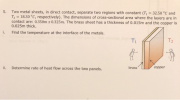 5. Two metal sheets, in direct contact, separate two regions with constant (T2 = 32.50 °C and T2 = 18.30 °C, respectively). The dimensions of cross-sectional area where the layers are in contact are: 0.350m x 0.325m. The brass sheet has a thickness of 0.015m and the copper is 0.025m thick. Find the temperature at the interface of the metals. T1 Tz i. # ii. Determine rate of heat flow across the two panels. brass copper
 2. Two stainless steel plate 10 mm thick are subjected to a constant pressure of 1 bar under vacuum conditions for which there is an overall temperature drop of 100°C across the plate. What would be effect of loading silicone oil on metallic interface? TABLE 3.1 Thermal contact resistance for (a) metallic interfaces under vacuum conditions and (b) aluminum interface (10-um surface roughness, 105 Nm2 with different interfacial fluids [1 Thermal Resistance, Rzc x 10 (m2-K/W) (a) Vacuum Interface Contact...
 Problem 2 [8 marks] A wall is composed of 75 cm of stainless steel (-17 Wm and 4 cm of an insulating material. On one side of the wall, heat is continuously generated at a rate of 2500 W/m and the wan temperature is Ti = 500°C. On the other side of the wall, the air temperature is 30°C. a) Calculate the temperature at the steel and insulation interface, T b) Calculate the surface temperature of the insulating material (5)...
 Problem 2 (15 pts) A spherical container containing radioactive waste is thrown into the ocean waters maintained at 300 half of the container is made of stainless steel with a thermal conductivity of 15.1 W/mK. The convection coefficient has the same value of 555 W/m2 K with both lid and bottom. The inner radius of the co the container is 600 K (the same for the lid and may be assumed to have an infinite contact resistance. Assume that the...
 2.) A plane wall is made of brick with a thermal conductivity of 1.5 W/(m-K). The wall is 20 cm thick and has a surface area of 10 m2. One side of the wall is exposed to outside air blowing against the wall resulting in a heat transfer coefficient of 20 W/(m2-K). The other side is exposed to an air-conditioned room with a convective heat transfer coefficient of 5 W/(m2-K). a. What are the thermal resistances corresponding to conduction through...
 5. Two metal sheets, in direct contact, separate two regions with constant (T2 = 32.50 °C and T2 = 18.30 °C, respectively). The dimensions of cross-sectional area where the layers are in contact are: 0.350m x 0.325m. The brass sheet has a thickness of 0.015m and the copper is 0.025m thick. Find the temperature at the interface of the metals. T1 Tz i. # ii. Determine rate of heat flow across the two panels. brass copper
Most questions answered within 3 hours.
-
Where is the error in this code sequence?
String s1 = "Hello";
String s2 = "ello";...
asked 11 months ago -
Financial data for Joel de Paris, Inc., for last year
follow:
Joel de Paris, Inc.
Balance...
asked 11 months ago -
Consider this reaction:
Al2(SO4)3 (aq)+ BaCl3
(aq) Al2Cl6 (aq)- +
3BaSO4(s) . What is the...
asked 11 months ago -
Suppose that Savneet is considering increasing her
recent random sample from 20 car rentals to 40...
asked 11 months ago -
Trucks arrive at an unloading terminal at an average rate of 120
per hour.
Trucks arrive...
asked 11 months ago -
Why are methanol and ethanol completely soluble in water while
octanol is not very little soluble....
asked 11 months ago -
A facilities manager at a university reads in a research report
that the mean amount of...
asked 11 months ago -
When the CuSO4 is rehydrated by adding water to the anhydrous
compound, is this an endothermic...
asked 11 months ago -
A ray of sunlight is passing from diamond into crown glass; the
angle of incidence is...
asked 11 months ago -
A block of mass 0.249 kg is placed on top of a light, vertical
spring of...
asked 11 months ago -
how do the kidneys compensate in the presences of acidosis
a) trigger hyperventilate
b) reserve acid...
asked 11 months ago -
Question 501 pts
The rental rate of capital to the firm increases. Which of the
following...
asked 11 months ago