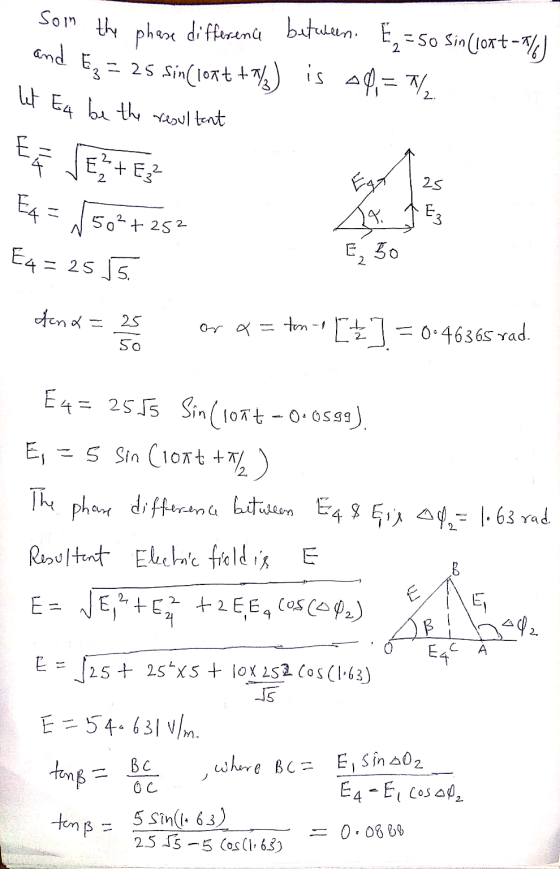
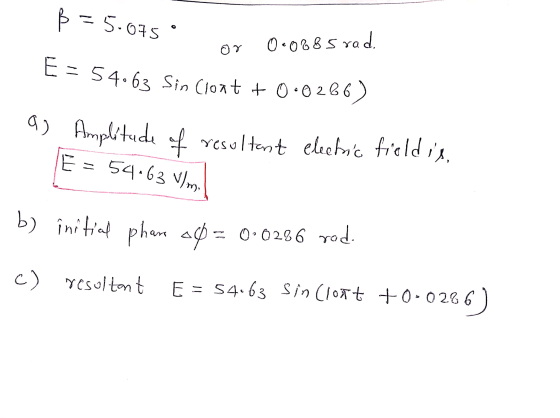
![Problem 2 [25 pts]: Three parallel waves travelling together are represented by the following functions: E, = 5sin (10nt + 3)](http://img.homeworklib.com/questions/5787a720-d9a4-11ea-a06f-f943743a84b8.png?x-oss-process=image/resize,w_560)
Homework Answers
Add Answer to:
Problem 2 [25 pts]: Three parallel waves travelling together are represented by the following functions: E,...
Problem 1 [30 pts): Two waves travelling in opposite directions produce a standing wave. The individual...
 Problem 1 [30 pts): Two waves travelling in opposite directions produce a standing wave. The individual wave functions are: b = 6sin(4x - 5t) 42 = 6sin(4x + 5t) where x and y are measured in m and t in s. a) (10 pts] Find the amplitude of the simple harmonic motion of the element of the medium located at x = 2.7 m. b) (20 pts) Find the positions of the first three nodes and antinodes if one end...
Question: Two light waves traveling in the x direction have an electric field component polarized parallel...
 Question: Two light waves traveling in the x direction have an electric field component polarized parallel to the y axis given by El-892sin(3.54x 10¹⁵) μν/m E2-892sin(3.54x 10% + 0.22) μν/m at a point P, where t is in seconds and phase is in radians. Part 1) What is the amplitude of the resulting electric field at this point? Part 2) What is the phase difference between Ei and E +E2? rad Part 3) What is the intensity of the resultant...
U Question 4 2 pts Problem 3: Proton travelling inside a parallel-plate capacitor. A proton travelling...
 U Question 4 2 pts Problem 3: Proton travelling inside a parallel-plate capacitor. A proton travelling at a speed of 1.0 x 10⁶m/s enters the gap between the plates of a parallel-plate capacitor. The plates are 2.0 cm long in the direction the proton is travelling and the surface charge densities on the plates are 1.0 x 10C/m². Assume the electric field is uniform inside the capacitor and zero outside. The mass of a proton is 1.7 x 10⁻²⁷ kg....
PROBLEM 2 150 pts.] A signal is consist of three sine functions: the first one, ,...
 PROBLEM 2 150 pts.] A signal is consist of three sine functions: the first one, , has a wave frequency of 50 Hz, the second one, 2, has 100 Hz, and the last one, r3, has 200 Hz. However, each function has different amplitude: the amplitude of the first signal component x! is 10 cm, the amplitude of the second signal component xi s 5 cm; and the amplitude of the last signal component t3 is 1 cm. As a...
Problem 6. Electromagnetic plane waves in a lossy medium The electric field of an electromagnetic plane wave traveling in a lossy medium can be written as where z is the distance, t is time, and f...
 Problem 6. Electromagnetic plane waves in a lossy medium The electric field of an electromagnetic plane wave traveling in a lossy medium can be written as where z is the distance, t is time, and fthe frequency. For f 1 GHz, it is found by measurement that the amplitude of the electric field is attenuated by a factor of 3 after the wave travels 100 m (i.e., to 1/3 of the amplitude at z-0 when it arrives at z- 100...
Problem 2 [8 pts] Oscillator As a quality control technician at a violin string factory, you cut a sample of E-string o...
 Problem 2 [8 pts] Oscillator As a quality control technician at a violin string factory, you cut a sample of E-string off a large roll. The sample that you cut has a mass of ms = 1.021 grams and a full length of 2.5 meters. To test the string, you stretch some of it across a length L = 0.35 m, applying tension by means of a hanging mass m (as pictured). A variable frequency oscillator is used to excite...
1) Two parallel beams of light are brought together on a surface. Each beam has wave length h-500...
 1) Two parallel beams of light are brought together on a surface. Each beam has wave length h-500 nm and intensity 1 W/m at the surface. What is the resultant intensity for each of the following path lengths or phase differences between the beams? Phase or path length difference Intensity (W/m) 0 radians (phase) T/2 radians (phase) 60 degrees (phase) 3π radians (phase) 300 nm (path length) 1000 nm (path length) 5.5 λ (path length) 2) A wave of wavelength...
PLEASE ANSWER ALL OF THE QUESTIONS Question 1 1 pts Each of three objects has a...
 PLEASE ANSWER ALL OF THE QUESTIONS
Question 1 1 pts Each of three objects has a net charge. Objects A and B repel each other. Objects B and C attract each other. Which one of the following table entries is a possible combination of the signs of the net charges on these three objects? A B с (1) + + - + (2) + + (3) (4) - (5) + - 0 1) 3) 0 (3) and (5) O (1)...
PLEASE ANSWER ALL OF THE QUESTIONS
Question 1 1 pts Each of three objects has a net charge. Objects A and B repel each other. Objects B and C attract each other. Which one of the following table entries is a possible combination of the signs of the net charges on these three objects? A B с (1) + + - + (2) + + (3) (4) - (5) + - 0 1) 3) 0 (3) and (5) O (1)...
Yes, this is one problem. Please solve ALL PARTS. Guaranteed thumbs up for the person who solves it. 3 1. Photodiode...
 Yes, this is one problem. Please solve ALL PARTS. Guaranteed
thumbs up for the person who solves it.
3 1. Photodiode amplifier circuit You are designinga CF photosensor circuit for a light detection and ranging LiDAR) system in autonomous vehicles. The circuit utilizes a transimpedance amplifier to convert low-level RF photodiode current signal to a usable voltage output. It consists of a photodiode, an amplifier, and feedback capacitor/resistor pair as shown in Figure 1. We will derive simple equations to...
Yes, this is one problem. Please solve ALL PARTS. Guaranteed
thumbs up for the person who solves it.
3 1. Photodiode amplifier circuit You are designinga CF photosensor circuit for a light detection and ranging LiDAR) system in autonomous vehicles. The circuit utilizes a transimpedance amplifier to convert low-level RF photodiode current signal to a usable voltage output. It consists of a photodiode, an amplifier, and feedback capacitor/resistor pair as shown in Figure 1. We will derive simple equations to...
 Problem 1 [30 pts): Two waves travelling in opposite directions produce a standing wave. The individual wave functions are: b = 6sin(4x - 5t) 42 = 6sin(4x + 5t) where x and y are measured in m and t in s. a) (10 pts] Find the amplitude of the simple harmonic motion of the element of the medium located at x = 2.7 m. b) (20 pts) Find the positions of the first three nodes and antinodes if one end...
 Question: Two light waves traveling in the x direction have an electric field component polarized parallel to the y axis given by El-892sin(3.54x 10¹⁵) μν/m E2-892sin(3.54x 10% + 0.22) μν/m at a point P, where t is in seconds and phase is in radians. Part 1) What is the amplitude of the resulting electric field at this point? Part 2) What is the phase difference between Ei and E +E2? rad Part 3) What is the intensity of the resultant...
 U Question 4 2 pts Problem 3: Proton travelling inside a parallel-plate capacitor. A proton travelling at a speed of 1.0 x 10⁶m/s enters the gap between the plates of a parallel-plate capacitor. The plates are 2.0 cm long in the direction the proton is travelling and the surface charge densities on the plates are 1.0 x 10C/m². Assume the electric field is uniform inside the capacitor and zero outside. The mass of a proton is 1.7 x 10⁻²⁷ kg....
 PROBLEM 2 150 pts.] A signal is consist of three sine functions: the first one, , has a wave frequency of 50 Hz, the second one, 2, has 100 Hz, and the last one, r3, has 200 Hz. However, each function has different amplitude: the amplitude of the first signal component x! is 10 cm, the amplitude of the second signal component xi s 5 cm; and the amplitude of the last signal component t3 is 1 cm. As a...
 Problem 6. Electromagnetic plane waves in a lossy medium The electric field of an electromagnetic plane wave traveling in a lossy medium can be written as where z is the distance, t is time, and fthe frequency. For f 1 GHz, it is found by measurement that the amplitude of the electric field is attenuated by a factor of 3 after the wave travels 100 m (i.e., to 1/3 of the amplitude at z-0 when it arrives at z- 100...
 Problem 2 [8 pts] Oscillator As a quality control technician at a violin string factory, you cut a sample of E-string off a large roll. The sample that you cut has a mass of ms = 1.021 grams and a full length of 2.5 meters. To test the string, you stretch some of it across a length L = 0.35 m, applying tension by means of a hanging mass m (as pictured). A variable frequency oscillator is used to excite...
 1) Two parallel beams of light are brought together on a surface. Each beam has wave length h-500 nm and intensity 1 W/m at the surface. What is the resultant intensity for each of the following path lengths or phase differences between the beams? Phase or path length difference Intensity (W/m) 0 radians (phase) T/2 radians (phase) 60 degrees (phase) 3π radians (phase) 300 nm (path length) 1000 nm (path length) 5.5 λ (path length) 2) A wave of wavelength...
 PLEASE ANSWER ALL OF THE QUESTIONS
Question 1 1 pts Each of three objects has a net charge. Objects A and B repel each other. Objects B and C attract each other. Which one of the following table entries is a possible combination of the signs of the net charges on these three objects? A B с (1) + + - + (2) + + (3) (4) - (5) + - 0 1) 3) 0 (3) and (5) O (1)...
PLEASE ANSWER ALL OF THE QUESTIONS
Question 1 1 pts Each of three objects has a net charge. Objects A and B repel each other. Objects B and C attract each other. Which one of the following table entries is a possible combination of the signs of the net charges on these three objects? A B с (1) + + - + (2) + + (3) (4) - (5) + - 0 1) 3) 0 (3) and (5) O (1)...
 Yes, this is one problem. Please solve ALL PARTS. Guaranteed
thumbs up for the person who solves it.
3 1. Photodiode amplifier circuit You are designinga CF photosensor circuit for a light detection and ranging LiDAR) system in autonomous vehicles. The circuit utilizes a transimpedance amplifier to convert low-level RF photodiode current signal to a usable voltage output. It consists of a photodiode, an amplifier, and feedback capacitor/resistor pair as shown in Figure 1. We will derive simple equations to...
Yes, this is one problem. Please solve ALL PARTS. Guaranteed
thumbs up for the person who solves it.
3 1. Photodiode amplifier circuit You are designinga CF photosensor circuit for a light detection and ranging LiDAR) system in autonomous vehicles. The circuit utilizes a transimpedance amplifier to convert low-level RF photodiode current signal to a usable voltage output. It consists of a photodiode, an amplifier, and feedback capacitor/resistor pair as shown in Figure 1. We will derive simple equations to...
Most questions answered within 3 hours.
-
Where is the error in this code sequence?
String s1 = "Hello";
String s2 = "ello";...
asked 10 months ago -
Financial data for Joel de Paris, Inc., for last year
follow:
Joel de Paris, Inc.
Balance...
asked 10 months ago -
Consider this reaction:
Al2(SO4)3 (aq)+ BaCl3
(aq) Al2Cl6 (aq)- +
3BaSO4(s) . What is the...
asked 10 months ago -
Suppose that Savneet is considering increasing her
recent random sample from 20 car rentals to 40...
asked 10 months ago -
Trucks arrive at an unloading terminal at an average rate of 120
per hour.
Trucks arrive...
asked 10 months ago -
Why are methanol and ethanol completely soluble in water while
octanol is not very little soluble....
asked 10 months ago -
A facilities manager at a university reads in a research report
that the mean amount of...
asked 10 months ago -
When the CuSO4 is rehydrated by adding water to the anhydrous
compound, is this an endothermic...
asked 10 months ago -
A ray of sunlight is passing from diamond into crown glass; the
angle of incidence is...
asked 10 months ago -
A block of mass 0.249 kg is placed on top of a light, vertical
spring of...
asked 10 months ago -
how do the kidneys compensate in the presences of acidosis
a) trigger hyperventilate
b) reserve acid...
asked 10 months ago -
Question 501 pts
The rental rate of capital to the firm increases. Which of the
following...
asked 10 months ago