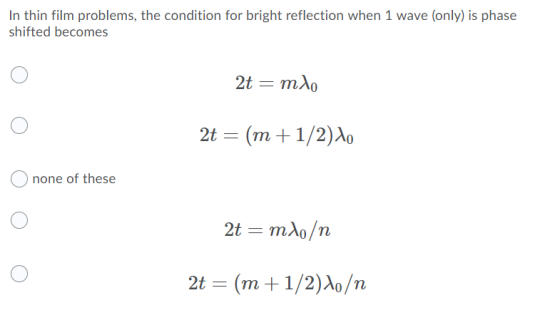
In thin film problems, the condition for bright reflection when 1 wave (only) is phase shifted becomes
Homework Answers

Add Answer to:
In thin film problems, the condition for bright reflection when
1 wave (only) is phase shifted...
Question 24 (1 point) In thin film problems, the condition for bright reflection when 1 wave...
 Question 24 (1 point) In thin film problems, the condition for bright reflection when 1 wave (only is phase shifted becomes 2t = (m +1/2)40/n 2t =mo 2t = (m +1/2)0 none of these 2t = m/o/n Question 25 (1 point) ✓ Saved
Question 24 (1 point) In thin film problems, the condition for bright reflection when 1 wave...
 Question 24 (1 point) In thin film problems, the condition for bright reflection when 1 wave (only) is phase shifted becomes 2t = mło 2t = (m + 1/2) 20 2t = moln Onone of these 2t = (m + 1/2)^o/n
Question 24 (1 point) In thin film problems, the condition for bright reflection when 1 wave...
 Question 24 (1 point) In thin film problems, the condition for bright reflection when 1 wave (only) is phase shifted becomes 2t = mło 2t = (m + 1/2) 20 2t = moln Onone of these 2t = (m + 1/2)lo/n
A tire swing of length L = 6.3 m hangs from a tree over the water. ...
A tire swing of length L = 6.3 m hangs from a tree over the water. On a hot day, a swimmer uses the swing to jump into the lake, and afterward the swing oscillates as a simple pendulum. What is the period of this pendulum? Question options: 5.0 s 6.0 s none of these 3.1 s 4.3 s Question An electric field of magnitude 100. N/c points vertically downward near Earth's surface. What force does a free electron experience...
The default setting is a thin film of glass(n = 1.5) with air (n = 1)on...
 The default setting is a thin film of glass(n = 1.5) with air (n
= 1)on both sides.The starting wavelength is 652 nm and the
starting thickness is 544 nm. Use these starting values for this
next set of questions.
1. Is there a phase shift on the front (left) interface? On the
back (right) interface in the simulation?Justify why there is/isn’t
a phase shift at each interface.
2. How does the wavelength in the film (glass) compare to the...
The default setting is a thin film of glass(n = 1.5) with air (n
= 1)on both sides.The starting wavelength is 652 nm and the
starting thickness is 544 nm. Use these starting values for this
next set of questions.
1. Is there a phase shift on the front (left) interface? On the
back (right) interface in the simulation?Justify why there is/isn’t
a phase shift at each interface.
2. How does the wavelength in the film (glass) compare to the...
When light experiences a phase change, such as what happens in thin film interference, what physical...
When light experiences a phase change, such as what happens in thin film interference, what physical property or properties change phase? A. wave velocity B. electric and/or magnetic field How many 3rd order bright interference fringes occur in a Young’s Double Slit Experiment? Group of answer choices A. 0 B. 1 C. 2 D. 3
When a soap film gets *very* thin, down to a molecular lengths scale, its reflection across...
When a soap film gets *very* thin, down to a molecular lengths scale, its reflection across the entire visible spectrum becomes zero. Why? Explain. Why is it not the other two answers? a. It is too thin to reflect light. b. Reflections from the front and back surface are out of phase, and there is essentially no path difference. c. The molecular length scale is about 1/4 of optical wavelengths, resulting in destructive interference.
Question 5: How would dust and oil on the glass plates affect the results? EXPERIMENT 10 THIN FILM I...
 Question 5:
How would dust and oil on the glass plates affect the
results?
EXPERIMENT 10 THIN FILM INTERFERENCE Light from a monochromatic source is shined downward on two glass plates that are separated at one end by a hair. Light that is reflected from the top and bottom surfaces of the wedge-shaped thin film of air undergoes interference, and a series of dark and light lines are seen. By counting the number of dark or light lines over a...
Question 5:
How would dust and oil on the glass plates affect the
results?
EXPERIMENT 10 THIN FILM INTERFERENCE Light from a monochromatic source is shined downward on two glass plates that are separated at one end by a hair. Light that is reflected from the top and bottom surfaces of the wedge-shaped thin film of air undergoes interference, and a series of dark and light lines are seen. By counting the number of dark or light lines over a...
Wave Optics CHAPTER 17 17-5 17.4 Thin-Film Interference oure shows a wave transmitted from air through...
 Wave Optics CHAPTER 17 17-5 17.4 Thin-Film Interference oure shows a wave transmitted from air through a thin oil film on water. The film has a kness t oil/2, where Noil is the wavelength of the light while in the oil. 2. The fi nicna n1 1.00 n2 1403 1.33 a. Referring to the indices of refraction shown on the figure, indicate at each boundary with a Y (yes) or N (no) whether the reflected wave undergoes a phase change...
I I know that the thickness = lambda/(2nsin 30) BUT why? I've also attached some notes I have! (P...
 I
I know that the thickness = lambda/(2nsin 30) BUT why?
I've also attached some notes I have!
(Please explain using diagram and words for me to rate
the answer)
We were unable to transcribe this imageThin-Film Interference When light is incident on a thin transparent film, the light waves reflected from the front and back surfaces interfere. For near-normal incidence, the wavelength con ditions for maximum and minimum intensity of the light reflected from a film in air are...
I
I know that the thickness = lambda/(2nsin 30) BUT why?
I've also attached some notes I have!
(Please explain using diagram and words for me to rate
the answer)
We were unable to transcribe this imageThin-Film Interference When light is incident on a thin transparent film, the light waves reflected from the front and back surfaces interfere. For near-normal incidence, the wavelength con ditions for maximum and minimum intensity of the light reflected from a film in air are...
 Question 24 (1 point) In thin film problems, the condition for bright reflection when 1 wave (only is phase shifted becomes 2t = (m +1/2)40/n 2t =mo 2t = (m +1/2)0 none of these 2t = m/o/n Question 25 (1 point) ✓ Saved
 Question 24 (1 point) In thin film problems, the condition for bright reflection when 1 wave (only) is phase shifted becomes 2t = mło 2t = (m + 1/2) 20 2t = moln Onone of these 2t = (m + 1/2)^o/n
 Question 24 (1 point) In thin film problems, the condition for bright reflection when 1 wave (only) is phase shifted becomes 2t = mło 2t = (m + 1/2) 20 2t = moln Onone of these 2t = (m + 1/2)lo/n
 The default setting is a thin film of glass(n = 1.5) with air (n
= 1)on both sides.The starting wavelength is 652 nm and the
starting thickness is 544 nm. Use these starting values for this
next set of questions.
1. Is there a phase shift on the front (left) interface? On the
back (right) interface in the simulation?Justify why there is/isn’t
a phase shift at each interface.
2. How does the wavelength in the film (glass) compare to the...
The default setting is a thin film of glass(n = 1.5) with air (n
= 1)on both sides.The starting wavelength is 652 nm and the
starting thickness is 544 nm. Use these starting values for this
next set of questions.
1. Is there a phase shift on the front (left) interface? On the
back (right) interface in the simulation?Justify why there is/isn’t
a phase shift at each interface.
2. How does the wavelength in the film (glass) compare to the...
 Question 5:
How would dust and oil on the glass plates affect the
results?
EXPERIMENT 10 THIN FILM INTERFERENCE Light from a monochromatic source is shined downward on two glass plates that are separated at one end by a hair. Light that is reflected from the top and bottom surfaces of the wedge-shaped thin film of air undergoes interference, and a series of dark and light lines are seen. By counting the number of dark or light lines over a...
Question 5:
How would dust and oil on the glass plates affect the
results?
EXPERIMENT 10 THIN FILM INTERFERENCE Light from a monochromatic source is shined downward on two glass plates that are separated at one end by a hair. Light that is reflected from the top and bottom surfaces of the wedge-shaped thin film of air undergoes interference, and a series of dark and light lines are seen. By counting the number of dark or light lines over a...
 Wave Optics CHAPTER 17 17-5 17.4 Thin-Film Interference oure shows a wave transmitted from air through a thin oil film on water. The film has a kness t oil/2, where Noil is the wavelength of the light while in the oil. 2. The fi nicna n1 1.00 n2 1403 1.33 a. Referring to the indices of refraction shown on the figure, indicate at each boundary with a Y (yes) or N (no) whether the reflected wave undergoes a phase change...
 I
I know that the thickness = lambda/(2nsin 30) BUT why?
I've also attached some notes I have!
(Please explain using diagram and words for me to rate
the answer)
We were unable to transcribe this imageThin-Film Interference When light is incident on a thin transparent film, the light waves reflected from the front and back surfaces interfere. For near-normal incidence, the wavelength con ditions for maximum and minimum intensity of the light reflected from a film in air are...
I
I know that the thickness = lambda/(2nsin 30) BUT why?
I've also attached some notes I have!
(Please explain using diagram and words for me to rate
the answer)
We were unable to transcribe this imageThin-Film Interference When light is incident on a thin transparent film, the light waves reflected from the front and back surfaces interfere. For near-normal incidence, the wavelength con ditions for maximum and minimum intensity of the light reflected from a film in air are...
Most questions answered within 3 hours.
-
Where is the error in this code sequence?
String s1 = "Hello";
String s2 = "ello";...
asked 10 months ago -
Financial data for Joel de Paris, Inc., for last year
follow:
Joel de Paris, Inc.
Balance...
asked 10 months ago -
Consider this reaction:
Al2(SO4)3 (aq)+ BaCl3
(aq) Al2Cl6 (aq)- +
3BaSO4(s) . What is the...
asked 10 months ago -
Suppose that Savneet is considering increasing her
recent random sample from 20 car rentals to 40...
asked 10 months ago -
Trucks arrive at an unloading terminal at an average rate of 120
per hour.
Trucks arrive...
asked 10 months ago -
Why are methanol and ethanol completely soluble in water while
octanol is not very little soluble....
asked 10 months ago -
A facilities manager at a university reads in a research report
that the mean amount of...
asked 10 months ago -
When the CuSO4 is rehydrated by adding water to the anhydrous
compound, is this an endothermic...
asked 10 months ago -
A ray of sunlight is passing from diamond into crown glass; the
angle of incidence is...
asked 10 months ago -
A block of mass 0.249 kg is placed on top of a light, vertical
spring of...
asked 10 months ago -
how do the kidneys compensate in the presences of acidosis
a) trigger hyperventilate
b) reserve acid...
asked 10 months ago -
Question 501 pts
The rental rate of capital to the firm increases. Which of the
following...
asked 10 months ago