
Homework Answers
Answer :
To understand the phenomenon "Surface tension" let, us consider :
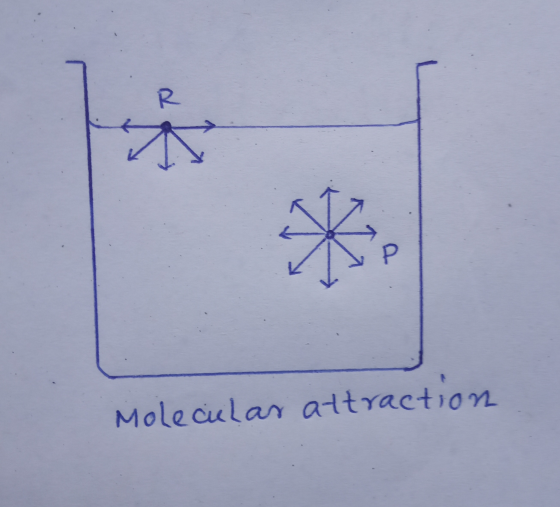
A liquid contact with its vapor. A molecule P is present somewhere in the body of the liquid, which is subjected to the forces of attraction from all directions by the surrounding molecule and is particularly in a uniform field of forces. But, for a molecule at the surface (R) , the net attraction towards the bulk of liquid is much greater than that towards the vapor, where the attracting molecules are more widely dispersed. That means the molecules at the surface are pulled inwards. As a result of the tendency to contract, surface of a liquid behaves like as, if it is in a state of tension. The force that tends to contract the surface of a liquid is known as surface tension.
It is expressed as the force per unit length acting at the right angles to the line along the surface of the liquid.
Given, the surface tension for water at 20°C is 72.8 mN/m and at 100°C the surface tension is 58.9 mN/m.
Explanation :
According to Kinetic Theory, the molecular kinetic energy is proportional to absolute temperature. The rise in temperature of a liquid, therefore, is accompanied by increase in energy of it's molecule.
Hence, with increasing the temperature, the kinetic energy of molecules also increases which leads to the decrease in the intermolecular forces of attraction . So, the surface tension of a liquid will decrease with the rise of temperature.
Thus, when we increase the temperature of the water from 20°C to 100°C , the water molecules gains more kinetic energy, which decrease the strength of the H-bonding in water. Thus, the surface tension of water also decreases from 72.8 mN/m to 58.9 mN/m.
If we rise the temperature of a liquid to the critical temperature , then the surface of separation between a liquid and it's vapor disappears, thus, the surface tension becomes zero.
Add Answer to:
4. The surface tension for water at 20 °C is 72.8 mN/m and at 100 °C...
4. The surface tension for water at 20 °C is 72.8 mN/m and at 100 °C...
 4. The surface tension for water at 20 °C is 72.8 mN/m and at 100 °C the surface tension is 58.9 mN/m. Provide an explanation for why the surface tension of water decreases as the temperature increases.
. Consider an air bubble with radius 0.1 um in water at 20 °C: a. Calculate...
. Consider an air bubble with radius 0.1 um in water at 20 °C: a. Calculate the overpressure inside the bubble and show your calculation procedures. (The surface tension of water is 72.8 mNm-1) b. Calculate the vapor pressure of water inside the bubble, relative to that over a flat water surface. Show your calculation procedures. (The surface tension of water: 72.8 mN m-1 the molecular weight of water:18 g mol1; the gas constant R: 8.314 J-mol1K-)
*Explanations should be brief. Draw a box around each final answer, if applicable.* 1. Consider intermolecular...
 *Explanations should be brief. Draw a box around each final answer, if applicable.* 1. Consider intermolecular forces and kinetic energies with respect to a solid and a liquid. Explain why molecules in a liquid are free to move past each other, while molecules in a solid are held in fixed positions. 2. Use your knowledge of intermolecular forces to provide an explanation for why the boiling point of 2-hexanol is higher than the boiling point of 2,3-dimethyl-2-butanol. Be sure to...
A cell is roughly spherical with a radius of 30.5×10⁻⁶m. The surface tension of water is 71.99 mN...
A cell is roughly spherical with a radius of 30.5×10⁻⁶m. The surface tension of water is 71.99 mN⋅m−1. If the cell grows to double its volume, calculate the magnitude of the work required to expand the cell surface. Assume the cell is surrounded by pure water and that T=298.15K. Express your answer with the appropriate units. Please explain how you arrived to your answer.
values of the surface tension of water, ? in N m-1, at different temperatures, Tin °C,...
 values of the surface tension of water, ? in N m-1, at different temperatures, Tin °C, are given below. If where 8 is the temperature on the Kelvin scale, find the most probable values of the constants a and b. T (°C)10 20 30 40 (Nm-1) 0.074 0.073 0.071 0.070 0.068 0.066 50 60
Question 3. A-C 3. Surface tension of a water strider For an animal the size of...
 Question 3. A-C
3. Surface tension of a water strider For an animal the size of a human, surface tension seems to be a rather small and insignificant force (though it plays an important if unnoticed role in our breathing). But as animals get smaller, surface tension gets increasingly significant. (The weight of the animal goes down with the cube of the size while the surface tension only decreases linearly.) For animals like the basilisk lizard and the jacana (bird),...
Question 3. A-C
3. Surface tension of a water strider For an animal the size of a human, surface tension seems to be a rather small and insignificant force (though it plays an important if unnoticed role in our breathing). But as animals get smaller, surface tension gets increasingly significant. (The weight of the animal goes down with the cube of the size while the surface tension only decreases linearly.) For animals like the basilisk lizard and the jacana (bird),...
3. Surface tension of a water strider For an animal the size of a human, surface...
 3. Surface tension of a water strider For an animal the size of a human, surface tension seems to be a rather small and insignificant force (though it plays an important if unnoticed role in our breathing). But as animals get smaller, surface tension gets increasingly significant. (The weight of the animal goes down with the cube of the size while the surface tension only decreases linearly.) For animals like the basilisk lizard and the jacana (bird), they appear to...
3. Surface tension of a water strider For an animal the size of a human, surface...
 3. Surface tension of a water strider For an animal the size of a human, surface tension seems to be a rather small and insignificant force (though it plays an important if unnoticed role in our breathing). But as animals get smaller, surface tension gets increasingly significant. (The weight of the animal goes down with the cube of the size while the surface tension only decreases linearly.) For animals like the basilisk lizard and the jacana (bird), they appear to...
3. Surface tension of a water strider For an animal the size of a human, surface...
 3. Surface tension of a water strider For an animal the size of a human, surface tension seems to be a rather small and insignificant force (though it plays an important if unnoticed role in our breathing). But as animals get smaller, surface tension gets increasingly significant. (The weight of the animal goes down with the cube of the size while the surface tension only decreases linearly.) For animals like the basilisk lizard and the jacana (bird), they appear to...
3. Surface tension of a water strider For an animal the size of a human, surface...
 3. Surface tension of a water strider For an animal the size of a human, surface tension seems to be a rather small and insignificant force (though it plays an important if unnoticed role in our breathing). But as animals get smaller, surface tension gets increasingly significant. (The weight of the animal goes down with the cube of the size while the surface tension only decreases linearly.) For animals like the basilisk lizard and the jacana (bird), they appear to...
 4. The surface tension for water at 20 °C is 72.8 mN/m and at 100 °C the surface tension is 58.9 mN/m. Provide an explanation for why the surface tension of water decreases as the temperature increases.
 *Explanations should be brief. Draw a box around each final answer, if applicable.* 1. Consider intermolecular forces and kinetic energies with respect to a solid and a liquid. Explain why molecules in a liquid are free to move past each other, while molecules in a solid are held in fixed positions. 2. Use your knowledge of intermolecular forces to provide an explanation for why the boiling point of 2-hexanol is higher than the boiling point of 2,3-dimethyl-2-butanol. Be sure to...
 values of the surface tension of water, ? in N m-1, at different temperatures, Tin °C, are given below. If where 8 is the temperature on the Kelvin scale, find the most probable values of the constants a and b. T (°C)10 20 30 40 (Nm-1) 0.074 0.073 0.071 0.070 0.068 0.066 50 60
 Question 3. A-C
3. Surface tension of a water strider For an animal the size of a human, surface tension seems to be a rather small and insignificant force (though it plays an important if unnoticed role in our breathing). But as animals get smaller, surface tension gets increasingly significant. (The weight of the animal goes down with the cube of the size while the surface tension only decreases linearly.) For animals like the basilisk lizard and the jacana (bird),...
Question 3. A-C
3. Surface tension of a water strider For an animal the size of a human, surface tension seems to be a rather small and insignificant force (though it plays an important if unnoticed role in our breathing). But as animals get smaller, surface tension gets increasingly significant. (The weight of the animal goes down with the cube of the size while the surface tension only decreases linearly.) For animals like the basilisk lizard and the jacana (bird),...
 3. Surface tension of a water strider For an animal the size of a human, surface tension seems to be a rather small and insignificant force (though it plays an important if unnoticed role in our breathing). But as animals get smaller, surface tension gets increasingly significant. (The weight of the animal goes down with the cube of the size while the surface tension only decreases linearly.) For animals like the basilisk lizard and the jacana (bird), they appear to...
 3. Surface tension of a water strider For an animal the size of a human, surface tension seems to be a rather small and insignificant force (though it plays an important if unnoticed role in our breathing). But as animals get smaller, surface tension gets increasingly significant. (The weight of the animal goes down with the cube of the size while the surface tension only decreases linearly.) For animals like the basilisk lizard and the jacana (bird), they appear to...
 3. Surface tension of a water strider For an animal the size of a human, surface tension seems to be a rather small and insignificant force (though it plays an important if unnoticed role in our breathing). But as animals get smaller, surface tension gets increasingly significant. (The weight of the animal goes down with the cube of the size while the surface tension only decreases linearly.) For animals like the basilisk lizard and the jacana (bird), they appear to...
 3. Surface tension of a water strider For an animal the size of a human, surface tension seems to be a rather small and insignificant force (though it plays an important if unnoticed role in our breathing). But as animals get smaller, surface tension gets increasingly significant. (The weight of the animal goes down with the cube of the size while the surface tension only decreases linearly.) For animals like the basilisk lizard and the jacana (bird), they appear to...
Most questions answered within 3 hours.
-
Where is the error in this code sequence?
String s1 = "Hello";
String s2 = "ello";...
asked 11 months ago -
Financial data for Joel de Paris, Inc., for last year
follow:
Joel de Paris, Inc.
Balance...
asked 11 months ago -
Consider this reaction:
Al2(SO4)3 (aq)+ BaCl3
(aq) Al2Cl6 (aq)- +
3BaSO4(s) . What is the...
asked 11 months ago -
Suppose that Savneet is considering increasing her
recent random sample from 20 car rentals to 40...
asked 11 months ago -
Trucks arrive at an unloading terminal at an average rate of 120
per hour.
Trucks arrive...
asked 11 months ago -
Why are methanol and ethanol completely soluble in water while
octanol is not very little soluble....
asked 11 months ago -
A facilities manager at a university reads in a research report
that the mean amount of...
asked 11 months ago -
When the CuSO4 is rehydrated by adding water to the anhydrous
compound, is this an endothermic...
asked 11 months ago -
A ray of sunlight is passing from diamond into crown glass; the
angle of incidence is...
asked 11 months ago -
A block of mass 0.249 kg is placed on top of a light, vertical
spring of...
asked 11 months ago -
how do the kidneys compensate in the presences of acidosis
a) trigger hyperventilate
b) reserve acid...
asked 11 months ago -
Question 501 pts
The rental rate of capital to the firm increases. Which of the
following...
asked 11 months ago