
Homework Answers
For any given potential the way to find the maxima/minima which
are generally called the turning points is to solve for the
derivate of the function and set it to zero, i.e, 
For us,  Now solving for
  gives us
  solutions.
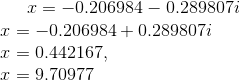
Now the first two solutions are imaginary and we can discard
them. So we see that there are indeed two turning points. Lets us
plot the function  and see,
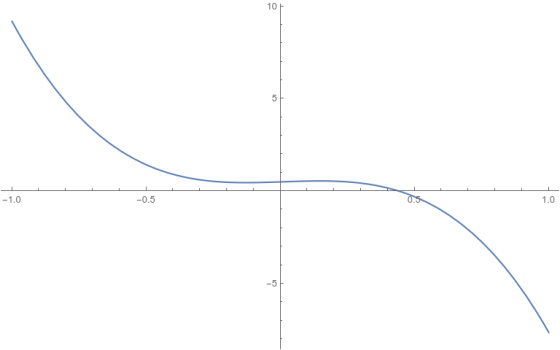
This is near the first turning point,  which is clearly a maximum.
 This is near the second
turning point,
This is near the second
turning point,  which is clearly the minimum (global).
So how can we that the function has only this as the global minimum? Look at say for positive x. For large x, exp(x) dominates and you can ignore x^3. So exp(x) -> infinity and the function is bounded. For small x, exp(x) can be expanded and written as 1 + x + x^2 / 2 + x^3 / 6 + O(x^4). The fourth order term can be neglected since for small x (x < 1), x^4 -> 0. Hence we can say that the function has two turning points, one minimum one maximum.
Now for large x < 0, exp(x) -> and x^3 dominates and its grow and hence its bounded (as can be seen from the graph as well). For small x, again the same logic as above applies. Expansion and check. This is how one can find the turning points intutitively.
Now coming to the question, since the other turning point is a maximum, we can't possibly have any small oscillation there, as any tiny perturbation around that point and the mass will slide to the global minimum (and hence the name its an unstable fixed point).
So the time period is not defined for the mass at the other turning point since its a maximum.
tl;dr The system has two real turning points, One maximum, the other minimum for which the tiemperiod is well defined. The maximum has no well defined time period as any small perturbation will lead to the mass sliding off to the global minimum.
PS: If you say try to write the equation about the maximum
you'll get,  instead of the usual
  for small oscillation. So the system grows and falls for any small
perturbation.
for small oscillation. So the system grows and falls for any small
perturbation.
Add Answer to:
3. A particle with unknown mass is placed into a region of space and subject to...
A particle of mass m moves through a region of space where it is subject to...
 A particle of mass m moves through a region of space where it is subject to a force Ē (I) = Foe-kaầ, where Fo and k are constants. (a) How much work does the force do on the mass to move it from x = 0 to x = oo? (b) If it starts from rest, how fast is the mass moving when it is infinitely far away?
3. A particle of mass is constrained to move without friction along the x-axis, subject to...
 3. A particle of mass is constrained to move without friction along the x-axis, subject to a potential energy siven by Ue) Uo/ constants. Show that for small oscillations about x 0, the particle undergoes simple harmonic motion. What condition on x is required for the oscillations to be "small" (i.e. simple harmonic)? Find the period Tof the oscillations. - 1) where Uo and b are positive
A particle of mass 5 kg is subject to a conservative force whose potential energy (in...
 A particle of mass 5 kg is subject to a conservative force whose potential energy (in joules) as a function of position (in meters) is given by the equation U(x) =-100x5e-1x [where x > 0] (a) Determine the position xo where the particle experiences stable equilibrium (b) Find the potential energy Uo of the particle at the position x 2106 The particle is displaced slightly from position x = xo and released (c) Determine the effective value of the spring...
A particle is introduced to a region with a potential described by U(x)--2x2 +x*+1 Joules. 3. a. ...
 A particle is introduced to a region with a potential described by U(x)--2x2 +x*+1 Joules. 3. a. (2 pts) In software, plot the potential U) Set your axis ranges: -2 SxS2 and 0s b. (5 pts) Find the equilibrium positions and determine whether they are stable or c. (8 pts) Describe the motion of the particle for total energy values E-О.0.05. 1.0, 2.0 unstable. Explain how you arrived at your answers. (all in Joules). What I am looking for here...
3. A particle subject only to conservative forces has the potential energy vs. position curve shown...
 3. A particle subject only to conservative forces has the potential energy vs. position curve shown to the right. The function for the potential is: U(x)-k where γ 1.00 J.m2 and k-7.00 Jr. The particle has a mass of 3.00 kg. (a) Calculate the force on the particle as a function of position, F(x). (b) At which points, (A, B, C, D), must the particle be placed at rest such that it will stay at rest? Why must the particle...
From Classical Mechanics by Taylor 3. (30 pt +10 bonus pt) The mass shown in the...
 From Classical Mechanics by Taylor
3. (30 pt +10 bonus pt) The mass shown in the figure below is resting on a frictionless horizontal table. Each of the two identical springs has force constant and un-stretched length o The mass rests at the origin of an r-y coordinate system, and the two springs are on theヱaxis as shown in the figure. The distances a are not necessarily equal to lo- (That is, the spring may already be stretched or compressed.)...
From Classical Mechanics by Taylor
3. (30 pt +10 bonus pt) The mass shown in the figure below is resting on a frictionless horizontal table. Each of the two identical springs has force constant and un-stretched length o The mass rests at the origin of an r-y coordinate system, and the two springs are on theヱaxis as shown in the figure. The distances a are not necessarily equal to lo- (That is, the spring may already be stretched or compressed.)...
1. A force of 5.78x10⁻¹⁶ N acts on an unknown particle that travels at a 90...
1. A force of 5.78x10⁻¹⁶ N acts on an unknown particle that travels at a 90 ° angle through a magnetic field. the velocity of the particle is 5.65x10⁴ m / s and the field is 3.20x10⁻² T, how many elementary charges does the particle carry? 2.What potential must be applied to a source of mass ions (9.99x1027 kg) to be accelerated by a region where there is a 1.2 T perpendicular magnetic field, if the minimum electric field to...
Mahiindra cole Centrale Tutorial Sheet-3 Central forces/SHM PHYSICS-101 Date 150220 1) Let a particle be subject to an attractive central force of the form n where r is the distance between the parti...
 Mahiindra cole Centrale Tutorial Sheet-3 Central forces/SHM PHYSICS-101 Date 150220 1) Let a particle be subject to an attractive central force of the form n where r is the distance between the particle and the centre of the force. Find fn), if all circular orbits are to have identical areal velocities, A 2) For what values of n are circular orbits stable with the potential energy un-Ai where A > 0? 3) A satellite of mass m 2,000 kg is...
It's a weak acid strong base titration Experiment 4: Identification of an unknown acid by titration...
 It's a weak acid strong base titration
Experiment 4: Identification of an unknown acid by titration Page 2 of 15 Background In this experiment, you will use both qualitative and quantitative properties to determine an unknown acid's identity and concentration. To do this analysis, you will perform a titration of your unknown acid sample-specifically a potentiometric titration where you use a pH meter and record pH values during the titration, combined with a visual titration using a color indi- cator...
It's a weak acid strong base titration
Experiment 4: Identification of an unknown acid by titration Page 2 of 15 Background In this experiment, you will use both qualitative and quantitative properties to determine an unknown acid's identity and concentration. To do this analysis, you will perform a titration of your unknown acid sample-specifically a potentiometric titration where you use a pH meter and record pH values during the titration, combined with a visual titration using a color indi- cator...
The Economist article “Indonesias economic growth is being held back by populism,” (see below) highlights a...
The Economist article “Indonesias economic growth is being held back by populism,” (see below) highlights a number of features of Indonesias economic growth potential (as of January, 2019). After reading the article, evaluate the quality of Indonesia’s policy environment. Specifically, consider which aspects of Indonesia’s policy and demographic setting are conducive to economic growth and which are inhibiting economic growth? Begin with a brief summary of the requirements for economic growth that are explained in Modules 20 and 22. When...
 A particle of mass m moves through a region of space where it is subject to a force Ē (I) = Foe-kaầ, where Fo and k are constants. (a) How much work does the force do on the mass to move it from x = 0 to x = oo? (b) If it starts from rest, how fast is the mass moving when it is infinitely far away?
 3. A particle of mass is constrained to move without friction along the x-axis, subject to a potential energy siven by Ue) Uo/ constants. Show that for small oscillations about x 0, the particle undergoes simple harmonic motion. What condition on x is required for the oscillations to be "small" (i.e. simple harmonic)? Find the period Tof the oscillations. - 1) where Uo and b are positive
 A particle of mass 5 kg is subject to a conservative force whose potential energy (in joules) as a function of position (in meters) is given by the equation U(x) =-100x5e-1x [where x > 0] (a) Determine the position xo where the particle experiences stable equilibrium (b) Find the potential energy Uo of the particle at the position x 2106 The particle is displaced slightly from position x = xo and released (c) Determine the effective value of the spring...
 A particle is introduced to a region with a potential described by U(x)--2x2 +x*+1 Joules. 3. a. (2 pts) In software, plot the potential U) Set your axis ranges: -2 SxS2 and 0s b. (5 pts) Find the equilibrium positions and determine whether they are stable or c. (8 pts) Describe the motion of the particle for total energy values E-О.0.05. 1.0, 2.0 unstable. Explain how you arrived at your answers. (all in Joules). What I am looking for here...
 3. A particle subject only to conservative forces has the potential energy vs. position curve shown to the right. The function for the potential is: U(x)-k where γ 1.00 J.m2 and k-7.00 Jr. The particle has a mass of 3.00 kg. (a) Calculate the force on the particle as a function of position, F(x). (b) At which points, (A, B, C, D), must the particle be placed at rest such that it will stay at rest? Why must the particle...
 From Classical Mechanics by Taylor
3. (30 pt +10 bonus pt) The mass shown in the figure below is resting on a frictionless horizontal table. Each of the two identical springs has force constant and un-stretched length o The mass rests at the origin of an r-y coordinate system, and the two springs are on theヱaxis as shown in the figure. The distances a are not necessarily equal to lo- (That is, the spring may already be stretched or compressed.)...
From Classical Mechanics by Taylor
3. (30 pt +10 bonus pt) The mass shown in the figure below is resting on a frictionless horizontal table. Each of the two identical springs has force constant and un-stretched length o The mass rests at the origin of an r-y coordinate system, and the two springs are on theヱaxis as shown in the figure. The distances a are not necessarily equal to lo- (That is, the spring may already be stretched or compressed.)...
 Mahiindra cole Centrale Tutorial Sheet-3 Central forces/SHM PHYSICS-101 Date 150220 1) Let a particle be subject to an attractive central force of the form n where r is the distance between the particle and the centre of the force. Find fn), if all circular orbits are to have identical areal velocities, A 2) For what values of n are circular orbits stable with the potential energy un-Ai where A > 0? 3) A satellite of mass m 2,000 kg is...
 It's a weak acid strong base titration
Experiment 4: Identification of an unknown acid by titration Page 2 of 15 Background In this experiment, you will use both qualitative and quantitative properties to determine an unknown acid's identity and concentration. To do this analysis, you will perform a titration of your unknown acid sample-specifically a potentiometric titration where you use a pH meter and record pH values during the titration, combined with a visual titration using a color indi- cator...
It's a weak acid strong base titration
Experiment 4: Identification of an unknown acid by titration Page 2 of 15 Background In this experiment, you will use both qualitative and quantitative properties to determine an unknown acid's identity and concentration. To do this analysis, you will perform a titration of your unknown acid sample-specifically a potentiometric titration where you use a pH meter and record pH values during the titration, combined with a visual titration using a color indi- cator...
Most questions answered within 3 hours.
-
Where is the error in this code sequence?
String s1 = "Hello";
String s2 = "ello";...
asked 10 months ago -
Financial data for Joel de Paris, Inc., for last year
follow:
Joel de Paris, Inc.
Balance...
asked 10 months ago -
Consider this reaction:
Al2(SO4)3 (aq)+ BaCl3
(aq) Al2Cl6 (aq)- +
3BaSO4(s) . What is the...
asked 10 months ago -
Suppose that Savneet is considering increasing her
recent random sample from 20 car rentals to 40...
asked 10 months ago -
Trucks arrive at an unloading terminal at an average rate of 120
per hour.
Trucks arrive...
asked 10 months ago -
Why are methanol and ethanol completely soluble in water while
octanol is not very little soluble....
asked 10 months ago -
A facilities manager at a university reads in a research report
that the mean amount of...
asked 10 months ago -
When the CuSO4 is rehydrated by adding water to the anhydrous
compound, is this an endothermic...
asked 10 months ago -
A ray of sunlight is passing from diamond into crown glass; the
angle of incidence is...
asked 10 months ago -
A block of mass 0.249 kg is placed on top of a light, vertical
spring of...
asked 10 months ago -
how do the kidneys compensate in the presences of acidosis
a) trigger hyperventilate
b) reserve acid...
asked 10 months ago -
Question 501 pts
The rental rate of capital to the firm increases. Which of the
following...
asked 10 months ago