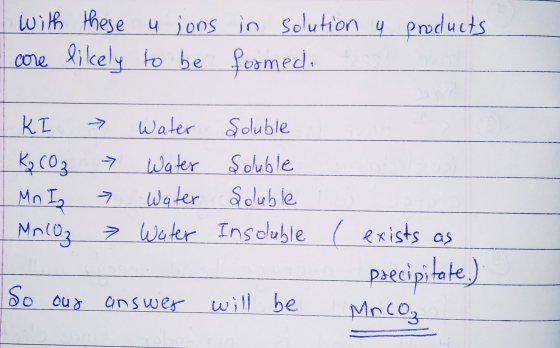
What precipitate is most likely formed from a solution containing Mn2+, K+, I-, and CO32-.
What precipitate is most likely formed from a solution containing Mn2+, K+, I-, and CO32-.
Homework Answers
Add Answer to:
What precipitate is most likely formed from a
solution containing Mn2+, K+, I-,
and CO32-.
A solution containing a mixture of metal cations was treated with dilute HCl and no precipitate...
 A solution containing a mixture of metal cations was treated with dilute HCl and no precipitate formed. Next, H2S was bubbled through the acidic solution. A precipitate formed and was filtered off. Then, the pH was raised to about 8 and H2S was again bubbled through the solution. A precipitate again formed and was filtered off. Finally, the solution was treated with a sodium carbonate solution, which resulted in no precipitation. Which metal ions were definately present, which were definitely...
if a solution containing 0.12 M CO32-, N3, Br-, and CN- is treated with Ag+, in...
 if
a solution containing 0.12 M CO32-, N3, Br-, and CN- is treated
with Ag+, in what order will the anions precipitate
6. 0/3 points Previous Answers My Notes Ask You If a solution containing 0.12 M CO?, N o r, and is treated with Ag, in what order will the anions precipitate? (Order your answer from first to last, with species separated by chemPad X.X" - Osek CN>Br>CO,>N CNBCO 42-N The components in your answer are not in the...
if
a solution containing 0.12 M CO32-, N3, Br-, and CN- is treated
with Ag+, in what order will the anions precipitate
6. 0/3 points Previous Answers My Notes Ask You If a solution containing 0.12 M CO?, N o r, and is treated with Ag, in what order will the anions precipitate? (Order your answer from first to last, with species separated by chemPad X.X" - Osek CN>Br>CO,>N CNBCO 42-N The components in your answer are not in the...
A solution containing a mixture of metal cations was treated with dilute HCl and a precipitate formed. The solutio...
 A solution containing a mixture of metal cations was treated with dilute HCl and a precipitate formed. The solution was filtered, and H, S was bubbled through the acidic solution. A precipitate again formed and was filtered off. Then, the pH was raised to about 8 and H, S was again bubbled through the solution. This time, no precipitate formed. Finally, the solution was treated with a sodium carbonate solution, which resulted in the formation of a precipitate. Classify the...
olution containing a mixture of metal cations was treated with dilute HCl and no precipitate formed.
 A solution containing a mixture of metal cations was treated with dilute HCl and no precipitate formed. Next, H2S was bubbled through the acidic solution. A precipitate formed and was filtered off. Then, the pH was raised to about 8 and H2Swas again bubbled through the solution. A precipitate again formed and
was filtered off. Finally, the solution was treated with a sodium
carbonate solution, which resulted in no precipitation.Classify the metal ions based on whether they were definitely
present, definitely...
A solution containing a mixture of metal cations was treated with dilute HCl and no precipitate formed. Next, H2S was bubbled through the acidic solution. A precipitate formed and was filtered off. Then, the pH was raised to about 8 and H2Swas again bubbled through the solution. A precipitate again formed and
was filtered off. Finally, the solution was treated with a sodium
carbonate solution, which resulted in no precipitation.Classify the metal ions based on whether they were definitely
present, definitely...
A solution containing a mixture of metal cations was treated as outlined. Dilute HClHCl was added...
A solution containing a mixture of metal cations was treated as outlined. Dilute HClHCl was added and no precipitate formed. H2SH2S was bubbled through the acidic solution. A precipitate formed and was filtered off. The pH was raised to about 99 and H2SH2S was again bubbled through the solution. A precipitate formed and was filtered off. Finally, sodium carbonate was added to the filtered solution and no precipitate formed. What can be said about the presence of each of these...
A solution containing a mixture of metal cations was treated with dilute HCl and no precipitate...
 A solution containing a mixture of metal cations was treated
with dilute HCl and no precipitate formed. Next, H2S was bubbled
through the acidic solution. A precipitate formed and was filtered
off. Then, the pH was raised to about 8 and H2S was again bubbled
through the solution. A precipitate again formed and was filtered
off. Finally, the solution was treated with a sodium carbonate
solution, which resulted in no precipitation.
Classify the metal ions based on whether they were...
A solution containing a mixture of metal cations was treated
with dilute HCl and no precipitate formed. Next, H2S was bubbled
through the acidic solution. A precipitate formed and was filtered
off. Then, the pH was raised to about 8 and H2S was again bubbled
through the solution. A precipitate again formed and was filtered
off. Finally, the solution was treated with a sodium carbonate
solution, which resulted in no precipitation.
Classify the metal ions based on whether they were...
Pre-Lab Exercises Consider the following: A student added a solution of HCl to a solution containing...
 Pre-Lab Exercises Consider the following: A student added a solution of HCl to a solution containing Fe2+, Cr3+, K+, and Ag+ ions in a test tube. a) Which ion(s), if any, will likely precipitate out of solution? b) If precipitation occurred, what is (are) the formula(s) of the salt(s) that precipitate? c) What would happen to any precipitate formed in part (b) if aqueous ammonia is added to it? Write the equation for the reaction.
A solution containing a mixture of metal cations was treated with dilute HCl and a precipitate fo...
 A solution containing a mixture of metal cations was treated with dilute HCl and a precipitate formed. The solution was filtered and H2S was bubbled through the acidic solution. A precipitate again formed and was filtered off. Then, the pH was raised to about 8 and H2S was again bubbled through the solution. This time, no precipitate formed. Finally, the solution was treated with a sodium carbonate solution, which resulted in formation of a precipitate. Which metal ions were definitely...
A solution containing a mixture of metal cations was treated with dilute HCl and no precipitate...
 A solution containing a mixture of metal cations was treated with dilute HCl and no precipitate formed. Next, H, S was bubbled through the acidic solution. A precipitate formed and was filtered off. Then, the pH was raised to about 8 and HS was again bubbled through the solution. A precipitate again formed and was filtered off. Finally, the solution was treated with a sodium carbonate solution, which resulted in no precipitation Classify the metal ions based on whether they...
A solution containing a mixture of metal cations was treated as outlined. 1. Dilute HCl was...
 A solution containing a mixture of metal cations was treated as outlined. 1. Dilute HCl was added and a precipitate formed. The precipitate was filtered off. 2. H,S was bubbled through the acidic solution. Again, a precipitate formed and was filtered off. 3. The pH was raised to about 9 and H,S was again bubbled through the solution. No precipitate formed. 4. Finally, sodium carbonate was added. A precipitate formed and was filtered off. What can be said about the...
 A solution containing a mixture of metal cations was treated with dilute HCl and no precipitate formed. Next, H2S was bubbled through the acidic solution. A precipitate formed and was filtered off. Then, the pH was raised to about 8 and H2S was again bubbled through the solution. A precipitate again formed and was filtered off. Finally, the solution was treated with a sodium carbonate solution, which resulted in no precipitation. Which metal ions were definately present, which were definitely...
 if
a solution containing 0.12 M CO32-, N3, Br-, and CN- is treated
with Ag+, in what order will the anions precipitate
6. 0/3 points Previous Answers My Notes Ask You If a solution containing 0.12 M CO?, N o r, and is treated with Ag, in what order will the anions precipitate? (Order your answer from first to last, with species separated by chemPad X.X" - Osek CN>Br>CO,>N CNBCO 42-N The components in your answer are not in the...
if
a solution containing 0.12 M CO32-, N3, Br-, and CN- is treated
with Ag+, in what order will the anions precipitate
6. 0/3 points Previous Answers My Notes Ask You If a solution containing 0.12 M CO?, N o r, and is treated with Ag, in what order will the anions precipitate? (Order your answer from first to last, with species separated by chemPad X.X" - Osek CN>Br>CO,>N CNBCO 42-N The components in your answer are not in the...
 A solution containing a mixture of metal cations was treated with dilute HCl and a precipitate formed. The solution was filtered, and H, S was bubbled through the acidic solution. A precipitate again formed and was filtered off. Then, the pH was raised to about 8 and H, S was again bubbled through the solution. This time, no precipitate formed. Finally, the solution was treated with a sodium carbonate solution, which resulted in the formation of a precipitate. Classify the...
 A solution containing a mixture of metal cations was treated
with dilute HCl and no precipitate formed. Next, H2S was bubbled
through the acidic solution. A precipitate formed and was filtered
off. Then, the pH was raised to about 8 and H2S was again bubbled
through the solution. A precipitate again formed and was filtered
off. Finally, the solution was treated with a sodium carbonate
solution, which resulted in no precipitation.
Classify the metal ions based on whether they were...
A solution containing a mixture of metal cations was treated
with dilute HCl and no precipitate formed. Next, H2S was bubbled
through the acidic solution. A precipitate formed and was filtered
off. Then, the pH was raised to about 8 and H2S was again bubbled
through the solution. A precipitate again formed and was filtered
off. Finally, the solution was treated with a sodium carbonate
solution, which resulted in no precipitation.
Classify the metal ions based on whether they were...
 Pre-Lab Exercises Consider the following: A student added a solution of HCl to a solution containing Fe2+, Cr3+, K+, and Ag+ ions in a test tube. a) Which ion(s), if any, will likely precipitate out of solution? b) If precipitation occurred, what is (are) the formula(s) of the salt(s) that precipitate? c) What would happen to any precipitate formed in part (b) if aqueous ammonia is added to it? Write the equation for the reaction.
 A solution containing a mixture of metal cations was treated with dilute HCl and a precipitate formed. The solution was filtered and H2S was bubbled through the acidic solution. A precipitate again formed and was filtered off. Then, the pH was raised to about 8 and H2S was again bubbled through the solution. This time, no precipitate formed. Finally, the solution was treated with a sodium carbonate solution, which resulted in formation of a precipitate. Which metal ions were definitely...
 A solution containing a mixture of metal cations was treated with dilute HCl and no precipitate formed. Next, H, S was bubbled through the acidic solution. A precipitate formed and was filtered off. Then, the pH was raised to about 8 and HS was again bubbled through the solution. A precipitate again formed and was filtered off. Finally, the solution was treated with a sodium carbonate solution, which resulted in no precipitation Classify the metal ions based on whether they...
 A solution containing a mixture of metal cations was treated as outlined. 1. Dilute HCl was added and a precipitate formed. The precipitate was filtered off. 2. H,S was bubbled through the acidic solution. Again, a precipitate formed and was filtered off. 3. The pH was raised to about 9 and H,S was again bubbled through the solution. No precipitate formed. 4. Finally, sodium carbonate was added. A precipitate formed and was filtered off. What can be said about the...
Most questions answered within 3 hours.
-
Where is the error in this code sequence?
String s1 = "Hello";
String s2 = "ello";...
asked 10 months ago -
Financial data for Joel de Paris, Inc., for last year
follow:
Joel de Paris, Inc.
Balance...
asked 10 months ago -
Consider this reaction:
Al2(SO4)3 (aq)+ BaCl3
(aq) Al2Cl6 (aq)- +
3BaSO4(s) . What is the...
asked 10 months ago -
Suppose that Savneet is considering increasing her
recent random sample from 20 car rentals to 40...
asked 10 months ago -
Trucks arrive at an unloading terminal at an average rate of 120
per hour.
Trucks arrive...
asked 10 months ago -
Why are methanol and ethanol completely soluble in water while
octanol is not very little soluble....
asked 10 months ago -
A facilities manager at a university reads in a research report
that the mean amount of...
asked 10 months ago -
When the CuSO4 is rehydrated by adding water to the anhydrous
compound, is this an endothermic...
asked 10 months ago -
A ray of sunlight is passing from diamond into crown glass; the
angle of incidence is...
asked 10 months ago -
A block of mass 0.249 kg is placed on top of a light, vertical
spring of...
asked 10 months ago -
how do the kidneys compensate in the presences of acidosis
a) trigger hyperventilate
b) reserve acid...
asked 10 months ago -
Question 501 pts
The rental rate of capital to the firm increases. Which of the
following...
asked 10 months ago