
Homework Answers
Add Answer to:
5. How much faster would a reaction be if a catalyst is used that lowers the...
5. How much faster would a reaction be if a catalyst is used that lowers the...
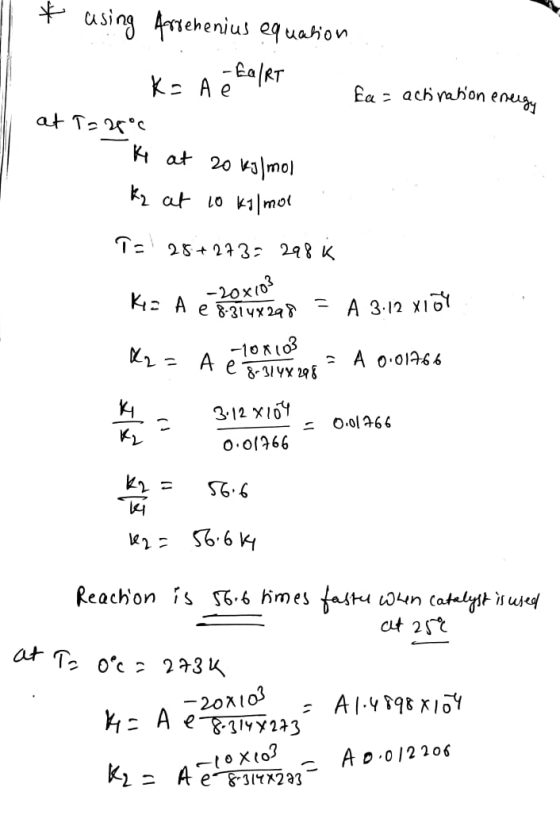
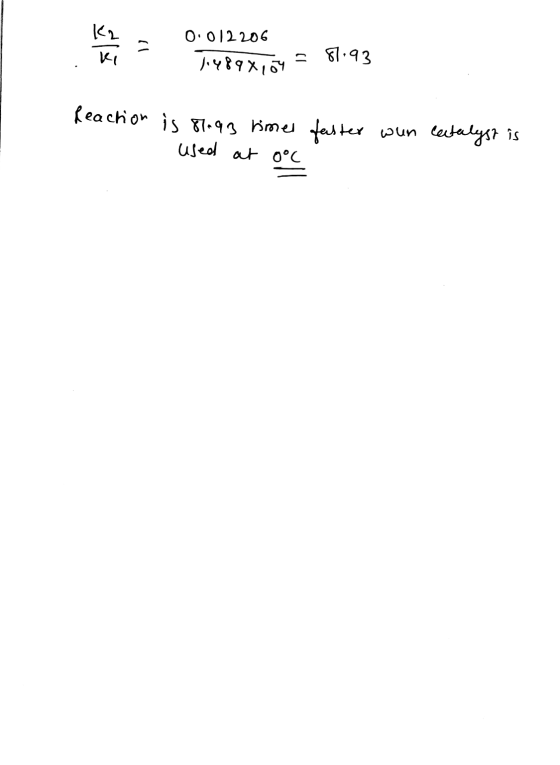
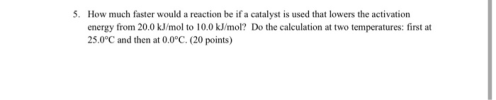
 5. How much faster would a reaction be if a catalyst is used that lowers the activation energy from 20.0 kJ/mol to 10.0 kJ/mol? Do the calculation at two temperatures: first at 25.0°C and then at 0.0°C. (20 points)
5. How much faster would a reaction be if a catalyst is used that lowers the...
 5. How much faster would a reaction be if a catalyst is used that lowers the activation energy from 20.0 kJ/mol to 10.0 kJ/mol? Do the calculation at two temperatures: first at 25.0°C and then at 0.0°C. (20 points)
5. How much faster would a reaction be if a catalyst is used that lowers the...
 5. How much faster would a reaction be if a catalyst is used that lowers the activation energy from 20.0 kJ/mol to 10.0 kJ/mol? Do the calculation at two temperatures: first at 25.0°C and then at 0.0°C. (20 points) (V) Helpful Stuff Thermodynamics: AG° = AH-TAS Nernst Equation: 6 = 6 - (RT/nF)InQ AG=RTIK At 25°C: 8 = 6 - (0.0591/n)logQ AGRT Ke=e AGⓇ =-nF8° Units/Constants: Volt: 1 V = 1 J/C Faraday: 1 F = 96,485 C/mole Arrhenius Equation:...
A catalyst lowers the activation energy for a particular reaction from 75.0 kJ mol−1to 40.0 kJ...
A catalyst lowers the activation energy for a particular reaction from 75.0 kJ mol−1to 40.0 kJ mol−1. By what factor does the rate constant increase if the catalyst is used at 25.0 °C? Assume that all rate constants obey the Arrhenius equation and that the pre-exponential factors for the uncatalyzed and catalyzed reactions are equal
The best description of how a catalyst makes a reaction proceed at a faster rate is...
The best description of how a catalyst makes a reaction proceed at a faster rate is a. A catalyst increases the kinetic energy of the reactant particles. b. A catalyst provides an alternate path for the reaction and effectively lowers the activation energy. c. A catalyst lowers the average energy of the product molecules. d. A catalyst changes the position of equilibrium by shifting the reaction towards the products. e. A catalyst raises height of the energy barrier required for...
Suppose that a catalyst lowers the activation barrier of a reaction from 121 kJ/mol to 59...
 Suppose that a catalyst lowers the
activation barrier of a reaction from 121 kJ/mol to 59 kJ/mol .
Part A By what factor would you expect the reaction rate to
increase at 25 ∘C? (Assume that the frequency factors for the
catalyzed and uncatalyzed reactions are identical.) Express your
answer using two significant figures.
<Topic_6_kinetics Exercise 14.81 31 of 32 > A Review | Constants Periodic Table Suppose that a catalyst lowers the activation barrier of a reaction from 121...
Suppose that a catalyst lowers the
activation barrier of a reaction from 121 kJ/mol to 59 kJ/mol .
Part A By what factor would you expect the reaction rate to
increase at 25 ∘C? (Assume that the frequency factors for the
catalyzed and uncatalyzed reactions are identical.) Express your
answer using two significant figures.
<Topic_6_kinetics Exercise 14.81 31 of 32 > A Review | Constants Periodic Table Suppose that a catalyst lowers the activation barrier of a reaction from 121...
The activation energy for a reaction is 15 kJ mol-1 at 27° C. A catalyst lowers...
 The activation energy for a reaction is 15 kJ mol-1 at 27° C. A catalyst lowers the activation energy to 10 kJ mol at the same temperature. By what factor is the reaction rate increased? Assume that the reactant concentrations and the pre-exponential factor in the Arrhenius equation are unchanged. O A. 1.5 OB. 1.1 OC. 0.67 O D.7.4 O E. 1.7 x 10⁷ Reset Selection
15) Suppose that a catalyst lowers the activation energy of a reaction from 115kJ/mol to 95kJ/mol...
 15) Suppose that a catalyst lowers the activation energy of a reaction from 115kJ/mol to 95kJ/mol. By what factor would the rate increase at 25°C? a) 1.2 b) 336 c) 3000 d) 11000 e) 6 x 1041
15) Suppose that a catalyst lowers the activation energy of a reaction from 115kJ/mol to 95kJ/mol. By what factor would the rate increase at 25°C? a) 1.2 b) 336 c) 3000 d) 11000 e) 6 x 1041
15) Suppose that a catalyst lowers the activation energy of a reaction from 115kJ/mol to 95kJ/mol. By what factor would the rate increase at 25°C? a) 1.2 b) 336 c) 3000 d) 11000 e) 6 x 1041
Suppose that a catalyst lowers the activation barrier of a reaction from 128 kJ mol−1kJ mol−1...
Suppose that a catalyst lowers the activation barrier of a reaction from 128 kJ mol−1kJ mol−1 to 55 kJ mol−1kJ mol−1 . By what factor would you expect the reaction rate to increase at 25 ∘C∘C?
Suppose that a catalyst lowers the activation barrier of a reaction from 126 kJ/mol to 52...
Suppose that a catalyst lowers the activation barrier of a reaction from 126 kJ/mol to 52 kJ/mol . Part A By what factor would you expect the reaction rate to increase at 25 ∘C? (Assume that the frequency factors for the catalyzed and uncatalyzed reactions are identical.)
 5. How much faster would a reaction be if a catalyst is used that lowers the activation energy from 20.0 kJ/mol to 10.0 kJ/mol? Do the calculation at two temperatures: first at 25.0°C and then at 0.0°C. (20 points)
 5. How much faster would a reaction be if a catalyst is used that lowers the activation energy from 20.0 kJ/mol to 10.0 kJ/mol? Do the calculation at two temperatures: first at 25.0°C and then at 0.0°C. (20 points)
 5. How much faster would a reaction be if a catalyst is used that lowers the activation energy from 20.0 kJ/mol to 10.0 kJ/mol? Do the calculation at two temperatures: first at 25.0°C and then at 0.0°C. (20 points) (V) Helpful Stuff Thermodynamics: AG° = AH-TAS Nernst Equation: 6 = 6 - (RT/nF)InQ AG=RTIK At 25°C: 8 = 6 - (0.0591/n)logQ AGRT Ke=e AGⓇ =-nF8° Units/Constants: Volt: 1 V = 1 J/C Faraday: 1 F = 96,485 C/mole Arrhenius Equation:...
 Suppose that a catalyst lowers the
activation barrier of a reaction from 121 kJ/mol to 59 kJ/mol .
Part A By what factor would you expect the reaction rate to
increase at 25 ∘C? (Assume that the frequency factors for the
catalyzed and uncatalyzed reactions are identical.) Express your
answer using two significant figures.
<Topic_6_kinetics Exercise 14.81 31 of 32 > A Review | Constants Periodic Table Suppose that a catalyst lowers the activation barrier of a reaction from 121...
Suppose that a catalyst lowers the
activation barrier of a reaction from 121 kJ/mol to 59 kJ/mol .
Part A By what factor would you expect the reaction rate to
increase at 25 ∘C? (Assume that the frequency factors for the
catalyzed and uncatalyzed reactions are identical.) Express your
answer using two significant figures.
<Topic_6_kinetics Exercise 14.81 31 of 32 > A Review | Constants Periodic Table Suppose that a catalyst lowers the activation barrier of a reaction from 121...
 The activation energy for a reaction is 15 kJ mol-1 at 27° C. A catalyst lowers the activation energy to 10 kJ mol at the same temperature. By what factor is the reaction rate increased? Assume that the reactant concentrations and the pre-exponential factor in the Arrhenius equation are unchanged. O A. 1.5 OB. 1.1 OC. 0.67 O D.7.4 O E. 1.7 x 10⁷ Reset Selection
 15) Suppose that a catalyst lowers the activation energy of a reaction from 115kJ/mol to 95kJ/mol. By what factor would the rate increase at 25°C? a) 1.2 b) 336 c) 3000 d) 11000 e) 6 x 1041
15) Suppose that a catalyst lowers the activation energy of a reaction from 115kJ/mol to 95kJ/mol. By what factor would the rate increase at 25°C? a) 1.2 b) 336 c) 3000 d) 11000 e) 6 x 1041
15) Suppose that a catalyst lowers the activation energy of a reaction from 115kJ/mol to 95kJ/mol. By what factor would the rate increase at 25°C? a) 1.2 b) 336 c) 3000 d) 11000 e) 6 x 1041
Most questions answered within 3 hours.
-
Where is the error in this code sequence?
String s1 = "Hello";
String s2 = "ello";...
asked 10 months ago -
Financial data for Joel de Paris, Inc., for last year
follow:
Joel de Paris, Inc.
Balance...
asked 10 months ago -
Consider this reaction:
Al2(SO4)3 (aq)+ BaCl3
(aq) Al2Cl6 (aq)- +
3BaSO4(s) . What is the...
asked 10 months ago -
Suppose that Savneet is considering increasing her
recent random sample from 20 car rentals to 40...
asked 10 months ago -
Trucks arrive at an unloading terminal at an average rate of 120
per hour.
Trucks arrive...
asked 10 months ago -
Why are methanol and ethanol completely soluble in water while
octanol is not very little soluble....
asked 10 months ago -
A facilities manager at a university reads in a research report
that the mean amount of...
asked 10 months ago -
When the CuSO4 is rehydrated by adding water to the anhydrous
compound, is this an endothermic...
asked 10 months ago -
A ray of sunlight is passing from diamond into crown glass; the
angle of incidence is...
asked 10 months ago -
A block of mass 0.249 kg is placed on top of a light, vertical
spring of...
asked 10 months ago -
how do the kidneys compensate in the presences of acidosis
a) trigger hyperventilate
b) reserve acid...
asked 10 months ago -
Question 501 pts
The rental rate of capital to the firm increases. Which of the
following...
asked 10 months ago