Physics
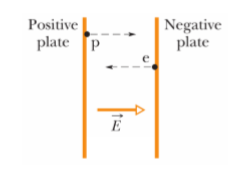
Two large parallel plates have been oppositely charged. There is a uniform electric field ~ E present between the plates, as shown in the figure. A proton, with mass mp, is released from the positive plate at the same moment as an electron, with mass me, is released from the negative plate. Ignore the force that the two charges exert on each other. What fraction of the way to the negative plate has the proton moved by the time the electron passes it?
 Annotation 2020-08-11 174410.png
Homework Answers


A uniform electric field exists in the region between two oppositely charged parallel plates 1.50 apart....
A uniform electric field exists in the region between two oppositely charged parallel plates 1.50 apart. A proton is released from rest at the surface of the positively charged plate and strikes the surface of the opposite plate in a time interval 1.41×10⁻⁶ . A) Find the magnitude of the electric field. Use 1.60×10⁻¹⁹ for the magnitude of the charge on an electron and 1.67×10⁻²⁷ for the mass of a proton. ------ N/C B)Find the speed of the proton at...
A Proton between Oppositely Charged Plates A uniform electric field exists in the region between two...
 A Proton between Oppositely Charged Plates A uniform electric field exists in the region between two oppositely charged parallel plates 1.55 cm apart. A proton is released from rest at the surface of the positively charged plate and strikes the surface of the opposite plate in a time interval 1.56x10⁻⁶ s. Part A Find the magnitude of the electric field. Use 1.60x10⁻¹⁹ C for the magnitude of the charge on an electron and 1.67x10⁻²⁷ kg for the mass of a...
A uniform electric field exists in the region between two oppositely charged parallel plates 1.59 cm...
A uniform electric field exists in the region between two oppositely charged parallel plates 1.59 cm apart. A proton is released from rest at the surface of the positively charged plate and strikes the surface of the opposite plate in a time interval 1.59×10⁻⁶ s . Part A) Find the magnitude of the electric field. Use 1.60×10⁻¹⁹ C for the magnitude of the charge on an electron and 1.67×10⁻²⁷ kg for the mass of a proton. __________ N/C Part B)...
Find the magnitude of the electric field ConstantsI Periodic Table Use 1.60x10⁻¹⁹ C for the magnitude...
 Find the magnitude of the electric field ConstantsI Periodic Table Use 1.60x10⁻¹⁹ C for the magnitude of the charge on an electron and 1.67x10⁻²⁷ kg for the mass of a proton. A uniform electric field exists in the region between two oppositely charged parallel plates 1.52 cm apart. A proton is released from rest at the surface of the positively charged plate and strikes the surface of the opposite plate in a time interval 1.53x10⁻⁶ s View Available Hin(s) N/C...
A uniform electric field exists in the region between two oppositely charged parallel plates 1.56 cm...
 A uniform electric field exists in the region between two
oppositely charged parallel plates 1.56 cm apart. A proton is
released from rest at the surface of the positively charged plate
and strikes the surface of the opposite plate in a time interval
1.54×10^−6 s.
Part A Find the magnitude of the electric field. Use 1.60x10⁻¹⁹ C for the magnitude of the charge on an electron and 1.67x10⁻²⁷ kg for the mass of a proton View Available Hint(s) N/C Submit...
A uniform electric field exists in the region between two
oppositely charged parallel plates 1.56 cm apart. A proton is
released from rest at the surface of the positively charged plate
and strikes the surface of the opposite plate in a time interval
1.54×10^−6 s.
Part A Find the magnitude of the electric field. Use 1.60x10⁻¹⁹ C for the magnitude of the charge on an electron and 1.67x10⁻²⁷ kg for the mass of a proton View Available Hint(s) N/C Submit...
What is the answer to part B, and what formula should be used? t A Proton...
 What is the answer to part B, and what formula should
be used?
t A Proton between Oppositely Charged Plates 4 of 10 > Constants Part A A uniform electric field exists in the region between two oppositely charged parallel plates 1.70 cm apart. A proton is released from rest at the surface of the positively charged plate and strikes the surface of the opposite plate in a time interval 1.54x10⁻⁶ s Find the magnitude of the electric field Use...
What is the answer to part B, and what formula should
be used?
t A Proton between Oppositely Charged Plates 4 of 10 > Constants Part A A uniform electric field exists in the region between two oppositely charged parallel plates 1.70 cm apart. A proton is released from rest at the surface of the positively charged plate and strikes the surface of the opposite plate in a time interval 1.54x10⁻⁶ s Find the magnitude of the electric field Use...
A proton and an electron are released from rest at the same time from the midpoint...
 A proton and an electron are released from rest at the same time from the midpoint between two charged parallel plates. The plates are charged with equal surface charge densities of opposite signs. Ignore the interaction between the electron and the proton and consider only the interaction of each charge with the electric field of the plates. After being released, the proton will accelerate toward the negative plate, and the electron will accelerate toward the positive plate. (a) Which charge...
The electric field between two parallel plates is uniform, with magnitude 576 N/C. A proton is...
 The electric field between two parallel plates is uniform, with magnitude 576 N/C. A proton is held stationary at the positive plate, and an electron is held stationary at the negative plate. The plate separation is 4.30 cm. At the same moment, both particles are released (a) Calculate the distance (in cm) from the positive plate at which the two pass each other. Ignore the electrical attraction between the proton and electron cm (b) Repeat part (a) for a sodium...
The electric field between two parallel plates is uniform, with magnitude 600 N/C
The electric field between two parallel plates is uniform, with magnitude 600 N/C. A proton is held stationary at the positive plate, and an electron is held stationary at the negative plate. The plate separation is 3.66 cm. At the same moment, both particles are released (a) Calculate the distance (in cm) from the positive plate at which the two pass each other. Ignore the electrical attraction between the proton and electron (b) Repeat part (a) for a sodium lon (Na+) and...
A uniform electric field exists in a region between two oppositely charged plates. An electron is...
A uniform electric field exists in a region between two oppositely charged plates. An electron is released from rest at the surface of the negatively charged plate and strikes the surface of the opposite plate 6.00 cm. away, in a time of 1.80E-08 s. What is the magnitude of the electric field (in newtons/coulomb)?
 A Proton between Oppositely Charged Plates A uniform electric field exists in the region between two oppositely charged parallel plates 1.55 cm apart. A proton is released from rest at the surface of the positively charged plate and strikes the surface of the opposite plate in a time interval 1.56x10⁻⁶ s. Part A Find the magnitude of the electric field. Use 1.60x10⁻¹⁹ C for the magnitude of the charge on an electron and 1.67x10⁻²⁷ kg for the mass of a...
 Find the magnitude of the electric field ConstantsI Periodic Table Use 1.60x10⁻¹⁹ C for the magnitude of the charge on an electron and 1.67x10⁻²⁷ kg for the mass of a proton. A uniform electric field exists in the region between two oppositely charged parallel plates 1.52 cm apart. A proton is released from rest at the surface of the positively charged plate and strikes the surface of the opposite plate in a time interval 1.53x10⁻⁶ s View Available Hin(s) N/C...
 A uniform electric field exists in the region between two
oppositely charged parallel plates 1.56 cm apart. A proton is
released from rest at the surface of the positively charged plate
and strikes the surface of the opposite plate in a time interval
1.54×10^−6 s.
Part A Find the magnitude of the electric field. Use 1.60x10⁻¹⁹ C for the magnitude of the charge on an electron and 1.67x10⁻²⁷ kg for the mass of a proton View Available Hint(s) N/C Submit...
A uniform electric field exists in the region between two
oppositely charged parallel plates 1.56 cm apart. A proton is
released from rest at the surface of the positively charged plate
and strikes the surface of the opposite plate in a time interval
1.54×10^−6 s.
Part A Find the magnitude of the electric field. Use 1.60x10⁻¹⁹ C for the magnitude of the charge on an electron and 1.67x10⁻²⁷ kg for the mass of a proton View Available Hint(s) N/C Submit...
 What is the answer to part B, and what formula should
be used?
t A Proton between Oppositely Charged Plates 4 of 10 > Constants Part A A uniform electric field exists in the region between two oppositely charged parallel plates 1.70 cm apart. A proton is released from rest at the surface of the positively charged plate and strikes the surface of the opposite plate in a time interval 1.54x10⁻⁶ s Find the magnitude of the electric field Use...
What is the answer to part B, and what formula should
be used?
t A Proton between Oppositely Charged Plates 4 of 10 > Constants Part A A uniform electric field exists in the region between two oppositely charged parallel plates 1.70 cm apart. A proton is released from rest at the surface of the positively charged plate and strikes the surface of the opposite plate in a time interval 1.54x10⁻⁶ s Find the magnitude of the electric field Use...
 A proton and an electron are released from rest at the same time from the midpoint between two charged parallel plates. The plates are charged with equal surface charge densities of opposite signs. Ignore the interaction between the electron and the proton and consider only the interaction of each charge with the electric field of the plates. After being released, the proton will accelerate toward the negative plate, and the electron will accelerate toward the positive plate. (a) Which charge...
 The electric field between two parallel plates is uniform, with magnitude 576 N/C. A proton is held stationary at the positive plate, and an electron is held stationary at the negative plate. The plate separation is 4.30 cm. At the same moment, both particles are released (a) Calculate the distance (in cm) from the positive plate at which the two pass each other. Ignore the electrical attraction between the proton and electron cm (b) Repeat part (a) for a sodium...
Most questions answered within 3 hours.
-
Where is the error in this code sequence?
String s1 = "Hello";
String s2 = "ello";...
asked 10 months ago -
Financial data for Joel de Paris, Inc., for last year
follow:
Joel de Paris, Inc.
Balance...
asked 10 months ago -
Consider this reaction:
Al2(SO4)3 (aq)+ BaCl3
(aq) Al2Cl6 (aq)- +
3BaSO4(s) . What is the...
asked 10 months ago -
Suppose that Savneet is considering increasing her
recent random sample from 20 car rentals to 40...
asked 10 months ago -
Trucks arrive at an unloading terminal at an average rate of 120
per hour.
Trucks arrive...
asked 10 months ago -
Why are methanol and ethanol completely soluble in water while
octanol is not very little soluble....
asked 10 months ago -
A facilities manager at a university reads in a research report
that the mean amount of...
asked 10 months ago -
When the CuSO4 is rehydrated by adding water to the anhydrous
compound, is this an endothermic...
asked 10 months ago -
A ray of sunlight is passing from diamond into crown glass; the
angle of incidence is...
asked 10 months ago -
A block of mass 0.249 kg is placed on top of a light, vertical
spring of...
asked 10 months ago -
how do the kidneys compensate in the presences of acidosis
a) trigger hyperventilate
b) reserve acid...
asked 10 months ago -
Question 501 pts
The rental rate of capital to the firm increases. Which of the
following...
asked 10 months ago