In previous rounds of the Golden Balls game show, these players have built up a jackpot...
In previous rounds of the Golden Balls game show, these players have built up a jackpot of £47,250. Now, they must decide how the jackpot will be distributed. Each player in this round of has two strategies: split or steal. The payoffs to each player depend on the strategies played:
- If both choose split, they each receive half the jackpot.
- If one chooses steal and the other chooses split, the steal contestant wins the entire jackpot and the split contestant leaves with nothing.
- If both choose steal, neither contestant wins any money.
Match the letters in the payoff matrix below to the appropriate values based on the payoffs presented above.
|
LeeAnn |
|||
|
split |
steal |
||
|
Chloe |
split |
B A |
F E |
|
steal |
D C |
H G |
|
Question 1 options:
|
|
Homework Answers
Jackpot value is £47,250
There are two players i.e., Chole and LeeAnn.
There are two strategies i.e., split and steal.
- If both choose split, they each receive half the jackpot.
It means both will get £23,625
- If both choose steal, neither contestant wins any money.
It means both will get £0.
- If one chooses steal and the other chooses split, the steal contestant wins the entire jackpot and the split contestant leaves with nothing.
It means the players who steal will get £47,250 and the players who split will get £0
----------------
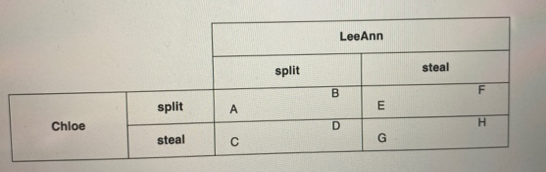
Note: First alphabet in each cell represents the payoff of Chloe corresponding to his strateggy in response to LeeAnn strategy.
and second alphabet in each cell represents the payoff of LeeAnn corresponding to his stratgey in repsonse to Chole strategy
For example; A represents the payoff of Chole when he choose "Split" given that LeeAnn choosed "split"
---------
A => £23,625
H => £0
G => £0
C => £47,250
D => £0
E=> £0
F=> £47,250
B => £23,625
Add Answer to:
In previous rounds of the Golden Balls game show, these players
have built up a jackpot...
In previous rounds of the Golden Balls game show, these players have built up a jackpot...
In previous rounds of the Golden Balls game show, these players have built up a jackpot of £47,250. Now, they must decide how the jackpot will be distributed. Each player in this round of has two strategies: split or steal. The payoffs to each player depend on the strategies played: If both choose split, they each receive half the jackpot. If one chooses steal and the other chooses split, the steal contestant wins the entire jackpot and the split contestant...
6. Consider a sequential game with 3 players. Player 1 can choose A or B. Player...
6. Consider a sequential game with 3 players. Player 1 can choose A or B. Player 2 can choose C, D, E, or F (depending on what player 1 chooses). Player 3 can choose G, H, I, J, K, L, M, or N (depending on what player 1 and 2 choose). Player 1 (P1) goes first, player 2 (P2) goes second, and player 3 (P3) goes third. Payoffs are written as the payoffs for P1, P2, and the for P3....
2. Consider the following sequential game. Player A can choose between two tasks, Tl and T2....
 2. Consider the following sequential game. Player A can choose between two tasks, Tl and T2. After having observed the choice of A, Player B chooses between two projects Pl or P2. The payoffs are as follows: If A chooses TI and B chooses P1 the payoffs are (12, 8), where the first payoff is for A and the second for B; if A chooses T1 and B opts for P2 the payoffs are (20, 7); if A chooses T2...
Problem 1. (20 points) Consider a game with two players, Alice and Bob. Alice can choose...
 Problem 1. (20 points) Consider a game with two players, Alice and Bob. Alice can choose A or B. The game ends if she chooses A while it continues to Bob if she chooses B. Bob then can choose C or D. If he chooses C the game ends, and if he chooses D the game continues to Alice. Finally, Alice can choose E or F and the game ends after each of these choices. a. Present this game as...
2. Consider the following sequential game. Player A can choose between two tasks, TI and T2....
 2. Consider the following sequential game. Player A can choose between two tasks, TI and T2. After having observed the choice of A, Player B chooses between two projects P1 or P2. The payoffs are as follows: If A chooses TI and B chooses Pl the payoffs are (12.8), where the first payoff is for A and the second for B; if A chooses TI and B opts for P2 the payoffs are (20,7); if A chooses T2 and B...
hello there, i have to implement this on java processing. can someone please help me regarding...
hello there, i have to implement this on java processing. can someone please help me regarding that? thanks War is the name of a popular children’s card game. There are many variants. After playing War with a friend for over an hour, they argue that this game must never end . However! You are convinced that it will end. As a budding computer scientist, you decide to build a simulator to find out for sure! You will implement the logic...
 2. Consider the following sequential game. Player A can choose between two tasks, Tl and T2. After having observed the choice of A, Player B chooses between two projects Pl or P2. The payoffs are as follows: If A chooses TI and B chooses P1 the payoffs are (12, 8), where the first payoff is for A and the second for B; if A chooses T1 and B opts for P2 the payoffs are (20, 7); if A chooses T2...
 Problem 1. (20 points) Consider a game with two players, Alice and Bob. Alice can choose A or B. The game ends if she chooses A while it continues to Bob if she chooses B. Bob then can choose C or D. If he chooses C the game ends, and if he chooses D the game continues to Alice. Finally, Alice can choose E or F and the game ends after each of these choices. a. Present this game as...
 2. Consider the following sequential game. Player A can choose between two tasks, TI and T2. After having observed the choice of A, Player B chooses between two projects P1 or P2. The payoffs are as follows: If A chooses TI and B chooses Pl the payoffs are (12.8), where the first payoff is for A and the second for B; if A chooses TI and B opts for P2 the payoffs are (20,7); if A chooses T2 and B...
Most questions answered within 3 hours.
-
Where is the error in this code sequence?
String s1 = "Hello";
String s2 = "ello";...
asked 11 months ago -
Financial data for Joel de Paris, Inc., for last year
follow:
Joel de Paris, Inc.
Balance...
asked 11 months ago -
Consider this reaction:
Al2(SO4)3 (aq)+ BaCl3
(aq) Al2Cl6 (aq)- +
3BaSO4(s) . What is the...
asked 11 months ago -
Suppose that Savneet is considering increasing her
recent random sample from 20 car rentals to 40...
asked 11 months ago -
Trucks arrive at an unloading terminal at an average rate of 120
per hour.
Trucks arrive...
asked 11 months ago -
Why are methanol and ethanol completely soluble in water while
octanol is not very little soluble....
asked 11 months ago -
A facilities manager at a university reads in a research report
that the mean amount of...
asked 11 months ago -
When the CuSO4 is rehydrated by adding water to the anhydrous
compound, is this an endothermic...
asked 11 months ago -
A ray of sunlight is passing from diamond into crown glass; the
angle of incidence is...
asked 11 months ago -
A block of mass 0.249 kg is placed on top of a light, vertical
spring of...
asked 11 months ago -
how do the kidneys compensate in the presences of acidosis
a) trigger hyperventilate
b) reserve acid...
asked 11 months ago -
Question 501 pts
The rental rate of capital to the firm increases. Which of the
following...
asked 11 months ago