
Homework Answers
Request Answer!
We need at least 10 more requests to produce the answer.
0 / 10 have requested this problem solution
The more requests, the faster the answer.
Add Answer to:
please answer all parts to this question! they are all part of
one question so i...
please answer all parts to this question! They are all from one question, so they could...
 please answer all parts to this question! They are all from one
question, so they could not be posted separately. Please double
check your answer! The last person got it wrong :( thanks! Will
give thumbs up.
Consider the following galvanic cell: Pt(s)|Br- (aq)|Br2(1)||Cr2O72- (aq), Cr3+ (aq)|Pt(s) Q6.1 3 Points a. What is n, the number of electrons transferred in the balanced overall reaction that occurs in this galvanic cell? Write the number in the box below. Enter your answer...
please answer all parts to this question! They are all from one
question, so they could not be posted separately. Please double
check your answer! The last person got it wrong :( thanks! Will
give thumbs up.
Consider the following galvanic cell: Pt(s)|Br- (aq)|Br2(1)||Cr2O72- (aq), Cr3+ (aq)|Pt(s) Q6.1 3 Points a. What is n, the number of electrons transferred in the balanced overall reaction that occurs in this galvanic cell? Write the number in the box below. Enter your answer...
please make sure these are correct! I have gotten two wrong answers already. thanks. Will give...
 please make sure these are correct! I have gotten two wrong
answers already. thanks. Will give thumbs up
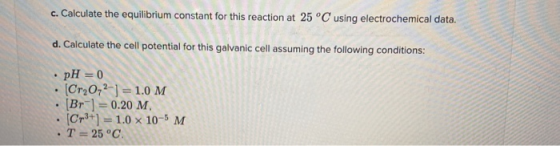
Consider the following galvanic cell: Pt(s)|Br- (aq)|Br2(1)||Cr2O72- (aq), Cr3+ (aq)|Pt(s) C. Calculate the equilibrium constant for this reaction at 25 °C using electrochemical data. d. Calculate the cell potential for this galvanic cell assuming the following conditions: pH = 0 · [Cr2O72-] = 1.0 M Br-) = 0.20 M, (Cr3+] = 1.0 x 10⁻⁵ M T = 25 °C. Create and upload...
please make sure these are correct! I have gotten two wrong
answers already. thanks. Will give thumbs up
Consider the following galvanic cell: Pt(s)|Br- (aq)|Br2(1)||Cr2O72- (aq), Cr3+ (aq)|Pt(s) C. Calculate the equilibrium constant for this reaction at 25 °C using electrochemical data. d. Calculate the cell potential for this galvanic cell assuming the following conditions: pH = 0 · [Cr2O72-] = 1.0 M Br-) = 0.20 M, (Cr3+] = 1.0 x 10⁻⁵ M T = 25 °C. Create and upload...
1) Balance the following reaction under acidic conditions and calculate the cell potential in (V) at...
1) Balance the following reaction under acidic conditions and calculate the cell potential in (V) at 298 K generated by the cell. Report your answer to the hundredths place. Cr2O72-(aq) + I-(aq) → Cr3+(aq) + I2(s) [Cr2O72-] = 2.0 M, [H+] = 1.0 M, [I-] = 1.0 M, [Cr3+] = 1.0 × 10⁻⁵ M 2) What is the value of n for the following reaction? Enter the whole number. 3Ni+(aq) + Cr(OH)3(s) + 5OH-(aq) → 3Ni(s) + CrO42-(aq) + 4H2O(l)
HELP!! I do not understand this at alll Be sure to answer all parts. A galvanic...
HELP!! I do not understand this at alll Be sure to answer all parts. A galvanic cell with Ecell = 0.30 V can be constructed using an iron electrode in a 1.0 M Fe(NO3)2 solution, and either a tin electrode in a 1.0 M Sn(NO3)2 solution, or a chromium electrode in a 1.0 M Cr(NO3)3 solution even though Sn2+/Sn and Cr3+/Cr have different reduction potentials. Give the overall balanced reaction for Fe-Sn cell. Do not include the states of matter....
Please answer all parts to this question! parts a through e! This is all one question...
 Please answer all parts to this question! parts a through e!
This is all one question so I could not post them separately,
please also check your answers because the last person got it
wrong! Thank you! Will give thumbs up.
a. Which of the following species will be reduced by Zn(s), but not by Ag(s) under standard conditions? O Pb(s) O Mg2+(s) O Cl2(g) O Au(s) O A13+ (aq) O None of the above Q5.2 1.8 Points b. Which...
Please answer all parts to this question! parts a through e!
This is all one question so I could not post them separately,
please also check your answers because the last person got it
wrong! Thank you! Will give thumbs up.
a. Which of the following species will be reduced by Zn(s), but not by Ag(s) under standard conditions? O Pb(s) O Mg2+(s) O Cl2(g) O Au(s) O A13+ (aq) O None of the above Q5.2 1.8 Points b. Which...
Can anyone help me check mu answer and show the solution? Thanks! Consider the galvanic cell...
 Can anyone help me check mu answer and show the solution?
Thanks!
Consider the galvanic cell shown below (the contents of each half-cell are written beneath each compartment): Pt 1.0 M Br2 1.0 M Cr3+ 1.0 M Br The standard reduction potentials are as follows: Cr3+ (aq) + 3e" - Cr(s) = -0.725 V Br2(aq) + 2e - 2Br (aq) E = + 1.090 V When current is allowed to flow, which species is reduced? Select one: O a. Br...
Can anyone help me check mu answer and show the solution?
Thanks!
Consider the galvanic cell shown below (the contents of each half-cell are written beneath each compartment): Pt 1.0 M Br2 1.0 M Cr3+ 1.0 M Br The standard reduction potentials are as follows: Cr3+ (aq) + 3e" - Cr(s) = -0.725 V Br2(aq) + 2e - 2Br (aq) E = + 1.090 V When current is allowed to flow, which species is reduced? Select one: O a. Br...
please show all work. thank you 4. Consider an electrochemical cell (a.k.a. galvanic cell or voltaic...
 please show all work. thank you
4. Consider an electrochemical cell (a.k.a. galvanic cell or voltaic cell) with Ag(s) and 1.0 M AgNO3(aq) in one compartment and Cu(s) and 1.0 M Cu(NO3)2(aq) in the other compartment. Write the reactions and calculate the standard state cell potential at 298 K. E cathode = a. Reduction (cathode): Eanode = b. Oxidation (anode): Eºcell = C. Net (overall cell reaction): 5. Consider a galvanic cell with Sn(s) and 1.0 M Sn(NO3)2(aq) in one...
please show all work. thank you
4. Consider an electrochemical cell (a.k.a. galvanic cell or voltaic cell) with Ag(s) and 1.0 M AgNO3(aq) in one compartment and Cu(s) and 1.0 M Cu(NO3)2(aq) in the other compartment. Write the reactions and calculate the standard state cell potential at 298 K. E cathode = a. Reduction (cathode): Eanode = b. Oxidation (anode): Eºcell = C. Net (overall cell reaction): 5. Consider a galvanic cell with Sn(s) and 1.0 M Sn(NO3)2(aq) in one...
Consider the following galvanic cell at 25°C. Pt | Cr2+ (0.33 M), Cr3+ (2.0 M) ||...
 Consider the following galvanic cell at 25°C. Pt | Cr2+ (0.33 M), Cr3+ (2.0 M) || Co2+ (0.18 M) I Co The overall reaction and equilibrium constant value are given below. 2 Cr2+(aq) + Co2+(aq) → 2 Cr3+ (aq) + Co(s) K = 2.79x10⁷ Calculate the cell potential E for this galvanic cell and AG for the cell reaction at these conditions. E -2.5 ху AG Need Help? Read It
Please answer all parts to this question! parts a through c! This is all one question...
 Please answer all parts to this question! parts a through c!
This is all one question so I could not post them separately,
please also check your answers because the last person got it
wrong! Thank you! Will give thumbs up.
Intions undergo the following reaction: 3In+ (aq) + 2In(s) + In3+ (aq) As this reaction was allowed to proceed, the concentration of Int was measured at intervals to obtain the following data: -4.60 -4.80 -5.00 y=-0.0613x - 4.8063 R2...
Please answer all parts to this question! parts a through c!
This is all one question so I could not post them separately,
please also check your answers because the last person got it
wrong! Thank you! Will give thumbs up.
Intions undergo the following reaction: 3In+ (aq) + 2In(s) + In3+ (aq) As this reaction was allowed to proceed, the concentration of Int was measured at intervals to obtain the following data: -4.60 -4.80 -5.00 y=-0.0613x - 4.8063 R2...
Please state the answer clearly for a thumbs up! D Question 10 Refer to the galvanic...
 Please state the answer clearly for a thumbs up!
D Question 10 Refer to the galvanic cell below (the contents of each half-cell are written beneath each compartment): 0.10 M MnO4 0.40 M Cr3+ 0.20 M Mn2+ 0.30 M Cr20,2- 0.010 MH 0.010 MH+ The standard reduction potentials are as follows: MnO4 +8H+ +5e Mn2+ + 4H20, <= 1.51 V Cr2O72- + 14H* +6e2Cr3+ +7H20, € = 1.33 V When current is allowed to flow, which species is oxidized? o...
Please state the answer clearly for a thumbs up!
D Question 10 Refer to the galvanic cell below (the contents of each half-cell are written beneath each compartment): 0.10 M MnO4 0.40 M Cr3+ 0.20 M Mn2+ 0.30 M Cr20,2- 0.010 MH 0.010 MH+ The standard reduction potentials are as follows: MnO4 +8H+ +5e Mn2+ + 4H20, <= 1.51 V Cr2O72- + 14H* +6e2Cr3+ +7H20, € = 1.33 V When current is allowed to flow, which species is oxidized? o...
 please answer all parts to this question! They are all from one
question, so they could not be posted separately. Please double
check your answer! The last person got it wrong :( thanks! Will
give thumbs up.
Consider the following galvanic cell: Pt(s)|Br- (aq)|Br2(1)||Cr2O72- (aq), Cr3+ (aq)|Pt(s) Q6.1 3 Points a. What is n, the number of electrons transferred in the balanced overall reaction that occurs in this galvanic cell? Write the number in the box below. Enter your answer...
please answer all parts to this question! They are all from one
question, so they could not be posted separately. Please double
check your answer! The last person got it wrong :( thanks! Will
give thumbs up.
Consider the following galvanic cell: Pt(s)|Br- (aq)|Br2(1)||Cr2O72- (aq), Cr3+ (aq)|Pt(s) Q6.1 3 Points a. What is n, the number of electrons transferred in the balanced overall reaction that occurs in this galvanic cell? Write the number in the box below. Enter your answer...
 please make sure these are correct! I have gotten two wrong
answers already. thanks. Will give thumbs up
Consider the following galvanic cell: Pt(s)|Br- (aq)|Br2(1)||Cr2O72- (aq), Cr3+ (aq)|Pt(s) C. Calculate the equilibrium constant for this reaction at 25 °C using electrochemical data. d. Calculate the cell potential for this galvanic cell assuming the following conditions: pH = 0 · [Cr2O72-] = 1.0 M Br-) = 0.20 M, (Cr3+] = 1.0 x 10⁻⁵ M T = 25 °C. Create and upload...
please make sure these are correct! I have gotten two wrong
answers already. thanks. Will give thumbs up
Consider the following galvanic cell: Pt(s)|Br- (aq)|Br2(1)||Cr2O72- (aq), Cr3+ (aq)|Pt(s) C. Calculate the equilibrium constant for this reaction at 25 °C using electrochemical data. d. Calculate the cell potential for this galvanic cell assuming the following conditions: pH = 0 · [Cr2O72-] = 1.0 M Br-) = 0.20 M, (Cr3+] = 1.0 x 10⁻⁵ M T = 25 °C. Create and upload...
 Please answer all parts to this question! parts a through e!
This is all one question so I could not post them separately,
please also check your answers because the last person got it
wrong! Thank you! Will give thumbs up.
a. Which of the following species will be reduced by Zn(s), but not by Ag(s) under standard conditions? O Pb(s) O Mg2+(s) O Cl2(g) O Au(s) O A13+ (aq) O None of the above Q5.2 1.8 Points b. Which...
Please answer all parts to this question! parts a through e!
This is all one question so I could not post them separately,
please also check your answers because the last person got it
wrong! Thank you! Will give thumbs up.
a. Which of the following species will be reduced by Zn(s), but not by Ag(s) under standard conditions? O Pb(s) O Mg2+(s) O Cl2(g) O Au(s) O A13+ (aq) O None of the above Q5.2 1.8 Points b. Which...
 Can anyone help me check mu answer and show the solution?
Thanks!
Consider the galvanic cell shown below (the contents of each half-cell are written beneath each compartment): Pt 1.0 M Br2 1.0 M Cr3+ 1.0 M Br The standard reduction potentials are as follows: Cr3+ (aq) + 3e" - Cr(s) = -0.725 V Br2(aq) + 2e - 2Br (aq) E = + 1.090 V When current is allowed to flow, which species is reduced? Select one: O a. Br...
Can anyone help me check mu answer and show the solution?
Thanks!
Consider the galvanic cell shown below (the contents of each half-cell are written beneath each compartment): Pt 1.0 M Br2 1.0 M Cr3+ 1.0 M Br The standard reduction potentials are as follows: Cr3+ (aq) + 3e" - Cr(s) = -0.725 V Br2(aq) + 2e - 2Br (aq) E = + 1.090 V When current is allowed to flow, which species is reduced? Select one: O a. Br...
 please show all work. thank you
4. Consider an electrochemical cell (a.k.a. galvanic cell or voltaic cell) with Ag(s) and 1.0 M AgNO3(aq) in one compartment and Cu(s) and 1.0 M Cu(NO3)2(aq) in the other compartment. Write the reactions and calculate the standard state cell potential at 298 K. E cathode = a. Reduction (cathode): Eanode = b. Oxidation (anode): Eºcell = C. Net (overall cell reaction): 5. Consider a galvanic cell with Sn(s) and 1.0 M Sn(NO3)2(aq) in one...
please show all work. thank you
4. Consider an electrochemical cell (a.k.a. galvanic cell or voltaic cell) with Ag(s) and 1.0 M AgNO3(aq) in one compartment and Cu(s) and 1.0 M Cu(NO3)2(aq) in the other compartment. Write the reactions and calculate the standard state cell potential at 298 K. E cathode = a. Reduction (cathode): Eanode = b. Oxidation (anode): Eºcell = C. Net (overall cell reaction): 5. Consider a galvanic cell with Sn(s) and 1.0 M Sn(NO3)2(aq) in one...
 Consider the following galvanic cell at 25°C. Pt | Cr2+ (0.33 M), Cr3+ (2.0 M) || Co2+ (0.18 M) I Co The overall reaction and equilibrium constant value are given below. 2 Cr2+(aq) + Co2+(aq) → 2 Cr3+ (aq) + Co(s) K = 2.79x10⁷ Calculate the cell potential E for this galvanic cell and AG for the cell reaction at these conditions. E -2.5 ху AG Need Help? Read It
 Please answer all parts to this question! parts a through c!
This is all one question so I could not post them separately,
please also check your answers because the last person got it
wrong! Thank you! Will give thumbs up.
Intions undergo the following reaction: 3In+ (aq) + 2In(s) + In3+ (aq) As this reaction was allowed to proceed, the concentration of Int was measured at intervals to obtain the following data: -4.60 -4.80 -5.00 y=-0.0613x - 4.8063 R2...
Please answer all parts to this question! parts a through c!
This is all one question so I could not post them separately,
please also check your answers because the last person got it
wrong! Thank you! Will give thumbs up.
Intions undergo the following reaction: 3In+ (aq) + 2In(s) + In3+ (aq) As this reaction was allowed to proceed, the concentration of Int was measured at intervals to obtain the following data: -4.60 -4.80 -5.00 y=-0.0613x - 4.8063 R2...
 Please state the answer clearly for a thumbs up!
D Question 10 Refer to the galvanic cell below (the contents of each half-cell are written beneath each compartment): 0.10 M MnO4 0.40 M Cr3+ 0.20 M Mn2+ 0.30 M Cr20,2- 0.010 MH 0.010 MH+ The standard reduction potentials are as follows: MnO4 +8H+ +5e Mn2+ + 4H20, <= 1.51 V Cr2O72- + 14H* +6e2Cr3+ +7H20, € = 1.33 V When current is allowed to flow, which species is oxidized? o...
Please state the answer clearly for a thumbs up!
D Question 10 Refer to the galvanic cell below (the contents of each half-cell are written beneath each compartment): 0.10 M MnO4 0.40 M Cr3+ 0.20 M Mn2+ 0.30 M Cr20,2- 0.010 MH 0.010 MH+ The standard reduction potentials are as follows: MnO4 +8H+ +5e Mn2+ + 4H20, <= 1.51 V Cr2O72- + 14H* +6e2Cr3+ +7H20, € = 1.33 V When current is allowed to flow, which species is oxidized? o...
Most questions answered within 3 hours.
-
Where is the error in this code sequence?
String s1 = "Hello";
String s2 = "ello";...
asked 10 months ago -
Financial data for Joel de Paris, Inc., for last year
follow:
Joel de Paris, Inc.
Balance...
asked 10 months ago -
Consider this reaction:
Al2(SO4)3 (aq)+ BaCl3
(aq) Al2Cl6 (aq)- +
3BaSO4(s) . What is the...
asked 10 months ago -
Suppose that Savneet is considering increasing her
recent random sample from 20 car rentals to 40...
asked 10 months ago -
Trucks arrive at an unloading terminal at an average rate of 120
per hour.
Trucks arrive...
asked 10 months ago -
Why are methanol and ethanol completely soluble in water while
octanol is not very little soluble....
asked 10 months ago -
A facilities manager at a university reads in a research report
that the mean amount of...
asked 10 months ago -
When the CuSO4 is rehydrated by adding water to the anhydrous
compound, is this an endothermic...
asked 10 months ago -
A ray of sunlight is passing from diamond into crown glass; the
angle of incidence is...
asked 10 months ago -
A block of mass 0.249 kg is placed on top of a light, vertical
spring of...
asked 10 months ago -
how do the kidneys compensate in the presences of acidosis
a) trigger hyperventilate
b) reserve acid...
asked 10 months ago -
Question 501 pts
The rental rate of capital to the firm increases. Which of the
following...
asked 10 months ago