Please answer all parts to this question! parts a through e!
This is all one question so I could not post them separately,
please also check your answers because the last person got it
wrong! Thank you! Will give thumbs up. 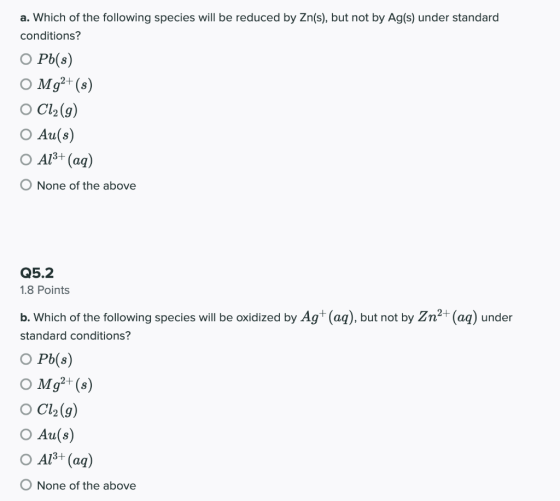
Homework Answers
Answers: (a) None of the above
(b) Pb(s)
As Pb is present in between above Ag and below Zn in the activity series , it has higher tendency to get oxidised than Ag but lesser tendency to get oxidised than zinc. Hence, Ag+ can get reduced to Ag and oxidise Pb to Pb2+.
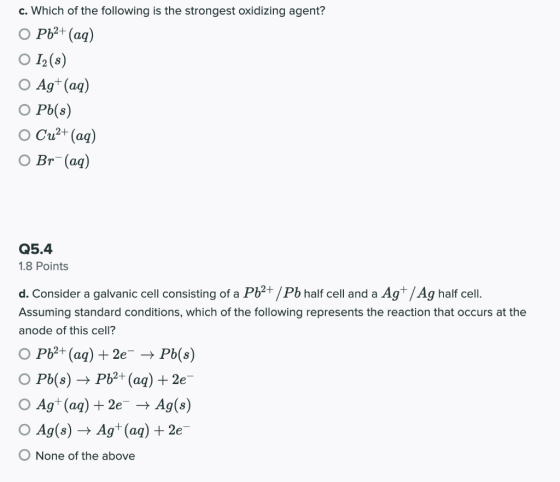
(c) Ag+
(d) Pb(s) ----> Pb2+(aq) + 2e-
As lead is above silver in the activity series, the reduction potential of lead will be less than silver. So, silver will be placed in cathode and get reduced while lead will be in anode and get oxidised.
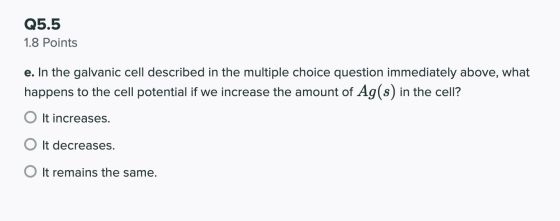
(e) It remains the same
Since Ag is in solid state, its volume is negligible and hence is neglected in calculating reaction quotient for determining cell potential. Hence, cell potential remains same.
Add Answer to:
Please answer all parts to this question! parts a through e!
This is all one question...
this is all part of the same question! will give thumbs up! thanks! a. Which of...
 this is all part of the same question! will give thumbs up!
thanks!
a. Which of the following species will be reduced by Zn(s), but not by Ag(s) under standard conditions? O Pb(s) O Mg2+ (8) O Cl2(9) Au(s) O A13+ (aq) O None of the above Q5.2 1.8 Points b. Which of the following species will be oxidized by Ag+ (aq), but not by Zn2+ (aq) under standard conditions? O Pb(s) O Mg2+ (s) O Cl2(9) O Au(s) O...
this is all part of the same question! will give thumbs up!
thanks!
a. Which of the following species will be reduced by Zn(s), but not by Ag(s) under standard conditions? O Pb(s) O Mg2+ (8) O Cl2(9) Au(s) O A13+ (aq) O None of the above Q5.2 1.8 Points b. Which of the following species will be oxidized by Ag+ (aq), but not by Zn2+ (aq) under standard conditions? O Pb(s) O Mg2+ (s) O Cl2(9) O Au(s) O...
both of these are part of the same question so I could not post them separately!...
 both of these are part of the same question so I could not
post them separately! please answer both its the same question!
will give thumbs up
d. Consider a galvanic cell consisting of a Pb2+/Pb half cell and a Ag+ /Ag half cell. Assuming standard conditions, which of the following represents the reaction that occurs at the anode of this cell? O Pb2+ (aq) + 2e + Pb(s) O Pb(s) + Pb2+ (aq) + 2e O Ag+ (aq) +...
both of these are part of the same question so I could not
post them separately! please answer both its the same question!
will give thumbs up
d. Consider a galvanic cell consisting of a Pb2+/Pb half cell and a Ag+ /Ag half cell. Assuming standard conditions, which of the following represents the reaction that occurs at the anode of this cell? O Pb2+ (aq) + 2e + Pb(s) O Pb(s) + Pb2+ (aq) + 2e O Ag+ (aq) +...
can you answer questions 7,8,9,10 Question 7 (10 points) ✓ Saved (7) For a galvanic cell...
 can you answer questions 7,8,9,10
Question 7 (10 points) ✓ Saved (7) For a galvanic cell notation: (-) Mg/Mg2+ (aq) // Cu2+ (aq) / Cu (+). which of the following is fully correct? (a) Mg2+ is oxidized to Mg, and Cu2+ (aq) is reduced to Cu O (b) Mg2+ is reduced to Mg, and Cu2+ (aq) is oxidized to Cu (c) Mg is oxidized to Mg2+, and Cu²+ (aq) is reduced to Cu (d) Mg is reduced to Mg2+, and...
can you answer questions 7,8,9,10
Question 7 (10 points) ✓ Saved (7) For a galvanic cell notation: (-) Mg/Mg2+ (aq) // Cu2+ (aq) / Cu (+). which of the following is fully correct? (a) Mg2+ is oxidized to Mg, and Cu2+ (aq) is reduced to Cu O (b) Mg2+ is reduced to Mg, and Cu2+ (aq) is oxidized to Cu (c) Mg is oxidized to Mg2+, and Cu²+ (aq) is reduced to Cu (d) Mg is reduced to Mg2+, and...
For each set of materials below: i.Write the cell notation (line notation)for a galvanic cell and...
 For each set of materials below:
i.Write the cell notation (line notation)for a galvanic cell
and
ii.Calculate the standard cell potential
a. Pb(s), Zn(s), Pb2+(aq),Zn2+(aq)
b. Ag(s), Fe(s), Ag+(aq),Fe2+(aq)
c. Mg(s), Zn(s), Mg2+(aq),Zn2+(aq)
d. Fe(s), Mg(s), Fe2+(aq), Mg2+(aq
e. Ag(s), Pb(s), Pb2+(aq), Ag+(aq)
2. For each set of materials below: Write the cell notation (line notation) for a galvanic cell and Calculate the standard cell potential ii. a. Pb (). Zn (3), Pb2+(aq), Zn2+ (aq) 6. Ag (3), Fe (3),...
For each set of materials below:
i.Write the cell notation (line notation)for a galvanic cell
and
ii.Calculate the standard cell potential
a. Pb(s), Zn(s), Pb2+(aq),Zn2+(aq)
b. Ag(s), Fe(s), Ag+(aq),Fe2+(aq)
c. Mg(s), Zn(s), Mg2+(aq),Zn2+(aq)
d. Fe(s), Mg(s), Fe2+(aq), Mg2+(aq
e. Ag(s), Pb(s), Pb2+(aq), Ag+(aq)
2. For each set of materials below: Write the cell notation (line notation) for a galvanic cell and Calculate the standard cell potential ii. a. Pb (). Zn (3), Pb2+(aq), Zn2+ (aq) 6. Ag (3), Fe (3),...
can you please help.me answer these three questions please? I am really desperate and in need...
 can you please help.me answer these three questions
please? I am really desperate and in need of help.
Question 10 Consider the galvanic cell that uses Ni2+ (aq) /Ni (s) and Al3+ (aq)/Al(s) electrodes. Ni2+(aq) + 2e - Ni(s) Ered = -0.257 V Al3+(aq) + 3e Al(s) Eºred = -1.676 V Calculate AG° 0 -273.9 kJ ho O-821.6 kJ 0 -410.8 kJ +821.6 kJ O +273.9 kJ Question 11 Consider the galvanic cell that uses Ni2+ (aq) /Ni (s) and...
can you please help.me answer these three questions
please? I am really desperate and in need of help.
Question 10 Consider the galvanic cell that uses Ni2+ (aq) /Ni (s) and Al3+ (aq)/Al(s) electrodes. Ni2+(aq) + 2e - Ni(s) Ered = -0.257 V Al3+(aq) + 3e Al(s) Eºred = -1.676 V Calculate AG° 0 -273.9 kJ ho O-821.6 kJ 0 -410.8 kJ +821.6 kJ O +273.9 kJ Question 11 Consider the galvanic cell that uses Ni2+ (aq) /Ni (s) and...
Hi. can some one please explain me the solution for this question. the correct answer is...
 Hi. can some one please explain me the solution for
this question. the correct answer is C. thanks.
8. Consider the following galvanic cell and standard reduction potentials: Ag (aq) + e → Ag(s) E=0.80 V Pb²+ (aq) + 2e → Pb(s) E = -0.13 V IMA Which one of the following statements is TRUE? a) The cell on the left containing Ag (aq) is the anode. b) The initial reading on the voltmeter would be 0.67 V. c) Oxidation...
Hi. can some one please explain me the solution for
this question. the correct answer is C. thanks.
8. Consider the following galvanic cell and standard reduction potentials: Ag (aq) + e → Ag(s) E=0.80 V Pb²+ (aq) + 2e → Pb(s) E = -0.13 V IMA Which one of the following statements is TRUE? a) The cell on the left containing Ag (aq) is the anode. b) The initial reading on the voltmeter would be 0.67 V. c) Oxidation...
Please show all steps taken (prefer typed solution) Half-Reaction E ° (V) Ag+ (aq) + e−...
 Please show all steps taken (prefer typed solution)
Half-Reaction
E
°
(V)
Ag+ (aq) + e− → Ag (s)
0.7996
Al3+ (aq) + 3e− → Al (s)
−1.676
Au+ (aq) + e− → Au (s)
1.692
Au3+ (aq) + 3e− → Au (s)
1.498
Ba2+ (aq) + 2e− → Ba (s)
−2.912
Br2 (l) + 2e− → 2Br− (aq)
1.066
Ca2+ (aq) + 2e− → Ca (s)
−2.868
Cl2 (g) + 2e− → 2Cl− (aq)
1.35827
Co2+ (aq) + 2e−...
Please show all steps taken (prefer typed solution)
Half-Reaction
E
°
(V)
Ag+ (aq) + e− → Ag (s)
0.7996
Al3+ (aq) + 3e− → Al (s)
−1.676
Au+ (aq) + e− → Au (s)
1.692
Au3+ (aq) + 3e− → Au (s)
1.498
Ba2+ (aq) + 2e− → Ba (s)
−2.912
Br2 (l) + 2e− → 2Br− (aq)
1.066
Ca2+ (aq) + 2e− → Ca (s)
−2.868
Cl2 (g) + 2e− → 2Cl− (aq)
1.35827
Co2+ (aq) + 2e−...
6. Consider the following galvanic cell and standard reduction potentials: Ag Pb E° = 0.80 V salt bridge Ag+ (aq) + e →...
 6. Consider the following galvanic cell and standard reduction potentials: Ag Pb E° = 0.80 V salt bridge Ag+ (aq) + e → Ag(s) Pb2+(aq) + 2e → Pb(s) E° = -0.13 V 1 M Ag+ 1 M Pb2+ Which one of the following statements is TRUE? a) The cell on the left containing Ag+(aq) is the anode. b) The initial reading on the voltmeter would be 0.67 V. c) Oxidation occurs in the cell on the right containing Pb²+(aq)....
Use the standard half-cell potentials listed below to determine which the following metals will dissolve in...
 Use the standard half-cell potentials listed below to determine which the following metals will dissolve in hydrochloric acid. Cl2(g) + 2e + 2C1-(aq); E° = 1.36 V 2H+(aq) + 2e + H2(g); E° = 0.00 V O Cu; E°(Cu2+/Cu) = +0.34V O Au; E°(Au3+/Au) = +1.50V O Al; E°(A13+/Al) = -1.66V O Ag; E°(Ag+/Ag) = +0.80V O Pt; E°(Pt2+/Pt) = +1.19V
Use the standard half-cell potentials listed below to determine which the following metals will dissolve in...
 Use the standard half-cell potentials listed below to determine which the following metals will dissolve in hydrochloric acid. Cl2(g) + 2e -- 2014(aq); E° = 1.36 V 2H+(aq) + 2e - H2(g); E° = 0.00 V OPt; E°(P+2+/Pt) = +1.19V O Ag; E°(Ag+/Ag) = +0.80V O Au; EⓇ(Au3+/Au) = +1.50V O Al; E(A13+/Al) = -1.66V O Cu; E(Cu2+/Cu) = +0.34V
 this is all part of the same question! will give thumbs up!
thanks!
a. Which of the following species will be reduced by Zn(s), but not by Ag(s) under standard conditions? O Pb(s) O Mg2+ (8) O Cl2(9) Au(s) O A13+ (aq) O None of the above Q5.2 1.8 Points b. Which of the following species will be oxidized by Ag+ (aq), but not by Zn2+ (aq) under standard conditions? O Pb(s) O Mg2+ (s) O Cl2(9) O Au(s) O...
this is all part of the same question! will give thumbs up!
thanks!
a. Which of the following species will be reduced by Zn(s), but not by Ag(s) under standard conditions? O Pb(s) O Mg2+ (8) O Cl2(9) Au(s) O A13+ (aq) O None of the above Q5.2 1.8 Points b. Which of the following species will be oxidized by Ag+ (aq), but not by Zn2+ (aq) under standard conditions? O Pb(s) O Mg2+ (s) O Cl2(9) O Au(s) O...
 both of these are part of the same question so I could not
post them separately! please answer both its the same question!
will give thumbs up
d. Consider a galvanic cell consisting of a Pb2+/Pb half cell and a Ag+ /Ag half cell. Assuming standard conditions, which of the following represents the reaction that occurs at the anode of this cell? O Pb2+ (aq) + 2e + Pb(s) O Pb(s) + Pb2+ (aq) + 2e O Ag+ (aq) +...
both of these are part of the same question so I could not
post them separately! please answer both its the same question!
will give thumbs up
d. Consider a galvanic cell consisting of a Pb2+/Pb half cell and a Ag+ /Ag half cell. Assuming standard conditions, which of the following represents the reaction that occurs at the anode of this cell? O Pb2+ (aq) + 2e + Pb(s) O Pb(s) + Pb2+ (aq) + 2e O Ag+ (aq) +...
 can you answer questions 7,8,9,10
Question 7 (10 points) ✓ Saved (7) For a galvanic cell notation: (-) Mg/Mg2+ (aq) // Cu2+ (aq) / Cu (+). which of the following is fully correct? (a) Mg2+ is oxidized to Mg, and Cu2+ (aq) is reduced to Cu O (b) Mg2+ is reduced to Mg, and Cu2+ (aq) is oxidized to Cu (c) Mg is oxidized to Mg2+, and Cu²+ (aq) is reduced to Cu (d) Mg is reduced to Mg2+, and...
can you answer questions 7,8,9,10
Question 7 (10 points) ✓ Saved (7) For a galvanic cell notation: (-) Mg/Mg2+ (aq) // Cu2+ (aq) / Cu (+). which of the following is fully correct? (a) Mg2+ is oxidized to Mg, and Cu2+ (aq) is reduced to Cu O (b) Mg2+ is reduced to Mg, and Cu2+ (aq) is oxidized to Cu (c) Mg is oxidized to Mg2+, and Cu²+ (aq) is reduced to Cu (d) Mg is reduced to Mg2+, and...
 For each set of materials below:
i.Write the cell notation (line notation)for a galvanic cell
and
ii.Calculate the standard cell potential
a. Pb(s), Zn(s), Pb2+(aq),Zn2+(aq)
b. Ag(s), Fe(s), Ag+(aq),Fe2+(aq)
c. Mg(s), Zn(s), Mg2+(aq),Zn2+(aq)
d. Fe(s), Mg(s), Fe2+(aq), Mg2+(aq
e. Ag(s), Pb(s), Pb2+(aq), Ag+(aq)
2. For each set of materials below: Write the cell notation (line notation) for a galvanic cell and Calculate the standard cell potential ii. a. Pb (). Zn (3), Pb2+(aq), Zn2+ (aq) 6. Ag (3), Fe (3),...
For each set of materials below:
i.Write the cell notation (line notation)for a galvanic cell
and
ii.Calculate the standard cell potential
a. Pb(s), Zn(s), Pb2+(aq),Zn2+(aq)
b. Ag(s), Fe(s), Ag+(aq),Fe2+(aq)
c. Mg(s), Zn(s), Mg2+(aq),Zn2+(aq)
d. Fe(s), Mg(s), Fe2+(aq), Mg2+(aq
e. Ag(s), Pb(s), Pb2+(aq), Ag+(aq)
2. For each set of materials below: Write the cell notation (line notation) for a galvanic cell and Calculate the standard cell potential ii. a. Pb (). Zn (3), Pb2+(aq), Zn2+ (aq) 6. Ag (3), Fe (3),...
 can you please help.me answer these three questions
please? I am really desperate and in need of help.
Question 10 Consider the galvanic cell that uses Ni2+ (aq) /Ni (s) and Al3+ (aq)/Al(s) electrodes. Ni2+(aq) + 2e - Ni(s) Ered = -0.257 V Al3+(aq) + 3e Al(s) Eºred = -1.676 V Calculate AG° 0 -273.9 kJ ho O-821.6 kJ 0 -410.8 kJ +821.6 kJ O +273.9 kJ Question 11 Consider the galvanic cell that uses Ni2+ (aq) /Ni (s) and...
can you please help.me answer these three questions
please? I am really desperate and in need of help.
Question 10 Consider the galvanic cell that uses Ni2+ (aq) /Ni (s) and Al3+ (aq)/Al(s) electrodes. Ni2+(aq) + 2e - Ni(s) Ered = -0.257 V Al3+(aq) + 3e Al(s) Eºred = -1.676 V Calculate AG° 0 -273.9 kJ ho O-821.6 kJ 0 -410.8 kJ +821.6 kJ O +273.9 kJ Question 11 Consider the galvanic cell that uses Ni2+ (aq) /Ni (s) and...
 Hi. can some one please explain me the solution for
this question. the correct answer is C. thanks.
8. Consider the following galvanic cell and standard reduction potentials: Ag (aq) + e → Ag(s) E=0.80 V Pb²+ (aq) + 2e → Pb(s) E = -0.13 V IMA Which one of the following statements is TRUE? a) The cell on the left containing Ag (aq) is the anode. b) The initial reading on the voltmeter would be 0.67 V. c) Oxidation...
Hi. can some one please explain me the solution for
this question. the correct answer is C. thanks.
8. Consider the following galvanic cell and standard reduction potentials: Ag (aq) + e → Ag(s) E=0.80 V Pb²+ (aq) + 2e → Pb(s) E = -0.13 V IMA Which one of the following statements is TRUE? a) The cell on the left containing Ag (aq) is the anode. b) The initial reading on the voltmeter would be 0.67 V. c) Oxidation...
 Please show all steps taken (prefer typed solution)
Half-Reaction
E
°
(V)
Ag+ (aq) + e− → Ag (s)
0.7996
Al3+ (aq) + 3e− → Al (s)
−1.676
Au+ (aq) + e− → Au (s)
1.692
Au3+ (aq) + 3e− → Au (s)
1.498
Ba2+ (aq) + 2e− → Ba (s)
−2.912
Br2 (l) + 2e− → 2Br− (aq)
1.066
Ca2+ (aq) + 2e− → Ca (s)
−2.868
Cl2 (g) + 2e− → 2Cl− (aq)
1.35827
Co2+ (aq) + 2e−...
Please show all steps taken (prefer typed solution)
Half-Reaction
E
°
(V)
Ag+ (aq) + e− → Ag (s)
0.7996
Al3+ (aq) + 3e− → Al (s)
−1.676
Au+ (aq) + e− → Au (s)
1.692
Au3+ (aq) + 3e− → Au (s)
1.498
Ba2+ (aq) + 2e− → Ba (s)
−2.912
Br2 (l) + 2e− → 2Br− (aq)
1.066
Ca2+ (aq) + 2e− → Ca (s)
−2.868
Cl2 (g) + 2e− → 2Cl− (aq)
1.35827
Co2+ (aq) + 2e−...
 6. Consider the following galvanic cell and standard reduction potentials: Ag Pb E° = 0.80 V salt bridge Ag+ (aq) + e → Ag(s) Pb2+(aq) + 2e → Pb(s) E° = -0.13 V 1 M Ag+ 1 M Pb2+ Which one of the following statements is TRUE? a) The cell on the left containing Ag+(aq) is the anode. b) The initial reading on the voltmeter would be 0.67 V. c) Oxidation occurs in the cell on the right containing Pb²+(aq)....
 Use the standard half-cell potentials listed below to determine which the following metals will dissolve in hydrochloric acid. Cl2(g) + 2e + 2C1-(aq); E° = 1.36 V 2H+(aq) + 2e + H2(g); E° = 0.00 V O Cu; E°(Cu2+/Cu) = +0.34V O Au; E°(Au3+/Au) = +1.50V O Al; E°(A13+/Al) = -1.66V O Ag; E°(Ag+/Ag) = +0.80V O Pt; E°(Pt2+/Pt) = +1.19V
 Use the standard half-cell potentials listed below to determine which the following metals will dissolve in hydrochloric acid. Cl2(g) + 2e -- 2014(aq); E° = 1.36 V 2H+(aq) + 2e - H2(g); E° = 0.00 V OPt; E°(P+2+/Pt) = +1.19V O Ag; E°(Ag+/Ag) = +0.80V O Au; EⓇ(Au3+/Au) = +1.50V O Al; E(A13+/Al) = -1.66V O Cu; E(Cu2+/Cu) = +0.34V
Most questions answered within 3 hours.
-
Where is the error in this code sequence?
String s1 = "Hello";
String s2 = "ello";...
asked 10 months ago -
Financial data for Joel de Paris, Inc., for last year
follow:
Joel de Paris, Inc.
Balance...
asked 10 months ago -
Consider this reaction:
Al2(SO4)3 (aq)+ BaCl3
(aq) Al2Cl6 (aq)- +
3BaSO4(s) . What is the...
asked 10 months ago -
Suppose that Savneet is considering increasing her
recent random sample from 20 car rentals to 40...
asked 10 months ago -
Trucks arrive at an unloading terminal at an average rate of 120
per hour.
Trucks arrive...
asked 10 months ago -
Why are methanol and ethanol completely soluble in water while
octanol is not very little soluble....
asked 10 months ago -
A facilities manager at a university reads in a research report
that the mean amount of...
asked 10 months ago -
When the CuSO4 is rehydrated by adding water to the anhydrous
compound, is this an endothermic...
asked 10 months ago -
A ray of sunlight is passing from diamond into crown glass; the
angle of incidence is...
asked 10 months ago -
A block of mass 0.249 kg is placed on top of a light, vertical
spring of...
asked 10 months ago -
how do the kidneys compensate in the presences of acidosis
a) trigger hyperventilate
b) reserve acid...
asked 10 months ago -
Question 501 pts
The rental rate of capital to the firm increases. Which of the
following...
asked 10 months ago