
Homework Answers
Request Answer!
We need at least 10 more requests to produce the answer.
0 / 10 have requested this problem solution
The more requests, the faster the answer.
Add Answer to:
this is all part of the same question! will give thumbs up!
thanks!
a. Which of...
Please answer all parts to this question! parts a through e! This is all one question...
 Please answer all parts to this question! parts a through e!
This is all one question so I could not post them separately,
please also check your answers because the last person got it
wrong! Thank you! Will give thumbs up.
a. Which of the following species will be reduced by Zn(s), but not by Ag(s) under standard conditions? O Pb(s) O Mg2+(s) O Cl2(g) O Au(s) O A13+ (aq) O None of the above Q5.2 1.8 Points b. Which...
Please answer all parts to this question! parts a through e!
This is all one question so I could not post them separately,
please also check your answers because the last person got it
wrong! Thank you! Will give thumbs up.
a. Which of the following species will be reduced by Zn(s), but not by Ag(s) under standard conditions? O Pb(s) O Mg2+(s) O Cl2(g) O Au(s) O A13+ (aq) O None of the above Q5.2 1.8 Points b. Which...
both of these are part of the same question so I could not post them separately!...
 both of these are part of the same question so I could not
post them separately! please answer both its the same question!
will give thumbs up
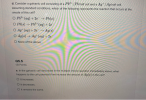
d. Consider a galvanic cell consisting of a Pb2+/Pb half cell and a Ag+ /Ag half cell. Assuming standard conditions, which of the following represents the reaction that occurs at the anode of this cell? O Pb2+ (aq) + 2e + Pb(s) O Pb(s) + Pb2+ (aq) + 2e O Ag+ (aq) +...
both of these are part of the same question so I could not
post them separately! please answer both its the same question!
will give thumbs up
d. Consider a galvanic cell consisting of a Pb2+/Pb half cell and a Ag+ /Ag half cell. Assuming standard conditions, which of the following represents the reaction that occurs at the anode of this cell? O Pb2+ (aq) + 2e + Pb(s) O Pb(s) + Pb2+ (aq) + 2e O Ag+ (aq) +...
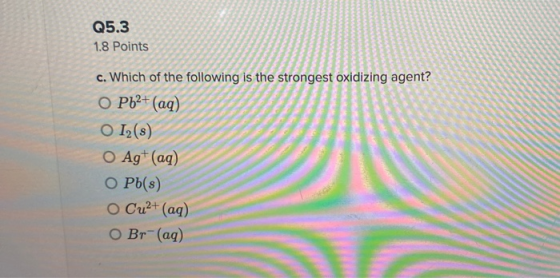
Which of the following species is the strongest oxidizing agent under standard state conditions
Which of the following species is the strongest oxidizing agent under standard state conditions? a. Ag+(aq) b. H2(g) c. H+(aq) d. Cl2(g) e. Al3+(aq) An oxidizing agent is a substance that gains electrons in a redox chemical reaction. I think Al3+ has a very high electron affinity and should pull electrons to it in a chemical reaction. Is Al3+ the best choice for this problem?
Given: 2H+(aq)+2e– ⇌H2(g);E°=0.00 Li+(aq)+e– ⇌Li(s);E°=–3.04V F2(g)+2e– ⇌2F–(aq);E°=2.87 Al3+(aq)+3e– ⇌Al(s);E°=–1.66V Pb2+(aq)+2e– ⇌Pb(s);E°=–0.13V Under standard-state conditions, which is...
Given: 2H+(aq)+2e– ⇌H2(g);E°=0.00 Li+(aq)+e– ⇌Li(s);E°=–3.04V F2(g)+2e– ⇌2F–(aq);E°=2.87 Al3+(aq)+3e– ⇌Al(s);E°=–1.66V Pb2+(aq)+2e– ⇌Pb(s);E°=–0.13V Under standard-state conditions, which is the strongest oxidizing agent? Select one: a. Pb2+ b. Al3+ c. F2 d. Li+ e.H+
1)Consider the following half-reactions: Half-reaction E° (V) Cl2(g) + 2e- > 2Cl-(aq) 1.360V Cd2+(aq) + 2e-...
1)Consider the following half-reactions: Half-reaction E° (V) Cl2(g) + 2e- > 2Cl-(aq) 1.360V Cd2+(aq) + 2e- > Cd(s) -0.403V Al3+(aq) + 3e- > Al(s) -1.660 The strongest oxidizing agent is: _______ enter formula The weakest oxidizing agent is: _______ The weakest reducing agent is: _______ The strongest reducing agent is: _______ Will Al3+(aq) reduce Cl2(g) to Cl-(aq)? _____yes or no Which species can be reduced by Cd(s)? If none, leave box blank. 2) Use the table 'Standard Reduction Potentials' located...
Table 20.1 Half Reaction E°(V). F2 (g) + 2e →2F (aq) +2.87 Cl2 (g) + 2e...
 Table 20.1 Half Reaction E°(V). F2 (g) + 2e →2F (aq) +2.87 Cl2 (g) + 2e → 2CV (aq) +1.359 Br2 (1) + 2e → 2Br (aq) +1.065 O2 (g) + 4H+ (aq) + 4e → 2H20 (1)+1.23 Agt te → Ag (s) +0.799 Fe3+ (aq) + € → Fe2+ (aq) +0.771 12 (s) + 2e → 21+ (aq) +0.536 Cu2+ + 2e → Cu(s) +0.34 2H+ + 2e → H2 (g) Pb2+ + 2e → Pb (s) -0.126 Ni2+...
please comment if need more info. no need to show work. A standard galvanic cell is constructed with Zn of the f...
 please comment if need more info. no need to show work.
A standard galvanic cell is constructed with Zn of the following statements are correct? Z n and F2 F half cell compartments connected by a salt bridge. Which Hint: Refer to a table of standard reduction potentials. (Choose all that apply.) F is reduced at the cathode. OF is oxidized at the anode. As the cell runs, anions will migrate from the ZnZn compartment to the FF compartment. The...
please comment if need more info. no need to show work.
A standard galvanic cell is constructed with Zn of the following statements are correct? Z n and F2 F half cell compartments connected by a salt bridge. Which Hint: Refer to a table of standard reduction potentials. (Choose all that apply.) F is reduced at the cathode. OF is oxidized at the anode. As the cell runs, anions will migrate from the ZnZn compartment to the FF compartment. The...
help with these please Half-reaction E° (V) Br26) + 2e —> 2Br (aq) 1.080V Ca2+(aq) +...
 help with these please
Half-reaction E° (V) Br26) + 2e —> 2Br (aq) 1.080V Ca2+(aq) + 2e —— Cd) 0.403V Zn2+ (aq) + 2e —— Zn(0.763V (1) The strongest oxidizing agent is: enter formula (2) The weakest oxidizing agent is: (3) The weakest reducing agent is: (4) The strongest reducing agent is: (5) Will Br2(1) oxidize Zn(s) to Zn?"(aq)? O (6) Which species can be oxidized by Ca2+(aq)? If none, leave box blank. Consider the following half-reactions: Half-reaction E° (V)...
help with these please
Half-reaction E° (V) Br26) + 2e —> 2Br (aq) 1.080V Ca2+(aq) + 2e —— Cd) 0.403V Zn2+ (aq) + 2e —— Zn(0.763V (1) The strongest oxidizing agent is: enter formula (2) The weakest oxidizing agent is: (3) The weakest reducing agent is: (4) The strongest reducing agent is: (5) Will Br2(1) oxidize Zn(s) to Zn?"(aq)? O (6) Which species can be oxidized by Ca2+(aq)? If none, leave box blank. Consider the following half-reactions: Half-reaction E° (V)...
1 of 1 Oxidizing Agent Under standard conditions, copper will plate out onto a nickel rod...
 1 of 1 Oxidizing Agent Under standard conditions, copper will plate out onto a nickel rod immersed in a solution containing Cu2+ ions, but aluminum will not plate onto a nickel rod immersed in a solution containing Alions. Which of the following is the strongest oxidizing agent? a) Ni(s) b) Al3+ (aq) C) Cu2+ (aq) a 5:26
1. which of the following is the strongest oxidizing agent? (in an acidic solution) (pick one)...
1. which of the following is the strongest oxidizing agent? (in an acidic solution) (pick one) PbO2(s) Mg(s) Ba2+(aq) NO3-(aq) MnO2(s) 2. what element is being oxidized in the following redox reaction? Co2+(aq)+NH4+(aq)=Co(s)+NO3-(aq) Choices are: O,N,Co,Xe, or H 3. which of the following reactant pairs would result in a spontaneous redox reaction? (pick one) Al(s)+Pb2+(aq) Pb(s)+Mn2+(aq) Ni(s)+Zn2+(aq) Ag(s)+Ni2+(aq)
 Please answer all parts to this question! parts a through e!
This is all one question so I could not post them separately,
please also check your answers because the last person got it
wrong! Thank you! Will give thumbs up.
a. Which of the following species will be reduced by Zn(s), but not by Ag(s) under standard conditions? O Pb(s) O Mg2+(s) O Cl2(g) O Au(s) O A13+ (aq) O None of the above Q5.2 1.8 Points b. Which...
Please answer all parts to this question! parts a through e!
This is all one question so I could not post them separately,
please also check your answers because the last person got it
wrong! Thank you! Will give thumbs up.
a. Which of the following species will be reduced by Zn(s), but not by Ag(s) under standard conditions? O Pb(s) O Mg2+(s) O Cl2(g) O Au(s) O A13+ (aq) O None of the above Q5.2 1.8 Points b. Which...
 both of these are part of the same question so I could not
post them separately! please answer both its the same question!
will give thumbs up
d. Consider a galvanic cell consisting of a Pb2+/Pb half cell and a Ag+ /Ag half cell. Assuming standard conditions, which of the following represents the reaction that occurs at the anode of this cell? O Pb2+ (aq) + 2e + Pb(s) O Pb(s) + Pb2+ (aq) + 2e O Ag+ (aq) +...
both of these are part of the same question so I could not
post them separately! please answer both its the same question!
will give thumbs up
d. Consider a galvanic cell consisting of a Pb2+/Pb half cell and a Ag+ /Ag half cell. Assuming standard conditions, which of the following represents the reaction that occurs at the anode of this cell? O Pb2+ (aq) + 2e + Pb(s) O Pb(s) + Pb2+ (aq) + 2e O Ag+ (aq) +...
 Table 20.1 Half Reaction E°(V). F2 (g) + 2e →2F (aq) +2.87 Cl2 (g) + 2e → 2CV (aq) +1.359 Br2 (1) + 2e → 2Br (aq) +1.065 O2 (g) + 4H+ (aq) + 4e → 2H20 (1)+1.23 Agt te → Ag (s) +0.799 Fe3+ (aq) + € → Fe2+ (aq) +0.771 12 (s) + 2e → 21+ (aq) +0.536 Cu2+ + 2e → Cu(s) +0.34 2H+ + 2e → H2 (g) Pb2+ + 2e → Pb (s) -0.126 Ni2+...
 please comment if need more info. no need to show work.
A standard galvanic cell is constructed with Zn of the following statements are correct? Z n and F2 F half cell compartments connected by a salt bridge. Which Hint: Refer to a table of standard reduction potentials. (Choose all that apply.) F is reduced at the cathode. OF is oxidized at the anode. As the cell runs, anions will migrate from the ZnZn compartment to the FF compartment. The...
please comment if need more info. no need to show work.
A standard galvanic cell is constructed with Zn of the following statements are correct? Z n and F2 F half cell compartments connected by a salt bridge. Which Hint: Refer to a table of standard reduction potentials. (Choose all that apply.) F is reduced at the cathode. OF is oxidized at the anode. As the cell runs, anions will migrate from the ZnZn compartment to the FF compartment. The...
 help with these please
Half-reaction E° (V) Br26) + 2e —> 2Br (aq) 1.080V Ca2+(aq) + 2e —— Cd) 0.403V Zn2+ (aq) + 2e —— Zn(0.763V (1) The strongest oxidizing agent is: enter formula (2) The weakest oxidizing agent is: (3) The weakest reducing agent is: (4) The strongest reducing agent is: (5) Will Br2(1) oxidize Zn(s) to Zn?"(aq)? O (6) Which species can be oxidized by Ca2+(aq)? If none, leave box blank. Consider the following half-reactions: Half-reaction E° (V)...
help with these please
Half-reaction E° (V) Br26) + 2e —> 2Br (aq) 1.080V Ca2+(aq) + 2e —— Cd) 0.403V Zn2+ (aq) + 2e —— Zn(0.763V (1) The strongest oxidizing agent is: enter formula (2) The weakest oxidizing agent is: (3) The weakest reducing agent is: (4) The strongest reducing agent is: (5) Will Br2(1) oxidize Zn(s) to Zn?"(aq)? O (6) Which species can be oxidized by Ca2+(aq)? If none, leave box blank. Consider the following half-reactions: Half-reaction E° (V)...
 1 of 1 Oxidizing Agent Under standard conditions, copper will plate out onto a nickel rod immersed in a solution containing Cu2+ ions, but aluminum will not plate onto a nickel rod immersed in a solution containing Alions. Which of the following is the strongest oxidizing agent? a) Ni(s) b) Al3+ (aq) C) Cu2+ (aq) a 5:26
Most questions answered within 3 hours.
-
Where is the error in this code sequence?
String s1 = "Hello";
String s2 = "ello";...
asked 10 months ago -
Financial data for Joel de Paris, Inc., for last year
follow:
Joel de Paris, Inc.
Balance...
asked 10 months ago -
Consider this reaction:
Al2(SO4)3 (aq)+ BaCl3
(aq) Al2Cl6 (aq)- +
3BaSO4(s) . What is the...
asked 10 months ago -
Suppose that Savneet is considering increasing her
recent random sample from 20 car rentals to 40...
asked 10 months ago -
Trucks arrive at an unloading terminal at an average rate of 120
per hour.
Trucks arrive...
asked 10 months ago -
Why are methanol and ethanol completely soluble in water while
octanol is not very little soluble....
asked 10 months ago -
A facilities manager at a university reads in a research report
that the mean amount of...
asked 10 months ago -
When the CuSO4 is rehydrated by adding water to the anhydrous
compound, is this an endothermic...
asked 10 months ago -
A ray of sunlight is passing from diamond into crown glass; the
angle of incidence is...
asked 10 months ago -
A block of mass 0.249 kg is placed on top of a light, vertical
spring of...
asked 10 months ago -
how do the kidneys compensate in the presences of acidosis
a) trigger hyperventilate
b) reserve acid...
asked 10 months ago -
Question 501 pts
The rental rate of capital to the firm increases. Which of the
following...
asked 10 months ago