

Homework Answers
Request Answer!
We need at least 10 more requests to produce the answer.
0 / 10 have requested this problem solution
The more requests, the faster the answer.
Add Answer to:
can you answer questions 7,8,9,10
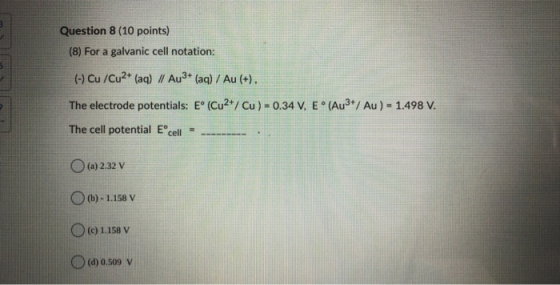
Question 7 (10 points) ✓ Saved (7) For a galvanic cell...
need answers for all questions Question 35 (3 points) (35) For galvanic cell: (-) Cr/ Cr3+...
 need answers for all questions
Question 35 (3 points) (35) For galvanic cell: (-) Cr/ Cr3+ (aq) // Cu2+ (aq) / Cu (+), the correct half reactions are 0 (a) Cr3+ (a) Cr3+ + 3e → Crat (-) electrode; Cu+ 2e → Cu2+ at (+) electrode (b) Cr - 3e → Cr3+ at (-) electrode; Cu2+ + 2e → 2 Cu at (+) electrode Occ) cr (c) Cr + 3e → Cr3+ at (-) electrode; Cu2+ - 2e → Cu...
need answers for all questions
Question 35 (3 points) (35) For galvanic cell: (-) Cr/ Cr3+ (aq) // Cu2+ (aq) / Cu (+), the correct half reactions are 0 (a) Cr3+ (a) Cr3+ + 3e → Crat (-) electrode; Cu+ 2e → Cu2+ at (+) electrode (b) Cr - 3e → Cr3+ at (-) electrode; Cu2+ + 2e → 2 Cu at (+) electrode Occ) cr (c) Cr + 3e → Cr3+ at (-) electrode; Cu2+ - 2e → Cu...
please answer all wueston Question 33 (3 points) (33) For a galvanic cell notation: (-) Ni...
 please answer all wueston
Question 33 (3 points) (33) For a galvanic cell notation: (-) Ni /Ni2+ (aq) // Au3+ (aq) / Au (+), The electrode potentials: Eº (Ni2+/ Ni) = -0.257 V, E ° (AU3+ / Au ) = 1.498 V. The cell potential Eºcell (a) 1.241 V (b) - 1.755 V O (0) 1.755 V (d) 1.498 Why Question 35 (3 points) (35) For galvanic cell: (-) Cr/ Cr3+ (aq) / Cu2+ (aq) / Cu(+), the correct half...
please answer all wueston
Question 33 (3 points) (33) For a galvanic cell notation: (-) Ni /Ni2+ (aq) // Au3+ (aq) / Au (+), The electrode potentials: Eº (Ni2+/ Ni) = -0.257 V, E ° (AU3+ / Au ) = 1.498 V. The cell potential Eºcell (a) 1.241 V (b) - 1.755 V O (0) 1.755 V (d) 1.498 Why Question 35 (3 points) (35) For galvanic cell: (-) Cr/ Cr3+ (aq) / Cu2+ (aq) / Cu(+), the correct half...
can you please help.me answer these three questions please? I am really desperate and in need...
 can you please help.me answer these three questions
please? I am really desperate and in need of help.
Question 10 Consider the galvanic cell that uses Ni2+ (aq) /Ni (s) and Al3+ (aq)/Al(s) electrodes. Ni2+(aq) + 2e - Ni(s) Ered = -0.257 V Al3+(aq) + 3e Al(s) Eºred = -1.676 V Calculate AG° 0 -273.9 kJ ho O-821.6 kJ 0 -410.8 kJ +821.6 kJ O +273.9 kJ Question 11 Consider the galvanic cell that uses Ni2+ (aq) /Ni (s) and...
can you please help.me answer these three questions
please? I am really desperate and in need of help.
Question 10 Consider the galvanic cell that uses Ni2+ (aq) /Ni (s) and Al3+ (aq)/Al(s) electrodes. Ni2+(aq) + 2e - Ni(s) Ered = -0.257 V Al3+(aq) + 3e Al(s) Eºred = -1.676 V Calculate AG° 0 -273.9 kJ ho O-821.6 kJ 0 -410.8 kJ +821.6 kJ O +273.9 kJ Question 11 Consider the galvanic cell that uses Ni2+ (aq) /Ni (s) and...
please comment if need more info. no need to show work. A standard galvanic cell is constructed with Zn of the f...
 please comment if need more info. no need to show work.
A standard galvanic cell is constructed with Zn of the following statements are correct? Z n and F2 F half cell compartments connected by a salt bridge. Which Hint: Refer to a table of standard reduction potentials. (Choose all that apply.) F is reduced at the cathode. OF is oxidized at the anode. As the cell runs, anions will migrate from the ZnZn compartment to the FF compartment. The...
please comment if need more info. no need to show work.
A standard galvanic cell is constructed with Zn of the following statements are correct? Z n and F2 F half cell compartments connected by a salt bridge. Which Hint: Refer to a table of standard reduction potentials. (Choose all that apply.) F is reduced at the cathode. OF is oxidized at the anode. As the cell runs, anions will migrate from the ZnZn compartment to the FF compartment. The...
answer plz Question 32 (3 points) (32) For a galvanic cell notation: (-) Zn /Zn2+ (aq)...
 answer plz
Question 32 (3 points) (32) For a galvanic cell notation: (-) Zn /Zn2+ (aq) // Cu2+ (aq) / Cu (+), which of the following is fully correct? (a) Zn2+ is oxidized to Zn, and Cu2+ (aq) is reduced to Cu. (b) Zn is oxidized to Zn2+, and Cu2+ (aq) is reduced to Cu. 0 (c) Zn2+ is reduced to Zn, and Cu2+ (aq) is oxidized to Cu. (d) Zn is reduced to Zn2+, and Cu (aq) is reduced...
answer plz
Question 32 (3 points) (32) For a galvanic cell notation: (-) Zn /Zn2+ (aq) // Cu2+ (aq) / Cu (+), which of the following is fully correct? (a) Zn2+ is oxidized to Zn, and Cu2+ (aq) is reduced to Cu. (b) Zn is oxidized to Zn2+, and Cu2+ (aq) is reduced to Cu. 0 (c) Zn2+ is reduced to Zn, and Cu2+ (aq) is oxidized to Cu. (d) Zn is reduced to Zn2+, and Cu (aq) is reduced...
Half-cell Potentials: Half Reaction: E value +0.80 V Agt + e → Ag Fe3+ + €...
 Half-cell Potentials: Half Reaction: E value +0.80 V Agt + e → Ag Fe3+ + € → Fe2+ +0.77 v +0.34 V -0.13 V Cu2+ +2e → Cu Pb2+ + 2e - → Ib Ni2+ + 2e → Ni Cd2+ +2e → Cd -0.25 V -0.40 V Fe2+ + 2e → Fe -0.44 V Zn2+ + 2e → Zn -0.76 V Al3+ +3e → AI - 1.66 V Consider an electrochemical cell constructed from the following half cells, linked by...
Please help, thanks. Use the table below to answer the questions that follow. Half Reaction &
Please help, thanks. Use the table below to answer the questions that follow. Half Reaction E°(V) Ag+ + e- → Ag (s) +0.80 Cu2+ + 2e- → Cu (s) +0.34 Pb2+ + 2e- → Pb (s) -0.13 Ni2+ + 2e- → Ni (s) -0.28 (A) Calculate E°cell for a voltaic cell made with Ni, Ni2+and Ag, and Ag+. (B) Which substance is Oxidized? (be sure to include the state of the oxidized substance in your answer) Zn(s) + CuSO4(aq) -->...
Calculate the E°cell for the following reaction: Cu2+ (aq) + Ni (s) → Cu (s)...
Calculate the E°cell for the following reaction: Cu2+ (aq) + Ni (s) → Cu (s) + Ni2+ (aq) A) (-0.59 ± 0.01) V B) (-0.09 ± 0.01) V C) (0.59 ± 0.01) V D) (0.09 ± 0.01) V --------------------------------------------------------------------------------------------------------- What is the proper line notation for the following reaction? Cu (s) + 2Ag+ (aq) → Cu2+ (aq) + 2Ag (s) A) Cu2+ | Cu || Ag | Ag+ B) Ag+ | Ag || Cu | Cu2+ C) Cu |...
Answer all question (a-d) thank you Consider a galvanic cell which has an Iron electrode submerged...
 Answer all question (a-d)
thank you
Consider a galvanic cell which has an Iron electrode submerged in a Fe(NO3)2 soln. and a Gold electrode submerged in a Au(NO3)3 soln. a) Find the Ecell of this cell under standard conditions: (2pts) Ans: Au3+ (aq) + 3e = Aus) ER 1.50 V + 2e = Fe(s) Er = -0.44 V Fe2+ (aq) b) Write out the balanced net reaction of this cell? (3pts) c) What is the cell potential if the concentration...
Answer all question (a-d)
thank you
Consider a galvanic cell which has an Iron electrode submerged in a Fe(NO3)2 soln. and a Gold electrode submerged in a Au(NO3)3 soln. a) Find the Ecell of this cell under standard conditions: (2pts) Ans: Au3+ (aq) + 3e = Aus) ER 1.50 V + 2e = Fe(s) Er = -0.44 V Fe2+ (aq) b) Write out the balanced net reaction of this cell? (3pts) c) What is the cell potential if the concentration...
A galvanic cell is based on the following half reactions E° (V) Au3+ + 3e- →...
A galvanic cell is based on the following half reactions E° (V) Au3+ + 3e- → Au 1.50 Mg2+ + 2e- → Mg -2.37 Calculate the standard potential for this cell. V This cell is set up at 25°C with [Mg2+] = 1.00 × 10⁻⁵M. The cell potential is observed to be 4.02 V. Calculate the [Au3+] that must be present. (Enter your answer to three significant figures.) [Au3+] = ?M
 need answers for all questions
Question 35 (3 points) (35) For galvanic cell: (-) Cr/ Cr3+ (aq) // Cu2+ (aq) / Cu (+), the correct half reactions are 0 (a) Cr3+ (a) Cr3+ + 3e → Crat (-) electrode; Cu+ 2e → Cu2+ at (+) electrode (b) Cr - 3e → Cr3+ at (-) electrode; Cu2+ + 2e → 2 Cu at (+) electrode Occ) cr (c) Cr + 3e → Cr3+ at (-) electrode; Cu2+ - 2e → Cu...
need answers for all questions
Question 35 (3 points) (35) For galvanic cell: (-) Cr/ Cr3+ (aq) // Cu2+ (aq) / Cu (+), the correct half reactions are 0 (a) Cr3+ (a) Cr3+ + 3e → Crat (-) electrode; Cu+ 2e → Cu2+ at (+) electrode (b) Cr - 3e → Cr3+ at (-) electrode; Cu2+ + 2e → 2 Cu at (+) electrode Occ) cr (c) Cr + 3e → Cr3+ at (-) electrode; Cu2+ - 2e → Cu...
 please answer all wueston
Question 33 (3 points) (33) For a galvanic cell notation: (-) Ni /Ni2+ (aq) // Au3+ (aq) / Au (+), The electrode potentials: Eº (Ni2+/ Ni) = -0.257 V, E ° (AU3+ / Au ) = 1.498 V. The cell potential Eºcell (a) 1.241 V (b) - 1.755 V O (0) 1.755 V (d) 1.498 Why Question 35 (3 points) (35) For galvanic cell: (-) Cr/ Cr3+ (aq) / Cu2+ (aq) / Cu(+), the correct half...
please answer all wueston
Question 33 (3 points) (33) For a galvanic cell notation: (-) Ni /Ni2+ (aq) // Au3+ (aq) / Au (+), The electrode potentials: Eº (Ni2+/ Ni) = -0.257 V, E ° (AU3+ / Au ) = 1.498 V. The cell potential Eºcell (a) 1.241 V (b) - 1.755 V O (0) 1.755 V (d) 1.498 Why Question 35 (3 points) (35) For galvanic cell: (-) Cr/ Cr3+ (aq) / Cu2+ (aq) / Cu(+), the correct half...
 can you please help.me answer these three questions
please? I am really desperate and in need of help.
Question 10 Consider the galvanic cell that uses Ni2+ (aq) /Ni (s) and Al3+ (aq)/Al(s) electrodes. Ni2+(aq) + 2e - Ni(s) Ered = -0.257 V Al3+(aq) + 3e Al(s) Eºred = -1.676 V Calculate AG° 0 -273.9 kJ ho O-821.6 kJ 0 -410.8 kJ +821.6 kJ O +273.9 kJ Question 11 Consider the galvanic cell that uses Ni2+ (aq) /Ni (s) and...
can you please help.me answer these three questions
please? I am really desperate and in need of help.
Question 10 Consider the galvanic cell that uses Ni2+ (aq) /Ni (s) and Al3+ (aq)/Al(s) electrodes. Ni2+(aq) + 2e - Ni(s) Ered = -0.257 V Al3+(aq) + 3e Al(s) Eºred = -1.676 V Calculate AG° 0 -273.9 kJ ho O-821.6 kJ 0 -410.8 kJ +821.6 kJ O +273.9 kJ Question 11 Consider the galvanic cell that uses Ni2+ (aq) /Ni (s) and...
 please comment if need more info. no need to show work.
A standard galvanic cell is constructed with Zn of the following statements are correct? Z n and F2 F half cell compartments connected by a salt bridge. Which Hint: Refer to a table of standard reduction potentials. (Choose all that apply.) F is reduced at the cathode. OF is oxidized at the anode. As the cell runs, anions will migrate from the ZnZn compartment to the FF compartment. The...
please comment if need more info. no need to show work.
A standard galvanic cell is constructed with Zn of the following statements are correct? Z n and F2 F half cell compartments connected by a salt bridge. Which Hint: Refer to a table of standard reduction potentials. (Choose all that apply.) F is reduced at the cathode. OF is oxidized at the anode. As the cell runs, anions will migrate from the ZnZn compartment to the FF compartment. The...
 answer plz
Question 32 (3 points) (32) For a galvanic cell notation: (-) Zn /Zn2+ (aq) // Cu2+ (aq) / Cu (+), which of the following is fully correct? (a) Zn2+ is oxidized to Zn, and Cu2+ (aq) is reduced to Cu. (b) Zn is oxidized to Zn2+, and Cu2+ (aq) is reduced to Cu. 0 (c) Zn2+ is reduced to Zn, and Cu2+ (aq) is oxidized to Cu. (d) Zn is reduced to Zn2+, and Cu (aq) is reduced...
answer plz
Question 32 (3 points) (32) For a galvanic cell notation: (-) Zn /Zn2+ (aq) // Cu2+ (aq) / Cu (+), which of the following is fully correct? (a) Zn2+ is oxidized to Zn, and Cu2+ (aq) is reduced to Cu. (b) Zn is oxidized to Zn2+, and Cu2+ (aq) is reduced to Cu. 0 (c) Zn2+ is reduced to Zn, and Cu2+ (aq) is oxidized to Cu. (d) Zn is reduced to Zn2+, and Cu (aq) is reduced...
 Half-cell Potentials: Half Reaction: E value +0.80 V Agt + e → Ag Fe3+ + € → Fe2+ +0.77 v +0.34 V -0.13 V Cu2+ +2e → Cu Pb2+ + 2e - → Ib Ni2+ + 2e → Ni Cd2+ +2e → Cd -0.25 V -0.40 V Fe2+ + 2e → Fe -0.44 V Zn2+ + 2e → Zn -0.76 V Al3+ +3e → AI - 1.66 V Consider an electrochemical cell constructed from the following half cells, linked by...
 Answer all question (a-d)
thank you
Consider a galvanic cell which has an Iron electrode submerged in a Fe(NO3)2 soln. and a Gold electrode submerged in a Au(NO3)3 soln. a) Find the Ecell of this cell under standard conditions: (2pts) Ans: Au3+ (aq) + 3e = Aus) ER 1.50 V + 2e = Fe(s) Er = -0.44 V Fe2+ (aq) b) Write out the balanced net reaction of this cell? (3pts) c) What is the cell potential if the concentration...
Answer all question (a-d)
thank you
Consider a galvanic cell which has an Iron electrode submerged in a Fe(NO3)2 soln. and a Gold electrode submerged in a Au(NO3)3 soln. a) Find the Ecell of this cell under standard conditions: (2pts) Ans: Au3+ (aq) + 3e = Aus) ER 1.50 V + 2e = Fe(s) Er = -0.44 V Fe2+ (aq) b) Write out the balanced net reaction of this cell? (3pts) c) What is the cell potential if the concentration...
Most questions answered within 3 hours.
-
Where is the error in this code sequence?
String s1 = "Hello";
String s2 = "ello";...
asked 10 months ago -
Financial data for Joel de Paris, Inc., for last year
follow:
Joel de Paris, Inc.
Balance...
asked 10 months ago -
Consider this reaction:
Al2(SO4)3 (aq)+ BaCl3
(aq) Al2Cl6 (aq)- +
3BaSO4(s) . What is the...
asked 10 months ago -
Suppose that Savneet is considering increasing her
recent random sample from 20 car rentals to 40...
asked 10 months ago -
Trucks arrive at an unloading terminal at an average rate of 120
per hour.
Trucks arrive...
asked 10 months ago -
Why are methanol and ethanol completely soluble in water while
octanol is not very little soluble....
asked 10 months ago -
A facilities manager at a university reads in a research report
that the mean amount of...
asked 10 months ago -
When the CuSO4 is rehydrated by adding water to the anhydrous
compound, is this an endothermic...
asked 10 months ago -
A ray of sunlight is passing from diamond into crown glass; the
angle of incidence is...
asked 10 months ago -
A block of mass 0.249 kg is placed on top of a light, vertical
spring of...
asked 10 months ago -
how do the kidneys compensate in the presences of acidosis
a) trigger hyperventilate
b) reserve acid...
asked 10 months ago -
Question 501 pts
The rental rate of capital to the firm increases. Which of the
following...
asked 10 months ago