
![c. What is the rate law that corresponds to this mechanism assuming the first step is at equilibrium? O rate = k K[A][B]? O r](http://img.homeworklib.com/questions/90412f40-dd15-11ea-b4c9-af7e8631efbc.png?x-oss-process=image/resize,w_560)
![d. Here are some initial velocity data for this reaction. Experiment (A), (M) [B]. (M) rate (M.-) 1 0.50 0.50 10. 2 0.25 0.50](http://img.homeworklib.com/questions/911f5ea0-dd15-11ea-b5f0-39d0e295210a.png?x-oss-process=image/resize,w_560)
Homework Answers
Request Answer!
We need at least 10 more requests to produce the answer.
0 / 10 have requested this problem solution
The more requests, the faster the answer.
Add Answer to:
hello! i know this question is long but it has multiple parts
so I could not...
Please answer all parts to this question! parts a through d with the explanation on question...
 Please answer all parts to this question! parts a through d with
the explanation on question d! This is all one question so I could
not post them separately, please also check your answers because
the last person got it wrong! Thank you! WIll give thumbs up.
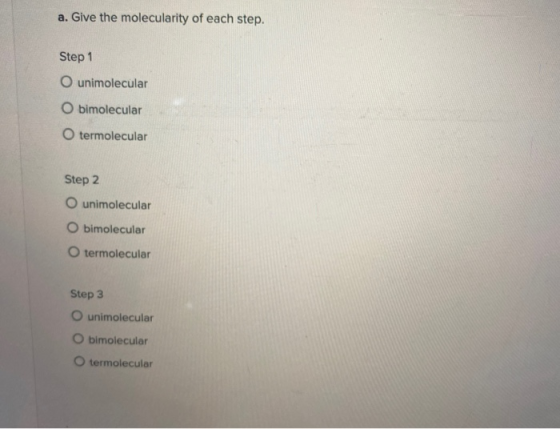
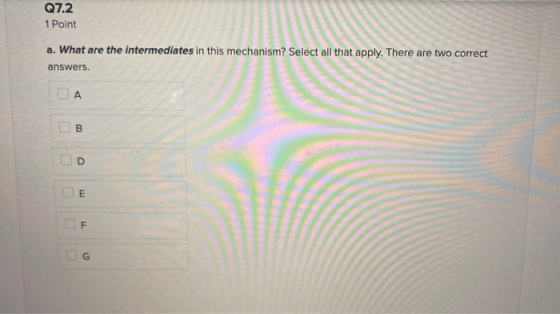
Consider the following reaction mechanism: Step 1 K 2A + B =D (fast equilibrium) Step 2 D+B k? E+ F (slow) Step 3 F G (fast) a. Give the molecularity of each step....
Please answer all parts to this question! parts a through d with
the explanation on question d! This is all one question so I could
not post them separately, please also check your answers because
the last person got it wrong! Thank you! WIll give thumbs up.
Consider the following reaction mechanism: Step 1 K 2A + B =D (fast equilibrium) Step 2 D+B k? E+ F (slow) Step 3 F G (fast) a. Give the molecularity of each step....
PLEASE MAKE SURE C AND D ARE CORRECT! i have had two wrong answers so far....
 PLEASE MAKE SURE C AND D ARE CORRECT! i have had two wrong
answers so far. This is all one question, so I could not post the
parts separately. Thanks.
Consider the following reaction mechanism: Step 1 K 2A + B =D (fast equilibrium) Step 2 D+B kk E+F (slow) Step 3 F G (fast) a. Give the molecularity of each step. Step 1 O unimolecular bimolecular O termolecular Step 2 unimolecular Obimolecular termolecular Step 3 unimolecular O bimolecular termolecular...
PLEASE MAKE SURE C AND D ARE CORRECT! i have had two wrong
answers so far. This is all one question, so I could not post the
parts separately. Thanks.
Consider the following reaction mechanism: Step 1 K 2A + B =D (fast equilibrium) Step 2 D+B kk E+F (slow) Step 3 F G (fast) a. Give the molecularity of each step. Step 1 O unimolecular bimolecular O termolecular Step 2 unimolecular Obimolecular termolecular Step 3 unimolecular O bimolecular termolecular...
Please make sure these both are correct I keep getting different answers, make sure it is...
 Please make sure these both are correct I
keep getting different answers, make sure it is not wrong the
answer you give. THANKS
Reaction 1 below occurs very slowly, while reaction 2 below occurs much more rapidly: 1. O2(g) → 20 (9) 2. Ar(g) + O2(g) → Ar(g) + 2O(g) Q9.1 2 Points a. Ar(g) can be viewd as a catalyst in reaction 2, as it accelerates the reaction, but is neither created nor destroyed by the reaction. Which of...
Please make sure these both are correct I
keep getting different answers, make sure it is not wrong the
answer you give. THANKS
Reaction 1 below occurs very slowly, while reaction 2 below occurs much more rapidly: 1. O2(g) → 20 (9) 2. Ar(g) + O2(g) → Ar(g) + 2O(g) Q9.1 2 Points a. Ar(g) can be viewd as a catalyst in reaction 2, as it accelerates the reaction, but is neither created nor destroyed by the reaction. Which of...
Be sure to answer all parts. Consider the following mechanism: (1) ClO−(aq) + H2O(l) ⇌ HClO(aq)...
Be sure to answer all parts. Consider the following mechanism: (1) ClO−(aq) + H2O(l) ⇌ HClO(aq) + OH−(aq) [fast] (2) I−(aq) + HClO(aq) → HIO(aq) + Cl−(aq) [slow] (3) OH−(aq) + HIO(aq) → H2O(l) + IO−(aq) [fast] (a) What is the overall equation? Select the single best answer. ClO−(aq) + I−(aq) ⇌ IO−(aq) + H2O(l) + Cl−(aq) ClO−(aq) + I−(aq) → IO−(aq) + H2O(l) + Cl−(aq) ClO−(aq) + I−(aq) → IO−(aq) + Cl−(aq) ClO−(aq) + I−(aq) ⇌ IO−(aq) +...
A three-step mechanism has been suggested for the formation of carbonyl chloride: Step 1: Cl2 ===> 2 Cl (fast equlibrium) Step 2: Cl + CO ===> COCl (fast equilibrium) Step 3: COCl + Cl2 ===> COCl2 + Cl (slow) What is the molecularit
1. A three-step mechanism has been suggested for the formation of carbonyl chloride: Step 1: Cl2 ===> 2 Cl (fast equlibrium) Step 2: Cl + CO ===> COCl (fast equilibrium) Step 3: COCl + Cl2 ===> COCl2 + Cl (slow) What is the molecularity of the rate-determining step? unimolecular bimolecular termolelcular none of these 2. The elementary reaction representing the formation of ozone, O2(g) + O(g) + M(g) ===> O3(g) + M*(g) is an example of a _________ reaction. unimolecular...
Question 7 1 pts The following two-step mechanism has been proposed for the gas phase decomposition...
 Question 7 1 pts The following two-step mechanism has been proposed for the gas phase decomposition of nitrous oxide: N20 (g) → N2 (g) + O (g) step 1 N20 (g) + O (g) - N2(g) + O2(g) step 2 Overall Reaction: 2 N20 (g) → 2N2 (g) + O2 (g) What is the molecularity of the first and second elementary steps of the mechanism? The first step is termolecular, and the second step is bimolecular, Both steps are bimolecular,...
The following mechanism has been proposed for the gas phase reaction of nitrogen monoxide with bromine....
The following mechanism has been proposed for the gas phase reaction of nitrogen monoxide with bromine. step 1: NO + Br2--->NOBr2 step 2: NOBr2 + NO --->2 NOBr (a) Identify the molecularity of each step in the mechanism. step 1 _________ (unimolecular, bimolecular, termolecular) step 2 _________ (unimolecular, bimolecular, termolecular) (b) Write the equation for the net reaction. Use the smallest integer coefficients possible. (c) Identify any intemediates and/or catalysts in this mechanism. Catalyst: Enter formula. If none, leave box...
Support shift the equilibrium to the left QUESTION 24 A proposed mechanism is: Step 1: C2...
 Support shift the equilibrium to the left QUESTION 24 A proposed mechanism is: Step 1: C2 → 2C (slow) Step 2: C +DCD (fast) What is the molecularity of the rate-determining step? O termolecular o unimolecular obimolecular zeromolecular More information is needed. QUESTION 25
14-99. The mechanism for the reaction 2H,0, (aq) ® 2H,00) +0,) in the presence of I...
 14-99. The mechanism for the reaction 2H,0, (aq) ® 2H,00) +0,) in the presence of I (aq) is proposed to be: Step 1: H,02(aq) + I (aq) ® H,0(0) + Ol (aq) Step 2: H,0, (aq) + 01 (aq) ® H,00) + 0,(g) + 1 (aq) (slow) (fast) What is the molecularity of the rate-determining step? Select one: a. zero molecular b. unimolecular c. bimolecular d. termolecular e. More information is needed to answer this question.
QUESTION 10 A proposed mechanism for the decomposition of ozone in the atmosphere is: Step 1:...
 QUESTION 10 A proposed mechanism for the decomposition of ozone in the atmosphere is: Step 1: 03(g) + hvO(g) + O2(g) (fast) Step 2: O(g) + O2(g) +202() (slow) What is the molecularity of the rate-determining step? unimolecular bimolecular zeromolecular More information is needed. termolecular QUESTION 11 At a certain temperature the equilibrium equals 0.11 for the reaction: 2 ICI(g) =12(g) + Cl2(g). What is the equilibrium concentration of Cl2 if 2.78 mol of 12 and 2.78 mol of Cl2...
 Please answer all parts to this question! parts a through d with
the explanation on question d! This is all one question so I could
not post them separately, please also check your answers because
the last person got it wrong! Thank you! WIll give thumbs up.
Consider the following reaction mechanism: Step 1 K 2A + B =D (fast equilibrium) Step 2 D+B k? E+ F (slow) Step 3 F G (fast) a. Give the molecularity of each step....
Please answer all parts to this question! parts a through d with
the explanation on question d! This is all one question so I could
not post them separately, please also check your answers because
the last person got it wrong! Thank you! WIll give thumbs up.
Consider the following reaction mechanism: Step 1 K 2A + B =D (fast equilibrium) Step 2 D+B k? E+ F (slow) Step 3 F G (fast) a. Give the molecularity of each step....
 PLEASE MAKE SURE C AND D ARE CORRECT! i have had two wrong
answers so far. This is all one question, so I could not post the
parts separately. Thanks.
Consider the following reaction mechanism: Step 1 K 2A + B =D (fast equilibrium) Step 2 D+B kk E+F (slow) Step 3 F G (fast) a. Give the molecularity of each step. Step 1 O unimolecular bimolecular O termolecular Step 2 unimolecular Obimolecular termolecular Step 3 unimolecular O bimolecular termolecular...
PLEASE MAKE SURE C AND D ARE CORRECT! i have had two wrong
answers so far. This is all one question, so I could not post the
parts separately. Thanks.
Consider the following reaction mechanism: Step 1 K 2A + B =D (fast equilibrium) Step 2 D+B kk E+F (slow) Step 3 F G (fast) a. Give the molecularity of each step. Step 1 O unimolecular bimolecular O termolecular Step 2 unimolecular Obimolecular termolecular Step 3 unimolecular O bimolecular termolecular...
 Please make sure these both are correct I
keep getting different answers, make sure it is not wrong the
answer you give. THANKS
Reaction 1 below occurs very slowly, while reaction 2 below occurs much more rapidly: 1. O2(g) → 20 (9) 2. Ar(g) + O2(g) → Ar(g) + 2O(g) Q9.1 2 Points a. Ar(g) can be viewd as a catalyst in reaction 2, as it accelerates the reaction, but is neither created nor destroyed by the reaction. Which of...
Please make sure these both are correct I
keep getting different answers, make sure it is not wrong the
answer you give. THANKS
Reaction 1 below occurs very slowly, while reaction 2 below occurs much more rapidly: 1. O2(g) → 20 (9) 2. Ar(g) + O2(g) → Ar(g) + 2O(g) Q9.1 2 Points a. Ar(g) can be viewd as a catalyst in reaction 2, as it accelerates the reaction, but is neither created nor destroyed by the reaction. Which of...
 Question 7 1 pts The following two-step mechanism has been proposed for the gas phase decomposition of nitrous oxide: N20 (g) → N2 (g) + O (g) step 1 N20 (g) + O (g) - N2(g) + O2(g) step 2 Overall Reaction: 2 N20 (g) → 2N2 (g) + O2 (g) What is the molecularity of the first and second elementary steps of the mechanism? The first step is termolecular, and the second step is bimolecular, Both steps are bimolecular,...
 Support shift the equilibrium to the left QUESTION 24 A proposed mechanism is: Step 1: C2 → 2C (slow) Step 2: C +DCD (fast) What is the molecularity of the rate-determining step? O termolecular o unimolecular obimolecular zeromolecular More information is needed. QUESTION 25
 14-99. The mechanism for the reaction 2H,0, (aq) ® 2H,00) +0,) in the presence of I (aq) is proposed to be: Step 1: H,02(aq) + I (aq) ® H,0(0) + Ol (aq) Step 2: H,0, (aq) + 01 (aq) ® H,00) + 0,(g) + 1 (aq) (slow) (fast) What is the molecularity of the rate-determining step? Select one: a. zero molecular b. unimolecular c. bimolecular d. termolecular e. More information is needed to answer this question.
 QUESTION 10 A proposed mechanism for the decomposition of ozone in the atmosphere is: Step 1: 03(g) + hvO(g) + O2(g) (fast) Step 2: O(g) + O2(g) +202() (slow) What is the molecularity of the rate-determining step? unimolecular bimolecular zeromolecular More information is needed. termolecular QUESTION 11 At a certain temperature the equilibrium equals 0.11 for the reaction: 2 ICI(g) =12(g) + Cl2(g). What is the equilibrium concentration of Cl2 if 2.78 mol of 12 and 2.78 mol of Cl2...
Most questions answered within 3 hours.
-
Where is the error in this code sequence?
String s1 = "Hello";
String s2 = "ello";...
asked 10 months ago -
Financial data for Joel de Paris, Inc., for last year
follow:
Joel de Paris, Inc.
Balance...
asked 10 months ago -
Consider this reaction:
Al2(SO4)3 (aq)+ BaCl3
(aq) Al2Cl6 (aq)- +
3BaSO4(s) . What is the...
asked 10 months ago -
Suppose that Savneet is considering increasing her
recent random sample from 20 car rentals to 40...
asked 10 months ago -
Trucks arrive at an unloading terminal at an average rate of 120
per hour.
Trucks arrive...
asked 10 months ago -
Why are methanol and ethanol completely soluble in water while
octanol is not very little soluble....
asked 10 months ago -
A facilities manager at a university reads in a research report
that the mean amount of...
asked 10 months ago -
When the CuSO4 is rehydrated by adding water to the anhydrous
compound, is this an endothermic...
asked 10 months ago -
A ray of sunlight is passing from diamond into crown glass; the
angle of incidence is...
asked 10 months ago -
A block of mass 0.249 kg is placed on top of a light, vertical
spring of...
asked 10 months ago -
how do the kidneys compensate in the presences of acidosis
a) trigger hyperventilate
b) reserve acid...
asked 10 months ago -
Question 501 pts
The rental rate of capital to the firm increases. Which of the
following...
asked 10 months ago