PLEASE MAKE SURE C AND D ARE CORRECT! i have had two wrong
answers so far. This is all one question, so I could not post the
parts separately. Thanks. 

![c. What is the rate law that corresponds to this mechanism assuming the first step is at equilibrium? rate = k2 K1[A][B]2 O r](http://img.homeworklib.com/questions/a54fb7b0-dc99-11ea-9390-0568434e697b.png?x-oss-process=image/resize,w_560)
![d. Here are some initial velocity data for this reaction. Experiment [A]. (M) [B]. (M) rate (M·s-1) 1 0.50 0.50 10. 2 0.25 0.](http://img.homeworklib.com/questions/a5c0cfb0-dc99-11ea-b058-31c962b0b9c2.png?x-oss-process=image/resize,w_560)
Homework Answers
Request Answer!
We need at least 10 more requests to produce the answer.
0 / 10 have requested this problem solution
The more requests, the faster the answer.
Add Answer to:
PLEASE MAKE SURE C AND D ARE CORRECT! i have had two wrong
answers so far....
Please answer all parts to this question! parts a through d with the explanation on question...
 Please answer all parts to this question! parts a through d with
the explanation on question d! This is all one question so I could
not post them separately, please also check your answers because
the last person got it wrong! Thank you! WIll give thumbs up.
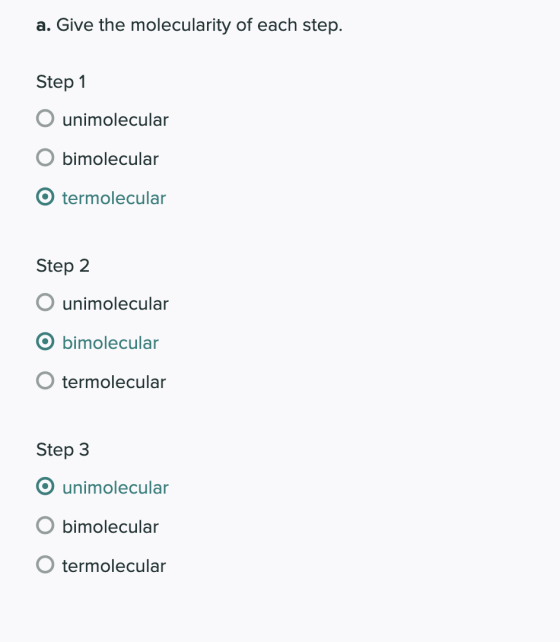
Consider the following reaction mechanism: Step 1 K 2A + B =D (fast equilibrium) Step 2 D+B k? E+ F (slow) Step 3 F G (fast) a. Give the molecularity of each step....
Please answer all parts to this question! parts a through d with
the explanation on question d! This is all one question so I could
not post them separately, please also check your answers because
the last person got it wrong! Thank you! WIll give thumbs up.
Consider the following reaction mechanism: Step 1 K 2A + B =D (fast equilibrium) Step 2 D+B k? E+ F (slow) Step 3 F G (fast) a. Give the molecularity of each step....
hello! i know this question is long but it has multiple parts so I could not...
 hello! i know this question is long but it has multiple parts
so I could not post them separately. please answer all parts of the
question, a through d... including the question at the end "are
these data consistent eith the proposed mechanism why or why
not????" thank you! i will give a thumbs up!
Consider the following reaction mechanism: Step 1 K 2A + BD (fast equilibrium) Step 2 D+BE+F (slow) Step 3 F G (fast) a. Give the...
hello! i know this question is long but it has multiple parts
so I could not post them separately. please answer all parts of the
question, a through d... including the question at the end "are
these data consistent eith the proposed mechanism why or why
not????" thank you! i will give a thumbs up!
Consider the following reaction mechanism: Step 1 K 2A + BD (fast equilibrium) Step 2 D+BE+F (slow) Step 3 F G (fast) a. Give the...
Please make sure these both are correct I keep getting different answers, make sure it is...
 Please make sure these both are correct I
keep getting different answers, make sure it is not wrong the
answer you give. THANKS
Reaction 1 below occurs very slowly, while reaction 2 below occurs much more rapidly: 1. O2(g) → 20 (9) 2. Ar(g) + O2(g) → Ar(g) + 2O(g) Q9.1 2 Points a. Ar(g) can be viewd as a catalyst in reaction 2, as it accelerates the reaction, but is neither created nor destroyed by the reaction. Which of...
Please make sure these both are correct I
keep getting different answers, make sure it is not wrong the
answer you give. THANKS
Reaction 1 below occurs very slowly, while reaction 2 below occurs much more rapidly: 1. O2(g) → 20 (9) 2. Ar(g) + O2(g) → Ar(g) + 2O(g) Q9.1 2 Points a. Ar(g) can be viewd as a catalyst in reaction 2, as it accelerates the reaction, but is neither created nor destroyed by the reaction. Which of...
Be sure to answer all parts. Consider the following mechanism: (1) ClO−(aq) + H2O(l) ⇌ HClO(aq)...
Be sure to answer all parts. Consider the following mechanism: (1) ClO−(aq) + H2O(l) ⇌ HClO(aq) + OH−(aq) [fast] (2) I−(aq) + HClO(aq) → HIO(aq) + Cl−(aq) [slow] (3) OH−(aq) + HIO(aq) → H2O(l) + IO−(aq) [fast] (a) What is the overall equation? Select the single best answer. ClO−(aq) + I−(aq) ⇌ IO−(aq) + H2O(l) + Cl−(aq) ClO−(aq) + I−(aq) → IO−(aq) + H2O(l) + Cl−(aq) ClO−(aq) + I−(aq) → IO−(aq) + Cl−(aq) ClO−(aq) + I−(aq) ⇌ IO−(aq) +...
Please make sure your answer is correct. I have gotten numerous wrong answers. Thanks. This one...
 Please make sure your answer is correct. I have gotten numerous
wrong answers. Thanks.
This one too:
And this one:
Again please make sure you are correct.
If you have time: This one was marked wrong too, so if you can
solve I give thumbs up thanks.
Consider the following reaction mechanism: Step 1 K 2A + B =D (fast equilibrium) Step 2 D+B *3 E+F (slow) Step 3 FKG (fast) c. What is the rate law that corresponds to...
Please make sure your answer is correct. I have gotten numerous
wrong answers. Thanks.
This one too:
And this one:
Again please make sure you are correct.
If you have time: This one was marked wrong too, so if you can
solve I give thumbs up thanks.
Consider the following reaction mechanism: Step 1 K 2A + B =D (fast equilibrium) Step 2 D+B *3 E+F (slow) Step 3 FKG (fast) c. What is the rate law that corresponds to...
14-99. The mechanism for the reaction 2H,0, (aq) ® 2H,00) +0,) in the presence of I...
 14-99. The mechanism for the reaction 2H,0, (aq) ® 2H,00) +0,) in the presence of I (aq) is proposed to be: Step 1: H,02(aq) + I (aq) ® H,0(0) + Ol (aq) Step 2: H,0, (aq) + 01 (aq) ® H,00) + 0,(g) + 1 (aq) (slow) (fast) What is the molecularity of the rate-determining step? Select one: a. zero molecular b. unimolecular c. bimolecular d. termolecular e. More information is needed to answer this question.
QUESTION 10 A proposed mechanism for the decomposition of ozone in the atmosphere is: Step 1:...
 QUESTION 10 A proposed mechanism for the decomposition of ozone in the atmosphere is: Step 1: 03(g) + hvO(g) + O2(g) (fast) Step 2: O(g) + O2(g) +202() (slow) What is the molecularity of the rate-determining step? unimolecular bimolecular zeromolecular More information is needed. termolecular QUESTION 11 At a certain temperature the equilibrium equals 0.11 for the reaction: 2 ICI(g) =12(g) + Cl2(g). What is the equilibrium concentration of Cl2 if 2.78 mol of 12 and 2.78 mol of Cl2...
please make sure this is correct! I have gotten two wrong answers already so far! Reaction...
 please make sure this is correct! I have gotten two wrong
answers already so far!
Reaction 1 below occurs very slowly, while reaction 2 below occurs much more rapidly: 1. O2(g) +20(g) 2. Ar(g) + O2(g) → Ar(g) +20(g) Q9.1 2 Points a. Ar(g) can be viewd as a catalyst in reaction 2, as it accelerates the reaction, but is neither created nor destroyed by the reaction. Which of the following is true? O Reaction 1 will have a greater...
please make sure this is correct! I have gotten two wrong
answers already so far!
Reaction 1 below occurs very slowly, while reaction 2 below occurs much more rapidly: 1. O2(g) +20(g) 2. Ar(g) + O2(g) → Ar(g) +20(g) Q9.1 2 Points a. Ar(g) can be viewd as a catalyst in reaction 2, as it accelerates the reaction, but is neither created nor destroyed by the reaction. Which of the following is true? O Reaction 1 will have a greater...
Make sure this is correct please I have gotten two wrong answers already a. Consider the...
 Make sure this is correct please I have gotten two wrong answers
already
a. Consider the following complex reaction. X + 2Y + products. What are the units of the rate constant for this reaction? OM.s-1 Os-1 O M-1.5-1 O M-2.5-1 O This question cannot be answered without additional information.
Make sure this is correct please I have gotten two wrong answers
already
a. Consider the following complex reaction. X + 2Y + products. What are the units of the rate constant for this reaction? OM.s-1 Os-1 O M-1.5-1 O M-2.5-1 O This question cannot be answered without additional information.
Please make sure parts e and f are correct, I have gotten two wrong answers so...
 Please make sure parts e and f are correct, I have gotten two
wrong answers so far. Thanks. Will give thumbs up. Please show
work.
Here is a list of hypothetical acids with their pKa's. The pKa values are valid at 25 °C. Acid pK a А 3.44 B 5.12 с 6.40 D 8.52 d. Which of these acids, in combination with its conjugate base, would be the best one to use to create a buffer with a pH of...
Please make sure parts e and f are correct, I have gotten two
wrong answers so far. Thanks. Will give thumbs up. Please show
work.
Here is a list of hypothetical acids with their pKa's. The pKa values are valid at 25 °C. Acid pK a А 3.44 B 5.12 с 6.40 D 8.52 d. Which of these acids, in combination with its conjugate base, would be the best one to use to create a buffer with a pH of...
 Please answer all parts to this question! parts a through d with
the explanation on question d! This is all one question so I could
not post them separately, please also check your answers because
the last person got it wrong! Thank you! WIll give thumbs up.
Consider the following reaction mechanism: Step 1 K 2A + B =D (fast equilibrium) Step 2 D+B k? E+ F (slow) Step 3 F G (fast) a. Give the molecularity of each step....
Please answer all parts to this question! parts a through d with
the explanation on question d! This is all one question so I could
not post them separately, please also check your answers because
the last person got it wrong! Thank you! WIll give thumbs up.
Consider the following reaction mechanism: Step 1 K 2A + B =D (fast equilibrium) Step 2 D+B k? E+ F (slow) Step 3 F G (fast) a. Give the molecularity of each step....
 hello! i know this question is long but it has multiple parts
so I could not post them separately. please answer all parts of the
question, a through d... including the question at the end "are
these data consistent eith the proposed mechanism why or why
not????" thank you! i will give a thumbs up!
Consider the following reaction mechanism: Step 1 K 2A + BD (fast equilibrium) Step 2 D+BE+F (slow) Step 3 F G (fast) a. Give the...
hello! i know this question is long but it has multiple parts
so I could not post them separately. please answer all parts of the
question, a through d... including the question at the end "are
these data consistent eith the proposed mechanism why or why
not????" thank you! i will give a thumbs up!
Consider the following reaction mechanism: Step 1 K 2A + BD (fast equilibrium) Step 2 D+BE+F (slow) Step 3 F G (fast) a. Give the...
 Please make sure these both are correct I
keep getting different answers, make sure it is not wrong the
answer you give. THANKS
Reaction 1 below occurs very slowly, while reaction 2 below occurs much more rapidly: 1. O2(g) → 20 (9) 2. Ar(g) + O2(g) → Ar(g) + 2O(g) Q9.1 2 Points a. Ar(g) can be viewd as a catalyst in reaction 2, as it accelerates the reaction, but is neither created nor destroyed by the reaction. Which of...
Please make sure these both are correct I
keep getting different answers, make sure it is not wrong the
answer you give. THANKS
Reaction 1 below occurs very slowly, while reaction 2 below occurs much more rapidly: 1. O2(g) → 20 (9) 2. Ar(g) + O2(g) → Ar(g) + 2O(g) Q9.1 2 Points a. Ar(g) can be viewd as a catalyst in reaction 2, as it accelerates the reaction, but is neither created nor destroyed by the reaction. Which of...
 Please make sure your answer is correct. I have gotten numerous
wrong answers. Thanks.
This one too:
And this one:
Again please make sure you are correct.
If you have time: This one was marked wrong too, so if you can
solve I give thumbs up thanks.
Consider the following reaction mechanism: Step 1 K 2A + B =D (fast equilibrium) Step 2 D+B *3 E+F (slow) Step 3 FKG (fast) c. What is the rate law that corresponds to...
Please make sure your answer is correct. I have gotten numerous
wrong answers. Thanks.
This one too:
And this one:
Again please make sure you are correct.
If you have time: This one was marked wrong too, so if you can
solve I give thumbs up thanks.
Consider the following reaction mechanism: Step 1 K 2A + B =D (fast equilibrium) Step 2 D+B *3 E+F (slow) Step 3 FKG (fast) c. What is the rate law that corresponds to...
 14-99. The mechanism for the reaction 2H,0, (aq) ® 2H,00) +0,) in the presence of I (aq) is proposed to be: Step 1: H,02(aq) + I (aq) ® H,0(0) + Ol (aq) Step 2: H,0, (aq) + 01 (aq) ® H,00) + 0,(g) + 1 (aq) (slow) (fast) What is the molecularity of the rate-determining step? Select one: a. zero molecular b. unimolecular c. bimolecular d. termolecular e. More information is needed to answer this question.
 QUESTION 10 A proposed mechanism for the decomposition of ozone in the atmosphere is: Step 1: 03(g) + hvO(g) + O2(g) (fast) Step 2: O(g) + O2(g) +202() (slow) What is the molecularity of the rate-determining step? unimolecular bimolecular zeromolecular More information is needed. termolecular QUESTION 11 At a certain temperature the equilibrium equals 0.11 for the reaction: 2 ICI(g) =12(g) + Cl2(g). What is the equilibrium concentration of Cl2 if 2.78 mol of 12 and 2.78 mol of Cl2...
 please make sure this is correct! I have gotten two wrong
answers already so far!
Reaction 1 below occurs very slowly, while reaction 2 below occurs much more rapidly: 1. O2(g) +20(g) 2. Ar(g) + O2(g) → Ar(g) +20(g) Q9.1 2 Points a. Ar(g) can be viewd as a catalyst in reaction 2, as it accelerates the reaction, but is neither created nor destroyed by the reaction. Which of the following is true? O Reaction 1 will have a greater...
please make sure this is correct! I have gotten two wrong
answers already so far!
Reaction 1 below occurs very slowly, while reaction 2 below occurs much more rapidly: 1. O2(g) +20(g) 2. Ar(g) + O2(g) → Ar(g) +20(g) Q9.1 2 Points a. Ar(g) can be viewd as a catalyst in reaction 2, as it accelerates the reaction, but is neither created nor destroyed by the reaction. Which of the following is true? O Reaction 1 will have a greater...
 Make sure this is correct please I have gotten two wrong answers
already
a. Consider the following complex reaction. X + 2Y + products. What are the units of the rate constant for this reaction? OM.s-1 Os-1 O M-1.5-1 O M-2.5-1 O This question cannot be answered without additional information.
Make sure this is correct please I have gotten two wrong answers
already
a. Consider the following complex reaction. X + 2Y + products. What are the units of the rate constant for this reaction? OM.s-1 Os-1 O M-1.5-1 O M-2.5-1 O This question cannot be answered without additional information.
 Please make sure parts e and f are correct, I have gotten two
wrong answers so far. Thanks. Will give thumbs up. Please show
work.
Here is a list of hypothetical acids with their pKa's. The pKa values are valid at 25 °C. Acid pK a А 3.44 B 5.12 с 6.40 D 8.52 d. Which of these acids, in combination with its conjugate base, would be the best one to use to create a buffer with a pH of...
Please make sure parts e and f are correct, I have gotten two
wrong answers so far. Thanks. Will give thumbs up. Please show
work.
Here is a list of hypothetical acids with their pKa's. The pKa values are valid at 25 °C. Acid pK a А 3.44 B 5.12 с 6.40 D 8.52 d. Which of these acids, in combination with its conjugate base, would be the best one to use to create a buffer with a pH of...
Most questions answered within 3 hours.
-
Where is the error in this code sequence?
String s1 = "Hello";
String s2 = "ello";...
asked 10 months ago -
Financial data for Joel de Paris, Inc., for last year
follow:
Joel de Paris, Inc.
Balance...
asked 10 months ago -
Consider this reaction:
Al2(SO4)3 (aq)+ BaCl3
(aq) Al2Cl6 (aq)- +
3BaSO4(s) . What is the...
asked 10 months ago -
Suppose that Savneet is considering increasing her
recent random sample from 20 car rentals to 40...
asked 10 months ago -
Trucks arrive at an unloading terminal at an average rate of 120
per hour.
Trucks arrive...
asked 10 months ago -
Why are methanol and ethanol completely soluble in water while
octanol is not very little soluble....
asked 10 months ago -
A facilities manager at a university reads in a research report
that the mean amount of...
asked 10 months ago -
When the CuSO4 is rehydrated by adding water to the anhydrous
compound, is this an endothermic...
asked 10 months ago -
A ray of sunlight is passing from diamond into crown glass; the
angle of incidence is...
asked 10 months ago -
A block of mass 0.249 kg is placed on top of a light, vertical
spring of...
asked 10 months ago -
how do the kidneys compensate in the presences of acidosis
a) trigger hyperventilate
b) reserve acid...
asked 10 months ago -
Question 501 pts
The rental rate of capital to the firm increases. Which of the
following...
asked 10 months ago