Please make sure your answer is correct. I have gotten numerous wrong answers. Thanks.

![c. What is the rate law that corresponds to this mechanism assuming the first step is at equilibrium? O rate = k2K1[A][B]2 O](http://img.homeworklib.com/questions/404c4010-dc4c-11ea-86b6-8fb387743ae4.png?x-oss-process=image/resize,w_560)
This one too:
 And this one:
 Again please make sure you are correct.
If you have time: This one was marked wrong too, so if you can solve I give thumbs up thanks.
Homework Answers
Request Answer!
We need at least 10 more requests to produce the answer.
0 / 10 have requested this problem solution
The more requests, the faster the answer.
Add Answer to:
Please make sure your answer is correct. I have gotten numerous
wrong answers. Thanks.
This one...
Please make sure these both are correct I keep getting different answers, make sure it is...
 Please make sure these both are correct I
keep getting different answers, make sure it is not wrong the
answer you give. THANKS
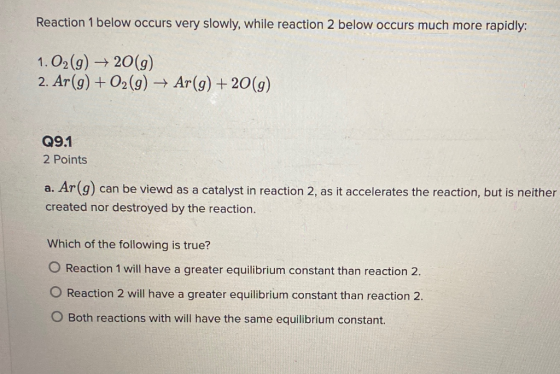
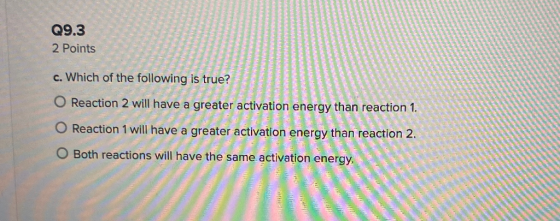
Reaction 1 below occurs very slowly, while reaction 2 below occurs much more rapidly: 1. O2(g) → 20 (9) 2. Ar(g) + O2(g) → Ar(g) + 2O(g) Q9.1 2 Points a. Ar(g) can be viewd as a catalyst in reaction 2, as it accelerates the reaction, but is neither created nor destroyed by the reaction. Which of...
Please make sure these both are correct I
keep getting different answers, make sure it is not wrong the
answer you give. THANKS
Reaction 1 below occurs very slowly, while reaction 2 below occurs much more rapidly: 1. O2(g) → 20 (9) 2. Ar(g) + O2(g) → Ar(g) + 2O(g) Q9.1 2 Points a. Ar(g) can be viewd as a catalyst in reaction 2, as it accelerates the reaction, but is neither created nor destroyed by the reaction. Which of...
please make sure this is correct! I have gotten two wrong answers already so far! Reaction...
 please make sure this is correct! I have gotten two wrong
answers already so far!
Reaction 1 below occurs very slowly, while reaction 2 below occurs much more rapidly: 1. O2(g) +20(g) 2. Ar(g) + O2(g) → Ar(g) +20(g) Q9.1 2 Points a. Ar(g) can be viewd as a catalyst in reaction 2, as it accelerates the reaction, but is neither created nor destroyed by the reaction. Which of the following is true? O Reaction 1 will have a greater...
please make sure this is correct! I have gotten two wrong
answers already so far!
Reaction 1 below occurs very slowly, while reaction 2 below occurs much more rapidly: 1. O2(g) +20(g) 2. Ar(g) + O2(g) → Ar(g) +20(g) Q9.1 2 Points a. Ar(g) can be viewd as a catalyst in reaction 2, as it accelerates the reaction, but is neither created nor destroyed by the reaction. Which of the following is true? O Reaction 1 will have a greater...
PLEASE MAKE SURE C AND D ARE CORRECT! i have had two wrong answers so far....
 PLEASE MAKE SURE C AND D ARE CORRECT! i have had two wrong
answers so far. This is all one question, so I could not post the
parts separately. Thanks.
Consider the following reaction mechanism: Step 1 K 2A + B =D (fast equilibrium) Step 2 D+B kk E+F (slow) Step 3 F G (fast) a. Give the molecularity of each step. Step 1 O unimolecular bimolecular O termolecular Step 2 unimolecular Obimolecular termolecular Step 3 unimolecular O bimolecular termolecular...
PLEASE MAKE SURE C AND D ARE CORRECT! i have had two wrong
answers so far. This is all one question, so I could not post the
parts separately. Thanks.
Consider the following reaction mechanism: Step 1 K 2A + B =D (fast equilibrium) Step 2 D+B kk E+F (slow) Step 3 F G (fast) a. Give the molecularity of each step. Step 1 O unimolecular bimolecular O termolecular Step 2 unimolecular Obimolecular termolecular Step 3 unimolecular O bimolecular termolecular...
Please answer all parts to this question! parts a through c with the explanation shown on...
 Please answer all parts to this question! parts a through c with
the explanation shown on question b! This is all one question so I
could not post them separately, please also check your answers
because the last person got it wrong! Thank you! Will give thumbs
up.
Reaction 1 below occurs very slowly, while reaction 2 below occurs much more rapidly: 1. O2(g) +20(9) 2. Ar(g) + O2(g) → Ar(9) +20(9) Q9.1 2 Points a. Ar(g) can be viewd...
Please answer all parts to this question! parts a through c with
the explanation shown on question b! This is all one question so I
could not post them separately, please also check your answers
because the last person got it wrong! Thank you! Will give thumbs
up.
Reaction 1 below occurs very slowly, while reaction 2 below occurs much more rapidly: 1. O2(g) +20(9) 2. Ar(g) + O2(g) → Ar(9) +20(9) Q9.1 2 Points a. Ar(g) can be viewd...
hello! this question has multiple parts! please answer a through c, as i could not post...
 hello! this question has multiple parts! please answer a
through c, as i could not post them separetly. will give thumbs up!
please do not forget the explanation on part b for the activation
energy.
Reaction 1 below occurs very slowly, while reaction 2 below occurs much more rapidly: 1. O2(g) +20(9) 2. Ar(g) + O2(g) + Ar(g) +20(9) 09.1 2 Points a. Ar(9) can be viewd as a catalyst in reaction 2, as it accelerates the reaction, but is...
hello! this question has multiple parts! please answer a
through c, as i could not post them separetly. will give thumbs up!
please do not forget the explanation on part b for the activation
energy.
Reaction 1 below occurs very slowly, while reaction 2 below occurs much more rapidly: 1. O2(g) +20(9) 2. Ar(g) + O2(g) + Ar(g) +20(9) 09.1 2 Points a. Ar(9) can be viewd as a catalyst in reaction 2, as it accelerates the reaction, but is...
Make sure this is correct please I have gotten two wrong answers already a. Consider the...
 Make sure this is correct please I have gotten two wrong answers
already
a. Consider the following complex reaction. X + 2Y + products. What are the units of the rate constant for this reaction? OM.s-1 Os-1 O M-1.5-1 O M-2.5-1 O This question cannot be answered without additional information.
Make sure this is correct please I have gotten two wrong answers
already
a. Consider the following complex reaction. X + 2Y + products. What are the units of the rate constant for this reaction? OM.s-1 Os-1 O M-1.5-1 O M-2.5-1 O This question cannot be answered without additional information.
Please answer all parts to this question! parts a through d with the explanation on question...
 Please answer all parts to this question! parts a through d with
the explanation on question d! This is all one question so I could
not post them separately, please also check your answers because
the last person got it wrong! Thank you! WIll give thumbs up.
Consider the following reaction mechanism: Step 1 K 2A + B =D (fast equilibrium) Step 2 D+B k? E+ F (slow) Step 3 F G (fast) a. Give the molecularity of each step....
Please answer all parts to this question! parts a through d with
the explanation on question d! This is all one question so I could
not post them separately, please also check your answers because
the last person got it wrong! Thank you! WIll give thumbs up.
Consider the following reaction mechanism: Step 1 K 2A + B =D (fast equilibrium) Step 2 D+B k? E+ F (slow) Step 3 F G (fast) a. Give the molecularity of each step....
please make sure these are correct! I have gotten two wrong answers already. thanks. Will give...
 please make sure these are correct! I have gotten two wrong
answers already. thanks. Will give thumbs up
Consider the following galvanic cell: Pt(s)|Br- (aq)|Br2(1)||Cr2O72- (aq), Cr3+ (aq)|Pt(s) C. Calculate the equilibrium constant for this reaction at 25 °C using electrochemical data. d. Calculate the cell potential for this galvanic cell assuming the following conditions: pH = 0 · [Cr2O72-] = 1.0 M Br-) = 0.20 M, (Cr3+] = 1.0 x 10⁻⁵ M T = 25 °C. Create and upload...
please make sure these are correct! I have gotten two wrong
answers already. thanks. Will give thumbs up
Consider the following galvanic cell: Pt(s)|Br- (aq)|Br2(1)||Cr2O72- (aq), Cr3+ (aq)|Pt(s) C. Calculate the equilibrium constant for this reaction at 25 °C using electrochemical data. d. Calculate the cell potential for this galvanic cell assuming the following conditions: pH = 0 · [Cr2O72-] = 1.0 M Br-) = 0.20 M, (Cr3+] = 1.0 x 10⁻⁵ M T = 25 °C. Create and upload...
please answer both parts to the question! will give thumbs up. thanks! c. Consider the following...
 please answer both parts to the question! will give thumbs up.
thanks!
c. Consider the following chemical reaction: 2A + 3B In the course of studying this reaction, we measure the concentration of A as the reaction proceeds and create three graphs: . . graph 1: The concentration of A is plotted as a function of time. graph 2: The logarithm of the concentration of A is plotted as a function of time. graph 3: The reciprocal of the concentration...
please answer both parts to the question! will give thumbs up.
thanks!
c. Consider the following chemical reaction: 2A + 3B In the course of studying this reaction, we measure the concentration of A as the reaction proceeds and create three graphs: . . graph 1: The concentration of A is plotted as a function of time. graph 2: The logarithm of the concentration of A is plotted as a function of time. graph 3: The reciprocal of the concentration...
For a one step reaction, the activation energy for the forward reaction is 40.0 kJ mol-1,...
For a one step reaction, the activation energy for the forward reaction is 40.0 kJ mol-1, and the enthalpy of reaction is -20.0 kJ mol-1. Which statement below is true? a. The activation energy of the forward reaction would be affected to a greater extent than the activation energy of the reverse reaction by addition of a catalyst. b. The value for the enthalpy of reaction would be decreased by addition of a catalyst. c. The reaction is endothermic. d....
 Please make sure these both are correct I
keep getting different answers, make sure it is not wrong the
answer you give. THANKS
Reaction 1 below occurs very slowly, while reaction 2 below occurs much more rapidly: 1. O2(g) → 20 (9) 2. Ar(g) + O2(g) → Ar(g) + 2O(g) Q9.1 2 Points a. Ar(g) can be viewd as a catalyst in reaction 2, as it accelerates the reaction, but is neither created nor destroyed by the reaction. Which of...
Please make sure these both are correct I
keep getting different answers, make sure it is not wrong the
answer you give. THANKS
Reaction 1 below occurs very slowly, while reaction 2 below occurs much more rapidly: 1. O2(g) → 20 (9) 2. Ar(g) + O2(g) → Ar(g) + 2O(g) Q9.1 2 Points a. Ar(g) can be viewd as a catalyst in reaction 2, as it accelerates the reaction, but is neither created nor destroyed by the reaction. Which of...
 please make sure this is correct! I have gotten two wrong
answers already so far!
Reaction 1 below occurs very slowly, while reaction 2 below occurs much more rapidly: 1. O2(g) +20(g) 2. Ar(g) + O2(g) → Ar(g) +20(g) Q9.1 2 Points a. Ar(g) can be viewd as a catalyst in reaction 2, as it accelerates the reaction, but is neither created nor destroyed by the reaction. Which of the following is true? O Reaction 1 will have a greater...
please make sure this is correct! I have gotten two wrong
answers already so far!
Reaction 1 below occurs very slowly, while reaction 2 below occurs much more rapidly: 1. O2(g) +20(g) 2. Ar(g) + O2(g) → Ar(g) +20(g) Q9.1 2 Points a. Ar(g) can be viewd as a catalyst in reaction 2, as it accelerates the reaction, but is neither created nor destroyed by the reaction. Which of the following is true? O Reaction 1 will have a greater...
 PLEASE MAKE SURE C AND D ARE CORRECT! i have had two wrong
answers so far. This is all one question, so I could not post the
parts separately. Thanks.
Consider the following reaction mechanism: Step 1 K 2A + B =D (fast equilibrium) Step 2 D+B kk E+F (slow) Step 3 F G (fast) a. Give the molecularity of each step. Step 1 O unimolecular bimolecular O termolecular Step 2 unimolecular Obimolecular termolecular Step 3 unimolecular O bimolecular termolecular...
PLEASE MAKE SURE C AND D ARE CORRECT! i have had two wrong
answers so far. This is all one question, so I could not post the
parts separately. Thanks.
Consider the following reaction mechanism: Step 1 K 2A + B =D (fast equilibrium) Step 2 D+B kk E+F (slow) Step 3 F G (fast) a. Give the molecularity of each step. Step 1 O unimolecular bimolecular O termolecular Step 2 unimolecular Obimolecular termolecular Step 3 unimolecular O bimolecular termolecular...
 Please answer all parts to this question! parts a through c with
the explanation shown on question b! This is all one question so I
could not post them separately, please also check your answers
because the last person got it wrong! Thank you! Will give thumbs
up.
Reaction 1 below occurs very slowly, while reaction 2 below occurs much more rapidly: 1. O2(g) +20(9) 2. Ar(g) + O2(g) → Ar(9) +20(9) Q9.1 2 Points a. Ar(g) can be viewd...
Please answer all parts to this question! parts a through c with
the explanation shown on question b! This is all one question so I
could not post them separately, please also check your answers
because the last person got it wrong! Thank you! Will give thumbs
up.
Reaction 1 below occurs very slowly, while reaction 2 below occurs much more rapidly: 1. O2(g) +20(9) 2. Ar(g) + O2(g) → Ar(9) +20(9) Q9.1 2 Points a. Ar(g) can be viewd...
 hello! this question has multiple parts! please answer a
through c, as i could not post them separetly. will give thumbs up!
please do not forget the explanation on part b for the activation
energy.
Reaction 1 below occurs very slowly, while reaction 2 below occurs much more rapidly: 1. O2(g) +20(9) 2. Ar(g) + O2(g) + Ar(g) +20(9) 09.1 2 Points a. Ar(9) can be viewd as a catalyst in reaction 2, as it accelerates the reaction, but is...
hello! this question has multiple parts! please answer a
through c, as i could not post them separetly. will give thumbs up!
please do not forget the explanation on part b for the activation
energy.
Reaction 1 below occurs very slowly, while reaction 2 below occurs much more rapidly: 1. O2(g) +20(9) 2. Ar(g) + O2(g) + Ar(g) +20(9) 09.1 2 Points a. Ar(9) can be viewd as a catalyst in reaction 2, as it accelerates the reaction, but is...
 Make sure this is correct please I have gotten two wrong answers
already
a. Consider the following complex reaction. X + 2Y + products. What are the units of the rate constant for this reaction? OM.s-1 Os-1 O M-1.5-1 O M-2.5-1 O This question cannot be answered without additional information.
Make sure this is correct please I have gotten two wrong answers
already
a. Consider the following complex reaction. X + 2Y + products. What are the units of the rate constant for this reaction? OM.s-1 Os-1 O M-1.5-1 O M-2.5-1 O This question cannot be answered without additional information.
 Please answer all parts to this question! parts a through d with
the explanation on question d! This is all one question so I could
not post them separately, please also check your answers because
the last person got it wrong! Thank you! WIll give thumbs up.
Consider the following reaction mechanism: Step 1 K 2A + B =D (fast equilibrium) Step 2 D+B k? E+ F (slow) Step 3 F G (fast) a. Give the molecularity of each step....
Please answer all parts to this question! parts a through d with
the explanation on question d! This is all one question so I could
not post them separately, please also check your answers because
the last person got it wrong! Thank you! WIll give thumbs up.
Consider the following reaction mechanism: Step 1 K 2A + B =D (fast equilibrium) Step 2 D+B k? E+ F (slow) Step 3 F G (fast) a. Give the molecularity of each step....
 please make sure these are correct! I have gotten two wrong
answers already. thanks. Will give thumbs up
Consider the following galvanic cell: Pt(s)|Br- (aq)|Br2(1)||Cr2O72- (aq), Cr3+ (aq)|Pt(s) C. Calculate the equilibrium constant for this reaction at 25 °C using electrochemical data. d. Calculate the cell potential for this galvanic cell assuming the following conditions: pH = 0 · [Cr2O72-] = 1.0 M Br-) = 0.20 M, (Cr3+] = 1.0 x 10⁻⁵ M T = 25 °C. Create and upload...
please make sure these are correct! I have gotten two wrong
answers already. thanks. Will give thumbs up
Consider the following galvanic cell: Pt(s)|Br- (aq)|Br2(1)||Cr2O72- (aq), Cr3+ (aq)|Pt(s) C. Calculate the equilibrium constant for this reaction at 25 °C using electrochemical data. d. Calculate the cell potential for this galvanic cell assuming the following conditions: pH = 0 · [Cr2O72-] = 1.0 M Br-) = 0.20 M, (Cr3+] = 1.0 x 10⁻⁵ M T = 25 °C. Create and upload...
 please answer both parts to the question! will give thumbs up.
thanks!
c. Consider the following chemical reaction: 2A + 3B In the course of studying this reaction, we measure the concentration of A as the reaction proceeds and create three graphs: . . graph 1: The concentration of A is plotted as a function of time. graph 2: The logarithm of the concentration of A is plotted as a function of time. graph 3: The reciprocal of the concentration...
please answer both parts to the question! will give thumbs up.
thanks!
c. Consider the following chemical reaction: 2A + 3B In the course of studying this reaction, we measure the concentration of A as the reaction proceeds and create three graphs: . . graph 1: The concentration of A is plotted as a function of time. graph 2: The logarithm of the concentration of A is plotted as a function of time. graph 3: The reciprocal of the concentration...
Most questions answered within 3 hours.
-
Where is the error in this code sequence?
String s1 = "Hello";
String s2 = "ello";...
asked 10 months ago -
Financial data for Joel de Paris, Inc., for last year
follow:
Joel de Paris, Inc.
Balance...
asked 10 months ago -
Consider this reaction:
Al2(SO4)3 (aq)+ BaCl3
(aq) Al2Cl6 (aq)- +
3BaSO4(s) . What is the...
asked 10 months ago -
Suppose that Savneet is considering increasing her
recent random sample from 20 car rentals to 40...
asked 10 months ago -
Trucks arrive at an unloading terminal at an average rate of 120
per hour.
Trucks arrive...
asked 10 months ago -
Why are methanol and ethanol completely soluble in water while
octanol is not very little soluble....
asked 10 months ago -
A facilities manager at a university reads in a research report
that the mean amount of...
asked 10 months ago -
When the CuSO4 is rehydrated by adding water to the anhydrous
compound, is this an endothermic...
asked 10 months ago -
A ray of sunlight is passing from diamond into crown glass; the
angle of incidence is...
asked 10 months ago -
A block of mass 0.249 kg is placed on top of a light, vertical
spring of...
asked 10 months ago -
how do the kidneys compensate in the presences of acidosis
a) trigger hyperventilate
b) reserve acid...
asked 10 months ago -
Question 501 pts
The rental rate of capital to the firm increases. Which of the
following...
asked 10 months ago