complete the function below so it prints out each string in a dictionary that is greater...
Homework Answers
#include<stdio.h>
#include<string.h>
#define NUMWORDS 7
#define MAXWORDLENGTH 20
//function to print the words greater than 9
void printBigWords(char dictionary[NUMWORDS][MAXWORDLENGTH], int
size)
{
//iterate over the dictionary
for(int i = 0;i < size;i++)
{
//if the current word length is
greater than 9, print the word
if(strlen(dictionary[i]) >
9)
{
printf("%s\n",
dictionary[i]);
}
}
return;
}
int main()
{
//create dictionary
char dictionary[NUMWORDS][MAXWORDLENGTH] = {"english",
"examination", "fixed", "exclamation", "interest", "average",
"arrangement"};
//print the words
printBigWords(dictionary, 10);
}
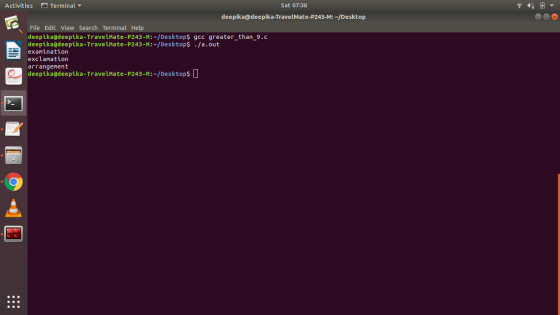
If you have any doubts please comment and please don't dislike.
Add Answer to:
complete the function below so it prints out each string in a
dictionary that is greater...
Complete the function below so it adds a semicolon to the end of the input string....
Complete the function below so it adds a semicolon to the end of the input string. You may use the preexisting string functions (assume that string.h is included) The string will be passed in as a parameter. void addSemi(char s[]){ /*complete the function*/ }
P1) Write a complete C program that prints out the word YES, if its string command...
P1) Write a complete C program that prints out the word YES, if its string command line argument contains the sequence the somewhere in it. It prints out the word NO otherwise. Both the word the and partial sequences like in the words theatre or brother qualify. Note: You can use string functions or not but if you do the only ones allowed are strcpy and strlen. ++++++++++++++++++++++++++++++++++++++++++++++++++++++++++++++++++++++++++++++++++++++++++++++ P2) What is the output of the following program (one answer per...
Write a complete C program that inputs a paragraph of text and prints out each unique...
Write a complete C program that inputs a paragraph of text and prints out each unique letter found in the text along with the number of times it occurred. A sample run of the program is given below. You should input your text from a data file specified on the command line. Your output should be formatted and presented exactly like the sample run (i.e. alphabetized with the exact spacings and output labels). The name of your data file along...
Programs 1. String Utilities In this exercise you will implement several utility functions involving strings. You...
Programs 1. String Utilities In this exercise you will implement several utility functions involving strings. You will place all of your function prototypes in a header file named string utils.h and all of your function definitions in a source file named string utils.c. You should implement your own main test driver program to test your functions, but you need not hand it in. a. void addChar(char *str, char c, int n) - this function should add a char c at...
C programming Write the implementation for the three functions described below. The functions are called from...
C programming Write the implementation for the three functions described below. The functions are called from the provided main function. You may need to define additional “helper” functions to solve the problem efficiently. a) Write a print_string function that prints the characters in a string to screen on- by-one. b) Write a is_identical function that compares if two strings are identical. The functions is required to be case insensitive. Return 0 if the two strings are not identical and 1...
In C Programming Language In this lab you will implement 4 string functions, two using array...
 In C Programming Language
In this lab you will implement 4 string functions, two using array notation and two using pointers. The functions must have the signatures given below. You may not use any C library string functions. The functions are 1. int my strlen (char s ) - This function returns the number of characters in a string. You should use array notation for this function. 2. int my strcpy (char s [], char t I)- This function overwrites...
In C Programming Language
In this lab you will implement 4 string functions, two using array notation and two using pointers. The functions must have the signatures given below. You may not use any C library string functions. The functions are 1. int my strlen (char s ) - This function returns the number of characters in a string. You should use array notation for this function. 2. int my strcpy (char s [], char t I)- This function overwrites...
C code only! Complete this function so that the function str2int convert the char array s...
C code only! Complete this function so that the function str2int convert the char array s into its equivalent integer value. The char array has only digit characters of{0, 1, .., 9}and ’\0’.And the first element is not 0, which means, the integer string in the char array is of base 10. For example, if we pass chars[] = ”123” intostr2int, then it should return 123.Close the braces when you are done int str2int(char s[]){
C-programming In activity 1, a function will accept an input string composed of a command and...
C-programming In activity 1, a function will accept an input string composed of a command and a parameter. The function will extract the command and convert the parameter into an integer. The conversion of the string to an integer can be done using atoi()- alphanumeric to integer. stdlib.h needs to be included. Note that the parameter characters, e.g., “10”, need to be extracted from the input string, assign to an array, and fed to atoi(). Write a function that accepts...
In the space below, write a C function definition for a function named StrLower, which will...
 In the space below, write a C function definition for a function named StrLower, which will receive one parameter, a pointer to a null-terminated string (i.e., pointer to char), convert each character in the string to lowercase (using the tolower function from <ctype.h>), and return nothing to the caller. Inside the function definition, you may use a for loop or a while loop. If you use any variables other than the incoming parameter, you must define them locally in the...
1. Complete the function asn2_1() so it prints the string that is passed to it as...
1. Complete the function asn2_1() so it prints the string that is passed to it as a parameter. import turtle def asn2_1(s): '''Prints string s''' pass #This statement does nothing - you can delete it or leave it
 In C Programming Language
In this lab you will implement 4 string functions, two using array notation and two using pointers. The functions must have the signatures given below. You may not use any C library string functions. The functions are 1. int my strlen (char s ) - This function returns the number of characters in a string. You should use array notation for this function. 2. int my strcpy (char s [], char t I)- This function overwrites...
In C Programming Language
In this lab you will implement 4 string functions, two using array notation and two using pointers. The functions must have the signatures given below. You may not use any C library string functions. The functions are 1. int my strlen (char s ) - This function returns the number of characters in a string. You should use array notation for this function. 2. int my strcpy (char s [], char t I)- This function overwrites...
 In the space below, write a C function definition for a function named StrLower, which will receive one parameter, a pointer to a null-terminated string (i.e., pointer to char), convert each character in the string to lowercase (using the tolower function from <ctype.h>), and return nothing to the caller. Inside the function definition, you may use a for loop or a while loop. If you use any variables other than the incoming parameter, you must define them locally in the...
Most questions answered within 3 hours.
-
Where is the error in this code sequence?
String s1 = "Hello";
String s2 = "ello";...
asked 10 months ago -
Financial data for Joel de Paris, Inc., for last year
follow:
Joel de Paris, Inc.
Balance...
asked 10 months ago -
Consider this reaction:
Al2(SO4)3 (aq)+ BaCl3
(aq) Al2Cl6 (aq)- +
3BaSO4(s) . What is the...
asked 10 months ago -
Suppose that Savneet is considering increasing her
recent random sample from 20 car rentals to 40...
asked 10 months ago -
Trucks arrive at an unloading terminal at an average rate of 120
per hour.
Trucks arrive...
asked 10 months ago -
Why are methanol and ethanol completely soluble in water while
octanol is not very little soluble....
asked 10 months ago -
A facilities manager at a university reads in a research report
that the mean amount of...
asked 10 months ago -
When the CuSO4 is rehydrated by adding water to the anhydrous
compound, is this an endothermic...
asked 10 months ago -
A ray of sunlight is passing from diamond into crown glass; the
angle of incidence is...
asked 10 months ago -
A block of mass 0.249 kg is placed on top of a light, vertical
spring of...
asked 10 months ago -
how do the kidneys compensate in the presences of acidosis
a) trigger hyperventilate
b) reserve acid...
asked 10 months ago -
Question 501 pts
The rental rate of capital to the firm increases. Which of the
following...
asked 10 months ago