
Homework Answers
Answer :
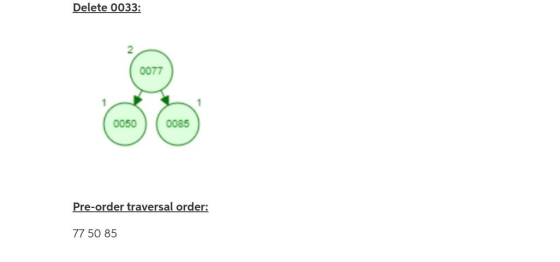
NOTE : PLEASE GIVE ME UP VOTE. THANK YOU .
Add Answer to:
Consider the AVL Tree below. Use the AVL Tree Deletion algorithm to delete 0033 from the...
Consider the AVL Tree below. Use the AVL Tree Insertion algorithm to add 0017 to the...
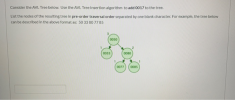 Consider the AVL Tree below. Use the AVL Tree Insertion algorithm to add 0017 to the tree. List the nodes of the resulting tree in pre-order traversal order separated by one blank character. For example, the tree below can be described in the above format as: 50 33 80 7785 0050 1 2 0033 0080 1 0077 0085
Use the Binary Search Tree (BST) deletion algorithm to delete 0075 from the BST below. List...
 Use the Binary Search Tree (BST) deletion algorithm to delete 0075 from the BST below. List the nodes of the resulting tree in pre-order traversal order separated by one blank character. For example, the tree below can be described in the above format as: 75 53 24 57 84 77 76 82 92 0075 0053 0034 0024 0057 0077 0092 0078 0082
Use the Binary Search Tree (BST) insertion algorithm to insert 0078 into the BST below. List...
 Use the Binary Search Tree (BST) insertion algorithm to insert 0078 into the BST below. List the nodes of the resulting tree in pre-order traversal order separated by one blank character. For example, the tree below can be described in the above format as: 75 53 24 57 84 77 76 82 92 0075 0053 0084 0024 0057 0077 OON 0076 0082
I need question 9-10 answered. Thank you Question 1 iShow the resulting binary search tree if...
 I need question 9-10 answered. Thank you
Question 1 iShow the resulting binary search tree if we are to insert following elements into the tree in given order, [34, 12, 23, 27,31,9,11,45, 20, 37. i) Show the resulting balanced binary search tree if we are to insert following sorted elements into the tree, [9,12,21, 23, 29, 31, 34, 45, 48, 52, 55] iii What is the pre-order traversal of the balanced binary search tree? v) What is the post-order traversal...
I need question 9-10 answered. Thank you
Question 1 iShow the resulting binary search tree if we are to insert following elements into the tree in given order, [34, 12, 23, 27,31,9,11,45, 20, 37. i) Show the resulting balanced binary search tree if we are to insert following sorted elements into the tree, [9,12,21, 23, 29, 31, 34, 45, 48, 52, 55] iii What is the pre-order traversal of the balanced binary search tree? v) What is the post-order traversal...
PROBLEM 6: Suppose we insert keys below into an initially empty binary search tree in the...
 PROBLEM 6: Suppose we insert keys below into an initially empty binary search tree in the given order 6, 9, 2, 1, 5, 7, 10, 8, 3,4 (a) Draw the resulting binary search tree. (b) List the keys according to: A pre-order traversal An in-order traversal A post-order traversal (c) Now we perform some deletions using the "deletion by copying" strategy in which promoted keys are always drawn from a node's right subtree (so that there is only one correct...
PROBLEM 6: Suppose we insert keys below into an initially empty Vanilla binary search tree in...
PROBLEM 6: Suppose we insert keys below into an initially empty Vanilla binary search tree in the given order: 6, 9, 2, 1, 5, 7, 10, 8, 3, 4 (a) Draw the resulting binary search tree. (b) List the keys according to: A pre-order traversal An in-order traversal A post-order traversal (c) Now we perform some deletions using the “deletion by copying” strategy in which promoted keys are always drawn from a node’s right subtree (so that there is only...
ALGORITHM AND DATA STRUCTURES Question Question 1: Convert the following binary tree into a heap using...
ALGORITHM AND DATA STRUCTURES Question Question 1: Convert the following binary tree into a heap using the Heapify algorithm. Draw the diagrams of the tree step by step after every alteration. Question 2: Show the heap that results when the items are inserted into the heap one by one, starting with one that is empty. 7, 3, 8, 1, 4, 20, 11, 33, 45, 23, 6 Question 3. Draw the 2-3-4 tree that results when values are inserted in the...
plz use python to answer it, thanks in advance 3. Tree and back arcs in a DFS 40 Marks For a given set of digraphs, write a program that performs DFS on each digraph starting at node 0 and prints...
 plz use python to answer it, thanks in advance
3. Tree and back arcs in a DFS 40 Marks For a given set of digraphs, write a program that performs DFS on each digraph starting at node 0 and prints out the total number of tree arcs and back arcs resulting from the traversal. Use our standard convention that when there is a choice of white or grey nodes, the one with the lowest index should be chosen. Input format:...
plz use python to answer it, thanks in advance
3. Tree and back arcs in a DFS 40 Marks For a given set of digraphs, write a program that performs DFS on each digraph starting at node 0 and prints out the total number of tree arcs and back arcs resulting from the traversal. Use our standard convention that when there is a choice of white or grey nodes, the one with the lowest index should be chosen. Input format:...
Please show that the code is working at the end. Your program should read from the standard input...
Please show that the code is working at the end. Your program should read from the standard input a sequence of integer values, with each value separated by a space. Your task is to: Build a binary search tree using these values in the order they are entered. Print 3 traversals: pre-, in-, and post-order. Allow the user to insert/delete a value. Once a new tree is generated, print it in-order. Find predecessor of a given value. The predecessor is...
 Consider the AVL Tree below. Use the AVL Tree Insertion algorithm to add 0017 to the tree. List the nodes of the resulting tree in pre-order traversal order separated by one blank character. For example, the tree below can be described in the above format as: 50 33 80 7785 0050 1 2 0033 0080 1 0077 0085
 Use the Binary Search Tree (BST) deletion algorithm to delete 0075 from the BST below. List the nodes of the resulting tree in pre-order traversal order separated by one blank character. For example, the tree below can be described in the above format as: 75 53 24 57 84 77 76 82 92 0075 0053 0034 0024 0057 0077 0092 0078 0082
 Use the Binary Search Tree (BST) insertion algorithm to insert 0078 into the BST below. List the nodes of the resulting tree in pre-order traversal order separated by one blank character. For example, the tree below can be described in the above format as: 75 53 24 57 84 77 76 82 92 0075 0053 0084 0024 0057 0077 OON 0076 0082
 I need question 9-10 answered. Thank you
Question 1 iShow the resulting binary search tree if we are to insert following elements into the tree in given order, [34, 12, 23, 27,31,9,11,45, 20, 37. i) Show the resulting balanced binary search tree if we are to insert following sorted elements into the tree, [9,12,21, 23, 29, 31, 34, 45, 48, 52, 55] iii What is the pre-order traversal of the balanced binary search tree? v) What is the post-order traversal...
I need question 9-10 answered. Thank you
Question 1 iShow the resulting binary search tree if we are to insert following elements into the tree in given order, [34, 12, 23, 27,31,9,11,45, 20, 37. i) Show the resulting balanced binary search tree if we are to insert following sorted elements into the tree, [9,12,21, 23, 29, 31, 34, 45, 48, 52, 55] iii What is the pre-order traversal of the balanced binary search tree? v) What is the post-order traversal...
 PROBLEM 6: Suppose we insert keys below into an initially empty binary search tree in the given order 6, 9, 2, 1, 5, 7, 10, 8, 3,4 (a) Draw the resulting binary search tree. (b) List the keys according to: A pre-order traversal An in-order traversal A post-order traversal (c) Now we perform some deletions using the "deletion by copying" strategy in which promoted keys are always drawn from a node's right subtree (so that there is only one correct...
 plz use python to answer it, thanks in advance
3. Tree and back arcs in a DFS 40 Marks For a given set of digraphs, write a program that performs DFS on each digraph starting at node 0 and prints out the total number of tree arcs and back arcs resulting from the traversal. Use our standard convention that when there is a choice of white or grey nodes, the one with the lowest index should be chosen. Input format:...
plz use python to answer it, thanks in advance
3. Tree and back arcs in a DFS 40 Marks For a given set of digraphs, write a program that performs DFS on each digraph starting at node 0 and prints out the total number of tree arcs and back arcs resulting from the traversal. Use our standard convention that when there is a choice of white or grey nodes, the one with the lowest index should be chosen. Input format:...
Most questions answered within 3 hours.
-
Where is the error in this code sequence?
String s1 = "Hello";
String s2 = "ello";...
asked 10 months ago -
Financial data for Joel de Paris, Inc., for last year
follow:
Joel de Paris, Inc.
Balance...
asked 10 months ago -
Consider this reaction:
Al2(SO4)3 (aq)+ BaCl3
(aq) Al2Cl6 (aq)- +
3BaSO4(s) . What is the...
asked 10 months ago -
Suppose that Savneet is considering increasing her
recent random sample from 20 car rentals to 40...
asked 10 months ago -
Trucks arrive at an unloading terminal at an average rate of 120
per hour.
Trucks arrive...
asked 10 months ago -
Why are methanol and ethanol completely soluble in water while
octanol is not very little soluble....
asked 10 months ago -
A facilities manager at a university reads in a research report
that the mean amount of...
asked 10 months ago -
When the CuSO4 is rehydrated by adding water to the anhydrous
compound, is this an endothermic...
asked 10 months ago -
A ray of sunlight is passing from diamond into crown glass; the
angle of incidence is...
asked 10 months ago -
A block of mass 0.249 kg is placed on top of a light, vertical
spring of...
asked 10 months ago -
how do the kidneys compensate in the presences of acidosis
a) trigger hyperventilate
b) reserve acid...
asked 10 months ago -
Question 501 pts
The rental rate of capital to the firm increases. Which of the
following...
asked 10 months ago