
Homework Answers

Add Answer to:
2. Determine the Nyquist rate for the following signals sin(4000nt) (a) x(t) = (b) x(t) =...
Signals and Systems Nyquist Rate of signal is? X(t) = sin( 500 TT4) Sin caso trd)...
 Signals and Systems
Nyquist Rate of signal is? X(t) = sin( 500 TT4) Sin caso trd) Tit + cos² (1000it) sin (400 T7E) Tt
Signals and Systems
Nyquist Rate of signal is? X(t) = sin( 500 TT4) Sin caso trd) Tit + cos² (1000it) sin (400 T7E) Tt
Problem 6. Find the Nyquist rate of the following signals (a) (t)= 1 cos(1000t)cos(3000t) sin(4000Tt) (b)...
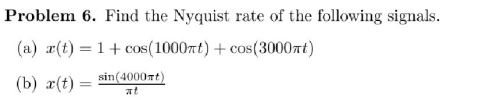 Problem 6. Find the Nyquist rate of the following signals (a) (t)= 1 cos(1000t)cos(3000t) sin(4000Tt) (b) r(t) пt
Find the Nyquist rates for these signals: (a) X(t) = sinc (20) (b)x(t) = 4 sinca...
 Find the Nyquist rates for these signals: (a) X(t) = sinc (20) (b)x(t) = 4 sinca (100t) (C) x(t) = 8 sin(50TTT) (d) x(t) = 4 sin(30TTt) + 3 cos(70nt) (e) X(t) = rect(300t) (f) X(t) = -10 sin(40nt) cos(300Tt) (g) X(t) = sinc(t/2)*710(t) (h) x(t) = sinc(t/2) 70.1() (i) X(t) = 8tri((t - 4)/12) (1) X(t) = 13e-201 cos(70TTt)u(t) (k) x(t) = u(t)-u(t-5)
4. Find the Nyquist rate for the following signals. For each case sketch the magnitude spectrum...
 4. Find the Nyquist rate for the following signals. For each case sketch the magnitude spectrum of the sampled signal if the sampling rate is 25% higher than the Nyquist rate. a.) ft)sinc E 2T 10 b.) h)=sinc 2T For all the following, use ft) given in part a.) c.) glt)= f(l-7) d.) c(t)- f)cos() 1 e.) x(t)= fit)+ _ sinc (t
4. Find the Nyquist rate for the following signals. For each case sketch the magnitude spectrum of the...
4. Find the Nyquist rate for the following signals. For each case sketch the magnitude spectrum of the sampled signal if the sampling rate is 25% higher than the Nyquist rate. a.) ft)sinc E 2T 10 b.) h)=sinc 2T For all the following, use ft) given in part a.) c.) glt)= f(l-7) d.) c(t)- f)cos() 1 e.) x(t)= fit)+ _ sinc (t
4. Find the Nyquist rate for the following signals. For each case sketch the magnitude spectrum of the...
Determine the Fourier transform of the following signals and plot the spectrum a. x(t) 4 sin...
 Determine the Fourier transform of the following signals and plot the spectrum a. x(t) 4 sin 2T1000t b, x(t)= 4sin 2πί000t cos 2π4000t c. x(t)= (4 + cos 272000) cos 2π5000t
(a) Determine the Fourier transform of x(t) 26(t-1)-6(t-3) (b) Compute the convolution sum of the following signals, (6%) [696] (c) The Fourier transform of a continuous-time signal a(t) is given bel...
 (a) Determine the Fourier transform of x(t) 26(t-1)-6(t-3) (b) Compute the convolution sum of the following signals, (6%) [696] (c) The Fourier transform of a continuous-time signal a(t) is given below. Determine the [696] total energy of (t) 4 sin w (d) Determine the DC value and the average power of the following periodic signal. (6%) 0.5 0.5 (e) Determine the Nyquist rate for the following signal. (6%) x(t) = [1-0.78 cos(50nt + π/4)]2. (f) Sketch the frequency spectrum of...
1. (15) By the Sampling Theorem the Nyquist sampling rate must be twice the highest bandwidth...
 1. (15) By the Sampling Theorem the Nyquist sampling rate must be twice the highest bandwidth of the message signal. For the three message signals below determine the Nyquist rate and the Nyquist interval for each. a) m(t) = 0.5 cos(150 ) + sin(300Ft) + 0.75 cos(350ft) b) m(t) = 2 cos(120rt) sin(3007) c) m(t) = sinc(4000) = sin(400m) Recall: the Fourier transform of a sinc waveform is a rectangular pulse
[15 total pts] Graphical visualization of a signal's spectrum can help determine the Nyquist rate for...
 [15 total pts] Graphical visualization of a signal's spectrum can help determine the Nyquist rate for sampling. Consider a signal x,(t) = cos(40t) cos(80t). Sketch the 2-sided complex spectrum and [5 pts] determine the minimum sampling rate that can be used to sample the signal without causing aliasing. [5 pts] Repeat Part a for the signal x2 t) cos(4 x 10³t) sin(3 x 10³Tt) cos(8 x 10Tt). [5 pts] Repeat Part a for the signal x3(t) cos(4 x 10³Trt) sin(3...
1. Determine the Fourier transforms X) of the following signals and plot the spectrum a x(...
 1. Determine the Fourier transforms X) of the following signals and plot the spectrum a x( ) = 4 sin 2.1 4000cos2x 2000 b. x(t) = (2+2 cos 2 x 20007) cos 2.5000
QUESTION 4 a. Determine the frequency spectrum of the signal x(t) b. What is the Nyquist...
 QUESTION 4 a. Determine the frequency spectrum of the signal x(t) b. What is the Nyquist rate for this signal? cos(t) + 5sn3t. me-invariant system defined by, dt dt what will the system output y(t) be? QUESTION 5 The system function of a casual LTI system is given as, 2s a. Find the impulse response of the system. b. Find the step response of the system. A causal discrete-time LTI system is described by, y[n] - (3/4) yin-1+(1/8) yin-21 xn]...
 Signals and Systems
Nyquist Rate of signal is? X(t) = sin( 500 TT4) Sin caso trd) Tit + cos² (1000it) sin (400 T7E) Tt
Signals and Systems
Nyquist Rate of signal is? X(t) = sin( 500 TT4) Sin caso trd) Tit + cos² (1000it) sin (400 T7E) Tt
 Problem 6. Find the Nyquist rate of the following signals (a) (t)= 1 cos(1000t)cos(3000t) sin(4000Tt) (b) r(t) пt
 Find the Nyquist rates for these signals: (a) X(t) = sinc (20) (b)x(t) = 4 sinca (100t) (C) x(t) = 8 sin(50TTT) (d) x(t) = 4 sin(30TTt) + 3 cos(70nt) (e) X(t) = rect(300t) (f) X(t) = -10 sin(40nt) cos(300Tt) (g) X(t) = sinc(t/2)*710(t) (h) x(t) = sinc(t/2) 70.1() (i) X(t) = 8tri((t - 4)/12) (1) X(t) = 13e-201 cos(70TTt)u(t) (k) x(t) = u(t)-u(t-5)
 4. Find the Nyquist rate for the following signals. For each case sketch the magnitude spectrum of the sampled signal if the sampling rate is 25% higher than the Nyquist rate. a.) ft)sinc E 2T 10 b.) h)=sinc 2T For all the following, use ft) given in part a.) c.) glt)= f(l-7) d.) c(t)- f)cos() 1 e.) x(t)= fit)+ _ sinc (t
4. Find the Nyquist rate for the following signals. For each case sketch the magnitude spectrum of the...
4. Find the Nyquist rate for the following signals. For each case sketch the magnitude spectrum of the sampled signal if the sampling rate is 25% higher than the Nyquist rate. a.) ft)sinc E 2T 10 b.) h)=sinc 2T For all the following, use ft) given in part a.) c.) glt)= f(l-7) d.) c(t)- f)cos() 1 e.) x(t)= fit)+ _ sinc (t
4. Find the Nyquist rate for the following signals. For each case sketch the magnitude spectrum of the...
 Determine the Fourier transform of the following signals and plot the spectrum a. x(t) 4 sin 2T1000t b, x(t)= 4sin 2πί000t cos 2π4000t c. x(t)= (4 + cos 272000) cos 2π5000t
 (a) Determine the Fourier transform of x(t) 26(t-1)-6(t-3) (b) Compute the convolution sum of the following signals, (6%) [696] (c) The Fourier transform of a continuous-time signal a(t) is given below. Determine the [696] total energy of (t) 4 sin w (d) Determine the DC value and the average power of the following periodic signal. (6%) 0.5 0.5 (e) Determine the Nyquist rate for the following signal. (6%) x(t) = [1-0.78 cos(50nt + π/4)]2. (f) Sketch the frequency spectrum of...
 1. (15) By the Sampling Theorem the Nyquist sampling rate must be twice the highest bandwidth of the message signal. For the three message signals below determine the Nyquist rate and the Nyquist interval for each. a) m(t) = 0.5 cos(150 ) + sin(300Ft) + 0.75 cos(350ft) b) m(t) = 2 cos(120rt) sin(3007) c) m(t) = sinc(4000) = sin(400m) Recall: the Fourier transform of a sinc waveform is a rectangular pulse
 [15 total pts] Graphical visualization of a signal's spectrum can help determine the Nyquist rate for sampling. Consider a signal x,(t) = cos(40t) cos(80t). Sketch the 2-sided complex spectrum and [5 pts] determine the minimum sampling rate that can be used to sample the signal without causing aliasing. [5 pts] Repeat Part a for the signal x2 t) cos(4 x 10³t) sin(3 x 10³Tt) cos(8 x 10Tt). [5 pts] Repeat Part a for the signal x3(t) cos(4 x 10³Trt) sin(3...
 1. Determine the Fourier transforms X) of the following signals and plot the spectrum a x( ) = 4 sin 2.1 4000cos2x 2000 b. x(t) = (2+2 cos 2 x 20007) cos 2.5000
 QUESTION 4 a. Determine the frequency spectrum of the signal x(t) b. What is the Nyquist rate for this signal? cos(t) + 5sn3t. me-invariant system defined by, dt dt what will the system output y(t) be? QUESTION 5 The system function of a casual LTI system is given as, 2s a. Find the impulse response of the system. b. Find the step response of the system. A causal discrete-time LTI system is described by, y[n] - (3/4) yin-1+(1/8) yin-21 xn]...
Most questions answered within 3 hours.
-
Where is the error in this code sequence?
String s1 = "Hello";
String s2 = "ello";...
asked 10 months ago -
Financial data for Joel de Paris, Inc., for last year
follow:
Joel de Paris, Inc.
Balance...
asked 10 months ago -
Consider this reaction:
Al2(SO4)3 (aq)+ BaCl3
(aq) Al2Cl6 (aq)- +
3BaSO4(s) . What is the...
asked 10 months ago -
Suppose that Savneet is considering increasing her
recent random sample from 20 car rentals to 40...
asked 10 months ago -
Trucks arrive at an unloading terminal at an average rate of 120
per hour.
Trucks arrive...
asked 10 months ago -
Why are methanol and ethanol completely soluble in water while
octanol is not very little soluble....
asked 10 months ago -
A facilities manager at a university reads in a research report
that the mean amount of...
asked 10 months ago -
When the CuSO4 is rehydrated by adding water to the anhydrous
compound, is this an endothermic...
asked 10 months ago -
A ray of sunlight is passing from diamond into crown glass; the
angle of incidence is...
asked 10 months ago -
A block of mass 0.249 kg is placed on top of a light, vertical
spring of...
asked 10 months ago -
how do the kidneys compensate in the presences of acidosis
a) trigger hyperventilate
b) reserve acid...
asked 10 months ago -
Question 501 pts
The rental rate of capital to the firm increases. Which of the
following...
asked 10 months ago