
Homework Answers
Add Answer to:
Which of the following is NOT expected when a eukaryotic cell is deprived from Oxygen? Select...
Which of the following is NOT expected when a eukaryotic cell is deprived from Oxygen? Select...
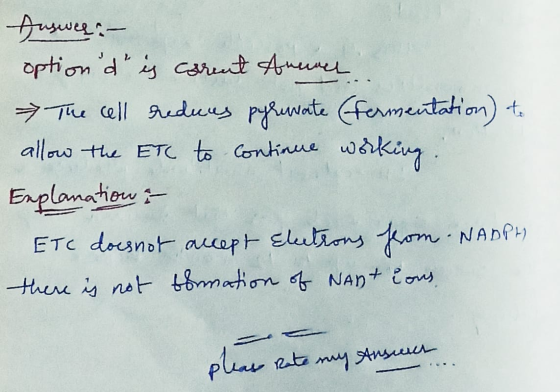
 Which of the following is NOT expected when a eukaryotic cell is deprived from Oxygen? Select one: a. All listed events are expected in a eukaryotic cell deprived of oxygen b. The cell continues to oxidize glucose to pyruvate through glycolysis c. The formation of CO2 from cell respiration stops d. Reduction of the production of ATP by substrate level phosphorylation in the mitochondria e. The cell reduces pyruvate (fermentation) to allow the ETC to continue working
Which of the following is NOT expected when a eukaryotic cell is deprived from Oxygen? Question...
 Which of the following is NOT expected when a eukaryotic cell is deprived from Oxygen? Question 40 Not yet answered Points out of 2.50 P Flag question Select one: O a. The formation of CO2 from cell respiration stops o b. Reduction of the production of ATP by substrate level phosphorylation in the mitochondria c. All listed events are expected in a eukaryotic cell deprived of oxygen O d. The cell reduces pyruvate (fermentation) to allow the ETC to continue...
Question 38 Which of the following statements regarding CRISPR-Cas system is TRUE? Not yet answered Points...
 Question 38 Which of the following statements regarding CRISPR-Cas system is TRUE? Not yet answered Points out of 2.50 Select one: a. CRISPR-Cas system uses a DNA-directed nuclease to degrade viral RNA P Flag question O b. CRISPR-Cas system uses an RNA-directed nuclease to degrade viral DNA C. CRISPR-Cas system uses a RNA-directed nuclease to degrade viral RNA O d. CRISPR-Cas system uses a DNA-directed nuclease to degrade viral DNA e. CRISPR-Cas is a defense mechanism in eukaryotes against viral...
In a cell, why must NADH be reoxidized? How does this happen in an organism that...
In a cell, why must NADH be reoxidized? How does this happen in an organism that uses respiration? Fermentation? 2. Explain the chemiosmotic mechanism of ATP generation. How does oxidative phosphorylation compare with substrate level phosphorylation found in glycolysis and the Kreb’s cycle? 3. Which of the following yields the greatest energy for a cell: fermentation, anaerobic respiration, or aerobic respiration? Which yields the least? Why? 4. Explain what happens to glucose during glycolysis and respiration in terms of oxidation...
In a cell, why must NADH be reoxidized? How does this happen in an organism that...
In a cell, why must NADH be reoxidized? How does this happen in an organism that uses respiration? Fermentation? 2. Explain the chemiosmotic mechanism of ATP generation. How does oxidative phosphorylation compare with substrate level phosphorylation found in glycolysis and the Kreb’s cycle? 3. Which of the following yields the greatest energy for a cell: fermentation, anaerobic respiration, or aerobic respiration? Which yields the least? Why? 4. Explain what happens to glucose during glycolysis and respiration in terms of oxidation...
is required to accept electron 17. At the very end of the electron transport chain in...
 is required to accept electron 17. At the very end of the electron transport chain in the mitochondria, final electron acceptor. A. carbon dioxide B. ADP C. ATP Synthase Doxygen E. NAD+ 18. Select the correct flow of energy transfer during cellular respiration. A. NADHH gradient glucose → ATP B glucose → NADH H gradient ATP C. glucose H gradient → NADH ATP D. glucose ATPH gradient → NADH 19. If a muscle cell has low levels of oxygen, which...
Louis Pasteur observed that when oxygen is introduced to cells consuming glucose at a high rate...
 Louis Pasteur observed that when oxygen is introduced to cells consuming glucose at a high rate in an anaerobic environment, fermentation ceases and the rate of glucose consumption decreases. This phenomenon is called the Pasteur effect. The basis of this effect is the shift from fermentation to oxidative phosphorylation to regenerate NAD*. Additionally, the cells also synthesize ATP through oxidative phosphorylation. In respiration-deficient yeast mutants that lack cytochrome oxidase, the Pasteur effect is not seen. Select the reasons why the...
NADH --> NAD+ + 2e- + H+ Question options: demonstrates that NADH can reduce to other...
NADH --> NAD+ + 2e- + H+ Question options: demonstrates that NADH can reduce to other molecules is the equation for the reduction of NADH is the equation for the oxidation of NADH demonstrates that NADH can donate e- to other molecules Glycolysis results in Question options: the synthesis of ATP via substrate-level phosphorylation the complete oxidation of glucose the reduction of electron carriers the sythesis of ATP via oxidative phosphorylation Pyruvate oxidation (which happens twice for every molecule of...
What is the net yield of NADH when 26 moles of glucose are used to form...
What is the net yield of NADH when 26 moles of glucose are used to form pyruvate during glycolysis and the pyruvate is reduced during fermentation? If a bacterial cell capable of aerobic respiration and fermentation has no oxygen available, which metabolic process could be used to regenerate NAD+ so glycolysis can continue producing ATP? Aerobic Respiration Glyoxylate Pathway Pentose 5 Phosphate Pathwway Fermentation Anaerobic Respiration Which biochemical process puts electrons back on the same carbon source they came from?...
- Attempt 1 ar Respiration and fermentation summary ③ 3 ott Part C - Fermentation -...
 - Attempt 1 ar Respiration and fermentation summary ③ 3 ott Part C - Fermentation - ATP production in the absence of oxygen Under anaerobic conditions (a lack of oxygen), glycolysis continues in most cells deste the fact that oxidative phosphorylation stops and its production of NAD (which is needed as an input to glycolysis) also stops. The diagram Vlustrates the process of fermentation which is used by many cols in the absence of oxygen In fermentation, the NADH produced...
 Which of the following is NOT expected when a eukaryotic cell is deprived from Oxygen? Select one: a. All listed events are expected in a eukaryotic cell deprived of oxygen b. The cell continues to oxidize glucose to pyruvate through glycolysis c. The formation of CO2 from cell respiration stops d. Reduction of the production of ATP by substrate level phosphorylation in the mitochondria e. The cell reduces pyruvate (fermentation) to allow the ETC to continue working
 Which of the following is NOT expected when a eukaryotic cell is deprived from Oxygen? Question 40 Not yet answered Points out of 2.50 P Flag question Select one: O a. The formation of CO2 from cell respiration stops o b. Reduction of the production of ATP by substrate level phosphorylation in the mitochondria c. All listed events are expected in a eukaryotic cell deprived of oxygen O d. The cell reduces pyruvate (fermentation) to allow the ETC to continue...
 Question 38 Which of the following statements regarding CRISPR-Cas system is TRUE? Not yet answered Points out of 2.50 Select one: a. CRISPR-Cas system uses a DNA-directed nuclease to degrade viral RNA P Flag question O b. CRISPR-Cas system uses an RNA-directed nuclease to degrade viral DNA C. CRISPR-Cas system uses a RNA-directed nuclease to degrade viral RNA O d. CRISPR-Cas system uses a DNA-directed nuclease to degrade viral DNA e. CRISPR-Cas is a defense mechanism in eukaryotes against viral...
 is required to accept electron 17. At the very end of the electron transport chain in the mitochondria, final electron acceptor. A. carbon dioxide B. ADP C. ATP Synthase Doxygen E. NAD+ 18. Select the correct flow of energy transfer during cellular respiration. A. NADHH gradient glucose → ATP B glucose → NADH H gradient ATP C. glucose H gradient → NADH ATP D. glucose ATPH gradient → NADH 19. If a muscle cell has low levels of oxygen, which...
 Louis Pasteur observed that when oxygen is introduced to cells consuming glucose at a high rate in an anaerobic environment, fermentation ceases and the rate of glucose consumption decreases. This phenomenon is called the Pasteur effect. The basis of this effect is the shift from fermentation to oxidative phosphorylation to regenerate NAD*. Additionally, the cells also synthesize ATP through oxidative phosphorylation. In respiration-deficient yeast mutants that lack cytochrome oxidase, the Pasteur effect is not seen. Select the reasons why the...
 - Attempt 1 ar Respiration and fermentation summary ③ 3 ott Part C - Fermentation - ATP production in the absence of oxygen Under anaerobic conditions (a lack of oxygen), glycolysis continues in most cells deste the fact that oxidative phosphorylation stops and its production of NAD (which is needed as an input to glycolysis) also stops. The diagram Vlustrates the process of fermentation which is used by many cols in the absence of oxygen In fermentation, the NADH produced...
Most questions answered within 3 hours.
-
Where is the error in this code sequence?
String s1 = "Hello";
String s2 = "ello";...
asked 10 months ago -
Financial data for Joel de Paris, Inc., for last year
follow:
Joel de Paris, Inc.
Balance...
asked 10 months ago -
Consider this reaction:
Al2(SO4)3 (aq)+ BaCl3
(aq) Al2Cl6 (aq)- +
3BaSO4(s) . What is the...
asked 10 months ago -
Suppose that Savneet is considering increasing her
recent random sample from 20 car rentals to 40...
asked 10 months ago -
Trucks arrive at an unloading terminal at an average rate of 120
per hour.
Trucks arrive...
asked 10 months ago -
Why are methanol and ethanol completely soluble in water while
octanol is not very little soluble....
asked 10 months ago -
A facilities manager at a university reads in a research report
that the mean amount of...
asked 10 months ago -
When the CuSO4 is rehydrated by adding water to the anhydrous
compound, is this an endothermic...
asked 10 months ago -
A ray of sunlight is passing from diamond into crown glass; the
angle of incidence is...
asked 10 months ago -
A block of mass 0.249 kg is placed on top of a light, vertical
spring of...
asked 10 months ago -
how do the kidneys compensate in the presences of acidosis
a) trigger hyperventilate
b) reserve acid...
asked 10 months ago -
Question 501 pts
The rental rate of capital to the firm increases. Which of the
following...
asked 10 months ago