
Homework Answers
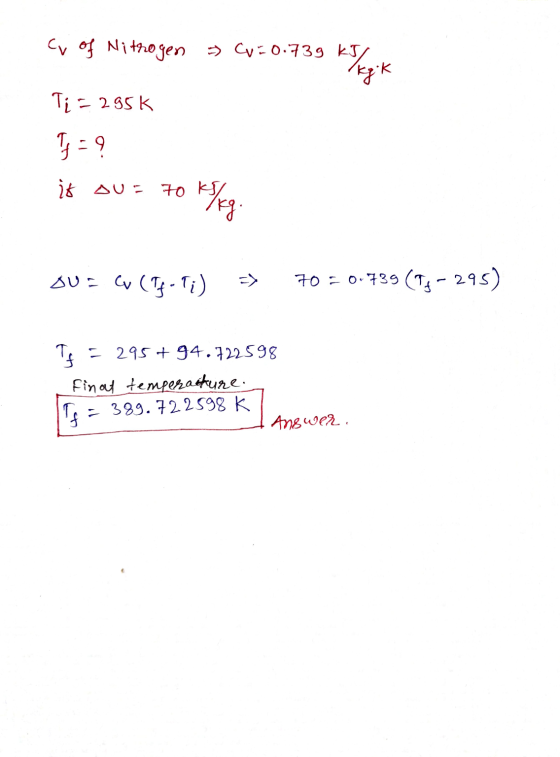
Please RATE my Answer
Thank you
Add Answer to:
3 kg of nitrogen gas initially at a temp: 295K and a pressure of 100 kPa...
Nitrogen at 120 kPa and 30°C is compressed to 620 kPa in an adiabatic compressor. Calculate...
 Nitrogen at 120 kPa and 30°C is compressed to 620 kPa in an adiabatic compressor. Calculate the minimum work needed for this process in kJ/kg. Use the table containing the ideal gas specific heats of various common gases. The minimum work needed for this process is k J/kg.
a piston -cylinder device contains 2.5 Kg of carbon dioxide (CO2 ) initially at 100 KPa...
a piston -cylinder device contains 2.5 Kg of carbon dioxide (CO2 ) initially at 100 KPa and 300o C. The carbon dioxide is then compressed to 200 kPa following a process of Pv1.25 =constant. Determine (A) the boundary worked needed for the process (B) The temperature after compression . use Ideal gas state and Pressure in absolute pressure ; R=0.1889 KJ/Kg-K
A piston-cylinder device contains 0.78 kg of nitrogen gas at 140 kPa and 37°C. The gas...
 A piston-cylinder device contains 0.78 kg of nitrogen gas at 140 kPa and 37°C. The gas is now compressed slowly in a polytropic process during which PV1.3 = constant. The process ends when the volume is reduced by one-half. Determine the entropy change of nitrogen during this process. The gas constant of nitrogen is R= 0.2968 kJ/kg-K. The constant volume specific heat of nitrogen at room temperature is Cr=0.743 kJ/kg-K. (Round the final answer to five decimal places.) The entropy...
A piston-cylinder assembly initially contains 0.8 kg of air at 100 kPa and 300 K. It...
 A piston-cylinder assembly initially contains 0.8 kg of air at 100 kPa and 300 K. It is then compressed in a polytropic process PV3 = C to half the original volume. Assuming the ideal gas model for air and specific heat ratio is constant, k=1.4, determine (a) the final temperature, (b) work and heat transfer, each in kJ. R= 0.287 kJ/kg K. W, 82
A rigid copper tank, initially containing 1 m^3 of air at 295K, 5 bar, is connected...
A rigid copper tank, initially containing 1 m^3 of air at 295K, 5 bar, is connected by a valve to a large supply line carrying air at 295K, 15 bar. The valve is opened only as long as required to fill the tank with air to a pressure of 15 bar. Finally, the air in the tank is at 310 K. The copper tank, which has a mass of 20 kg, is at the same temperature as the air in...
QUESTION 4 Determine the final pressure (kPa) for a gas undergoing a process from state 1...
QUESTION 4 Determine the final pressure (kPa) for a gas undergoing a process from state 1 (T1 = 300 K, P1 = 129 kPa) to a temperature of T2 = 839 K if s2 - s1 = 0.903 kJ/kg-K. Assume constant specific heats as given below (DO NOT USE the ideal gas tables). Cp = 1.135 kJ/kg-K Cv = 0.759 kJ/kg-K
A piston-cylinder device contains 0.63 kg of nitrogen gas at 140 kPa and 37°C. The gas...
 A piston-cylinder device contains 0.63 kg of nitrogen gas at 140 kPa and 37°C. The gas is now compressed slowly in a polytropic process during which PV1.3. constant. The process ends when the volume is reduced by one-halt. Determine the entropy change of nitrogen during this process. The gas constant of nitrogen is R-0.2968 kJ/kg K. The constant volume specific heat of nitrogen at room temperature is C -0.743 kJ/kg K. (Round the final answer to five decimal places.) The...
Nitrogen in a piston cylinder device occupies 0.5 m3 at 100 kPa and 20 °C. It undergoes a compres...
 Nitrogen in a piston cylinder device occupies 0.5 m3 at 100 kPa and 20 °C. It undergoes a compression process (during which PV1.30-constant) to a final state where the temperature is 200 °C. The specific heats are assumed to be constant while Tsur - 15 C a) Prove that the gas, at state 1, can be treated as an ideal gas. b) Find the pressure and volume at state 2 c) Find the heat transfer, in kJ. d) Find the...
11.3 kg of Nitrogen undergoes a constant pressure process at 266.9 kPa. If the gas is...
 11.3 kg of Nitrogen undergoes a constant pressure process at 266.9 kPa. If the gas is contained in a piston-cylinder arrangement and expands from a volume of 0.6 m' to 1.4m3 What is the total amount of work done by the system on its surroundings? ( Answer in kJ to two decimal places, as a positive value.)
4) An ideal-gas mixture of helium and nitrogen with a nitrogen mass fraction of 35 percent...
 4) An ideal-gas mixture of helium and nitrogen with a nitrogen mass fraction of 35 percent is contained in a piston-cylinder device arranged to maintain a fixed pressure of 700 kPa. The mixture is heated from 300 K to 500 K a. Determine the molar mass and gas constant for the mixture. b. Determine the work produced, in kJ/kg. (Hint: Try finding the specific c. Determine the constant-volume and constant-pressure specific heats (Answer: 5.72 kg/kmol, 1.45 kJ/kg K) volumes at...
 Nitrogen at 120 kPa and 30°C is compressed to 620 kPa in an adiabatic compressor. Calculate the minimum work needed for this process in kJ/kg. Use the table containing the ideal gas specific heats of various common gases. The minimum work needed for this process is k J/kg.
 A piston-cylinder device contains 0.78 kg of nitrogen gas at 140 kPa and 37°C. The gas is now compressed slowly in a polytropic process during which PV1.3 = constant. The process ends when the volume is reduced by one-half. Determine the entropy change of nitrogen during this process. The gas constant of nitrogen is R= 0.2968 kJ/kg-K. The constant volume specific heat of nitrogen at room temperature is Cr=0.743 kJ/kg-K. (Round the final answer to five decimal places.) The entropy...
 A piston-cylinder assembly initially contains 0.8 kg of air at 100 kPa and 300 K. It is then compressed in a polytropic process PV3 = C to half the original volume. Assuming the ideal gas model for air and specific heat ratio is constant, k=1.4, determine (a) the final temperature, (b) work and heat transfer, each in kJ. R= 0.287 kJ/kg K. W, 82
 A piston-cylinder device contains 0.63 kg of nitrogen gas at 140 kPa and 37°C. The gas is now compressed slowly in a polytropic process during which PV1.3. constant. The process ends when the volume is reduced by one-halt. Determine the entropy change of nitrogen during this process. The gas constant of nitrogen is R-0.2968 kJ/kg K. The constant volume specific heat of nitrogen at room temperature is C -0.743 kJ/kg K. (Round the final answer to five decimal places.) The...
 Nitrogen in a piston cylinder device occupies 0.5 m3 at 100 kPa and 20 °C. It undergoes a compression process (during which PV1.30-constant) to a final state where the temperature is 200 °C. The specific heats are assumed to be constant while Tsur - 15 C a) Prove that the gas, at state 1, can be treated as an ideal gas. b) Find the pressure and volume at state 2 c) Find the heat transfer, in kJ. d) Find the...
 11.3 kg of Nitrogen undergoes a constant pressure process at 266.9 kPa. If the gas is contained in a piston-cylinder arrangement and expands from a volume of 0.6 m' to 1.4m3 What is the total amount of work done by the system on its surroundings? ( Answer in kJ to two decimal places, as a positive value.)
 4) An ideal-gas mixture of helium and nitrogen with a nitrogen mass fraction of 35 percent is contained in a piston-cylinder device arranged to maintain a fixed pressure of 700 kPa. The mixture is heated from 300 K to 500 K a. Determine the molar mass and gas constant for the mixture. b. Determine the work produced, in kJ/kg. (Hint: Try finding the specific c. Determine the constant-volume and constant-pressure specific heats (Answer: 5.72 kg/kmol, 1.45 kJ/kg K) volumes at...
Most questions answered within 3 hours.
-
Where is the error in this code sequence?
String s1 = "Hello";
String s2 = "ello";...
asked 11 months ago -
Financial data for Joel de Paris, Inc., for last year
follow:
Joel de Paris, Inc.
Balance...
asked 11 months ago -
Consider this reaction:
Al2(SO4)3 (aq)+ BaCl3
(aq) Al2Cl6 (aq)- +
3BaSO4(s) . What is the...
asked 11 months ago -
Suppose that Savneet is considering increasing her
recent random sample from 20 car rentals to 40...
asked 11 months ago -
Trucks arrive at an unloading terminal at an average rate of 120
per hour.
Trucks arrive...
asked 11 months ago -
Why are methanol and ethanol completely soluble in water while
octanol is not very little soluble....
asked 11 months ago -
A facilities manager at a university reads in a research report
that the mean amount of...
asked 11 months ago -
When the CuSO4 is rehydrated by adding water to the anhydrous
compound, is this an endothermic...
asked 11 months ago -
A ray of sunlight is passing from diamond into crown glass; the
angle of incidence is...
asked 11 months ago -
A block of mass 0.249 kg is placed on top of a light, vertical
spring of...
asked 11 months ago -
how do the kidneys compensate in the presences of acidosis
a) trigger hyperventilate
b) reserve acid...
asked 11 months ago -
Question 501 pts
The rental rate of capital to the firm increases. Which of the
following...
asked 11 months ago