
Homework Answers

Add Answer to:
x² ² Find parametric equations for an object moving clockwise along the ellipse 9 4 =...
511.An object is ig clockwise along the elliptical path 25x242 100, making a complete tour every ...
 511.An object is ig clockwise along the elliptical path 25x242 100, making a complete tour every 20 seconds. The object is at (0,5) whent-0 a) Write a parametric description of this motion, consistent with the given details. b)Do your equations describe an object that is moving with a constant speed? Explain.
511.An object is ig clockwise along the elliptical path 25x242 100, making a complete tour every 20 seconds. The object is at (0,5) whent-0 a) Write a parametric description...
511.An object is ig clockwise along the elliptical path 25x242 100, making a complete tour every 20 seconds. The object is at (0,5) whent-0 a) Write a parametric description of this motion, consistent with the given details. b)Do your equations describe an object that is moving with a constant speed? Explain.
511.An object is ig clockwise along the elliptical path 25x242 100, making a complete tour every 20 seconds. The object is at (0,5) whent-0 a) Write a parametric description...
The position of an object in circular motion is modeled by the given parametric equations. Describe...
 The position of an object in circular motion is modeled by the given parametric equations. Describe the path of the object by stating the radius of the circle, the position at time to the orientation of the motion (clockwise or counterclockwise), and the time that it takes to complete one revolution around the circle. x = 5 cos(4), y = sin(40) radius of the circle position at time to (x, y) = orientation of the motion dockwise counterclockwise time it...
(a) Give a set of parametric equations (with domain) for the line segment from (4, -1)...
 (a) Give a set of parametric equations (with domain) for the line segment from (4, -1) to (5,6). (b) Give a set of parametric equations (with domain) for the ellipse centered at (0,0) passing through the points (4,0), (-4,0), (0,3), and (0, -3), traversed once counter-clockwise. (c) Find the (x, y) coordinates of the points where the curve, defined parametrically by I= 2 cost y = sin 2t 0<t<T, has a horizontal tangent.
An object is moving in the plane and has parametric equations (6) 2+1 +1 The corresponding...
 An object is moving in the plane and has parametric equations (6) 2+1 +1 The corresponding derivative functions are x) 2/(1+0) YO (2+1) where to is in units of seconds and the units on the coordinate axes are feet (a) The horizontal velocity of the object at time is (b) The vertical Velocity of the object at time is (c) The tangent line to the path is horizontal at time to (d) The object crosses the y-axis at time to...
Consider an object moving along the parametrized curve with equations: x(t)=e^t + e^–t, y(t)=e^–t where t...
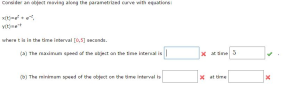 Consider an object moving along the parametrized curve with
equations: x(t)=e^t + e^–t, y(t)=e^–t where t is in the time
interval [0,5] seconds.
Consider an object moving along the parametrized curve with equations: x(t) e et, y(t)=e-t where t is in the time interval [o,5] seconds (a) The maximum speed of the object on thei inerval is x at time 5 (b) The minimum speed of the object on the time interval is x at time
Consider an object moving along the parametrized curve with
equations: x(t)=e^t + e^–t, y(t)=e^–t where t is in the time
interval [0,5] seconds.
Consider an object moving along the parametrized curve with equations: x(t) e et, y(t)=e-t where t is in the time interval [o,5] seconds (a) The maximum speed of the object on thei inerval is x at time 5 (b) The minimum speed of the object on the time interval is x at time
For parts e)-g), consider parametric equations x=6 sint and y=-6cost. They produce a circle centered at...
 For parts e)-g), consider parametric equations x=6 sint and y=-6cost. They produce a circle centered at the origin. At time t = 0 seconds, a particle starts moving along this circle. True or False? e) True The radius of the circle is 6. f) The start point is on the negative side of the y-axis. The particle moves counter-clockwise.
An object is moving counterclockwise at a constant speed around the circle x^2 + y^2 =...
An object is moving counterclockwise at a constant speed around the circle x^2 + y^2 = 1, where x and y are measured in meters. It completes one revolution every minute. a) What is its speed? b) What is its velocity vector 30 seconds after it passes the point (1,0)? Does your answer change if the object is moving clockwise? Explain.
The position of an object moving along an x axis is given by x = 3.03...
The position of an object moving along an x axis is given by x = 3.03 t - 4.04 t2 + 1.08 t3, where x is in meters and t in seconds. Find the position of the object at the following values of t: (a) 1 s, (b) 2 s, (c) 3 s, and (d) 4 s. (e) What is the object's displacement between t = 0 and t = 4 s? (f) What is its average velocity from t...
A) The position of an object moving along an x axis is given by x =...
A) The position of an object moving along an x axis is given by x = 3.00t - 4.00t2 + t3, where x is in meters and t in seconds. Find the position of the object at t = 2.03 s. B) What is the average velocity for the time interval from t = 2.03 s to t = 4.00 s.
Consider an object moving along the parametrized curve with equations: x(t)=et + e-t, y(t)=e-t where t...
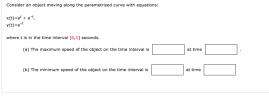 Consider an object moving along the parametrized curve with equations: x(t)=et + e-t, y(t)=e-t where t is in the time interval [0,1] seconds. The maximum speed of the object on the time interval is at time The minimum speed of the object on the time interval is at time
 511.An object is ig clockwise along the elliptical path 25x242 100, making a complete tour every 20 seconds. The object is at (0,5) whent-0 a) Write a parametric description of this motion, consistent with the given details. b)Do your equations describe an object that is moving with a constant speed? Explain.
511.An object is ig clockwise along the elliptical path 25x242 100, making a complete tour every 20 seconds. The object is at (0,5) whent-0 a) Write a parametric description...
511.An object is ig clockwise along the elliptical path 25x242 100, making a complete tour every 20 seconds. The object is at (0,5) whent-0 a) Write a parametric description of this motion, consistent with the given details. b)Do your equations describe an object that is moving with a constant speed? Explain.
511.An object is ig clockwise along the elliptical path 25x242 100, making a complete tour every 20 seconds. The object is at (0,5) whent-0 a) Write a parametric description...
 The position of an object in circular motion is modeled by the given parametric equations. Describe the path of the object by stating the radius of the circle, the position at time to the orientation of the motion (clockwise or counterclockwise), and the time that it takes to complete one revolution around the circle. x = 5 cos(4), y = sin(40) radius of the circle position at time to (x, y) = orientation of the motion dockwise counterclockwise time it...
 (a) Give a set of parametric equations (with domain) for the line segment from (4, -1) to (5,6). (b) Give a set of parametric equations (with domain) for the ellipse centered at (0,0) passing through the points (4,0), (-4,0), (0,3), and (0, -3), traversed once counter-clockwise. (c) Find the (x, y) coordinates of the points where the curve, defined parametrically by I= 2 cost y = sin 2t 0<t<T, has a horizontal tangent.
 An object is moving in the plane and has parametric equations (6) 2+1 +1 The corresponding derivative functions are x) 2/(1+0) YO (2+1) where to is in units of seconds and the units on the coordinate axes are feet (a) The horizontal velocity of the object at time is (b) The vertical Velocity of the object at time is (c) The tangent line to the path is horizontal at time to (d) The object crosses the y-axis at time to...
 Consider an object moving along the parametrized curve with
equations: x(t)=e^t + e^–t, y(t)=e^–t where t is in the time
interval [0,5] seconds.
Consider an object moving along the parametrized curve with equations: x(t) e et, y(t)=e-t where t is in the time interval [o,5] seconds (a) The maximum speed of the object on thei inerval is x at time 5 (b) The minimum speed of the object on the time interval is x at time
Consider an object moving along the parametrized curve with
equations: x(t)=e^t + e^–t, y(t)=e^–t where t is in the time
interval [0,5] seconds.
Consider an object moving along the parametrized curve with equations: x(t) e et, y(t)=e-t where t is in the time interval [o,5] seconds (a) The maximum speed of the object on thei inerval is x at time 5 (b) The minimum speed of the object on the time interval is x at time
 For parts e)-g), consider parametric equations x=6 sint and y=-6cost. They produce a circle centered at the origin. At time t = 0 seconds, a particle starts moving along this circle. True or False? e) True The radius of the circle is 6. f) The start point is on the negative side of the y-axis. The particle moves counter-clockwise.
 Consider an object moving along the parametrized curve with equations: x(t)=et + e-t, y(t)=e-t where t is in the time interval [0,1] seconds. The maximum speed of the object on the time interval is at time The minimum speed of the object on the time interval is at time
Most questions answered within 3 hours.
-
Where is the error in this code sequence?
String s1 = "Hello";
String s2 = "ello";...
asked 10 months ago -
Financial data for Joel de Paris, Inc., for last year
follow:
Joel de Paris, Inc.
Balance...
asked 10 months ago -
Consider this reaction:
Al2(SO4)3 (aq)+ BaCl3
(aq) Al2Cl6 (aq)- +
3BaSO4(s) . What is the...
asked 10 months ago -
Suppose that Savneet is considering increasing her
recent random sample from 20 car rentals to 40...
asked 10 months ago -
Trucks arrive at an unloading terminal at an average rate of 120
per hour.
Trucks arrive...
asked 10 months ago -
Why are methanol and ethanol completely soluble in water while
octanol is not very little soluble....
asked 10 months ago -
A facilities manager at a university reads in a research report
that the mean amount of...
asked 10 months ago -
When the CuSO4 is rehydrated by adding water to the anhydrous
compound, is this an endothermic...
asked 10 months ago -
A ray of sunlight is passing from diamond into crown glass; the
angle of incidence is...
asked 10 months ago -
A block of mass 0.249 kg is placed on top of a light, vertical
spring of...
asked 10 months ago -
how do the kidneys compensate in the presences of acidosis
a) trigger hyperventilate
b) reserve acid...
asked 10 months ago -
Question 501 pts
The rental rate of capital to the firm increases. Which of the
following...
asked 10 months ago