
Homework Answers


The object is moving in a 2-dimensional space and its position at time 't' is given by:
2-dimensional space: XY plane
X-position: X(t) = et + e-t
Y-position: Y(t) = e-t
The speed along these axes (X and Y) is given by the first differential of the position function with respect to time.
Hence,
Speed along X-axis:
Speed along Y-axis:
Hence,
Vx(t) = et - e-t
Vy(t) = -e-t
Total speed of the object is given by:
Hence,
The first differential is given by:
The first differential is zero when:
Therefore, V(t) has a minima or maxima at t = ln(2) / 4 = 0.173
To check if it is minima or maxima, we calculate the second differential.
We notice that the second differential is positive at t = 0.173. This implies that t = 0.173 is a local minima.
Therefore, the speed function decreases from t = 0 to t = 0.173, achieves a local minima at t = 0.173 and then increases till t = 1.
Maximum speed is at t = 0 or t = 1.
V(0) = 1 and V(1) = 5.659
Hence, maximum speed is 5.659 at t = 1
Minimum speed is:
ANSWER:
a) Max. speed is 5.659 at time 1
b) Min. speed is 0.828 at time 0.173
GRAPHICALLY:

Add Answer to:
Consider an object moving along the parametrized curve with equations: x(t)=et + e-t, y(t)=e-t where t...
Consider an object moving along the parametrized curve with equations: x(t)=et + e–t, y(t)=e–t where t...
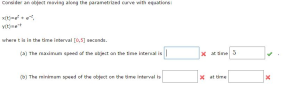
Consider an object moving along the parametrized curve with equations: x(t)=et + e–t, y(t)=e–t where t is in the time interval [0,7] seconds. (a) The maximum speed of the object on the time interval is ___ at time ___. (b) The minimum speed of the object on the time interval is ___ at time ___
Consider an object moving along the parametrized curve with equations: x(t)=e^t + e^–t, y(t)=e^–t where t...
 Consider an object moving along the parametrized curve with
equations: x(t)=e^t + e^–t, y(t)=e^–t where t is in the time
interval [0,5] seconds.
Consider an object moving along the parametrized curve with equations: x(t) e et, y(t)=e-t where t is in the time interval [o,5] seconds (a) The maximum speed of the object on thei inerval is x at time 5 (b) The minimum speed of the object on the time interval is x at time
Consider an object moving along the parametrized curve with
equations: x(t)=e^t + e^–t, y(t)=e^–t where t is in the time
interval [0,5] seconds.
Consider an object moving along the parametrized curve with equations: x(t) e et, y(t)=e-t where t is in the time interval [o,5] seconds (a) The maximum speed of the object on thei inerval is x at time 5 (b) The minimum speed of the object on the time interval is x at time
1. a. Consider the curve defined by the following parametric equations: r(t) = et-e-t, y(t) = et ...
 1. a. Consider the curve defined by the following parametric equations: r(t) = et-e-t, y(t) = et + e-t where t can be any number. Determine where the particle describing the curve is when tIn(3) In(2). 0, ln(2) and In(3). Split up the work among your group Onex, vou l'ave found i lose live polnia, try to n"惱; wbai ille wlu le curve "u"ht lex k like. b. Verify that every point on the curve from the previous problem solves...
A) The position of an object moving along an x axis is given by x =...
A) The position of an object moving along an x axis is given by x = 3.00t - 4.00t2 + t3, where x is in meters and t in seconds. Find the position of the object at t = 2.03 s. B) What is the average velocity for the time interval from t = 2.03 s to t = 4.00 s.
A particle moves along a curve with parametric equations x(t) = ln(t+1), y(t) = sin(t), z(t)...
 A particle moves along a curve with parametric equations x(t) = ln(t+1), y(t) = sin(t), z(t) = 3t, where t is time. Determine the speed of the particle at t = 0.
Consider an object moving along a line with the following velocity and initial position. Assume time...
 Consider an object moving along a line with the following
velocity and initial position. Assume time t is measured in seconds
and velocities have units of m/s. Complete parts (a) through (d)
below.
Consider an object moving along a line with the following velocity and initial position. Assume time t is measured in seconds and velocities have units of m/s. Complete parts (a) through (d) below. v(t) = -1-2cos for Osts (0) = 0 (**). a. Over the given interval,...
Consider an object moving along a line with the following
velocity and initial position. Assume time t is measured in seconds
and velocities have units of m/s. Complete parts (a) through (d)
below.
Consider an object moving along a line with the following velocity and initial position. Assume time t is measured in seconds and velocities have units of m/s. Complete parts (a) through (d) below. v(t) = -1-2cos for Osts (0) = 0 (**). a. Over the given interval,...
For parts e)-g), consider parametric equations x=6 sint and y=-6cost. They produce a circle centered at...
 For parts e)-g), consider parametric equations x=6 sint and y=-6cost. They produce a circle centered at the origin. At time t = 0 seconds, a particle starts moving along this circle. True or False? e) True The radius of the circle is 6. f) The start point is on the negative side of the y-axis. The particle moves counter-clockwise.
An object is moving along the x-axis according to the equation x(t) =(8.00t^3 - 7.00t +...
An object is moving along the x-axis according to the equation x(t) =(8.00t^3 - 7.00t + 3.00t^2 -7) m. Solve for the velocity and the acceleration at time t= 2.00 seconds.
x² ² Find parametric equations for an object moving clockwise along the ellipse 9 4 =...
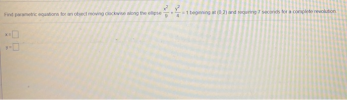 x² ² Find parametric equations for an object moving clockwise along the ellipse 9 4 = 1 beginning at (0.2) and requiring 7 seconds for a complete revolution X=
An object moves along the y axis according to the equation y(t) = b + ct3,...
An object moves along the y axis according to the equation y(t) = b + ct3, where b = 7.50 m, c = 3.50 m/s3, and y(t) will be in meters when t is entered in seconds. Determine the following. (a) average velocity of the object during the time interval t = 1.00 s to t = 3.00 s m/s (b) instantaneous velocity at the time t = 2.00 s m/s (c) acceleration of the object at the time t...
 Consider an object moving along the parametrized curve with
equations: x(t)=e^t + e^–t, y(t)=e^–t where t is in the time
interval [0,5] seconds.
Consider an object moving along the parametrized curve with equations: x(t) e et, y(t)=e-t where t is in the time interval [o,5] seconds (a) The maximum speed of the object on thei inerval is x at time 5 (b) The minimum speed of the object on the time interval is x at time
Consider an object moving along the parametrized curve with
equations: x(t)=e^t + e^–t, y(t)=e^–t where t is in the time
interval [0,5] seconds.
Consider an object moving along the parametrized curve with equations: x(t) e et, y(t)=e-t where t is in the time interval [o,5] seconds (a) The maximum speed of the object on thei inerval is x at time 5 (b) The minimum speed of the object on the time interval is x at time
 1. a. Consider the curve defined by the following parametric equations: r(t) = et-e-t, y(t) = et + e-t where t can be any number. Determine where the particle describing the curve is when tIn(3) In(2). 0, ln(2) and In(3). Split up the work among your group Onex, vou l'ave found i lose live polnia, try to n"惱; wbai ille wlu le curve "u"ht lex k like. b. Verify that every point on the curve from the previous problem solves...
 A particle moves along a curve with parametric equations x(t) = ln(t+1), y(t) = sin(t), z(t) = 3t, where t is time. Determine the speed of the particle at t = 0.
 Consider an object moving along a line with the following
velocity and initial position. Assume time t is measured in seconds
and velocities have units of m/s. Complete parts (a) through (d)
below.
Consider an object moving along a line with the following velocity and initial position. Assume time t is measured in seconds and velocities have units of m/s. Complete parts (a) through (d) below. v(t) = -1-2cos for Osts (0) = 0 (**). a. Over the given interval,...
Consider an object moving along a line with the following
velocity and initial position. Assume time t is measured in seconds
and velocities have units of m/s. Complete parts (a) through (d)
below.
Consider an object moving along a line with the following velocity and initial position. Assume time t is measured in seconds and velocities have units of m/s. Complete parts (a) through (d) below. v(t) = -1-2cos for Osts (0) = 0 (**). a. Over the given interval,...
 For parts e)-g), consider parametric equations x=6 sint and y=-6cost. They produce a circle centered at the origin. At time t = 0 seconds, a particle starts moving along this circle. True or False? e) True The radius of the circle is 6. f) The start point is on the negative side of the y-axis. The particle moves counter-clockwise.
 x² ² Find parametric equations for an object moving clockwise along the ellipse 9 4 = 1 beginning at (0.2) and requiring 7 seconds for a complete revolution X=
Most questions answered within 3 hours.
-
Where is the error in this code sequence?
String s1 = "Hello";
String s2 = "ello";...
asked 10 months ago -
Financial data for Joel de Paris, Inc., for last year
follow:
Joel de Paris, Inc.
Balance...
asked 10 months ago -
Consider this reaction:
Al2(SO4)3 (aq)+ BaCl3
(aq) Al2Cl6 (aq)- +
3BaSO4(s) . What is the...
asked 10 months ago -
Suppose that Savneet is considering increasing her
recent random sample from 20 car rentals to 40...
asked 10 months ago -
Trucks arrive at an unloading terminal at an average rate of 120
per hour.
Trucks arrive...
asked 10 months ago -
Why are methanol and ethanol completely soluble in water while
octanol is not very little soluble....
asked 10 months ago -
A facilities manager at a university reads in a research report
that the mean amount of...
asked 10 months ago -
When the CuSO4 is rehydrated by adding water to the anhydrous
compound, is this an endothermic...
asked 10 months ago -
A ray of sunlight is passing from diamond into crown glass; the
angle of incidence is...
asked 10 months ago -
A block of mass 0.249 kg is placed on top of a light, vertical
spring of...
asked 10 months ago -
how do the kidneys compensate in the presences of acidosis
a) trigger hyperventilate
b) reserve acid...
asked 10 months ago -
Question 501 pts
The rental rate of capital to the firm increases. Which of the
following...
asked 10 months ago