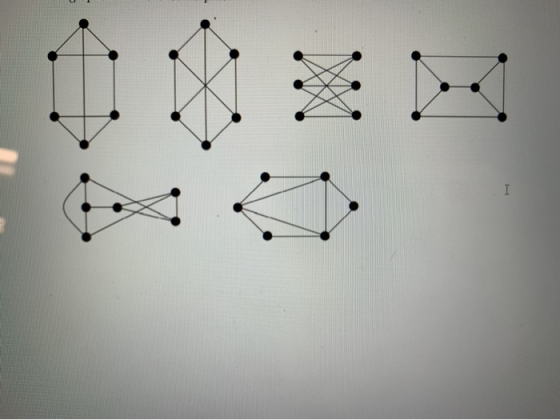
Homework Answers
To check the isomorphism of the graphs, there are four criteria as-
1) Equal number of vertices
2) Equal number of edges
3) Same degree of sequence (connected edges)
4) Equal number of circuit of particular length
Here, all the graphs have equal number of vertices i.e 6, have equal number of edges i.e 9, but degree of sequences are not same in all the graph as graphs a,b,c,d,e has 3 degree of sequence and in graph f has 4 degree of sequence. Again, minimum number of length of circuit is 3 in graphs a,d,e,f and in graphs b and c there are 4 minimum length of circuit.
Hence, set of isomorphic is {a, d, e} and {b, c}
(2) [20 ptsl Which of the following pairs of graphs are isomorphic? Explain why (2) [20 ptsl Which of the following pairs of graphs are isomorphic? Explain why
 (2) [20 ptsl Which of the following pairs of graphs are isomorphic? Explain why
(2) [20 ptsl Which of the following pairs of graphs are isomorphic? Explain why
(2) [20 ptsl Which of the following pairs of graphs are isomorphic? Explain why
Determine whether the given pair of graphs is isomorphic, if the graphs are not isomorphic provide...
 Determine whether the given pair of graphs is isomorphic, if the graphs are not isomorphic provide an argument? kes A-33 S:3 B B) 5 5 4
Determine whether the given pair of graphs is isomorphic, if the graphs are not isomorphic provide...
 Determine whether the given pair of graphs is isomorphic, if the graphs are not isomorphic provide an argument? A) F G B) 4) Consider the following weighted graph G below
Homework Problems Problem 12.8. Determine which among the four graphs pictured in Figure 12.24 are isomorphic....
 Homework Problems Problem 12.8. Determine which among the four graphs pictured in Figure 12.24 are isomorphic. For each pair of isomorphic graphs, describe an isomorphism between them. For each pair of graphs that are not isomorphic, give a property that is preserved under isomorphism such that one graph has the property, but the other does not. For at least one of the properties you choose, prove that it is indeed preserved under isomorphism (you only need prove one of them)...
17. (G2) Draw two non-isomorphic graphs with 4 vertices. Carefully explain how you know they are not isomorphic 17. (G2) Draw two non-isomorphic graphs with 4 vertices. Carefully explain how you...
 17. (G2) Draw two non-isomorphic graphs with 4 vertices. Carefully explain how you know they are not isomorphic
17. (G2) Draw two non-isomorphic graphs with 4 vertices. Carefully explain how you know they are not isomorphic
17. (G2) Draw two non-isomorphic graphs with 4 vertices. Carefully explain how you know they are not isomorphic
3. For each pair of graphs, determine whether or not they are isomorphic. If they are...
 3. For each pair of graphs, determine whether or not they are isomorphic. If they are isomorphic, write down an isomorphism between them (a map between vertices that extends to a map between edges). If they are not isomorphic, give a graph invariant that distinguishes them. 1 b 5 11 (b)
3. For cach pair of graphs, determine whether or not they are isomorphic. If they are...
 3. For cach pair of graphs, determine whether or not they are isomorphic. If they are isomorphic, write down an isomorphism between them (a map between vertices that extends to a map between edges). If they are not isomorphic, give a graph invariant that distinguishes them. d 3 2 b (a) a 2 4 7 h (b)
3.16 How many (non-isomorphic) graphs have the degree sequence s: 6, 6, 6, 6, 6, 6,6,...
 3.16 How many (non-isomorphic) graphs have the degree sequence s: 6, 6, 6, 6, 6, 6,6, 6, 6? 3.17 Consider the (unlabeled) graphs H1, H2, H3 and G of Figure 3.18. subgraph of G? (a) Is H1 isomorphic to a (b) Is H2 isomorphic to a subgraph of G? (c) Is H3 isomorphic to a subgraph of G? DEX H3: H2 H1 G: To lqr Figure 3.18: Graphs in Exercise 3.17 3.18 Does there exist a graph with exactly three...
10. Two of the graphs in Figure 1.25 are isomorphic. FIGURE 1.25 (a) For the pair...
 10. Two of the graphs in Figure 1.25 are isomorphic. FIGURE 1.25 (a) For the pair that is isomorphic, give an appropriate one-to-one corre- spondence (b) Prove that the remaining graph is not isomporhic to the other two
Are these graphs isomorphic? Yes because they have the same number of vertices No because they...
 Are these graphs isomorphic? Yes because they have the same number of vertices No because they don't have the same number of edges Yes because the graphs have the same degree sequence No because the graphs don't have the same number of vertices.
 (2) [20 ptsl Which of the following pairs of graphs are isomorphic? Explain why
(2) [20 ptsl Which of the following pairs of graphs are isomorphic? Explain why
(2) [20 ptsl Which of the following pairs of graphs are isomorphic? Explain why
 Determine whether the given pair of graphs is isomorphic, if the graphs are not isomorphic provide an argument? kes A-33 S:3 B B) 5 5 4
 Determine whether the given pair of graphs is isomorphic, if the graphs are not isomorphic provide an argument? A) F G B) 4) Consider the following weighted graph G below
 Homework Problems Problem 12.8. Determine which among the four graphs pictured in Figure 12.24 are isomorphic. For each pair of isomorphic graphs, describe an isomorphism between them. For each pair of graphs that are not isomorphic, give a property that is preserved under isomorphism such that one graph has the property, but the other does not. For at least one of the properties you choose, prove that it is indeed preserved under isomorphism (you only need prove one of them)...
 17. (G2) Draw two non-isomorphic graphs with 4 vertices. Carefully explain how you know they are not isomorphic
17. (G2) Draw two non-isomorphic graphs with 4 vertices. Carefully explain how you know they are not isomorphic
17. (G2) Draw two non-isomorphic graphs with 4 vertices. Carefully explain how you know they are not isomorphic
 3. For each pair of graphs, determine whether or not they are isomorphic. If they are isomorphic, write down an isomorphism between them (a map between vertices that extends to a map between edges). If they are not isomorphic, give a graph invariant that distinguishes them. 1 b 5 11 (b)
 3. For cach pair of graphs, determine whether or not they are isomorphic. If they are isomorphic, write down an isomorphism between them (a map between vertices that extends to a map between edges). If they are not isomorphic, give a graph invariant that distinguishes them. d 3 2 b (a) a 2 4 7 h (b)
 3.16 How many (non-isomorphic) graphs have the degree sequence s: 6, 6, 6, 6, 6, 6,6, 6, 6? 3.17 Consider the (unlabeled) graphs H1, H2, H3 and G of Figure 3.18. subgraph of G? (a) Is H1 isomorphic to a (b) Is H2 isomorphic to a subgraph of G? (c) Is H3 isomorphic to a subgraph of G? DEX H3: H2 H1 G: To lqr Figure 3.18: Graphs in Exercise 3.17 3.18 Does there exist a graph with exactly three...
 10. Two of the graphs in Figure 1.25 are isomorphic. FIGURE 1.25 (a) For the pair that is isomorphic, give an appropriate one-to-one corre- spondence (b) Prove that the remaining graph is not isomporhic to the other two
 Are these graphs isomorphic? Yes because they have the same number of vertices No because they don't have the same number of edges Yes because the graphs have the same degree sequence No because the graphs don't have the same number of vertices.
Most questions answered within 3 hours.
-
Where is the error in this code sequence?
String s1 = "Hello";
String s2 = "ello";...
asked 10 months ago -
Financial data for Joel de Paris, Inc., for last year
follow:
Joel de Paris, Inc.
Balance...
asked 10 months ago -
Consider this reaction:
Al2(SO4)3 (aq)+ BaCl3
(aq) Al2Cl6 (aq)- +
3BaSO4(s) . What is the...
asked 10 months ago -
Suppose that Savneet is considering increasing her
recent random sample from 20 car rentals to 40...
asked 10 months ago -
Trucks arrive at an unloading terminal at an average rate of 120
per hour.
Trucks arrive...
asked 10 months ago -
Why are methanol and ethanol completely soluble in water while
octanol is not very little soluble....
asked 10 months ago -
A facilities manager at a university reads in a research report
that the mean amount of...
asked 10 months ago -
When the CuSO4 is rehydrated by adding water to the anhydrous
compound, is this an endothermic...
asked 10 months ago -
A ray of sunlight is passing from diamond into crown glass; the
angle of incidence is...
asked 10 months ago -
A block of mass 0.249 kg is placed on top of a light, vertical
spring of...
asked 10 months ago -
how do the kidneys compensate in the presences of acidosis
a) trigger hyperventilate
b) reserve acid...
asked 10 months ago -
Question 501 pts
The rental rate of capital to the firm increases. Which of the
following...
asked 10 months ago