
Homework Answers
Answer:
Given that,
Suppose you roll two 4 sided dice.
Let the probabilities of the first die be represented by random variable X and those of the second die be represented by random variable Y Let random variable Z be (X-Y).
The range of Z will be from -3 to 3.
The values of Z are computed for different X and Y as:
| Y=1 | Y=2 | Y=3 | Y=4 | |
| X=1 | Z=0 | Z=-1 | Z=-2 | Z=-3 |
| X=2 | Z=1 | Z=0 | Z=-1 | Z=-2 |
| X=3 | Z=2 | Z=1 | Z=0 | Z=-1 |
| X=4 | Z=3 | Z=2 | Z=1 | Z=0 |
P(Z = -3) = 1/16
P(Z = -2) = 2/16
P(Z = -1) = 3/16
P(Z = 0) = 4/16
P(Z = 1) = 3/16
P(Z = 2) = 2/16
P(Z = 3) = 1/16
(1).
Find E(Z):
The expected value here is computed as:
E(Z) = (3/16)(-1 + 1) + (2/16)(-2 + 2) + (1/16)(3 - 3) + 0(4/16) = 0
Therefore E(Z) = 0
(2).
Find P(Z =-1|Z < 1):
P(Z = -1 | Z < 1) is computed using bayes theorem as:
P(Z = -1) / P(Z < 1)
= 1/10
= 0.1
Therefore 0.1 is the required probability here.
(3).
P(Z = 2) = 2/16
Probability that the game has to be played 4 times before we get z = 2 is computed here as:
= (14/16)^3(2/16)
= 0.0837
Therefore 0.0837 is the required probability here.
(4).
P(Z = 0) = 4/16
The required probability here is computed as:
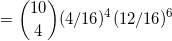
=210(0.039)(0.17798)
=1.4577
Add Answer to:
Suppose you roll two 4 sided dice. Let the probabilities of the first die be represented...
Suppose you roll two 4 sided dice. Let the probabilities of the first die be represented...
 Suppose you roll two 4 sided dice. Let the probabilities of the first die be represented by random variable X and those of the second die be represented by random variable Y. Let random variable Z be X-Y). The range of Z will be from 0 to 3. 1. (2.5 points) Find E(Z). 2. (2.5 points) Find P(Z = 21Z >1). 3. (2.5 points) What is the probability that you have to play the game 6 times before you roll...
Suppose you roll two 4 sided dice. Let the probabilities of the first die be represented...
 Suppose you roll two 4 sided dice. Let the probabilities of the first die be represented by random variable X and those of the second die be represented by random variable Y. Let random variable Z be (X+Y). The range of Z will be from 2-8. 1.(2.5 points) Find E(Z). 2. (2.5 points) Find P(Z = 71Z > 5). 3.(2.5 points) What is the probability that you have to play the game 4 times before you roll Z=7? 4. (2.5...
Suppose you roll two 4 sided dice. Let the probabilities of the first die be represented...
 Suppose you roll two 4 sided dice. Let the probabilities of the first die be represented by random variable X and those of the second die be represented by random variable Y. Let random variable Z be (X+Y). The range of Z will be from 2-8. 1.(2.5 points) Find E(Z). 2. (2.5 points) Find P(Z = 71Z > 5). 3.(2.5 points) What is the probability that you have to play the game 4 times before you roll Z=7? 4. (2.5...
Suppose you roll two 4 sided dice. Let the probabilities of the first die be represented...
 Suppose you roll two 4 sided dice. Let the probabilities of the first die be represented by random variable X and those of the second die be represented by random variable Y. Let random variable Z be (X-Y). The range of Z will be from -3 to 3. 1. (2.5 points) Find E(Z). 2. (2.5 points) Find P(Z =-1|Z < 1). 3. (2.5 points) What is the probability that you have to play the game 3 times before you roll...
Suppose you roll two 4 sided dice. Let the probabilities of the first die be represented...
Suppose you roll two 4 sided dice. Let the probabilities of the first die be represented by random variable X and those of the second die be represented by random variable Y. Let random variable Z be |X-Y|. The range of Z will be from 0 to 3. 1. Find E(Z). 2. Find P(Z = 1|Z <3). 3. What is the probability that you have to play the game 4 times before you roll Z=3? 4. What is the probability...
Roll two fair four-sided dice. Let X and Y be the die scores from the 1st...
Roll two fair four-sided dice. Let X and Y be the die scores from the 1st die and the 2nd die, respectively, and define a random variable Z = X − Y (a) Find the pmf of Z. (b) Draw the histogram of the pmf of Z. (c) Find P{Z < 0}. (d) Are the events {Z < 0} and {Z is odd} independent? Why?
dice is unbiased. Throws independent. Step 1. You roll a six-sided die. Let X be the...
 dice is unbiased. Throws independent.
Step 1. You roll a six-sided die. Let X be the (random) number that you obtain. Step 2. You roll X six-sided dice. Let Y be the total number (sum) that you obtain from these X dice. Find E[Y] rounded to nearest .xx.
dice is unbiased. Throws independent.
Step 1. You roll a six-sided die. Let X be the (random) number that you obtain. Step 2. You roll X six-sided dice. Let Y be the total number (sum) that you obtain from these X dice. Find E[Y] rounded to nearest .xx.
Step 1. You roll a six-sided die. Let X be the (random) number that you obtain....
 Step 1. You roll a six-sided die. Let X be the (random) number that you obtain. Step 2. You roll X six-sided dice. Let Y be the total number (sum) that you obtain from these X dice. Find E[Y], rounded to nearest .XX.
There exists 3-sided dice. Such a die, when you roll it, will show 1, 2, or...
There exists 3-sided dice. Such a die, when you roll it, will show 1, 2, or 3 with equal probability. The experiment is to roll 3 such dice. Random variable T is the total of all 3 dice. t P(T=t) 3 4 5 6 7 8 9
2. (25 points) Sekora International Casino (SIC) is launching a new game making use of fair 6-sided dice . In phase 1, roll two 6-sided dice and compute the difference between the rolls. Call thi...
 2. (25 points) Sekora International Casino (SIC) is launching a new game making use of fair 6-sided dice . In phase 1, roll two 6-sided dice and compute the difference between the rolls. Call this difference . In phase 2, roll r dice, and add up the total of the rolls. This is the payout in dollars of the game. (with the numbers 1-6 on the sides). The game proceeds in two phases as follows: (a) (5 points) In the...
 Suppose you roll two 4 sided dice. Let the probabilities of the first die be represented by random variable X and those of the second die be represented by random variable Y. Let random variable Z be X-Y). The range of Z will be from 0 to 3. 1. (2.5 points) Find E(Z). 2. (2.5 points) Find P(Z = 21Z >1). 3. (2.5 points) What is the probability that you have to play the game 6 times before you roll...
 Suppose you roll two 4 sided dice. Let the probabilities of the first die be represented by random variable X and those of the second die be represented by random variable Y. Let random variable Z be (X+Y). The range of Z will be from 2-8. 1.(2.5 points) Find E(Z). 2. (2.5 points) Find P(Z = 71Z > 5). 3.(2.5 points) What is the probability that you have to play the game 4 times before you roll Z=7? 4. (2.5...
 Suppose you roll two 4 sided dice. Let the probabilities of the first die be represented by random variable X and those of the second die be represented by random variable Y. Let random variable Z be (X+Y). The range of Z will be from 2-8. 1.(2.5 points) Find E(Z). 2. (2.5 points) Find P(Z = 71Z > 5). 3.(2.5 points) What is the probability that you have to play the game 4 times before you roll Z=7? 4. (2.5...
 Suppose you roll two 4 sided dice. Let the probabilities of the first die be represented by random variable X and those of the second die be represented by random variable Y. Let random variable Z be (X-Y). The range of Z will be from -3 to 3. 1. (2.5 points) Find E(Z). 2. (2.5 points) Find P(Z =-1|Z < 1). 3. (2.5 points) What is the probability that you have to play the game 3 times before you roll...
 dice is unbiased. Throws independent.
Step 1. You roll a six-sided die. Let X be the (random) number that you obtain. Step 2. You roll X six-sided dice. Let Y be the total number (sum) that you obtain from these X dice. Find E[Y] rounded to nearest .xx.
dice is unbiased. Throws independent.
Step 1. You roll a six-sided die. Let X be the (random) number that you obtain. Step 2. You roll X six-sided dice. Let Y be the total number (sum) that you obtain from these X dice. Find E[Y] rounded to nearest .xx.
 Step 1. You roll a six-sided die. Let X be the (random) number that you obtain. Step 2. You roll X six-sided dice. Let Y be the total number (sum) that you obtain from these X dice. Find E[Y], rounded to nearest .XX.
 2. (25 points) Sekora International Casino (SIC) is launching a new game making use of fair 6-sided dice . In phase 1, roll two 6-sided dice and compute the difference between the rolls. Call this difference . In phase 2, roll r dice, and add up the total of the rolls. This is the payout in dollars of the game. (with the numbers 1-6 on the sides). The game proceeds in two phases as follows: (a) (5 points) In the...
Most questions answered within 3 hours.
-
Where is the error in this code sequence?
String s1 = "Hello";
String s2 = "ello";...
asked 10 months ago -
Financial data for Joel de Paris, Inc., for last year
follow:
Joel de Paris, Inc.
Balance...
asked 10 months ago -
Consider this reaction:
Al2(SO4)3 (aq)+ BaCl3
(aq) Al2Cl6 (aq)- +
3BaSO4(s) . What is the...
asked 10 months ago -
Suppose that Savneet is considering increasing her
recent random sample from 20 car rentals to 40...
asked 10 months ago -
Trucks arrive at an unloading terminal at an average rate of 120
per hour.
Trucks arrive...
asked 10 months ago -
Why are methanol and ethanol completely soluble in water while
octanol is not very little soluble....
asked 10 months ago -
A facilities manager at a university reads in a research report
that the mean amount of...
asked 10 months ago -
When the CuSO4 is rehydrated by adding water to the anhydrous
compound, is this an endothermic...
asked 10 months ago -
A ray of sunlight is passing from diamond into crown glass; the
angle of incidence is...
asked 10 months ago -
A block of mass 0.249 kg is placed on top of a light, vertical
spring of...
asked 10 months ago -
how do the kidneys compensate in the presences of acidosis
a) trigger hyperventilate
b) reserve acid...
asked 10 months ago -
Question 501 pts
The rental rate of capital to the firm increases. Which of the
following...
asked 10 months ago