Roll two fair four-sided dice. Let X and Y be the die scores from the 1st...
Roll two fair four-sided dice. Let X and Y be the die scores from the 1st die and the 2nd die, respectively, and define a random variable Z = X − Y (a) Find the pmf of Z. (b) Draw the histogram of the pmf of Z. (c) Find P{Z < 0}. (d) Are the events {Z < 0} and {Z is odd} independent? Why?
Homework Answers
a)below is pmf of Z
P(Z=-5) =P(X=1,Y=6) =1/36
P(Z=-4) =P(X=1,Y=5)+P(X=2,Y=6)=2/36
P(Z=-3)=3/36
P(Z=-2)=4/36
P(Z=-1)=5/36
P(Z=0)=6/36
P(Z=1)=5/36
P(Z=2)=4/36
P(Z=3)=3/36
P(Z=4)=2/36
P(Z=5)=1/36
b)
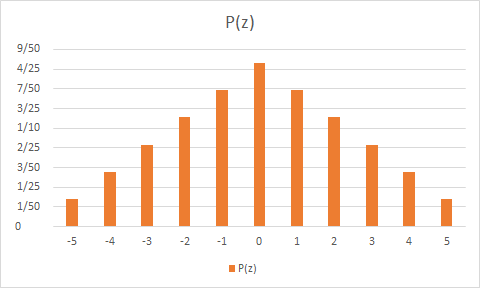
c)
P(Z<0) =P(Z=-5)+P(Z=-4)+P(Z=-3)+P(Z=-2)+P(Z=-1) =5/12
d)
P(Z<0) =5/12
P(Z is odd) =P(Z=-5)+P(Z=-3)+P(Z=-1)+P(Z=1)+P(Z=3)+P(Z=5) =1/2
P(Z<0 and Z is odd) =P(Z=-5)+P(Z=-3)+P(Z=-1) =1/4
since P(Z<0)*P(Z is odd)=(5/12)*(1/2) =5/24 is not equal to P(Z<0 and Z is odd)
therefore event {Z < 0} and {Z is odd} are not independent
Add Answer to:
Roll two fair four-sided dice. Let X and Y be the die scores
from the 1st...
In this experiment, both a fair four-sided die and a fair six-sided die are rolled (these...
In this experiment, both a fair four-sided die and a fair six-sided die are rolled (these dice both have the numbers most people would expect on them). Let Z be a random variable that represents the absolute value of their difference. For instance, if a 4 and a 1 are rolled, the corresponding value of Z is 3. (a) What is the pmf of Z? (b) Draw a graph of the cdf of Z
Suppose you roll two 4 sided dice. Let the probabilities of the first die be represented...
Suppose you roll two 4 sided dice. Let the probabilities of the first die be represented by random variable X and those of the second die be represented by random variable Y. Let random variable Z be |X-Y|. The range of Z will be from 0 to 3. 1. Find E(Z). 2. Find P(Z = 1|Z <3). 3. What is the probability that you have to play the game 4 times before you roll Z=3? 4. What is the probability...
dice is unbiased. Throws independent. Step 1. You roll a six-sided die. Let X be the...
 dice is unbiased. Throws independent.
Step 1. You roll a six-sided die. Let X be the (random) number that you obtain. Step 2. You roll X six-sided dice. Let Y be the total number (sum) that you obtain from these X dice. Find E[Y] rounded to nearest .xx.
dice is unbiased. Throws independent.
Step 1. You roll a six-sided die. Let X be the (random) number that you obtain. Step 2. You roll X six-sided dice. Let Y be the total number (sum) that you obtain from these X dice. Find E[Y] rounded to nearest .xx.
Suppose you roll two 4 sided dice. Let the probabilities of the first die be represented...
 Suppose you roll two 4 sided dice. Let the probabilities of the first die be represented by random variable X and those of the second die be represented by random variable Y. Let random variable Z be X-Y). The range of Z will be from 0 to 3. 1. (2.5 points) Find E(Z). 2. (2.5 points) Find P(Z = 21Z >1). 3. (2.5 points) What is the probability that you have to play the game 6 times before you roll...
Suppose you roll two 4 sided dice. Let the probabilities of the first die be represented...
 Suppose you roll two 4 sided dice. Let the probabilities of the first die be represented by random variable X and those of the second die be represented by random variable Y. Let random variable Z be (X-Y). The range of Z will be from -3 to 3. 1. (2.5 points) Find E(Z). 2. (2.5 points) Find P(Z =-1|Z < 1). 3. (2.5 points) What is the probability that you have to play the game 3 times before you roll...
Suppose you roll two 4 sided dice. Let the probabilities of the first die be represented...
 Suppose you roll two 4 sided dice. Let the probabilities of the first die be represented by random variable X and those of the second die be represented by random variable Y. Let random variable Z be (X-Y). The range of Z will be from -3 to 3. 1. (2.5 points) Find E(Z). 2. (2.5 points) Find P(Z =-1|Z < 1). 3. (2.5 points) What is the probability that you have to play the game 3 times before you roll...
You roll two six-sided fair dice. a. Let A be the event that either a 3...
You roll two six-sided fair dice. a. Let A be the event that either a 3 or 4 is rolled first followed by an odd number. P(A) = Round your answer to four decimal places. b. Let B be the event that the sum of the two dice is at most 7. P(B) = Round your answer to four decimal places. c. Are A and B mutually exclusive events? No, they are not Mutually Exclusive Yes, they are Mutually Exclusive d....
Suppose that Adam rolls a fair six-sided die and a fair four-sided die simultaneously. Let A...
Suppose that Adam rolls a fair six-sided die and a fair four-sided die simultaneously. Let A be the event that the six-sided die is an even number and B be the event that the four-sided die is an odd number. Using the sample space of possible outcomes below, answer each of the following questions.What is P(A), the probability that the six-sided die is an even number?What is P(B), the probability that the four-sided die is an odd number?What is P(A...
Suppose you roll two 4 sided dice. Let the probabilities of the first die be represented...
 Suppose you roll two 4 sided dice. Let the probabilities of the first die be represented by random variable X and those of the second die be represented by random variable Y. Let random variable Z be (X+Y). The range of Z will be from 2-8. 1.(2.5 points) Find E(Z). 2. (2.5 points) Find P(Z = 71Z > 5). 3.(2.5 points) What is the probability that you have to play the game 4 times before you roll Z=7? 4. (2.5...
Suppose you roll two 4 sided dice. Let the probabilities of the first die be represented...
 Suppose you roll two 4 sided dice. Let the probabilities of the first die be represented by random variable X and those of the second die be represented by random variable Y. Let random variable Z be (X+Y). The range of Z will be from 2-8. 1.(2.5 points) Find E(Z). 2. (2.5 points) Find P(Z = 71Z > 5). 3.(2.5 points) What is the probability that you have to play the game 4 times before you roll Z=7? 4. (2.5...
 dice is unbiased. Throws independent.
Step 1. You roll a six-sided die. Let X be the (random) number that you obtain. Step 2. You roll X six-sided dice. Let Y be the total number (sum) that you obtain from these X dice. Find E[Y] rounded to nearest .xx.
dice is unbiased. Throws independent.
Step 1. You roll a six-sided die. Let X be the (random) number that you obtain. Step 2. You roll X six-sided dice. Let Y be the total number (sum) that you obtain from these X dice. Find E[Y] rounded to nearest .xx.
 Suppose you roll two 4 sided dice. Let the probabilities of the first die be represented by random variable X and those of the second die be represented by random variable Y. Let random variable Z be X-Y). The range of Z will be from 0 to 3. 1. (2.5 points) Find E(Z). 2. (2.5 points) Find P(Z = 21Z >1). 3. (2.5 points) What is the probability that you have to play the game 6 times before you roll...
 Suppose you roll two 4 sided dice. Let the probabilities of the first die be represented by random variable X and those of the second die be represented by random variable Y. Let random variable Z be (X-Y). The range of Z will be from -3 to 3. 1. (2.5 points) Find E(Z). 2. (2.5 points) Find P(Z =-1|Z < 1). 3. (2.5 points) What is the probability that you have to play the game 3 times before you roll...
 Suppose you roll two 4 sided dice. Let the probabilities of the first die be represented by random variable X and those of the second die be represented by random variable Y. Let random variable Z be (X-Y). The range of Z will be from -3 to 3. 1. (2.5 points) Find E(Z). 2. (2.5 points) Find P(Z =-1|Z < 1). 3. (2.5 points) What is the probability that you have to play the game 3 times before you roll...
 Suppose you roll two 4 sided dice. Let the probabilities of the first die be represented by random variable X and those of the second die be represented by random variable Y. Let random variable Z be (X+Y). The range of Z will be from 2-8. 1.(2.5 points) Find E(Z). 2. (2.5 points) Find P(Z = 71Z > 5). 3.(2.5 points) What is the probability that you have to play the game 4 times before you roll Z=7? 4. (2.5...
 Suppose you roll two 4 sided dice. Let the probabilities of the first die be represented by random variable X and those of the second die be represented by random variable Y. Let random variable Z be (X+Y). The range of Z will be from 2-8. 1.(2.5 points) Find E(Z). 2. (2.5 points) Find P(Z = 71Z > 5). 3.(2.5 points) What is the probability that you have to play the game 4 times before you roll Z=7? 4. (2.5...
Most questions answered within 3 hours.
-
Where is the error in this code sequence?
String s1 = "Hello";
String s2 = "ello";...
asked 10 months ago -
Financial data for Joel de Paris, Inc., for last year
follow:
Joel de Paris, Inc.
Balance...
asked 10 months ago -
Consider this reaction:
Al2(SO4)3 (aq)+ BaCl3
(aq) Al2Cl6 (aq)- +
3BaSO4(s) . What is the...
asked 10 months ago -
Suppose that Savneet is considering increasing her
recent random sample from 20 car rentals to 40...
asked 10 months ago -
Trucks arrive at an unloading terminal at an average rate of 120
per hour.
Trucks arrive...
asked 10 months ago -
Why are methanol and ethanol completely soluble in water while
octanol is not very little soluble....
asked 10 months ago -
A facilities manager at a university reads in a research report
that the mean amount of...
asked 10 months ago -
When the CuSO4 is rehydrated by adding water to the anhydrous
compound, is this an endothermic...
asked 10 months ago -
A ray of sunlight is passing from diamond into crown glass; the
angle of incidence is...
asked 10 months ago -
A block of mass 0.249 kg is placed on top of a light, vertical
spring of...
asked 10 months ago -
how do the kidneys compensate in the presences of acidosis
a) trigger hyperventilate
b) reserve acid...
asked 10 months ago -
Question 501 pts
The rental rate of capital to the firm increases. Which of the
following...
asked 10 months ago