
Homework Answers
Enzyme kinetics involves the study of an enzyme catalyzed reaction by determining the various kinetic parameters through equations and graphs. The fundamental equation for determining the kinetic parameters such as Km and Vmax is Michaelis-Menten equation, which is as the following:
Vo= Vmax. [S]/ Km +[S]
where, Vo or v is the initial velocity
Vmax is the maximum velocity
[S] is the substrate concentration
Km is the Michaelis constant or the enzyme affinity for the substrate
When a graph is plotted through this equation, approximate values of Km and Vmax are observed.
Therefore, to get exact values of Km and Vmax, the inverse of Michaelis-Menten equation is derived which is called Lineweaver Burk or LB equation, which is as the following:
1/Vo= (Km/Vmax).1/[S]+ 1/Vmax
This equation can be compared to a straight line equation:
1/Vo= (Km/Vmax).1/[S]+ 1/Vmax
y = m . x + c
where
y=1/Vo; m= Km/Vmax; x= 1/[S]; c=1/Vmax
So, y-axis: 1/Vo, and x-axis: 1/[S]
y-intercept= 1/Vmax; x-intercept= -1/Km
m= slope of the straight line
The given data is as the following:
| [S] | v (no inhibition) | v (inhibitor at conc. A) | v (inhibitor at conc. B) | 1/[S] | 1/v (no inhibitor) | 1/v (Inhibitor at conc. A) | 1/v (inhibitor at conc. B) |
| 1 | 12 | 7.8 | 4.3 | 1 | 0.083333 | 0.128205 | 0.232558 |
| 2 | 20 | 13.7 | 8 | 0.5 | 0.05 | 0.072993 | 0.125 |
| 4 | 29 | 21.8 | 14 | 0.25 | 0.034483 | 0.045872 | 0.071429 |
| 8 | 35 | 30.3 | 21 | 0.125 | 0.028571 | 0.033003 | 0.047619 |
| 12 | 40 | 34.5 | 26 | 0.083333 | 0.025 | 0.028986 | 0.038462 |
Michaelis-Menten Plot is hyperbolic in nature. The following plot is obtained by using the substrate concentration [S] and initial velocity v values. The velocity increases with the substrate but with further increase in the substrate concentration, not much change is observed in the velocity of the reaction. This velocity attained by the enzyme is maximum and called Vmax. The velocity of the reaction does not increase beyond Vmax. This happens due to complete saturation of the active sites with the substrate and any further addition of substrate gives no additional enhancement in the velocity or the rate of the reaction.
The substrate concentration at which the velocity of the reaction is equal to the half of the maximum velocity, is called Km or the Michaelis constant. It determines the affinity of the enzyme towards the substrate, higher the Km, lower is the affinity, lower the Km, higher is the affinity for the substrate.
Any change in the Km and Vmax in presence of inhibitors, help in determining the type of inhibitor.
![45 40 35 30 25 20 v (no inhibition) v (inhibitor at conc. A) -V (inhibitor at conc. B) 15 LO 5 0 0 5 10 15 [S]](http://img.homeworklib.com/questions/75cce770-e209-11ea-8689-c9665a683ec5.png?x-oss-process=image/resize,w_560)
Lineweaver Burk (LB) plot is prepared by taking the inverse values of [S] and initial velocity (v) values.
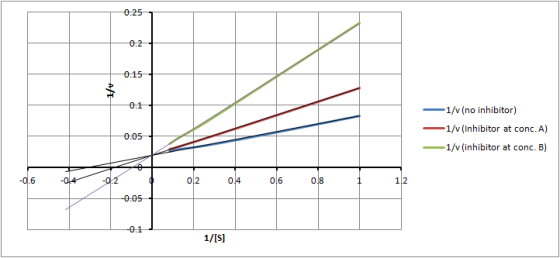
From the LB plot, it is evident that Km of the enzyme is increasing in the presence of the inhibitor, and it further increases with the increase in the inhibitor concentration. But, the maximum velocity Vmax of the reaction remains same in each case. Km in absence and presence of the inhibitor can be calculated from the x-intercepts, while Vmax is determined from the y-intercept. The LB plot indicates competitive inhibition by the inhibitor, it is increasing the Km, but does not affect the velocity of the reaction..
Competitive inhibition is one of the types of reversible inhibition. In this, the inhibitor and the substrate have similar structure, hence the inhibitor competes with the substrate for the active site and prevents the substrate binding. This lowers the affinity of the enzyme towards the substrate, hence increasing the Km of the enzyme. The inhibition can be reversed by increasing the substrate concentration, which causes the binding of substrate to the active site instead of the inhibitor, thus reversing the effect of the inhibitor.
Add Answer to:
1. Graphic depictions of enzyme kinetic data can aid in evaluation of reversible enzyme inhibition. Please...
1 Graphic depictions of enzyme kinetic data can and in evaluation of reversible enzyme inhibition. Please...
 1 Graphic depictions of enzyme kinetic data can and in evaluation of reversible enzyme inhibition. Please use the data below to determine type of inhibition for using two different concentrations (in blue and purple). Be sure to include graphical representation (Michaelis-Menton. I Lineweaver-Burk plots), type of inhibition, appropriate kinetic schemes and rate equations. The enzyme concentration at its initial state E, was kept constant. All data points are given in arbitrary units. Completely justify your answer. Use Excel or graphing...
CHEM3250 Assignment-Enzyme Inhibition Consider the data below for an enzyme catalyzed reaction. T...
 CHEM3250 Assignment-Enzyme Inhibition Consider the data below for an enzyme catalyzed reaction. The rate of the reaction has been determined with and without an inhibitor. A total concentration of enzyme of 20 uM was used in the experiment. SHOW WORK AND UNITS!!! Without Inhibitor With Inhibitor [substrate] (mM)Rate of formation of te of formation of product product (mM/min) mM/min) 6.67 5.25 0.49 7.04 38.91 1.0 2.2 6.9 41.8 44.0 1.5 3.5 1 a) On the same graph, plot the data...
1. MICHAELIS-MENTON-(REQUIRED) a. Draw a simple graph, showing the classic Michaelis-Menton plot of enzyme activity as...
 1. MICHAELIS-MENTON-(REQUIRED) a. Draw a simple graph, showing the classic Michaelis-Menton plot of enzyme activity as a function of substrate concentration; label both axes. Write the associated Michaelis-Menton equation and show the location of Km and Vmax on your graph. b. Draw a second graph showing the classic Lineweaver-Burk plot; label both axes. Show the location of Km and Vmax on your graph. Discuss which plot is the most useful to determine Vmax. Draw a second line on each graph...
The following data was obtained for an enzyme in the absence of an inhibitor, and in...
The following data was obtained for an enzyme in the absence of an inhibitor, and in the presence of two different inhibitors. The concentration of each inhibitor was 10 mM. The total concentration of enzyme was the same for each experiment. [S] {mM} without inhibitor v, {umol/(ml*s)} with inhibitor A v, {umol/(ml*s)} With inhibitor B v, {umol/(ml*s)} 0.0 0.0 0.0 0.0 1.0 3.6 3.2 2.6 2.0 6.3 5.3 4.5 4.0 10.0 7.8 7.1 8.0 14.3 10.1 10.2 12.0 16.7 11.3...
The kinetic data given below are for an enzyme in the absence and presence of a...
The kinetic data given below are for an enzyme in the absence and presence of a reversible inhibitor. From the data, generate both a Michaelis-Menten and Linweaver-Burk Plot for both that uninbibited and inhibited reactions. Graph both the uninhibited and inhibited data on the same plot. From these data calculate the Vmax and Km for the enzyme in absence and presence of the inhibitor. Is the inhibitor working cometitively or noncompetitively? Explain. [S], mM Vo, mM/min Vo, mM, min with...
3. Why is an allosteric enzyme more sensitive to substrate concentration around Km values than a...
 3. Why is an allosteric enzyme more sensitive to substrate concentration around Km values than a Michaelis-Menten enzyme with the same Vmax? 4. Explain how pH and temperature influence enzyme activity. ( A Lineweaver-Burk (double reciprocal) plot was used to compare the effects of three different reversible inhibitors (A, B and C) on an enzyme. The plot of 1/V vs 1/[S] for the enzyme with no inhibitor is shown in a solid black line. The plot of 1/V vs 1/[S]...
The following observations come from Lineweaver-Burke plots, based on kinetic data generated from a Michaelis/Menton-type enzyme...
The following observations come from Lineweaver-Burke plots, based on kinetic data generated from a Michaelis/Menton-type enzyme (E) that catalyzes the hydrolysis of a peptide substrate (S). All data were generated in the presence of 18.0 μM total enzyme. The enzyme-catalyzed reaction has a Km of 3.00 μM and a Vmax of 2.00 μM/sec. The enzyme-catalyzed reaction in the presence of 15.0 μM of Inhibitor A has an apparent Km of 2.25 μM and an apparent Vmax of 1.50 μM/sec. The...
2. The table shows the kinetic data for a reaction catalyzed by an enzyme under the...
 2. The table shows the kinetic data for a reaction catalyzed by an enzyme under the following conditions: in the absence of an inhibitor, and in the presence of two different inhibitors, (1) and (2) each at a concentration of 10 mM. Assume the total enzyme concentration, [Elo, is the same for all reactions and the enzyme obeys the Michaelis-Menten mechanism In the presence of presence of 10 mM inhibitor 1 inhibitor2 In the 10 mM No inhibitor mM 2.5...
5) (14 marks) The following kinetic data were obtained for an enzyme in the absence of...
 5) (14 marks) The following kinetic data were obtained for an enzyme in the absence of inhibitor (1), and in the presence of an inhibitor at 5 mM concentration (2). Assume[ET] is the same in each experiment. [S] (MM) (1) v(umol/mL sec) 12 (2) v(umol/mL sec) 4.3 1 8 2 4 20 29 14 21 8 35 12 40 26 a. Using a graphing program (excel or sigmaplot) construct a lineweaver burke plot representing the uninhibited reaction and the inhibited...
i need help with all question 5 please! thank you Question 5: Use the data below...
 i need help with all question 5 please! thank you
Question 5: Use the data below to construct a Michaelis-Menton curve of velocity vs. [S]. This is quite easy to do in Excel. Vo (UM/s) a) Estimate Vmax from your curve. b) Describe any difficulty you have in completing part (a). Is the enzyme saturated at the highest [S]? c) Using your Vmax estimate, calculate ! Vmax, and using your curve, estimate Km. 1/[S] M 8 1/VO (s/UM) 3.85E-03 [S]...
i need help with all question 5 please! thank you
Question 5: Use the data below to construct a Michaelis-Menton curve of velocity vs. [S]. This is quite easy to do in Excel. Vo (UM/s) a) Estimate Vmax from your curve. b) Describe any difficulty you have in completing part (a). Is the enzyme saturated at the highest [S]? c) Using your Vmax estimate, calculate ! Vmax, and using your curve, estimate Km. 1/[S] M 8 1/VO (s/UM) 3.85E-03 [S]...
 1 Graphic depictions of enzyme kinetic data can and in evaluation of reversible enzyme inhibition. Please use the data below to determine type of inhibition for using two different concentrations (in blue and purple). Be sure to include graphical representation (Michaelis-Menton. I Lineweaver-Burk plots), type of inhibition, appropriate kinetic schemes and rate equations. The enzyme concentration at its initial state E, was kept constant. All data points are given in arbitrary units. Completely justify your answer. Use Excel or graphing...
 CHEM3250 Assignment-Enzyme Inhibition Consider the data below for an enzyme catalyzed reaction. The rate of the reaction has been determined with and without an inhibitor. A total concentration of enzyme of 20 uM was used in the experiment. SHOW WORK AND UNITS!!! Without Inhibitor With Inhibitor [substrate] (mM)Rate of formation of te of formation of product product (mM/min) mM/min) 6.67 5.25 0.49 7.04 38.91 1.0 2.2 6.9 41.8 44.0 1.5 3.5 1 a) On the same graph, plot the data...
 1. MICHAELIS-MENTON-(REQUIRED) a. Draw a simple graph, showing the classic Michaelis-Menton plot of enzyme activity as a function of substrate concentration; label both axes. Write the associated Michaelis-Menton equation and show the location of Km and Vmax on your graph. b. Draw a second graph showing the classic Lineweaver-Burk plot; label both axes. Show the location of Km and Vmax on your graph. Discuss which plot is the most useful to determine Vmax. Draw a second line on each graph...
 3. Why is an allosteric enzyme more sensitive to substrate concentration around Km values than a Michaelis-Menten enzyme with the same Vmax? 4. Explain how pH and temperature influence enzyme activity. ( A Lineweaver-Burk (double reciprocal) plot was used to compare the effects of three different reversible inhibitors (A, B and C) on an enzyme. The plot of 1/V vs 1/[S] for the enzyme with no inhibitor is shown in a solid black line. The plot of 1/V vs 1/[S]...
 2. The table shows the kinetic data for a reaction catalyzed by an enzyme under the following conditions: in the absence of an inhibitor, and in the presence of two different inhibitors, (1) and (2) each at a concentration of 10 mM. Assume the total enzyme concentration, [Elo, is the same for all reactions and the enzyme obeys the Michaelis-Menten mechanism In the presence of presence of 10 mM inhibitor 1 inhibitor2 In the 10 mM No inhibitor mM 2.5...
 5) (14 marks) The following kinetic data were obtained for an enzyme in the absence of inhibitor (1), and in the presence of an inhibitor at 5 mM concentration (2). Assume[ET] is the same in each experiment. [S] (MM) (1) v(umol/mL sec) 12 (2) v(umol/mL sec) 4.3 1 8 2 4 20 29 14 21 8 35 12 40 26 a. Using a graphing program (excel or sigmaplot) construct a lineweaver burke plot representing the uninhibited reaction and the inhibited...
 i need help with all question 5 please! thank you
Question 5: Use the data below to construct a Michaelis-Menton curve of velocity vs. [S]. This is quite easy to do in Excel. Vo (UM/s) a) Estimate Vmax from your curve. b) Describe any difficulty you have in completing part (a). Is the enzyme saturated at the highest [S]? c) Using your Vmax estimate, calculate ! Vmax, and using your curve, estimate Km. 1/[S] M 8 1/VO (s/UM) 3.85E-03 [S]...
i need help with all question 5 please! thank you
Question 5: Use the data below to construct a Michaelis-Menton curve of velocity vs. [S]. This is quite easy to do in Excel. Vo (UM/s) a) Estimate Vmax from your curve. b) Describe any difficulty you have in completing part (a). Is the enzyme saturated at the highest [S]? c) Using your Vmax estimate, calculate ! Vmax, and using your curve, estimate Km. 1/[S] M 8 1/VO (s/UM) 3.85E-03 [S]...
Most questions answered within 3 hours.
-
Where is the error in this code sequence?
String s1 = "Hello";
String s2 = "ello";...
asked 11 months ago -
Financial data for Joel de Paris, Inc., for last year
follow:
Joel de Paris, Inc.
Balance...
asked 11 months ago -
Consider this reaction:
Al2(SO4)3 (aq)+ BaCl3
(aq) Al2Cl6 (aq)- +
3BaSO4(s) . What is the...
asked 11 months ago -
Suppose that Savneet is considering increasing her
recent random sample from 20 car rentals to 40...
asked 11 months ago -
Trucks arrive at an unloading terminal at an average rate of 120
per hour.
Trucks arrive...
asked 11 months ago -
Why are methanol and ethanol completely soluble in water while
octanol is not very little soluble....
asked 11 months ago -
A facilities manager at a university reads in a research report
that the mean amount of...
asked 11 months ago -
When the CuSO4 is rehydrated by adding water to the anhydrous
compound, is this an endothermic...
asked 11 months ago -
A ray of sunlight is passing from diamond into crown glass; the
angle of incidence is...
asked 11 months ago -
A block of mass 0.249 kg is placed on top of a light, vertical
spring of...
asked 11 months ago -
how do the kidneys compensate in the presences of acidosis
a) trigger hyperventilate
b) reserve acid...
asked 11 months ago -
Question 501 pts
The rental rate of capital to the firm increases. Which of the
following...
asked 11 months ago